Video wird geladen...
Video konnte nicht geladen werden
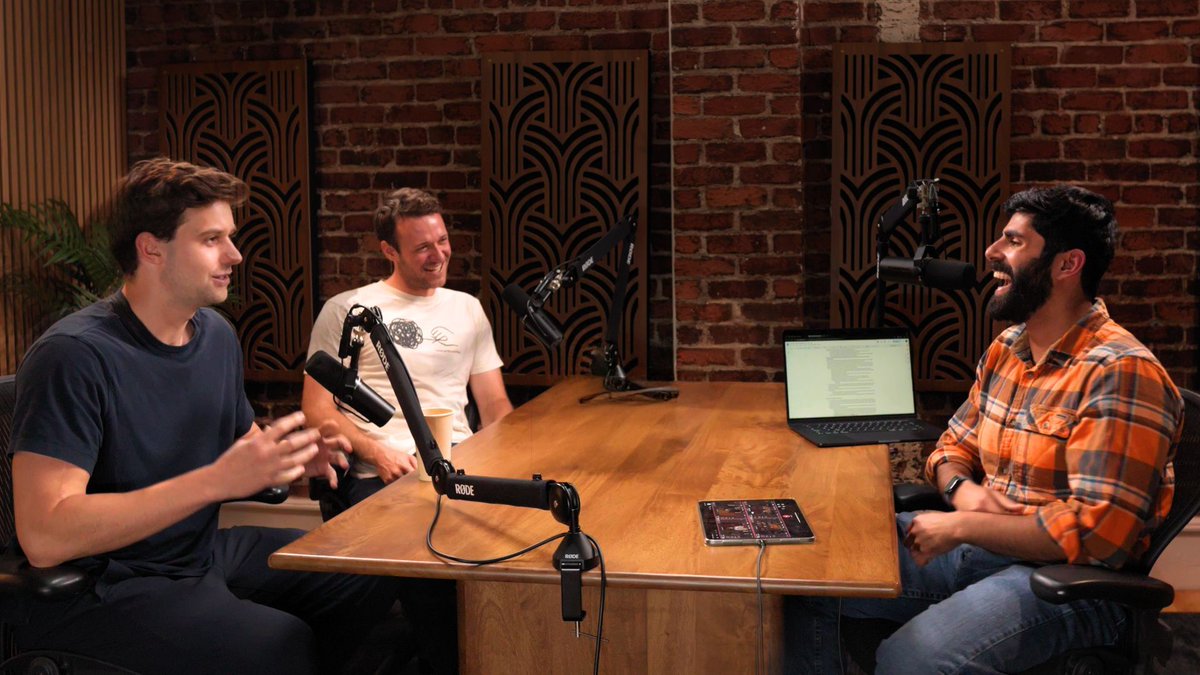
Thariq Shihipar (Thariq) is an engineer on Anthropic’s Claude Code team I asked him how Anthropic makes the most out of the models for engineering and how the industry will change soon. In this episode: • Internal best practices in leveraging the models • What percent of Anthropic's work... show more

65,304 Aufrufe • vor 8 Tagen •via X (Twitter)
35 Kommentare

@trq212 Excited to watch!

@trq212 Percent fully autonomous is already on the chapter list. That's the number. The rest is a podcast.

@trq212 Will watch this definitely and share my thoughts here ; loved you interview with @bcherny and I still remember Boris used to tell the importantance of side projects and ways to stand out in tech.

@trq212 Does he get into usage outside engineering at all? Watching non technical people pick up claude code has been the most interesting part of this shift to me, and it barely comes up anywhere.

@trq212 Thariq you are on vacation, please uninstall X for sometime and enjoy your vacation. Happy holidays!

@trq212 Been running Claude Code daily for months. The gap between my early sessions and now is almost entirely harness work. Better test gates, tighter context, knowing when to just kill a session and start over. The prompt barely changed.

@trq212 @grok so how should I prompt/setup my Claude code to get out the most out of it according to this video?

@trq212 8:54: "Load bearing".

@trq212 the 52:04 chapter on preventing breakages sounds more useful than another prompting tutorial; what checks caught the failures that code review missed?

@trq212 When code volume rises, which verification signal has proved most useful for deciding when an autonomous change still needs human review?

@trq212 @trq212 3 days isn’t a vacation

Thanks for sharing this. The section on loop engineering left me with one question: rather than asking how autonomous an agent can become, which tasks actually justify the cost of building reliable loops around them? For everyday work, repetitive and measurable tasks with clear verification criteria may be the best place to start.

@trq212 Higher code volume is the easy half. The hard half is treating AI diffs as untrusted until they pass the same breakage gates a human would: scoped reviews, replayable evals, and a rollback story that does not depend on the model remembering what it changed.

@trq212 the internal best practices angle is the one i'd wanna hear

@trq212 The number I want is the percent of the loop that is still a human holding the plan. If that doesn't fall as the model gets better, the harness isn't compounding.

@trq212 the durable bit is explicit guardrails + context handoffs, not the tooling brand

@trq212 the underrated lever in these convos is context discipline, not model choice. slimming one skill from ~2k tokens to ~400 and giving subagents narrow scopes did more for my output-per-session than any model upgrade. curious how much of trq212's internal playbook is just that

@trq212 Perfect thing to listen to rrn

@trq212 this is why i keep saying learning how to use the model matters less than learning how to work with it.

@trq212 Good detail on internal harnessing. Wonder how much transfers to teams without Anthropic-level compute.

@trq212 The internal best-practices angle is key. Teams learn faster when evaluation and verification are part of the workflow, not a final check.

@trq212 ok this one actually worth the watch

@trq212 the chapter I want is preventing AI-written breakages. tests that pass on the wrong spec are worse than failing ones. did they land on review, evals, or both?

Useful to hear the internal practices directly. One thing I'd love Thariq's view on: in enterprise deployments the model rarely runs raw it's behind managed settings, a gateway, hooks. Which of those internal best practices survive contact with a locked-down harness, and which quietly stop working?

@trq212 Interesting things in this interview: - Model system prompts are getting simpler, but harnesses are only getting more complex. H2 of 2026 is definitely the era of the harness - The concept of giving the model permission to burn tokens and ambitiously complex its work

@trq212 Great insight, Thariq is a gold mine

@trq212 If the software we wrote before wasn ot very good and is the same software that LLM's were trained on and it's writing nowadays...

@trq212 wow! Thariq is r always give expensive and important advices for agent engineering, ty for this video

@trq212 Claude Code has 5K+ open issues on GitHub and dozens of highly requested features that are unimplemented Software is not solved - it is still bounded by human attention

@trq212 Is wood paneling mandatory in tech now?

@trq212 The dude was supposed to be on vacation, unless this was recorded well in advance.

@trq212 In the model-vs-harness bit, did the stop-line end up living more in the prompt or in the runner?

@trq212 Curious how non-engineers actually use Claude Code daily beyond the internal eng practices

@trq212 the vanity metric is percent of code written by the model. the useful one is percent merged without a human reconstructing the agent’s assumptions. that gap is where agent tooling either compounds or creates review debt.

@trq212 The model-vs-harness chapter is the one I want to hear - better models get the headlines, but loop engineering decides whether a team ships without breaking things.