Video yükleniyor...

Video Yüklenemedi

Ana Sayfaya Dön

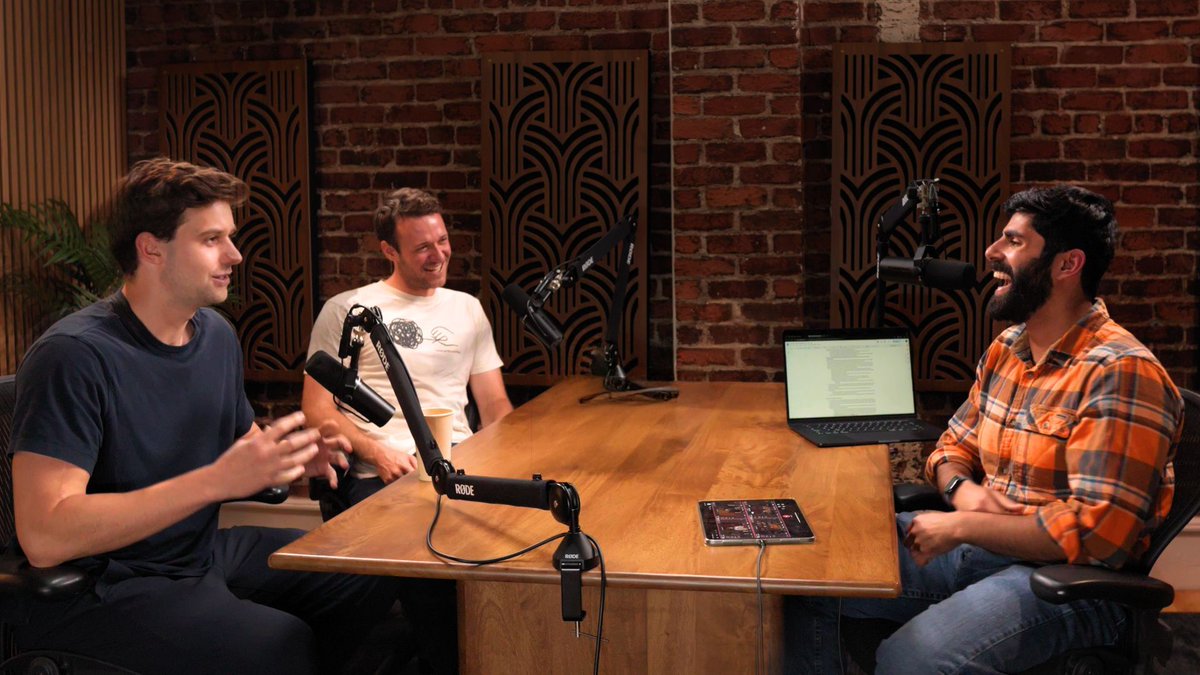
Thariq Shihipar (Thariq) is an engineer on Anthropic’s Claude Code team I asked him how Anthropic makes the most out of the models for engineering and how the industry will change soon. In this episode: • Internal best practices in leveraging the models • What percent of Anthropic's work...

65,304 görüntüleme • 8 gün önce •via X (Twitter)

35 Yorum

Madison Kanna profil fotoğrafı
Madison Kanna8 gün önce

@trq212 Excited to watch!

herman profil fotoğrafı
herman8 gün önce

@trq212 Percent fully autonomous is already on the chapter list. That's the number. The rest is a podcast.

Hemachandiran profil fotoğrafı
Hemachandiran8 gün önce

@trq212 Will watch this definitely and share my thoughts here ; loved you interview with @bcherny and I still remember Boris used to tell the importantance of side projects and ways to stand out in tech.

Eric Stevens profil fotoğrafı
Eric Stevens8 gün önce

@trq212 Does he get into usage outside engineering at all? Watching non technical people pick up claude code has been the most interesting part of this shift to me, and it barely comes up anywhere.

Stats Wire profil fotoğrafı
Stats Wire8 gün önce

@trq212 Thariq you are on vacation, please uninstall X for sometime and enjoy your vacation. Happy holidays!

Jatin Garg profil fotoğrafı
Jatin Garg8 gün önce

@trq212 Been running Claude Code daily for months. The gap between my early sessions and now is almost entirely harness work. Better test gates, tighter context, knowing when to just kill a session and start over. The prompt barely changed.

Serg profil fotoğrafı
Serg8 gün önce

@trq212 @grok so how should I prompt/setup my Claude code to get out the most out of it according to this video?

Mateo Presa profil fotoğrafı
Mateo Presa8 gün önce

@trq212 8:54: "Load bearing".

catman profil fotoğrafı
catman8 gün önce

@trq212 the 52:04 chapter on preventing breakages sounds more useful than another prompting tutorial; what checks caught the failures that code review missed?

AXIALIS | Desktop App Tools profil fotoğrafı
AXIALIS | Desktop App Tools7 gün önce

@trq212 When code volume rises, which verification signal has proved most useful for deciding when an autonomous change still needs human review?

Max profil fotoğrafı
Max8 gün önce

@trq212 @trq212 3 days isn’t a vacation

小曙|AI落地笔记 profil fotoğrafı
小曙|AI落地笔记8 gün önce

Thanks for sharing this. The section on loop engineering left me with one question: rather than asking how autonomous an agent can become, which tasks actually justify the cost of building reliable loops around them? For everyday work, repetitive and measurable tasks with clear verification criteria may be the best place to start.

Ankit Agarwal profil fotoğrafı
Ankit Agarwal7 gün önce

@trq212 Higher code volume is the easy half. The hard half is treating AI diffs as untrusted until they pass the same breakage gates a human would: scoped reviews, replayable evals, and a rollback story that does not depend on the model remembering what it changed.

Jamik profil fotoğrafı
Jamik7 gün önce

@trq212 the internal best practices angle is the one i'd wanna hear

ProtoXcution profil fotoğrafı
ProtoXcution8 gün önce

@trq212 The number I want is the percent of the loop that is still a human holding the plan. If that doesn't fall as the model gets better, the harness isn't compounding.

Levi Qiao profil fotoğrafı
Levi Qiao8 gün önce

@trq212 the durable bit is explicit guardrails + context handoffs, not the tooling brand

jingo profil fotoğrafı
jingo8 gün önce

@trq212 the underrated lever in these convos is context discipline, not model choice. slimming one skill from ~2k tokens to ~400 and giving subagents narrow scopes did more for my output-per-session than any model upgrade. curious how much of trq212's internal playbook is just that

The Coding Sloth profil fotoğrafı
The Coding Sloth8 gün önce

@trq212 Perfect thing to listen to rrn

KYD profil fotoğrafı
KYD8 gün önce

@trq212 this is why i keep saying learning how to use the model matters less than learning how to work with it.

GiBraN | use.fo profil fotoğrafı
GiBraN | use.fo8 gün önce

@trq212 Good detail on internal harnessing. Wonder how much transfers to teams without Anthropic-level compute.

Able Varghese profil fotoğrafı
Able Varghese7 gün önce

@trq212 The internal best-practices angle is key. Teams learn faster when evaluation and verification are part of the workflow, not a final check.

AI Mastery Guide profil fotoğrafı
AI Mastery Guide8 gün önce

@trq212 ok this one actually worth the watch

ethereagle · building profil fotoğrafı
ethereagle · building8 gün önce

@trq212 the chapter I want is preventing AI-written breakages. tests that pass on the wrong spec are worse than failing ones. did they land on review, evals, or both?

Cerebro profil fotoğrafı
Cerebro8 gün önce

Useful to hear the internal practices directly. One thing I'd love Thariq's view on: in enterprise deployments the model rarely runs raw it's behind managed settings, a gateway, hooks. Which of those internal best practices survive contact with a locked-down harness, and which quietly stop working?

ClearText AI profil fotoğrafı
ClearText AI8 gün önce

@trq212 Interesting things in this interview: - Model system prompts are getting simpler, but harnesses are only getting more complex. H2 of 2026 is definitely the era of the harness - The concept of giving the model permission to burn tokens and ambitiously complex its work

Kovil Singh profil fotoğrafı
Kovil Singh8 gün önce

@trq212 Great insight, Thariq is a gold mine

Dev Tony profil fotoğrafı
Dev Tony8 gün önce

@trq212 If the software we wrote before wasn ot very good and is the same software that LLM's were trained on and it's writing nowadays...

codila profil fotoğrafı
codila8 gün önce

@trq212 wow! Thariq is r always give expensive and important advices for agent engineering, ty for this video

FredipusRex profil fotoğrafı
FredipusRex8 gün önce

@trq212 Claude Code has 5K+ open issues on GitHub and dozens of highly requested features that are unimplemented Software is not solved - it is still bounded by human attention

Tibo @ txp.dev profil fotoğrafı
Tibo @ txp.dev8 gün önce

@trq212 Is wood paneling mandatory in tech now?

Ryan profil fotoğrafı
Ryan8 gün önce

@trq212 The dude was supposed to be on vacation, unless this was recorded well in advance.

Ryan Hsieh profil fotoğrafı
Ryan Hsieh8 gün önce

@trq212 In the model-vs-harness bit, did the stop-line end up living more in the prompt or in the runner?

dhinna ship .ico profil fotoğrafı
dhinna ship .ico8 gün önce

@trq212 Curious how non-engineers actually use Claude Code daily beyond the internal eng practices

John Rood profil fotoğrafı
John Rood8 gün önce

@trq212 the vanity metric is percent of code written by the model. the useful one is percent merged without a human reconstructing the agent’s assumptions. that gap is where agent tooling either compounds or creates review debt.

nomad.carpenter profil fotoğrafı
nomad.carpenter8 gün önce

@trq212 The model-vs-harness chapter is the one I want to hear - better models get the headlines, but loop engineering decides whether a team ships without breaking things.

Benzer Videolar

Xavier Leroy (creator of OCaml) is an expert in compilers, formal verification of software and functional programming. This interview should be an approachable resource if you're curious about formal verification of software since I was learning that on the fly during it. In this episode: • OCaml compared with Rust and JavaScript • What is formal verification and how does it work • How languages call each other across boundaries • How to address "almost-correct" LLM code • How type inference works in programming languages Where to watch: • YouTube - • Spotify - • Apple Podcasts - • Transcript - Thank you to the sponsor of this episode for supporting my work: • WorkOS: makes your app Enterprise Ready with easy to use APIs to add SSO, SCIM, RBAC, and more in just a few lines of code, check them out at Chapters: 00:00 - Intro 00:43 - What sets OCaml apart 04:39 - OCaml vs Rust 07:57 - Why is manual memory management more performant 11:21 - Javascript vs OCaml 14:00 - Famous Rob Pike quote 16:05 - Type inference and how it works 22:12 - What is formal verification and how does it work 40:07 - What made multicore support difficult for OCaml 50:17 - How programming languages interface and call each other 57:41 - The danger of almost-correct LLM code 01:05:39 - How LLMs will change programming languages 01:10:26 - Industry vs academia 01:15:05 - Most interesting unsolved problems 01:18:30 - Top book recommendations for engineers 01:21:17 - Advice for his younger self 01:23:31 - Outro

Ryan Peterman

23,942 görüntüleme • 1 ay önce

Sergey Levine (Sergey Levine) is one of the world's top robotics researchers and co-founder of Physical Intelligence. We talked about where humanoid robotics is today, thoughts on the Chinese robotics ecosystem, and his predictions for future timelines. In this episode: • Current state of robotics and surprising capabilities so far • Chinese robotics compared to US ecosystem • If OpenAI and Anthropic got into robotics • His top robotics research paper recommendation • Predictions for when humanoid robotics will land Where to watch: • YouTube - • Spotify - • Apple Podcasts - • Transcript - Thank you to the sponsor of this episode for supporting my work: • WorkOS: makes your app Enterprise Ready with easy to use APIs to add SSO, SCIM, RBAC, and more in just a few lines of code, check them out at Chapters: 00:00 Intro 00:37 Where are we today 04:20 Most surprising capabilities so far 07:03 The most inspiring real world robotics 08:36 If OpenAI or Anthropic got into robotics 10:22 Chinese robotics 13:15 Will one lab breakout from the rest 16:59 Thoughts on a concrete roadmap 21:03 Generalization and demonstrating it 26:04 Types of data and which is best for robotics 34:34 Why humanoid robotics differs from Waymo 37:10 If humanoid robotics failed here is why 39:55 Are there hot take modeling architectures in robotics 42:05 Thoughts on AI safety in robotics 46:44 Top robotics research paper recommendation 49:35 Why is Boston Dynamics less top of mind 53:47 Advice for his younger self 56:42 Outro

Ryan Peterman

69,882 görüntüleme • 22 gün önce

Claude Code cracked something open for us Every 🧱. Now I ship to codebases I barely know, every feature we ship makes the next one easier, and non-technical members of the team use the terminal. I’m genuinely grateful. So I brought its creators, Cat Wu (cat) and Boris Cherny (Boris Cherny) from Anthropic, on AI & I to say thank you—and to talk about everything they’ve learned from building Claude Code. We get into: • The workflows Anthropic’s smartest engineers use to push Claude Code to its limits. Why they pit subagents against each other to get cleaner results, how they turn past code into leverage, and the slash commands and MCPs they rely on most. • The product lessons behind one of the most loved AI agents in the world. How the team balances simplicity and power—building a tool that anyone can use, but that experts can bend to their will—and their philosophy of “unshipping,” or cutting back whenever there’s a simpler, more intuitive path to user intent. • A peek into the future of coding with AI. The new form factors they’re experimenting with to make Claude Code more autonomous, more reliable, and more accessible to non-technical users This is a must-watch for anyone—both technical and non-technical—who wants to learn how to use Claude Code like the people who built it. Watch below! Timestamps: Introduction: 00:01:26 Claude Code’s origin story: 00:02:25 How Anthropic dogfoods Claude Code: 00:07:03 Boris and Cat’s favorite slash commands: 00:14:06 How Boris uses Claude Code to plan feature development: 00:15:49 Everything Anthropic has learned about using sub-agents well: 00:21:53 Use Claude Code to turn past code into leverage: 00:26:16 The product decisions for building an agent that’s simple and powerful: 00:33:14 Making Claude Code accessible to the non-technical user: 00:36:38 The next form factor for coding with AI: 00:45:12

Dan Shipper 📧

57,619 görüntüleme • 10 ay önce

Claude Code is a major (and accidental!) hit for Anthropic that surprised even its creator, Boris Cherny. Claude Code, an Agentic AI coding product that lives in the terminal. Most of the new code at Anthropic is created through it today. And in the last 5 months since it was launched publicly, Claude Code went from $0 to $400M in revenue run rate (as per The Information). 00:00 – Intro 01:15 – Did You Expect Claude Code’s Success? 04:22 – How Claude Code Works and Origins 08:05 – Command Line vs IDE: Why Start Claude Code in the Terminal? 11:31 – The Evolution of Programming: From Punch Cards to Agents 13:20 – Product Follows Model: Simple Interfaces and Fast Evolution 15:17 – Who Is Claude Code For? (Engineers, Designers, PMs & More) 17:46 – What Can Claude Code Actually Do? (Actions & Capabilities) 21:14 – Agentic Actions, Subagents, and Workflows 25:30 – Claude Code’s Awareness, Memory, and Knowledge Sharing 33:28 – Model Context Protocol (MCP) and Customization 35:30 – Safety, Human Oversight, and Enterprise Considerations 38:10 – UX/UI: Making Claude Code Useful and Enjoyable 40:44 – Pricing for Power Users and Subscription Models 43:36 – Real-World Use Cases: Debugging, Testing, and More 46:44 – How Does Claude Code Transform Onboarding? 49:36 – The Future of Coding: Agents, Teams, and Collaboration 54:11 – The AI Coding Wars: Competition & Ecosystem 57:27 – The Future of Coding as a Profession 58:41 – What’s Next for Claude Code

Matt Turck

82,372 görüntüleme • 1 yıl önce

My conversation with OpenAI co-founder Greg Brockman This is the most detailed first-person account of the 72 hours after Sam Altman was fired. We also go deep on what comes next: the global race to AGI, why ChatGPT stopped showing reasoning, how much of OpenAI's own code is now written by AI ("it's hard to know what percent is not"), and the untold story of how OpenAI actually started in 2015. 00:00:00 Introduction 00:00:49 Meeting Sam Altman and Starting OpenAI 00:02:40 Building the Founding Team 00:04:25 DeepMind's Lead Over OpenAI 00:04:54 Changing OpenAI to a For-Profit Model 00:06:05 Breakthrough Moments at OpenAI 00:08:22 What Dota 2 Meant for OpenAI 00:10:04 Reasoning Versus Prediction 00:11:59 Tensions Grow at OpenAI 00:15:44 Sam Altman's Firing 00:17:49 Greg Quits OpenAI 00:19:56 Sam Explores Deal with Microsoft's Satya 00:20:28 Petition for Altman's Return 00:23:43 Ilya Sutskever Leaves OpenAI 00:24:59 Lessons Learned after Sam Ousting 00:28:22 The Thing Ilya Said that Greg Can't Forget 00:32:22 Is AI Going Parabolic? 00:33:24 How Much of OpenAI's Code is Written by AI? 00:36:21 Do AI Chatbots Tell Us What We Want to Hear? 00:38:06 The Global AI Race to Reach AGI 00:38:40 What Happens if US Doesn't Reach AGI First? 00:39:49 Are Countries Stealing AI Advancements? 00:40:38 Why ChatGPT No Longer Shows Reasoning 00:41:47 The Finite Constraints of Compute 00:43:38 On Investing Early in Data Centers 00:46:31 The Future of Data Center Specialization 00:47:52 How to Decide Whose Queries to Serve 00:49:08 OpenAI on Consumer vs Enterprise Models 00:53:05 Data Centers in Space? 01:00:56 What Should AI Regulation Look Like? 01:04:33 The Future of AI-Powered Entrepreneurship 01:04:44 AI and Job Loss 01:07:15 The Skills Young People Should Invest In 01:11:30 What Does Success Look Like For You? Full episode on X below. Also find it on: • YouTube: • Spotify: • Apple:

Shane Parrish

450,952 görüntüleme • 4 ay önce