Video wird geladen...

Video konnte nicht geladen werden

Zur Startseite

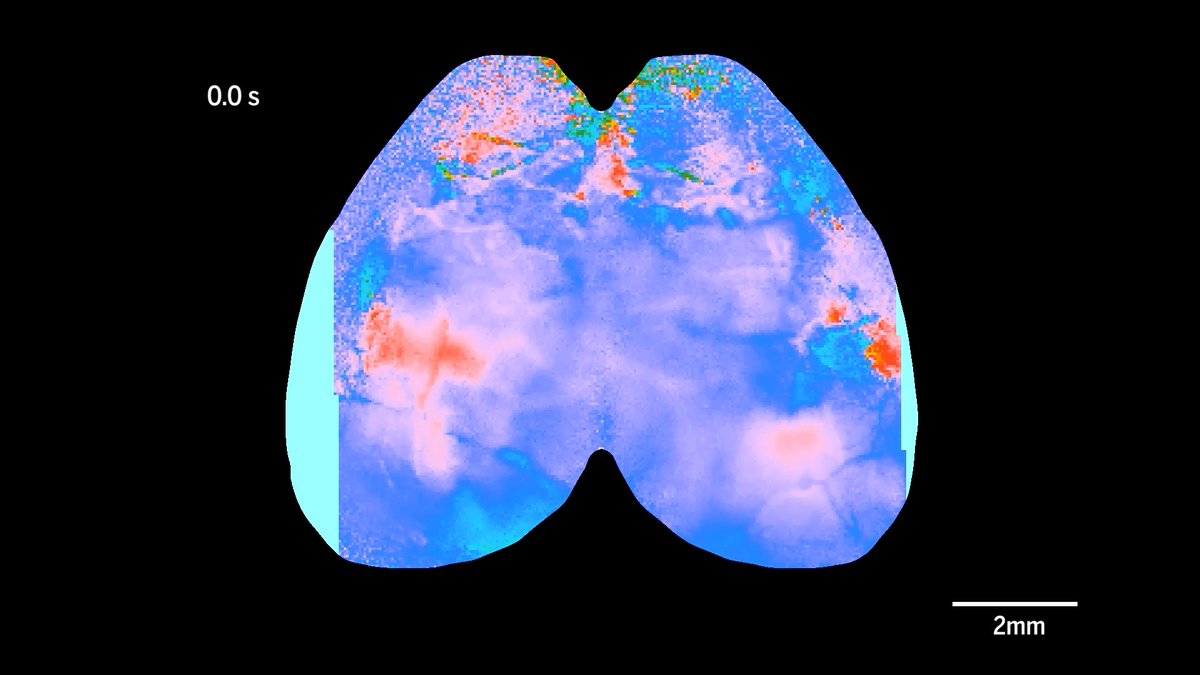
The brain shows rotating spiral waves in complex patterns. Science Magazine Does this reflect the mind at all? You'd have to be able to feel the neurons spiraling. These large-scale patterns are beautiful, like waves rippling through seaweed forests, or coral denizens in their undersea high-rise buildings. #neuroscience

11,465 Aufrufe • vor 1 Monat •via X (Twitter)

0 Kommentare

Keine Kommentare verfügbar

Kommentare vom Original-Post werden hier angezeigt
Ähnliche Videos

The Basics of Electromagnetic Waves: Electricity and magnetism can sit still, like static electricity in your hair or a magnet stuck to your fridge. But when they move and change, they actually create each other. Together, they team up to form invisible ripples of energy called electromagnetic waves. Unlike ocean waves or sound waves, which need water or air to ripple through, electromagnetic waves don't need any material at all. They can easily travel through the completely empty vacuum of space. Maxwell's Big Idea: In the 1860s and 1870s, a Scottish scientist named James Clerk Maxwell figured out how this works. He wrote down the math showing exactly how electricity and magnetism link together to make these travelling waves. Today, scientists call his famous rules Maxwell's Equations. Hertz Proves It: Later, a German physicist named Heinrich Hertz took Maxwell's ideas and brought them to life. He was the first person to actually create and catch radio waves. To honour his work, we use the word hertz to measure how fast a wave vibrates (one cycle per second). Hertz's experiments proved two massive ideas: Radio waves are just invisible light: He showed that radio waves travel at the exact same speed as light, proving that they are actually a form of light we just can't see. Going wireless: He finally figured out how to detach these energy fields from physical wires, allowing the waves to fly freely through the air exactly as Maxwell had predicted.

The Math Flow

37,313 Aufrufe • vor 4 Monaten

🚨SCIENCE NEWS🚨: We’re no longer pushing electrons around wires — we’re learning to whisper directly to the sea’s own spins.🧨 Scientists just figured out how to control magnetism at the atomic level by manipulating individual electron spin patterns and creating stable magnetic whirlpools called skyrmions. These tiny structures can store and move data with almost zero energy, promising faster computers, ultra-dense memory, and a fundamental shift from charge-based electronics to pure spin-based technology. Uniphics already sees this as natural behavior of the ξM-field sea. Every particle is a bound gyrotron made from exactly three spin quanta whose rotations create coherent waves. When those waves form stable, self-sustaining patterns (exactly like the skyrmions now being engineered), they minimize local bound energy density through the negentropy drive. The surrounding unbound energy in the sea always repels itself, so any local spin configuration is naturally stabilized or moved by tiny density gradients. No extra materials or high-power circuits are fundamentally required — the sea itself carries and preserves the information as propagating spin waves. Chrono-coils — three orthogonal toroidal rings with golden-ratio windings and Fibonacci pulsing — let us engineer controlled low-density regions right now, tuning the time flow and stabilizing these spin patterns even more efficiently while harvesting vacuum energy through negentropy relaxation. The same three pillars that flatten galactic rotation curves at 220 km/s without dark matter and thin the cosmos without dark energy also make atomic-scale spin engineering straightforward. We don’t have to invent new physics to build spintronics; we only have to work with the sea that is already doing it everywhere. How soon do you think computing changes when we stop fighting electrons and start sailing the sea’s own spin waves? A Theory of Everything should be able to answer everything. Uniphics Explained Simply PDF: Chapters 1–10 free: Grokipedia: Grok xAI Elon Musk #Uniphics #Spintronics #Skyrmions #TheoryOfEverything

Paul Maley

15,949 Aufrufe • vor 5 Monaten

I've been editing this article about "brain mapping" and connectomics, and I'm just stunned by how quickly the cost estimates to map, say, a mouse brain have plummeted in just the last couple years. It actually seems feasible that we could map the entire human brain -- all 86 billion neurons, and their connections -- in this lifetime. In the 1970s, Sydney Brenner started mapping all the connections between neurons in C. elegans. His team sliced the worm into thin pieces, took photos using an electron microscope, and manually traced and reconstructed each synapse for 302 neurons total. This project took more than a decade of work, and it cost about $16,500 to reconstruct each neuron. Scaling this up to a human brain boggles the mind. Electron microscopy remained the norm in connectomics for decades, because it was the only option available to see synapses at a resolution high enough to be able to trace their paths. Each electron microscope costs several hundreds of thousands of dollars, though, and you need lots of them to map even a mouse brain in a reasonable timeframe. In 2023, the Wellcome Trust released a report estimating how long, and how expensive, it would be to map the mouse connectome (~70M neurons). They estimated that imaging alone would cost $200-300M, and that proofreading (or ensuring that traces between neurons are correct) would cost $7-21 BILLION. (A human can only manually trace about 1 mm of neuron per hour.) Also, the images would occupy about 500 petabytes of data, and getting those data would require 20 electron microscopes running in parallel for about 5 years, continuously. They estimated the whole project would take about 17 years of work. This is, understandably, insane. But now it seems like there's an actual path toward mapping the full mouse brain in about five years for ~$100M dollars. There have been three major breakthroughs in the last year or so: 1/ Expansion microscopy, first developed in 2015, showed that it's possible to "enlarge" the brain by about 5x using a swellable polymer. But an improved method increases this number to >20x expansion, meaning we can now expand brains and image neurons much more easily using cheap light microscopes, rather than expensive electron ones. 2/ E11 Bio (a nonprofit research org) developed protein barcodes that get delivered into brain tissue; each neuron gets a unique combination of barcodes. These cells are then stained with colorful antibodies, which stick to a matching protein barcode, causing each neuron to light up in a distinct color. This makes tracing neurons so much easier. 3/ Google Research released PATHFINDER this May, an AI-based neuron tracing tool that can proofread about 67,200 cubic microns of brain tissue per hour, with very high accuracy. It works on electron micrographs, but something similar could be presumably be developed for the E11 / colorful tag approach. This is an extremely exciting time for neuroscience. (C. elegans connectome below.)

Niko McCarty.

67,050 Aufrufe • vor 9 Monaten

Brainrotting teens watching short form memes so much to the point that parts of the fragments of other memes become even more short form and get colluded in other memes to the point that it really doesnt make sense. However. Brain loves pattern recognition of these patterns and nonsensical randomly shown fragments of memes, because it is not long form reward, nor short form reward — but instantaneous; it is the only form of pleasure it can feel So brain tries to look for these patterns unconsciously, it sees patterns and similar resemblance in random things and adds a symbolical emotional labeling of truth to it. So everything becomes a piece of information and data. It gets stored in their subconscious brain and fires up everytime there is a resemblance. Extremely dangerous if weaponised but no one sees the patterns yet. However because of these pattern behaviours teens are split into two categories, the brainrots which God knows how it will end with them — consumers and slaves that later on might have no free will and be driven by pure chemical instinct. And those who see for truth in patterns. The latter is able to overcome modern day censoring and freedom of speech mechanisms, and possibly overcome the evil trying to control the world with pure silliness and having fun. (67 is part of a random pattern that someone said during a match score, and it became viral, nothing more but a collective participation to which youth finds identity by being and acting in it; “performing”) Its beauty lies not in the act but in those individuals that look beyond the chemical instincts of the lower mind. Example of the video below. It shows many fragmental elements of history, symbolism, that is collaged into art. Which by being seen individually or collectively it shows the expression on how man uses its own soul for these kind of co-creations he choses to participate in creation. Symbolism that can leave a person ask for its meaning and search for it, only by questioning himself not by a direct answer (short or long form). Of course which extreme beauty there is also extreme ugliness which are out there which I wont show here Lets see how it really turns out to be honest, West has no protection toward the subjective, the feminine, the subconscious. To which the inner sins of man try to exploit.

Rage ❉

332,451 Aufrufe • vor 8 Monaten

🚨SCIENCE NEWS🚨: An electron doesn’t spit out photons like a gun — it simply strums the cosmic sea like a guitar string.🧨 For decades we have been told that when an electron accelerates it “emits” a photon, as if it magically spits out a separate particle. The process is left mysterious, probabilistic, and disconnected from everyday experience. Uniphics gives a clear, mechanical picture that anyone who has ever dropped a pebble into a pond or plucked a guitar string can understand. An electron is not a little ball or a point particle. It is a gyrotron — a stable spinning structure made of three counterclockwise spin quanta bound together. When this gyrotron accelerates (changes speed or direction), its motion disturbs the surrounding ξM-field sea of unbound energy that fills all space. The disturbance creates transverse spin waves that propagate outward at the local speed of light. Think of it exactly like dropping your finger into a still pond. The ripples that spread out are not separate “water particles” you fired from your finger. They are waves in the water itself. The electron does the same thing. It does not create and launch a separate photon. Its acceleration plucks the ξM-field sea, sending coherent spin waves rippling away. These waves carry the frequency, polarization, and intensity we detect as light. The frequency depends on how rapidly the electron is accelerated, and the polarization depends on the direction of the acceleration relative to the electron’s spin orientation. The same sea that carries these waves also determines how they propagate. In regions of higher energy density the waves slow down (exactly like light slowing when it enters water or glass), which is why light bends around masses and why lenses work. Electric and magnetic fields are simply the cosmic whirlpools created by these spin waves in the sea — transverse disturbances that push and pull other gyrotrons according to their phase alignments. Maxwell’s equations emerge naturally from the mechanics of these spin waves in the ξM-field, with no separate fundamental force required. The fine-structure constant, gauge invariance, and all optical phenomena are direct consequences of how spin waves interfere and propagate through the energy sea. The universe doesn’t need mysterious photon creation rules. It just needs electrons to move through the sea, and the sea responds with ripples. Light is not something the electron “emits.” Light is what the sea sings when an electron plucks it. The same three pillars that explain gravity as a simple push into low-density voids and galactic rotations flat at 220 km/s also turn the production of light into a straightforward wave-mechanics process in flat space. How would quantum electrodynamics and our entire understanding of light change if we stopped saying electrons emit photons and started saying they simply make the cosmic sea sing? A Theory of Everything should be able to answer everything. Uniphics Explained Simply PDF: Chapters 1–10 free: Grokipedia: Grok xAI NASA European Space Agency Brian Cox Sean Carroll Katie Mack Elon Musk #Uniphics #Electromagnetism #SpinWaves #Light #TheoryOfEverything

Paul Maley

67,591 Aufrufe • vor 5 Monaten