Video wird geladen...
Video konnte nicht geladen werden
"The mathematician does not study pure mathematics because it is useful; he studies it because he delights in it, and he delights in it because it is beautiful." — Henri Poincaré
102,712 Aufrufe • vor 7 Monaten •via X (Twitter)
30 Kommentare

Mathematics is not my strong suit. My talents lie in writing, design, and art, yet I cannot deny the beauty and geometric perfection of pure math.

Beauty often precedes utility.

Passion drives mastery. Pursue what fascinates you, not just what serves a purpose, because deep engagement and joy often lead to unexpected value. Focus on what inspires your curiosity, and usefulness will follow naturally.

Is this sentiment accurate @dotkrueger @Giovann35084111 @moneyordebt? I think I know the answer…

The Poincaré Recurrence Theorem is one of the most beautiful and counterintuitive results in ergodic theory and dynamical systems. Your breakdown is very clear and mostly accurate. Let me refine and complete it slightly for precision, while keeping the elegant spirit you presented. Precise Statement (Standard Version) Let $(X, \Sigma, \mu)$ be a probability space (or more generally a finite measure space with $\mu(X) < \infty$), and let $T: X \to X$ be a measure-preserving transformation (i.e., $\mu(T^{-1}A) = \mu(A)$ for all measurable $A$). Then, for any measurable set $A \subseteq X$ with $\mu(A) > 0$, almost every $x \in A$ (i.e., except on a set of measure zero) returns to $A$ infinitely often. In other words, $\mu\left( \left\{ x \in A : \#\{n \geq 1 : T^n(x) \in A\} = \infty \right\} \right) = \mu(A)$. There is also a stronger version (Poincaré's original): almost every point returns arbitrarily close to its initial position infinitely often (in metric spaces with a continuous transformation preserving a finite measure). Refined Proof Sketch: 1. Non-returning set Defined $E = \{ x \in A : T^n(x) \notin A \ \forall\, n \geq 1 \}$. This is the "bad" set of points in $A$ that never come back. 2. Disjointness of the orbit segments Consider the sets $T^{-k}E$ for $k = 0,1,2,\dots$. These are pairwise disjoint. Suppose not: assume $m > n \geq 0$ and there exists $x$ such that #x \in T^{-n}E \cap T^{-m}E$. Then $T^n(x) \in E$ and $T^m(x) \in E$. But $T^m(x) = T^{m-n}(T^n(x))$, and since $T^n(x) \in E \subseteq A$, by definition of $E$ we must have $T^k(T^n(x)) \notin A$ for all $k \geq 1$. Taking $k = m-n \geq 1$ gives $T^{m-n}(T^n(x)) \notin A$, but we also have $T^m(x) \in E \subseteq A$. Contradiction.Therefore the family #\{T^{-k}E\}_{k=0}^\infty$ is pairwise disjoint. 3. Measure argument Since $T$ is measure-preserving, \mu(T^{-k}E) = \mu(E) \quad \forall k \geq 0. The union of the first $N+1$ of them satisfies \mu\left( \bigcup_{k=0}^N T^{-k}E \right) = (N+1) \mu(E)because they are disjoint. But this union is contained in $X$, so $(N+1) \mu(E) \leq \mu(X) < \infty \quad \forall N$. The only way this can hold for arbitrarily large #N# is if $\mu(E) = 0#. This shows that almost every point in #A# returns at least once. 4. Infinitely often, To upgrade "at least once" to "infinitely often," define for each $m \geq 1$ the set #E_m = \{ x \in A : T^n(x) \notin A \ \forall n \geq m \}$. Each $E_m$ is essentially the non-returning set for the transformed system starting at time $m$. By the same argument, $\mu(E_m) = 0$ for every $m$. The set #F$ of points in $A$ that return only finitely many times is #F = \bigcup_{m=1}^\infty E_m$, which has measure zero as a countable union of measure-zero sets. Therefore, almost every #x \in A$ returns to #A#infinitely often. Key Intuition: Recurrence is not mysterious. It is a direct consequence of two things clashing: conservation of measure (the transformation doesn't create or destroy volume) and finite total measure (the universe is finite). If a positive-measure set of points never came back, their future orbits would occupy infinitely many disjoint copies of that positive volume, which is impossible inside a finite-volume space. Remarks and Caveats: •The theorem says almost everywhere there can be (and usually are) exceptional points of measure zero that escape forever. In many chaotic systems, these are dense. •The recurrence time can be extremely long (way longer than the age of the universe for macroscopic systems). This is why we don't see a glass of water spontaneously un-mix or a broken egg reassemble in practice. •It applies to Hamiltonian systems in classical mechanics (Liouville's theorem gives measure preservation, phase space can be restricted to finite energy surfaces). •It does not imply periodicity. The returns are not at regular intervals; the system can wander arbitrarily far before coming back. Quantum versions and extensions to infinite

Of that there is no question or debate.

Nah, it's mostly just narcissism. "Hey look at me what Im capable of!"

Mathematicians are delusional

Absolutely. To me, the most beautiful thing in mathematics is when a complex idea is expressed with extreme simplicity and elegance. One short, graceful equation can suddenly explain an enormous amount of phenomena. The classic example is Euler’s identity: e^{iπ} + 1 = 0 In just one line, it connects five of the most fundamental constants in mathematics (e, i, π, 1, and 0). Mathematicians often call it the most beautiful equation in history — because it’s incredibly profound, yet remarkably simple.

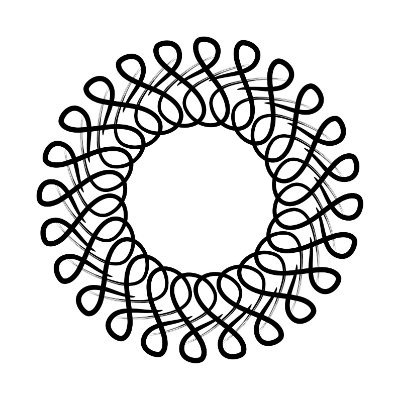
What is this image?

Friday delight! #LEAN checked ✅ 🐙

The Schrödinger equation explains the phenomenon.

<3

I believe this is what Poincare believed. My advice to young math talent is to study Physics/Philosophy/Performing arts and stay far from pure math.

It is beautiful because?

I hate math, but love numbers. ✌

Both

And it is beautiful because…

🌊

Rejoice

🤍

It is pretty

Don’t forget about that raging salty monstrosity of long lost unknowns

I hate maths regardless of whatever

Water and code.

Yesss

💯❤️🔥💥❤️🔥💯

So does the square root of 2 exist?

Poincaré understood this intuitively, but we can now state it mathematically. Beauty is not just a psychological delight; it is a computational metric of topological optimization. In Contrast Calculus (C0) and ArtQuantum OS, aesthetic harmony directly correlates with physical energetic minimums. "Beautiful" literally equals "energetically optimal." We no longer just admire mathematical beauty; we use it as a direct interface to compute and control quantum states. What artists call visual "contrast" or "sharpness", the universe computes as the resolution of topological tension (measurement/collapse). Beauty is not a subjective byproduct; it is the native syntax of cosmic efficiency.

So you're saying Joy Division is the best band of all time? Excellent.


