Loading video...

Video Failed to Load

Go Home

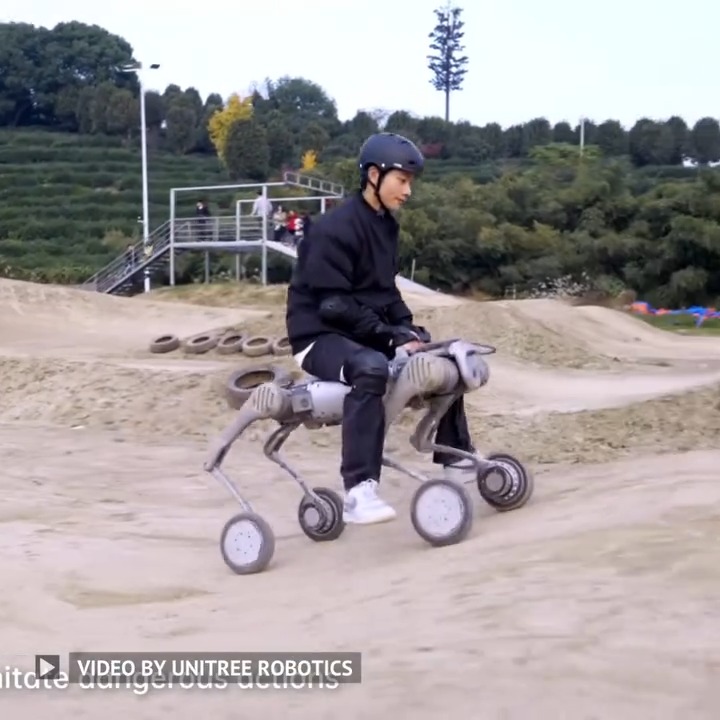
The Unitree B2-W offers advanced mobility, AI navigation, and adaptability, featuring 20 km/h speed, 100 kg pulling capacity, ultra-wide 4D LiDAR, and extended battery life. 🤖 #AIEngineering #unitreerobot #TechInnovation #futurerobotics

4 Comments

Armageist's profile picture
Armageist1 year ago

Give this thing sword hands and long range cover fire support by dogbot riflers and you have an excellent melee flanking horrorbot.

eurasier's profile picture
eurasier1 year ago

is this real

Doug's profile picture
Doug1 year ago

I’m in at $200.

Ekrem Fetić's profile picture
Ekrem Fetić1 year ago

With a rifle on his back he can be an excellent soldier.
Related Videos

The US needs to start getting really serious about AI and robotics. We can't let China beat us. This is the new Chinese-made Unitree B2-W robot. The Unitree B2-W is turning heads for its ability to walk, roll, climb, and even carry adult passengers across challenging terrain—all in one sleek, futuristic package. At first glance, you might catch yourself thinking, “Is this really real?” because it looks like something straight out of a sci-fi film. Yet, here it is: a Chinese-made robot that’s been engineered to shift seamlessly between legged and wheeled locomotion, push up to 220 pounds of horizontal pulling force, and sprint at speeds of around 12.5 MPH. Some have likened it to a “Boston Dynamics on steroids,” which only scratches the surface of how advanced and versatile it truly is. Beneath the metallic chassis is a sophisticated control system powered by an Intel Core i5 or i7 processor—or, in higher-tier configurations, a NVIDIA Jetson Orin which drives the B2-W’s multitude of onboard sensors, from its 3D LiDAR (with optional 32-wire automotive-grade LiDAR) to an array of depth and optical cameras. These sensors lets it perceive the environment, avoid obstacles, and adapt to uneven terrain, a capability further bolstered by its IP67-rated weather and dust protection. In real-world settings, that means it can climb 45-degree staircases, cross rocky paths, and transition seamlessly from indoor to outdoor operation without missing a beat. Arguably the most buzzworthy trick in its repertoire is the ride-on feature. While "quadruped" robots usually conjure up images of helpful mechanical “dogs” trotting beside you, the B2-W can support the weight of an adult, turning it into a legitimate personal transport over rough or slippery ground. This is all made possible by its formidable load capacity of up to 120 kg in standing mode, combined with a battery system of more than 2 kWh. Under ideal conditions, it can keep going for up to 50 km with a 40 kg load, though your mileage may literally vary. Unsurprisingly, all this power and agility have sparked a wave of conversation—both fascination and worry. People imagine scenarios where a B2-W might chase intruders or become militarized, carrying weapons rather than passengers or equipment. As technology marches forward, these concerns aren’t completely unfounded, but it also opens doors for legitimate uses in research, construction, rescue operations, and beyond. The B2-W’s adaptability, speed, and load-bearing capacities make it a compelling platform for anyone investigating the boundaries of legged robotics. Ultimately, the B2-W’s debut underscores just how quickly Chinese robotics—indeed, robotics worldwide—is evolving. From advanced AI navigation to all-terrain endurance, it’s pushing the envelope of what’s possible in the quadruped robot space. While it might look like a mechanical cousin of nature’s best pack animals, the B2-W is very much a product of cutting-edge engineering.

Ed Krassenstein

177,320 views • 1 year ago

Can Venezuela withstand the attack after Trump's green light? Initially, the targets would be Venezuelan radars, which would be attacked by American drones, disabling the anti-aircraft defenses. Venezuela does not have a dedicated drone interception system, which could be a crucial vulnerability. Iglas and RBS 70 are the only options to attack drones flying at max 5,000m altitude. Regarding the radars, Venezuela is operating only a little over half of its systems, which are Russian and Chinese models. American radars are partially operational. - HK-JM2: Chinese; 500 km; Long-range defense; Operational. - JYL-1: Chinese; 470 km; Long-range 3D; 7+ units; Operational. - JY-11B: Chinese; 450 km; 3D UHF; Multiple units; Operational. - TPS-70: American; 370 km; Mobile surveillance; Unknown status; Partially operational. - 36D6 Tin Shield: Russian; 300 km; 3D detection; Operational. - TPS-43: American; 360 km; Air surveillance; Unknown status; Possibly inoperative. These radars are also critical for the operation of Venezuelan drones and antiship missiles, which are quite numerous. Venezuelan Aerial Drones (Iranian, Russian, and Domestic): - Arpía 1/ANSU-100 (Mohajer-2): Iranian/local; Range: 50 km; Speed: 200 km/h; Dozens in use. - Orlan-10: Russian; Range: 120 km; Speed: 150 km/h. - Qods Mohajer/Mersad: Iranian; Range: 50 km; Speed: 200 km/h. - ANT-3X Gavilán: Venezuelan; Range: 120 km; Speed: 150 km/h. - Mohajer-6: Iranian; Range: 2,000 km; Speed: 200 km/h. - ANSU-200: Venezuelan/Iranian; Range: 500 km; Speed: 200 km/h (experimental). - Zamora V-1 (Shahed-136): Venezuelan; Range: 30 km; Speed: 150 km/h. Venezuelan Marine Drones (Domestic and Confirmed): - RAMMAX: Venezuelan; Range: 20 km; Speed: 20 km/h; (coastal patrol). - Iranian-Modified USVs (Peykaap III): Range: 50 km; Speed: 50 km/h. Chinese Marine Drones (Some unconfirmed): - Yunzhou: Chinese; Range: 740 km; Speed: 85 km/h (high-speed). - Cavalry A150: Chinese; Range: 500 km; Speed: 40 km/h. - Lanjing: Chinese; Range: 600 km; Speed: 74 km/h (submersible). - Scout S45: Chinese; Range: 350 km; Speed: 40 km/h. - Anti-mine UAV: Chinese; Range: 200 km; Speed: 40 km/h. Venezuelan Anti-Ship Missiles: - Kh-35 variants: Russian; Range: 130–300 km; Speed: Mach 0.8. - C-802/YJ-83: Chinese; Range: 180 km; Speed: Mach 0.9. - Kh-31 variants: Russian; Range: 110–250 km; Speed: Mach 3.5; Quantity: 20–50 (Su-30MK2, 2025). - CM-90 (Nasir-1): Iranian; Range: 90 km; Speed: Mach 0.85. Venezuelan Boats with Anti-Ship Missiles: - Nasr-1: Peykaap/IRGC swarms; Range: 90 km; Speed: Mach 0.85. - Fajr-3: Fast, asymmetric boats; Range: 25 km; Speed: Mach 0.7. Regarding vessels, the biggest threat from Venezuela are Iranian fast attack boats and their anti-ship missiles. I see no space for the rest of the navy to operate in this scenario. They might not even leave the naval bases. Even with the U.S. deploying a partial force, it's far beyond Venezuelan capabilities, but I repeat: If the Venezuelan military agrees to fight, these anti-ship missiles and drones will give the American fleet a hard time. Yemen has far less against a much larger task force and still made a significant impact. The defense systems as S300VM, Buk-2M and Pechoras were deployed around several cities. Maduro isn't as popular as Chavez was, and Venezuela is going through a tough time now, without even the support of its neighbors, something that wasn't the case in the past.

Patricia Marins

99,420 views • 9 months ago