Video wird geladen...

Video konnte nicht geladen werden

Zur Startseite

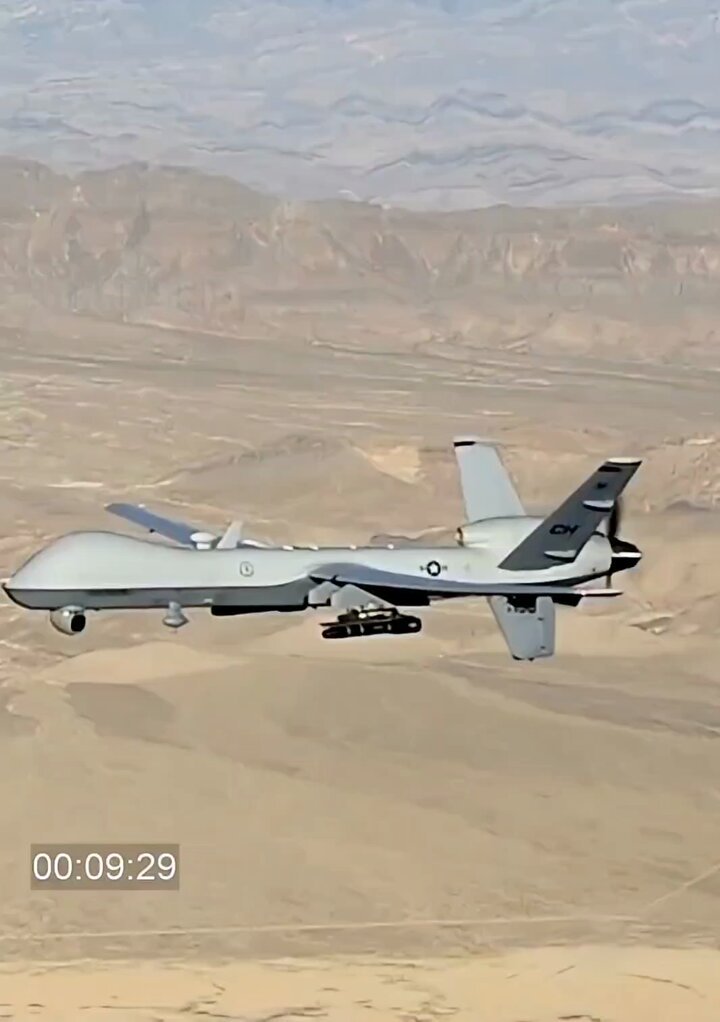
🇺🇸🇰🇷 The US has officially created and deployed the first permanent MQ-9 Reaper strike-reconnaissance UAV unit in South Korea, the 431st Expeditionary Reconnaissance Squadron, based at Kunsan Air Base. Interestingly, this is effectively the first revival of this unit since World War II, when it previously consisted of interceptors...

387,786 Aufrufe • vor 10 Monaten •via X (Twitter)

0 Kommentare

Keine Kommentare verfügbar

Kommentare vom Original-Post werden hier angezeigt
Ähnliche Videos

USAAF 14th PRS Spitfire PR Mk XI gunned down at point blank range likely by a Luftwaffe Me 262 jet fighter in 1944 The incident pictured most likely involved Spitfire PR Mk XI PL782 flown by 2nd Lt Robert B Hilborn. The aircraft was intercepted over Lechfeld by Leutnant Alfred Schreiber of Erprobungskommando 262 in Me262 A-1a WerkNr. 110372 "White 3". This latter unit was the first to deploy the Messerschmitt jet and would later form Kommando Nowotny. Hilborn managed to bail out of his stricken aircraft and was taken prisoner. The USAAF insignia on the top of the port wing is clearly visible as the aircraft banks away and both the severe vibration on firing and size of the cannon shell impacts suggest 30mm gunfire consistent with the Me 262's MK 108 battery in the nose, and the jet aircraft would also have been able to comfortably keep up with the fast unarmed photoreconnaissance Spitfire variant at altitude. The 3cm Minengeschoss high-capacity shells were formidable projectiles each containing over 70 grams of high explosive and were designed to detonate within six or so inches of having penetrated the aircraft skin, destroying the aircraft structure in the process and rendering the aircraft unflyable after only a few hits. The amount of debris flying off the Spitfire after only three visible detonations is testament to the devastating effect of such fire. The US 14th Photographic Reconnaissance Squadron began to train with British-made Supermarine Spitfire Mk V fighters in July 1943 before equipping with the photographic reconnaissance PR Mk XI variant later that year. The squadron flew combat reconnaissance missions in the European Theater of Operations from August 12th 1943 until April 25th 1945. The squadron's Spitfires flew the majority of the target photography missions, including the first Spitfire reconnaissance mission over Berlin in March 1944, while the other squadrons of the 7th Photographic Group (Reconnaissance) equipped with F-5 Lightnings concentrated on photographic mapping. Deep penetration missions included reconnaissance of oil refineries to determine when repairs had been performed that could justify returning them to Eighth Air Force's target list. The Squadron earned a Distinguished Unit Citation for reconnaissance missions flown over France between May 31st 1944 and the end of June. The squadron flew over 300 successful sorties to support Operation Overlord, the invasion of Normandy. It flew missions over the Netherlands to support Operation Market Garden in October 1944 and conducted damage assessment of Germany until July 23rd 1945. In late 1944, the Spitfires, flying solo missions and relying only on speed and altitude for defense, began to prove vulnerable to the jet powered Messerschmitt Me 262 fighters entering service with the Luftwaffe. A squadron aircraft lost on September 5th 1944 was probably the first Army Air Forces loss to a German jet fighter. Erprobungskommando 262 had been formed in April 1944 at Lechfeld just south of Augsburg, as a test unit (Jäger Erprobungskommando Thierfelder, commanded by Hauptmann Werner Thierfelder) to introduce the Me 262 into service and train a corps of pilots to fly it. This was not Leutnant Schreiber's first go at an Allied reconnaissance plane, while flying over Munich on July 26th he encountered a Mosquito PR Mark XVI of No. 540 Squadron RAF piloted by Fl. Lt. A.E. Wall. Schreiber attempted to shoot down the unarmed Mosquito, though Wall evaded Schreiber's three attack runs and was able land safely at Fermo in Italy after what was the first air to air interception by a jet fighter in history.

hw97karbine

108,413 Aufrufe • vor 1 Jahr

🧐🇺🇸 The Country That Put More Fighter Jets in Foreign Skies Than the Rest of the World Combined For more than 70 years, the United States has dominated the global fighter aircraft market, exporting thousands of combat jets to allies across the world. Its fighters have flown in the colors of dozens of nations, making American aircraft the backbone of many of the world's most powerful air forces. The numbers are staggering: ◽ F-16 Fighting Falcon, More than 4,600 built, making it one of the most successful fighter jet programs ever created. It remains America's most exported fighter and is operated by over 25 countries. ◽ F-15 Eagle & Strike Eagle, Among the most capable air superiority and strike fighters ever built, exported to key allies across the Middle East and Asia. ◽ F/A-18 Hornet & Super Hornet, Trusted by allied air forces and navies for decades. ◽ F-35 Lightning II, The largest fifth generation fighter export program in history, with more than 20 nations already committed to the aircraft. America's dominance is not just about building aircraft. It offers pilot training, weapons integration, maintenance support, continuous upgrades, and access to a vast military industrial network that keeps aircraft effective for decades. While many nations can build fighter jets, very few can provide the global support system that comes with them. From the F-4 Phantom and F-5 Tiger during the Cold War to today's F-35 stealth fighter, American aircraft have shaped air combat across generations. No nation has exported more fighter jets. No nation has equipped more allied air forces. And no fighter export empire has had a greater impact on the balance of air power worldwide.

Defence Index

10,320 Aufrufe • vor 1 Monat

🧐🇦🇪🇫🇷 The Most Advanced Mirage Ever Built Wasn't French When people think of the Mirage 2000, they think of France. But the most powerful and sophisticated version of this legendary fighter was built for the United Arab Emirates. Meet the Mirage 2000-9. Far more than a simple upgrade, the Mirage 2000-9 incorporated technologies developed for the Rafale, transforming the iconic fighter into one of the most capable 4th generation combat aircraft ever produced. Powered by the M53-P2 engine and equipped with the advanced RDY-2 multimode radar, the aircraft can simultaneously track multiple targets while conducting air to air and air to ground missions. Its arsenal is formidable: • MICA EM active radar guided air to air missiles • MICA IR infrared guided air to air missiles • Magic II short range air to air missiles • Black Shaheen long range cruise missiles • Laser guided bombs • Precision guided munitions • Conventional bombs • Air to surface missiles • Anti ship weapons • 30mm DEFA cannons The Mirage 2000-9 is also equipped with an advanced electronic warfare and self protection suite, allowing it to detect, jam, and evade enemy threats while operating deep inside contested airspace. With a combat radius stretching hundreds of kilometers and the ability to strike targets with precision, the aircraft became one of the most capable fighters in the Middle East. For years, it quietly stood as one of the region's most powerful air combat platforms, proof that even a design born in the 1970s could evolve into a world-class fighter. The Mirage 2000-9 wasn't just the final Mirage. It was the ultimate Mirage.

Defence Index

20,474 Aufrufe • vor 1 Monat