Загрузка видео...

Не удалось загрузить видео

На главную

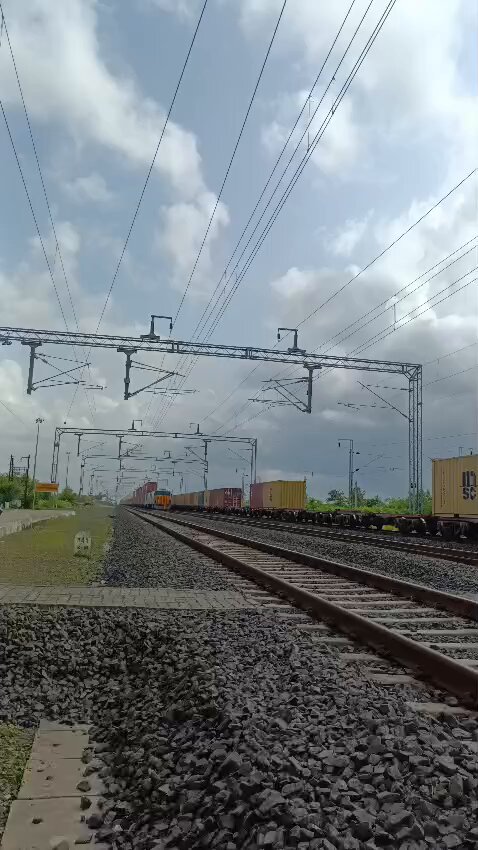
The Yongjin Railway, China's second electric traction double-stack container railway has started testing with a pair of push-pull HXD1B electric locomotives (7200kW or 9655 horsepower each) and a consist of double-stack high cube shipping containers in wellcars. Video by SS-287.
115,490 просмотров • 2 лет назад •via X (Twitter)

Комментарии: 9

Фото профиля Alan Fisher
Alan Fisher2 лет назад

I was told by American Class 1 Railroads that this was impossible

Фото профиля Matthew Bradfield
Matthew Bradfield2 лет назад

@RM_Transit Repost this to scare @CSX

Фото профиля Komi 민주당 🇺🇸🇩🇪🇲🇽🇨🇦🌹
Komi 민주당 🇺🇸🇩🇪🇲🇽🇨🇦🌹2 лет назад

American rail companies tremble

Фото профиля Nicolas Blume 🚂🚃 🇺🇦#standwithukraine
Nicolas Blume 🚂🚃 🇺🇦#standwithukraine2 лет назад

Americans: what is this dark magic?

Фото профиля Charles Kaneb
Charles Kaneb2 лет назад

HXD1B is the translation for "GG1"

Фото профиля Orrkid1
Orrkid12 лет назад

China's high speed rail network: US high speed rail network: - oops does not exist

Фото профиля Lucas Andrade Nunes
Lucas Andrade Nunes2 лет назад

American Class I be like: this is AI generator video...

Фото профиля Troels Halken 🇪🇺🇺🇦🇵🇸
Troels Halken 🇪🇺🇺🇦🇵🇸2 лет назад

@RM_Transit

Фото профиля Troels Halken 🇪🇺🇺🇦🇵🇸
Troels Halken 🇪🇺🇺🇦🇵🇸2 лет назад

@ChittiMarco

Похожие видео

"Art in Embassies" is part of global human trafficking network and how many of trafficking victims are transported around the world from this diabolical cabal. Interestingly, Diddy's house in LA was next to the container shipping port. and also has an island right across from another major shipping container port outside of Miami. There is a notable TikTok video where a user speculated about Diddy's proximity to shipping containers on Dodge Island, close to his Star Island property in Miami. This proximity led to claims that this might have been used for sex trafficking operations. Many sources have suggested that prosecutors might be interested in networks beyond just Diddy, possibly involving his connections or properties, although these are based on hearsay rather than fact. Human trafficking remains one of the most egregious violations of human rights globally, often involving the exploitation of individuals for labor or sexual servitude. Two less commonly discussed but significant vectors for this crime are the use of shipping containers and the art industry as a cover for trafficking activities, particularly child trafficking. Shipping containers provide a relatively low-risk method for traffickers to move people across international borders. These containers can be sealed, making it difficult for authorities to detect human cargo, especially when mixed with legitimate goods. Safety and Health Risks: The conditions inside these containers are often horrific, with victims facing extreme temperatures, lack of oxygen, and no sanitation, leading to significant health risks or even death. 2017 San Antonio Incident: In San Antonio, Texas, ten people died after being smuggled in a truck container, highlighting the dangers of such smuggling methods. 2003 Chinese Smuggling: Chinese nationals were discovered in a hard-top shipping container in Los Angeles, pointing to the use of these containers by organized crime for human smuggling. 2024 Wexford Case: In Ireland, 14 people were found in a shipping container at Rosslare Europort, triggering a human trafficking investigation. Efforts like the Container Control Program by UNODC and WCO aim to minimize the use of containers for illicit activities, including human trafficking. Proposals for using natural acids to detect human presence in containers have been explored, focusing on organic compounds like pyruvic and lactic acid. The art world's opaqueness, especially in transactions involving high-value pieces, can be exploited to mask human trafficking. Art can be used to launder money or to transport individuals under the guise of art-related travel or work. Exhibits like "The Journey Against Sex Trafficking" in Vienna used shipping containers to visually narrate the plight of trafficking victims, simultaneously raising awareness and highlighting the issue's severity. High-profile art shows and installations have been utilized to educate the public about human trafficking, though not always directly linked to the art industry's role in trafficking. There are claims and discussions online about the Getty Museum potentially being involved in child trafficking, leveraging its status as an art institution. The intertwining of human trafficking with shipping containers and the art industry highlights the adaptability of criminal networks in exploiting various sectors for illicit activities. While there are documented cases of human smuggling via shipping containers, the use of the art industry as a cover for trafficking is less substantiated but theoretically plausible given the industry's financial opacity and global reach. Tackling these issues requires: Enhanced vigilance at ports and within the art market. Better international cooperation and intelligence sharing. Public awareness to counteract myths while focusing on real threats. The complexity of these issues demands a nuanced approach that includes law enforcement, technological innovation for detection, and public education to address both the smuggling through containers and the potential misuse of the art world for trafficking. One thing for sure is that all human/child trafficking in any way, shape, or form, needs to end now, and for good.

The SCIF

204,961 просмотров • 1 год назад

Seriously, what a sour grape. I've spent the summer in Djibouti, and my observations and conversations with locals contradict everything you've said. While in Djibouti, I stopped at Ali Sabieh station, a minor station along the Addis Ababa-Djibouti railway that serves as a flagship project of China's Belt and Road Initiative and links landlocked Ethiopia with coastal Djibouti. It is Africa's first electrified trans-boundary railway. (Video 1, Picture 2) Manager of the Ali Sabieh passenger station, 32-year-old Souleiman Youssouf Ahmed, told me that the railway has greatly improved the safety and convenience of travel between Djibouti and Ethiopia. (Picture 3) According to Souleiman, Djiboutians flock to the Ethiopian city of Dire Dawa throughout the summer to escape the stifling heat. Minibuses were the only option from Dire Dawa to Ali Sabieh before the railway construction. While only designed to hold ten people, the minibus was frequently crammed with twenty. The minibus shared the road with the freight trucks; accidents were common. "The train cuts travel time by two hours while also providing passengers with the added bonuses of comfort and security. At its peak in the summer, the train has carried as many as 950 passengers in a single day," said Souleiman. Fatouma Houssein Daher, a Djiboutian girl who frequently takes the train to Ethiopia, expressed her appreciation for the railway, saying that it represents the friendship between China and Africa. "Taking the train to Ethiopia is a low-cost and comfortable option. It's lovely that the Chinese have helped us create our railway," she said. She added that she didn't understand why Western nations consistently disparage the railway that has made life easier for Djiboutians. Since it was put into operation in January 2018, the railway has seen 1,824 passenger trains pass through carrying nearly 530,900 people and 6,133 cargo trains with about 7,328,500 tonnes of goods. It has also cut the transportation time for goods from more than three days to less than 20 hours and reduced the cost by at least one third, substantially facilitating imports and exports from Ethiopia, a landlocked country in the Horn of Africa. So far, the Ethiopia-Djibouti railway has created 55,000 jobs in Ethiopia and Djibouti and provided training opportunities for more than 3,000 professionals, laying a solid foundation for the development of the railway industry in the two countries.

Eivor

19,217 просмотров • 2 лет назад

This video was shot by a train driver in Zimbabwe to show the decomposed railway system that now exists. Zimbabwe had one of the best railway systems in the world before independence, it competed with the British Railway system and its signals system was ahead of the British system. It was all destroyed under ZANUPF, there are no more regular passenger trains in Zimbabwe. The National Railways of Zimbabwe is run by the Government. Incompetent relatives and friends of ZANUPF politicians have been appointed as managers and directors, and they ran the company into the ground. The destruction of the railway system has made doing business in Zimbabwe expensive, but the ZANUPF politicians don’t care because they own transport companies that now move goods. Sadly, the last colonial ruler, Ian Smith, made a prophecy in 1980 which, at the time, was deemed racist. He said that under ZANUPF, using the railway system would be deemed dangerous, leading to the abandonment of railway services due to corruption and incompetence. That is exactly what happened. If Smith could talk, he would say, 'I told you so.' When I write about these things, I am called a Western puppet by ZANUPF, yet I am only calling for a return to normalcy that will benefit ALL Zimbabweans! No country succeeds economically without a railway system, destroying the railway system is one of the most UNPATRIOTIC things ZANUPF has ever done! What is patriotic about running a country without a decent railway system and making your country a laughing stock due to tragic failures caused by your corruption and incompetence? The board for the National Railways of Zimbabwe is chaired by ZANUPF politician Mike Madiro. President Emmerson Mnangagwa also appointed 82-year-old ZANUPF politician Tshinga Dube to the board. Before Madiro, the board was chaired by another ZANUPF politician, Martin Dinha. All they do is loot and pillage state enterprises. That is Zimbabwe’s story under ZANUPF, and the evidence is below in this video!

Hopewell Chin’ono

191,764 просмотров • 2 лет назад