Video yükleniyor...

Video Yüklenemedi

Ana Sayfaya Dön

This 3D chart visualizes how adjusting Jupiter’s impact scalar and base fee (a bivariate approach) influences order costs on Jupiter vs. Binance. The objective function axis reflects this cost difference across various SOL trade sizes. Valleys represent optimal combinations where Jupiter is most competitive. By analyzing this visualization, Jupiter...

11,419 görüntüleme • 2 yıl önce •via X (Twitter)

0 Yorum

Yorum bulunmuyor

Orijinal gönderinin yorumları burada görünecek

Benzer Videolar

I took this lesson a few days ago,one of the clearest breakdowns of how Jupiter Swap works. Let me walk you through it. So first,what even IS a Swap? Think of it like Spot Trading in traditional finance. You’re just trading one currency for another at the current market rate, except here it’s digital assets. USDC for SOL. Instant. On-chain. Simple enough. But here’s where it gets interesting…... The moment you go to swap, Jupiter doesn’t just grab the first price it sees,it aggregates liquidity from major sources. That's where Ultra V3 kicks in — think of it like an institutional trading desk firing up behind the scenes. It scans the ENTIRE market, aggregates liquidity from every major source, and routes your trade through the most efficient path possible. You’re not just getting A price for your trade. You’re getting THE best price. But it doesn’t stop there….. 🎯 Real-Time Slippage Estimation (RTSE) is running simultaneously — monitoring slippage live so your swap tolerance stays as tight as possible. No surprises. No overpaying. And on qualifying pairs? Jupiter covers the gas entirely. You just swap. That’s the Gasless feature, look for the icon when you’re executing. 📚 Two concepts you need to understand 💧 Liquidity —> How deep the market is. Deep liquidity means you can make large trades without moving the price against yourself. Jupiter taps the deepest pools on the network. 📉 Slippage —> The gap between what you were quoted and what you actually get. Volatile markets cause this. Ultra V3’s RTSE exists specifically to close that gap. ━━━━━━━━━━━━━━━ 🚀 Ready to swap? Here’s all you do ━━━━━━━━━━━━━━━ 1️⃣ Open the Trade tab → pick your Sell & Buy assets 2️⃣ Check the Execution Path — Jupiter shows you exactly how it’s routing your trade 3️⃣ Spot the Gasless icon if it applies 4️⃣ Hit Swap. Done. On-chain in seconds. And this is why the saying exists — If you want to swap smarter, Just Use Jupiter.

Sam || Jupiter Legion 😺😺

34,526 görüntüleme • 6 ay önce

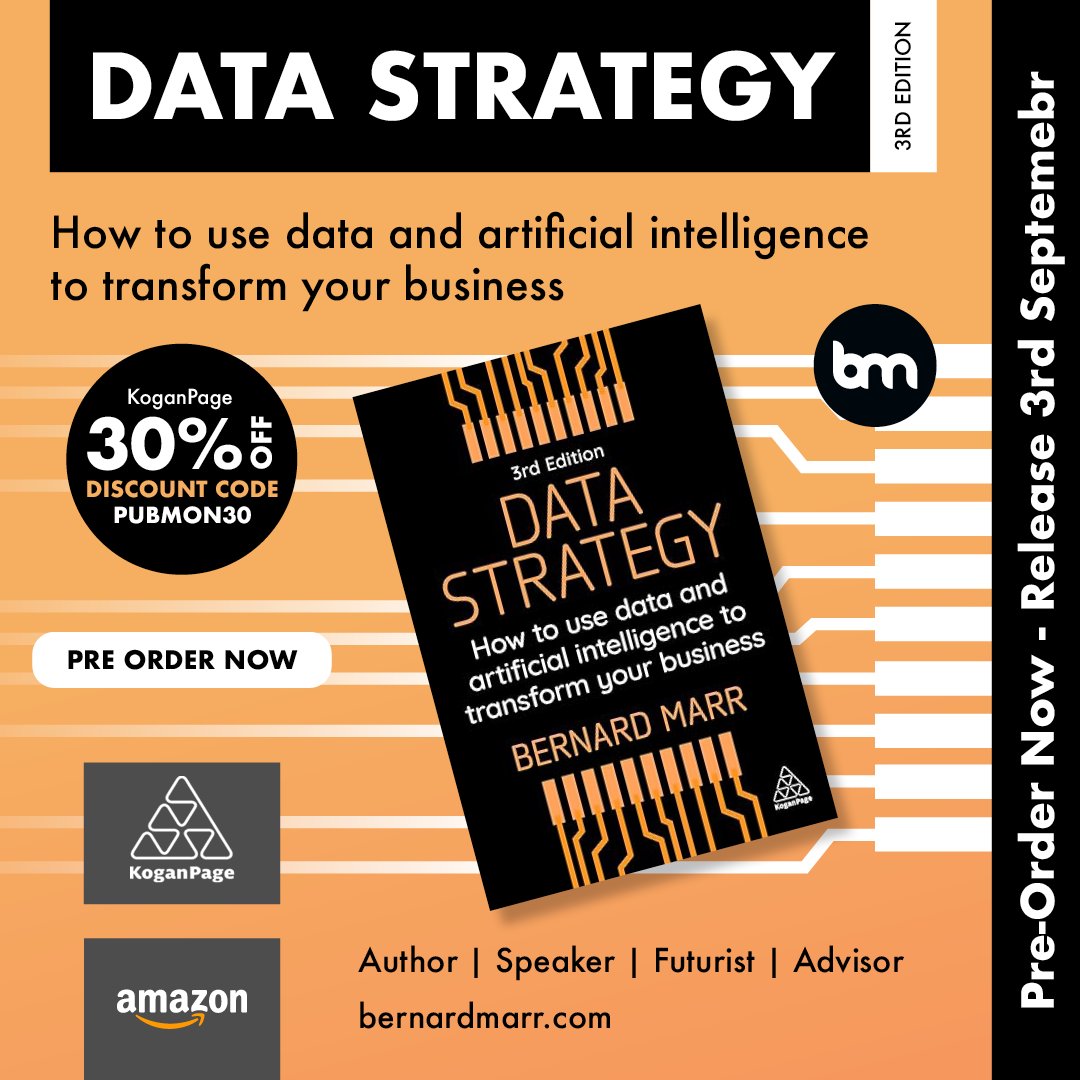
🚀 My New Book is Here: Data Strategy (3rd Edition) 🚀 I’m thrilled to share the release of my latest bestselling book, Data Strategy: How to Use Data and Artificial Intelligence to Transform Your Business. Every business today needs data to survive - but simply having data is not enough. What matters is how you use it. A well-designed data strategy is the key to unlocking value, driving insights, and giving your organisation the competitive edge it needs to thrive in the digital economy. From small organisations to global enterprises, I’ve seen first-hand how a data-driven approach can transform operations, improve decision-making, and unlock entirely new opportunities. That’s why I’ve poured my experience into this book — to help leaders and teams build strategies that don’t just talk about data, but actually deliver measurable impact. 🔍 In this third edition, I’ve expanded the book to reflect the latest developments in data and AI, including: ✅ Generative AI and its role in shaping business innovation. ✅ Synthetic data and how it can accelerate AI adoption. ✅ The potential of quantum computing and what it means for the future of data. ✅ Expanded guidance on cybersecurity, regulations, and ethics in a data-driven world. This isn’t just a theoretical framework - it’s a practical guide to collecting, managing, and using data effectively in order to drive growth, innovation, and long-term success. Whether you’re leading a start-up or a multinational, Data Strategy will equip you with the tools you need to stay ahead in a rapidly evolving landscape. 📖 Pre-order your copy today: 👉 Amazon - 👉 Kogan Page - I can’t wait to hear how this book helps you craft your own data-driven strategy and transform your business for the future.

Bernard Marr

10,980 görüntüleme • 1 yıl önce

I found 6 free Polymarket trading bots on GitHub for 6 different trading situations… Each of these repos comes with a detailed step by step setup and usage guide in English. > Easy 5 min setup 1. This bot includes 118 ready to use trading strategies and tools for prediction markets (Binance-Polymarket latency, Penny Clipper, DCA bots, Smart Routing and more). Additionally, it can trade autonomously across hundreds of different markets on major prediction platforms, DEXs and EVM chains. You can see this bot in action in the demo below. 2. A huge trading bot toolkit that includes Polymarket-Kalshi arbitrage, general arbitrage, copy trading, whale tracking, sports arbitrage, spread farming and more. 3. A weather trading bot that collects the latest temperature data from different sources (forecasts, public airport data and aviation observations like METAR) to generate a detailed weather report for a specific city and day. > Advanced setup 4. This bot can automatically manage all your limit orders on Polymarket to maximize liquidity rewards. 5. A trader behavior analysis bot that finds repeated patterns in his trades, shows which strategies he uses and helps you understand how to adapt them to your own trading. 6. A trading bot with a Smart Money strategy - it finds the best pnl traders in selected markets, filters them by win rate and consistency, and then creates a list for automated copy trading. All of these bots also support dry run mode, so you can test them on real markets but without risking any finds.

Recogard

17,196 görüntüleme • 27 gün önce

There has been a lot of hand wringing on the appropriate valuation of SpaceX. Some large institutions believe SpaceX can only be valued at half what the market seems to be willing to pay for it. Others are claiming it has 15X appreciation ahead of it. Almost all of this difference of opinion comes down to how comfortable you are modeling beyond 2030 and what valuation method you use. 2030 valuation using a traditional Gordan DCF produces a very different result than a 2040 EV/EBITDA Multiple. Both have pros and cons. Most analysts don’t really discuss this and lead with a headline number. We are very comfortable modeling out to 2040, as large portions of what SpaceX is proposing is real world infrastructure, which provides modelable physics constraints to anchor against. The analysis we released today explores this in-depth, its open to the public all the way through IPO. I highly encourage you check it out prior to then. We’ve run 5,000 monte carlo runs across 500 variables (real number, even though it sounds fake) and three valuation methods. This video is of a 3D cloud chart showing every simulation outcome expected in valuation output across two of the most impactful variables to the model when using an EV/EBITDA multiple from 2026 to 2040. The horizontal axis is the steepness of the orbital data center demand S-curve. The vertical axis is the rate at which chip compute efficiency becomes cheaper. Each of the 5,000 dots is one simulated future; green dots are the ones where SpaceX's 2040 value clears the $1.77T IPO line, over time. Under EV/EBITDA valuation through 2040, 96% of our simulated futures clear the expected IPO price once the bell rings Friday. We aren’t publishing this publicly to tell investors what the stock is worth, we’re publishing this to help investors understand the world of outcomes, what the fundamentals suggest through 2040, and what frankly most analysis simply won’t share. SpaceX is a generational company working on long term infrastructure harnessing a domain no one has been able to tap in so far: space. It deserves doing the work as an investor. because this in not financial advice. The cleanest way to hold SpaceX is a bond stapled to a call option (AI-Compute); Starlink is the bond, the near term SatCom annuity that funds the next flywheel. Understand the world of outcomes and take your position accordingly. Comparables and P/E won't take you far enough.

Aaron Burnett

1,521,934 görüntüleme • 4 ay önce

TOTAL #RWA VALUE HIT A NEW ATH OF $18.18B 🚨 As more institutions are jumping onboard, there's a talk that RWA sector could baloon to $16T by 2030. Many dont realize yet but it will become abundantly clear that 2025 is the year of tokenization, and we’re on the brink of an RWA Supercycle. At the core of this revolution, Brickken stands out as a key player in shaping the future of real-world asset tokenization I believe RWA szn is coming, I’m strategically positioning myself with Brickken, which just hit another record breaking milestone of $14M+ TVL, marking a 7.5% surge this week and reinforcing its dominance in real-world asset tokenization. 📊 Breaking Down Brickken’s TVL Rankings by chain: 🔹 #36 in the Overall RWA Category 🔹 #2 on Binance Smart Chain (BSC) 🔹 #7 on Base – 🔹 #24 on Ethereum Brickken’s dominance is expanding across multiple chains, showcasing widespread adoption and rising demand. With TVL growth accelerating, more assets are being tokenized and secured on its platform. The increasing $BKN staked in the Perpetual Staking Vault highlights strong community confidence and long-term commitment, while its market-validated TVL reflects the growing demand for secure, transparent, and efficient RWA tokenization. You might find these interesting: 🔗 Track Brickken’s TVL on DeFiLlama: 🔗 Learn How TVL is Calculated: 🔗 Tokenization Tracker: 🔗 Brickken Birthday Campaigns: 🔗 Join the Brickken Telegram Community: #Brickken #RWA #Tokenization #BKN

Aein

27,045 görüntüleme • 1 yıl önce

$IREN "we haven't disclosed the specific amount of GPUs" 1. 🤮 reminds me of $NBIS 2. Setting a terrible precedent here for future deals 3. Making it purposely difficult, to not let analysts properly value your 2027 revenue 4. Increasing the polarized view on IREN by the market However: "approximately 60MW of air-cooled Blackwells" 1. You typically don't talk about gross capacity in a deployment like this 2. If it would be gross capacity, the GPU hour rate at IT level would be crazy high (at PUE 1.2, $680m / 50 = 13.6m/MW) 3. At 60MW IT load, and ~14kW draw at DGX server level, we can get to ~4,286 DGX systems with 8 GPUs per. 4. Based on this we can conclude that 60MW of IT load can run approximately 34k DGX B300. 5. 34k DGX B300 at $680m/yr, would represent a GPU hour price of $2.28 Now this is the problem with not disclosing your GPU quantity. You purposely make your business model look bad, because by approach, you get to a GPU hour price that would imply a payback period of 4 years, where only the last year of the contract is 100% margin. But of course, we can also take "the glass is half full" approach. IREN has ordered 50K B300s from Dell. They have 2 purchase orders for this, 1 between Dell Canada and IE CA Leasing Ltd for 4 phases, and 1 between Dell USA and IE US Hardware 1 Inc (amended from IE US Hardware 4 Inc on April 27, 2026). The order for Canada is divided in 4 phases, and are going to Mackenzie for 80MW of gross capacity, which happens to be 4 buildings of 20MW. The order for Childress is divided in 2 phases, and are going to DC35 and DC36, (as depicted in the earnings presentation) and those are 50MW gross. The purchase price of the order for Childress was $1.2B, and for Canada it was $2.3B If we go with 50,000 B300s for a total of $3.5B then $1.2 would represent 34.285% of the 50,000 GPUs, or 17,140 B300s rounded down. For this calculation I will consider that $IREN will deploy 17,140 GPUs in 50MW gross capacity in DC35 and DC36 of block 3 in Childress.. That would imply at 1.2 PUE, IREN can run 17,140 B300s in 41.67MW IT load. Now by that ratio, they can run 24,680 GPUs in 60MW IT load — a massive difference with 34k units through the Nvidia DGX reference calculation. If common sense is applied, you can still get to 2 completely different outcomes, that show a difference of more than 9k GPUs. The GPU hour rate at 24.68k GPUs would be $3.145 per B300, as MASSIVE difference from the earlier calculated $2.28. Sure, the DGX system may be a factor here. And I'm sure that the reality is somewhere in the middle. But I personally hate this as an investor, to be unable to calculate profitability on unit economic basis. After all, contracts are signed on a $/GPU hour basis. Why hide this from your investors? Not being able to calculate payback periods, unable to calculate ROIC. And most importantly, we cannot properly assess the $NVDA deal on a contract basis. I really hope the payback period of this contract is not 4 years. I want the glass to be half full, but by starting to censor the purchases, IREN is taking a step in the wrong direction. Not a fan of this.

Frans Bakker

148,167 görüntüleme • 5 ay önce

Canton Network vs. Ethereum: What's the Difference? Ethereum (Ethereum) is a general-purpose public blockchain where transactions and smart contract activity are broadly visible across the network. Validators use proof-of-stake to agree on the chain’s state. Canton Network (Canton Network) takes a different approach, focusing on privacy, interoperability, and institutional financial workflows. Here are the key differences: (1) Privacy Ethereum is transparent by design. Addresses, balances, transactions, contract calls, and events can generally be inspected publicly. Ethereum is now researching additional privacy technologies, including private reads, private transactions, and zero-knowledge proofs. Canton uses sub-transaction-level privacy. Participants only receive the transaction data relevant to them, while sensitive information is shared on a need-to-know basis. (2) Network Structure Ethereum operates as a public blockchain with a shared global state maintained by its network of nodes and validators, plus layer 2 networks that settle back to it. Canton is designed as a network of networks. Applications can operate across different participant nodes and synchronizers while remaining interoperable, connected through the public Global Synchronizer run by super validators. (3) Consensus Ethereum’s proof-of-stake system uses validators to propose and attest to blocks, with validators staking ETH to participate in network security. Canton separates transaction validation from transaction ordering and confirmation. The participants involved in a transaction validate the relevant smart contract state, while synchronizers coordinate ordering and commits. (4) Smart Contracts Ethereum uses the Ethereum Virtual Machine, allowing developers to deploy programmable smart contracts across a broad public ecosystem. Canton uses Daml-based smart contracts and gives applications control over privacy, governance, permissions, and operating policies. This makes Canton particularly suited to workflows where different institutions need to interact without exposing every transaction to the entire network. (5) Main Use Cases Ethereum has developed into a broad platform for DeFi, NFTs, stablecoins, decentralized applications, and other permissionless applications. Canton is focused heavily on financial infrastructure, including tokenized assets, payments, institutional markets, and workflows requiring confidentiality. So, Ethereum emphasizes public verification and permissionless composability, while Canton emphasizes privacy-preserving interoperability between institutions on a public network.

BSCN

27,469 görüntüleme • 12 gün önce

Claude and a free weather API will earn you $100k+. Success rate for beginners: 80%. Complete guide and algorithm for building Polymarket weather trading bot. Simple logic, a low entry budget and high ROI -that’s why weather bots are so clean. Onchain proof these bots exist: 1st bot: 2nd bot: I verified their profitability by myself copying every trade - each bot's win rate over time ranges from 80 to 90%. I grew my starting capital by +40% in just one week. You can copy their trades and see for yourself in two clicks through this bot: The alpha is simple: you're not trading weather. You're trading other people's ignorance. Gap between what the crowd prices and what 51 ensemble models say. Polymarket asks: "Will Atlanta hit 95°F tomorrow?" Normies bet on vibes. You bet on math. The core tool: Open-Meteo API. Free. No key needed. 51-model ensemble. Clean JSON. Cooked and ready. Update every 30 min. Hardcode your city coordinates - don't waste time on geocoding at runtime. This single endpoint beats most paid tools for what Polymarket actually needs. The edge in one sentence: Market is heavy on 16°C. Your 51-model ensemble points at 19°C. That's your trade. Find that gap systematically across every city market, every day - and you have a scanner. That's what separates consistent traders from gamblers. How to start: - Week 1: Open-Meteo + tropicaltidbits. Pick one city market. Track model vs market price daily. Don't trade yet — just watch where you'd have been right. - Weeks 2–3: Automate the pull. Log ensemble divergences. Build the scanner. - Week 4: Now you have an edge. Trade it. Most people want to skip to week 4. That's exactly why most people lose. Now you have the algorithm framework plus a complete guide to get started. All that's left is to actually do it. Bookmark this post so you can come back to it when you start building the bot.

cvxv666

50,799 görüntüleme • 6 ay önce

A year ago you couldn't trade oil perps onchain without wondering if the price you saw was real Now RWA perps just did $525B in volume in Q1 2026. Pyth Network 🔮 Pro is the reason exchanges can finally list them with confidence 🛢️ Already above all of 2025 combined Oil, metals, global equities, ETFs. All traded as perpetual markets across major exchanges But here's what most people miss These markets only work if the price data works Bad prices create bad markets. A gold perp needs different infrastructure than an $ETH perp. SPY, NVDA, TSLA all need feeds that can handle mark prices, funding rates, liquidations in real time 1/ REAL-TIME DATA THAT WORKS RWA perps need market data that is fast, broad, and legally usable across the full trading lifecycle Not just another oracle. Infrastructure that exchanges can actually build on Sub-second latency. One API for all asset classes. Full licensing 2/ 24/7 COVERAGE TradFi assets don't trade on blockchain schedules Pyth Pro runs 24/7 feeds for markets that traditionally close nights and weekends Continuous pricing. No gaps. No downtime This is how you bridge TradFi infrastructure into onchain derivatives 3/ THE UNLOCK RWA perps are becoming one of the breakout derivative categories Not because someone decided to list them. Because the rails finally exist to support them properly Most people see the volume number. What matters is the infrastructure that made it possible 🔮

DeFi Oracle 🔮

21,595 görüntüleme • 5 ay önce

🚨PHYSICS NEWS🚨: Gravity Leaves Its Mark on Quantum Interference in a Tabletop Setup 🧨 According to research published in *Physical Review Letters* on June 8, 2026 by physicists at the University of Tennessee at Knoxville, scientists have performed the first tabletop experiment to detect a gravitationally induced phase shift in quantum interference. Using a 50-kilometer fiber interferometer, they measured a tiny but clear effect of gravity on quantum wave interference with high precision. **Uniphics explains this result as a direct consequence of variable time flow caused by energy density gradients.** In Uniphics, gravity is not the curvature of spacetime. Instead, it arises from differences in energy density across the ξM-field. These gradients create regions where time flows at different rates — a concept described by the Maley factor (the ratio of time flow between two locations). When quantum waves (spin waves in the Uniphics framework) travel along two different paths in an interferometer, they experience slightly different time flows if one path is closer to Earth’s mass than the other. Because the phase of a quantum wave depends on how much time has passed along its path, even a tiny difference in time flow produces a measurable phase shift between the two arms of the interferometer. The University of Tennessee experiment detected exactly this kind of phase shift, confirming that gravity affects the relative timing of quantum waves in a way that can be measured in a controlled laboratory setting. This result aligns closely with Uniphics predictions. The experiment effectively measures how energy density gradients near Earth alter local time flow, which then imprints itself on the interference pattern of quantum states. It provides clean, tabletop evidence that gravity influences quantum systems through changes in time flow rather than through geometric curvature. The ability to observe this effect with such precision in a laboratory opens the door to testing gravitational effects on quantum coherence in controlled environments — something Uniphics expects to become increasingly important as we explore the deep connection between energy density, time flow, and quantum behavior. Could tabletop experiments like this eventually allow us to map energy density gradients with quantum precision and test the effects of modified time flow in different gravitational environments? **A Theory of Everything should be able to answer everything.** Uniphics Explained Simply PDF: Chapters 1–10 free: Grokipedia: #Uniphics #TheoryOfEverything #QuantumGravity #Interferometry #TabletopPhysics Grok xAI

Paul Maley

17,993 görüntüleme • 4 ay önce

A week ago Polymarket declared war on algorithms. They introduced a draconian 3.15% commission on 15-minute markets called Taker Fee. The goal was clear: kill latency arbitrageurs who take money faster than the site UI updates. The math is simple: if your glitch gives a 2% edge and the platform takes 3.15% commission you're bankrupt. 90% of bots shut down that same night. But this bot didn't just stay. It increased its deposit. Profile hidden from everyone: Yesterday it closed the day with $27K profit. I looked at its logs to understand how it bypasses expected value. The old method is dead Previously bots simply compared BTC price on Binance and Polymarket. Saw the difference bought waited 30 seconds. This gave small profit that is now eaten by commission. New mechanics This bot stopped looking at price. It looks at pain. It is connected to the Liquidation Stream of Bybit and OKX exchanges. Price moves linearly. Liquidations are explosive. When a cascade of liquidations triggers on futures with margin calls of $50M+ per second the BTC price makes an impulse move that lasts 3-4 seconds before pulling back. This movement exceeds 1-2%. The essence The bot sees stop triggers on derivatives -> calculates impulse strength -> if Impulse > 3.15% Commission -> Enters the trade. While other bots filter market noise this script eats the corpses of margin traders from external exchanges. It doesn't care about direction. It cares about the amplitude of market pain. Result $205K net per month While you complain about commissions and unfair conditions the code adapted in 48 hours. No predictions. No AI. Just parasitizing on volatility of other people's mistakes. Right now this is the only working vector on 15-minute markets. A 3% commission is not scary if you take a 6% move. The nickname is a set of symbols. No avatar. It doesn't need fame it needs liquidity.

Blaze

91,850 görüntüleme • 9 ay önce

What does the U.S. expect from Cuba, why now, and who is next? The "Donroe Doctrine," as interpreted by Reuters, is the operational logic of a return to U.S. dominance in the Western Hemisphere: Washington seeks to control key energy and trade flows, push out competitors (primarily China, as well as Russia and Iran), and discipline its neighbors. ▪️ Cuba is a demonstration of the Donroe approach. President Trump is "pressuring Cuba" right now because a political moment has converged with Cuba’s technical vulnerability. Formally, the White House justifies its steps in the language of national security: Cuba is declared an "extraordinary threat," and therefore a mechanism is launched to punish not only Havana but also third countries that supply it with oil. The key instrument is neither "classic sanctions" nor a direct blockade, but tariffs as quasi-secondary sanctions: if a country sells or supplies oil to Cuba, the United States may impose an additional ad valorem duty on that country’s exports to the American market. This creates an effect of "fear and uncertainty": suppliers do not want to risk access to the U.S. for the sake of the Cuban route. ▪️ Why this is happening now is no coincidence. After Venezuelan oil supplies to Cuba were halted, Mexico is explicitly described as the main supplier, and the United States is attempting to "cut off" this very node and create an energy crisis on the island. The goal here is not simply to "punish," but to break the state’s ability to function and push the leadership toward concessions - or toward collapse. Domestic political interests in the U.S. also matter. A hardline policy toward Cuba has traditionally delivered electoral and symbolic returns among "hardline" circles in the United States, particularly in environments where Cuba is a marker of the struggle against "communist regimes." ▪️ Who could benefit from this? The most direct benefit is political: President Trump’s team and allied "hawks," who gain the opportunity to demonstrate results. The subjugation of Cuba is also a geopolitical signal to the region: the United States is demonstrating that it is prepared to discipline supply chains in the Western Hemisphere and punish partners with tariffs for "incorrect" cooperation. ▪️ Following President Trump’s "Cuban logic," it becomes clearer who might come after Cuba. The Donroe logic typically does not search abstractly for the "next enemy"; it looks either for target regimes where trade and economic tools are already available and a crisis can be created quickly, or for hub states through which regional behavior can be conveniently managed. • Nicaragua appears to be the most "structurally" suitable next target: a tariff and trade campaign (Section 301 and phased-in tariffs) has already been launched against it. • Parallel cases such as Haiti are also possible, though a different approach may be used there - not "breaking the regime," but managing the country’s political transition through signals to elites. • Colombia should also be concerned, as threats and hints of forceful options have been voiced regarding it. • Finally, Mexico, which is systematically under pressure to "align" with the American regional agenda.

Anton Gerashchenko

119,330 görüntüleme • 8 ay önce

What is Pi App Studio’s New creation Pricing Model? Pi Network (Pi Network) has announced a major change to how creators will pay to build and edit apps through Pi App Studio, with the new pricing taking effect on August 24, 2026. Until now, Pi heavily subsidized App Studio for all creators. Under the introductory model, creators paid just 0.25 Pi to create an app and another 0.25 Pi to edit one. But Pi says the actual cost of providing AI-powered app creation is significantly higher than what creators were paying. That means Pi Network has been covering much of the difference. Now, after collecting data on how creators use App Studio, Pi is changing that approach. So, what exactly is changing? (1) Standard App Studio pricing is coming From August 24, creators will face a standard creation and editing price that more closely reflects the underlying cost of the AI services used. The exact price will not necessarily be fixed. Pi says it may vary depending on the resources required to create or edit an app. Importantly, Pi says it will not add a markup to the underlying AI service costs. (2) Some creators can still receive subsidized pricing The biggest change is that Pi is not completely removing its subsidies. Instead, subsidies will become more selective. Creators whose apps attract a sufficient number of real users can continue receiving the previous subsidized pricing. The focus will be on apps demonstrating genuine utility and usage from distinct users, rather than activity generated by the creator alone. (3) Pi wants creators to build useful apps This is arguably the most important part of the new model. Pi says not every app created through App Studio becomes something that other people actually use. Some apps are created simply for experimentation, testing or potentially spam. Continuing to subsidize every creation equally could therefore consume significant network resources without producing meaningful utility. The new model is designed to change that incentive. Creators now have a stronger reason to build apps that solve problems, attract users and provide value to the Pi ecosystem. (4) Subsidized pricing is not permanent or guaranteed Qualifying for the subsidy will not be a one-time decision. Pi plans to regularly review creator eligibility using newly generated data. A creator who does not qualify when the new pricing model launches could qualify later if their app attracts more genuine users. Likewise, the qualification criteria, pricing structure and number of creator tiers could change as App Studio develops. (5) Existing creators have a short window to improve The new pricing model begins on August 24, 2026. Before then, existing creators can improve their apps and encourage more Pioneers to use them. Pi specifically recommends improving an app's usefulness and usability, collecting feedback and continuing to build products that solve real problems. Pi wants its resources going toward apps that people actually use. At its core, the change turns App Studio from a broadly subsidized experimentation tool into a more usage-driven ecosystem.

BSCN

28,165 görüntüleme • 1 ay önce