正在加载视频...

视频加载失败

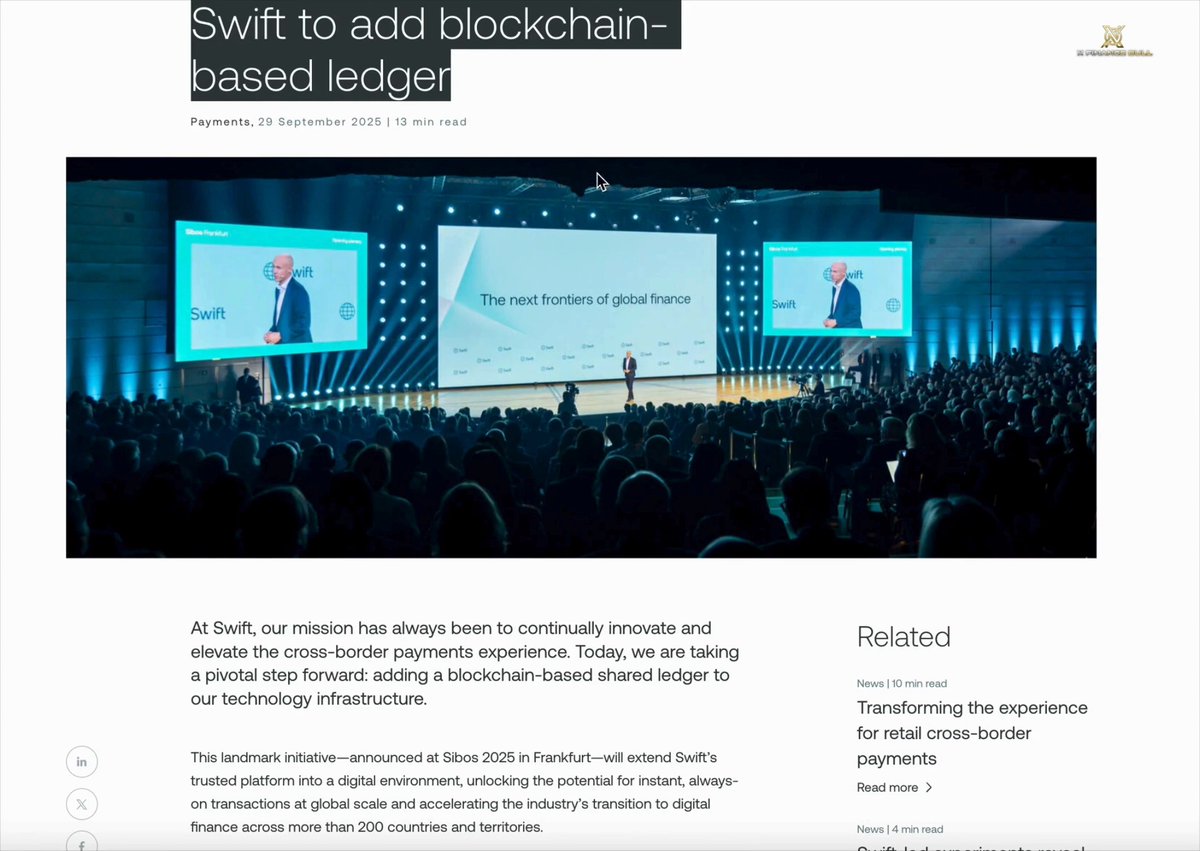
🚨🔥 This Changes Everything For The XRP Ledger. The SEC introduces "innovation exemption" that would allow tokenized versions of stocks like Apple and Nvidia to trade around the clock on blockchain platforms without full registration. The plan is championed by SEC Chair Paul Atkins(who praised Ripple after SEC win),...

108,681 次观看 • 1 个月前 •via X (Twitter)

0 条评论

暂无评论

原始帖子的评论将显示在这里

相关视频

DTCC is leading the adoption of the new financial system, and I’m getting even more bullish on $XLM, $XRP, $HBAR and $QNT. Understand what’s happening here. DTCC isn’t building tokenization around one chain or one form of digital cash. It wants institutions to choose how assets settle: Stablecoins. Tokenized deposits. Another tokenized asset. Even asset-for-asset settlement. That changes the game. DTCC’s depository subsidiary already custodies more than $114 trillion in assets, and its Tokenization Service is moving toward stocks, ETFs and U.S. Treasuries becoming programmable across multiple blockchain networks. Now look at the infrastructure already lining up around that future. $XLM This one has the direct connection. DTCC officially selected Stellar for its Tokenization Service, with DTC-tokenized assets expected on Stellar in the first half of 2027. Stellar already has stablecoins, native asset issuance, a DEX, liquidity pools and path payments. That means tokenized assets can potentially move directly against digital money instead of sitting idle. $XRP XRPL brings another piece: liquidity. CSD BR is already using XRPL with regulated BTG Pactual fund shares. And XRPL’s auto-bridging can route: Asset A → XRP → Asset B when XRP provides the better liquidity path. The more tokenized assets exist, the more valuable that becomes. $HBAR Hedera already has regulated tokenized funds, government securities, institutional collateral movements and stablecoin cash flows through Archax, Lloyds and Aberdeen. Real assets are already being used as working capital. $QNT Then comes the money layer. The Clearing House selected Quant to power interoperability and orchestration for U.S. tokenized bank deposits connected to RTP and CHIPS. So DTCC builds the digital assets. Banks build digital money. Quant connects the money. Stellar distributes assets. XRPL provides liquidity. Hedera handles institutional tokenization and collateral. I think we are watching separate pieces of the same financial machine being assembled. And it’s happening much FASTER NOW!

X Finance Bull

63,365 次观看 • 10 天前

🚨SEC OFFICIALLY GREENLIT TOKENIZED U.S. STOCK TRADING🚨 $XRP, $XLM and $HBAR have been building toward this moment for years. I went through the actual SEC order, and one detail changes how I look at all three. The SEC’s new five-year Innovation Exemption allows qualifying Tokenized Securities Venues to trade real tokenized U.S. stocks through permissioned AMMs and liquidity pools on public blockchains. These tokenized shares must preserve the rights of the underlying stock. But here is the part that matters for crypto. A tokenized U.S. stock can be paired with a non-security crypto asset. And the SEC specifically says the exemption does not limit which type of non-security crypto asset a venue can choose. Now go back six months. The SEC’s March interpretation explicitly listed: XRP XLM HBAR as examples of digital commodities. Read those two developments together. For the first time, I can look at a federal framework where a real tokenized U.S. stock and assets like XRP, XLM or HBAR can potentially exist on opposite sides of the same regulated onchain market. Think: Tokenized stock / XRP Tokenized stock / XLM Tokenized stock / HBAR The real opportunity is not a few network fees. It is liquidity. If a professional market maker supports one of those pools, it needs inventory of the paired asset. That is a completely different type of demand. And these three ecosystems have not been sitting around waiting for tokenization to arrive. Ripple and Aviva Investors are already exploring traditional fund tokenization on XRPL. XRPL has native trading infrastructure, AMMs, credentials, permissioning and tokenization tools. Stellar already hosts roughly $4B in tokenized assets, and DTCC/DTC plans to connect its tokenization service to Stellar, with Russell 1000 stocks, major ETFs and U.S. Treasuries among the asset classes being evaluated. Then Hedera already has Archax, with 100+ tokenized assets and $300M+ in value across names including Aberdeen, State Street, Fidelity International, Legal & General and BlackRock-related fund exposure. Lloyds Banking Group has already used tokenized assets on Hedera as collateral for FX activity. That is why this SEC move feels different to me. These networks spent years building the rails. Now U.S. regulation is starting to create an actual market structure where stocks can move onchain and non-security crypto assets can sit directly beside them as liquidity pairs. That is a much bigger story than “tokenization is bullish.” This is traditional securities liquidity and crypto liquidity beginning to meet. $XRP, $XLM and $HBAR are already standing at that intersection. Which digital commodity gets chosen for the first REAL tokenized-stock liquidity pair?

X Finance Bull

79,999 次观看 • 22 天前

BREAKING🚨 OVER $2 BILLION IN ELECTRICITY IS NOW TOKENIZED ON $XRP LEDGER. 👇 Not crypto. Not DeFi yield. Electricity. Real energy. Real economic value. ON XRP INFRASTRUCTURE Justoken turned real-world electricity production into digital financial assets living on XRPL. That's physical energy flowing through power grids being represented, traded, and settled on the same blockchain that powers XRP. This is why every XRP holder needs to understand what this means for token demand. Every single transaction on XRPL requires XRP for fees. Issuing tokens. Moving them. Trading them. Settling them. Managing them. Each action burns a fraction of XRP. $2B in tokenized electricity generates constant transactional demand. Every new account on XRPL requires XRP reserves. More companies. More brokers. More settlement accounts. More wallets holding tokenized energy. Each one locks XRP just to exist on the ledger. Every trust line requires XRP reserves. XRPL tokens operate through trust lines. Each trust line locks additional XRP. $2B in tokenized assets means thousands of trust lines. Thousands of XRP reserve requirements. As tokenized energy gets traded, financed, and settled, XRP sits at the center of liquidity routes. The native DEX on XRPL means these tokens can be exchanged through XRP as the bridge asset. Payment paths. Exchange routes. Settlement layers. All flowing through XRP. This is not a partnership announcement. This is $2 billion in real-world commodity value creating measurable, ongoing demand for XRP through network fees, account reserves, trust lines, and liquidity routing. The tokenization of assets on XRPL is the demand driver most people haven't modeled yet. Justoken just proved it at $2B scale. TRILLIONS COMING SOON

X Finance Bull

94,066 次观看 • 4 个月前

And so it begins. Ripple is building repo settlement directly on $XRP Ledger. Once you understand how big repo is, the XRP thesis gets insane. Repo sounds complicated, but the idea is simple. A bank or institution has a Treasury. Another party provides cash. The Treasury becomes collateral. Later, the cash plus interest comes back and the Treasury is returned. Now imagine doing that on XRPL where both sides settle together in one atomic transaction. No payment without collateral. No collateral without payment. That is exactly what XRPL Batch is designed to enable. And Ripple’s proposed On-Chain Cosigner goes even further. Different institutions, custodians, transfer agents and settlement participants can all authorize the same transaction directly on XRPL. Ripple’s product manager literally said: “We’re building repo settlement on XRPL.” And Ripple Custody is the immediate customer. This matters because repo is one of the biggest markets in finance. U.S. Treasury repo alone exceeds $8T in daily transaction volume. Tokenized repo infrastructure is already proving institutions will use blockchain at scale, with distributed-ledger repo activity already around $365B–$400B per day. Now Ripple is assembling its own stack: →Ripple Prime →Ripple Treasury →Ripple Custody →RLUSD →OUSG →XRPL Batch →On-Chain Cosigner →Collateral Mobility My bullish scenario? If only 5% of U.S. Treasury repo eventually settles through XRPL, that’s roughly $100T+ in annualized settlement turnover. And every repo lifecycle can create multiple XRPL interactions. This is bigger than putting assets onchain. It’s making trillion-dollar collateral markets move onchain repeatedly. That’s where things get wild for XRP. Is your $XRP bag ready for this? 👀

X Finance Bull

39,660 次观看 • 1 个月前

HOLY MOLY! 🚨 Ripple just plugged directly into the institutional tokenization pipeline in Asia-Pacific ripple:native holders need to understand how big this setup can become. Ripple Custody is now integrated with SettleMint’s Digital Asset Lifecycle Platform. A financial institution can use the combined system to issue an asset, apply compliance rules, secure it, distribute it, settle it and manage it through its entire life. Bonds. Funds. Equities. Cash. Real assets. Structured products. And the rollout has already started in Asia-Pacific. Here’s where ripple:native enters. Ripple Custody directly supports XRP Ledger and XRP. It can create XRPL issuer accounts, issue tokenized assets, manage trust lines, send XRP and trade XRP against issued assets through XRPL’s native DEX. Then add RLUSD as digital cash. The setup can become: institution → SettleMint → Ripple Custody → XRPL → tokenized asset + RLUSD + XRP liquidity And Ripple has another institutional door through Ripple Prime, already serving 300+ customers and clearing more than $3T annually. What catches my attention is the distribution. Ripple doesn’t have to convince every bank to build tokenization infrastructure from scratch anymore. SettleMint already gives them the lifecycle system. Ripple plugs custody and digital-asset infrastructure directly into it. The companies say the offering is intended to expand into other regulated markets globally. If more institutions choose XRPL for issuance, suddenly XRP is sitting beside a growing market of bonds, funds, stablecoins and other financial assets that all need liquidity. That’s where this gets VERY serious for ripple:native.

X Finance Bull

23,551 次观看 • 1 个月前

🚨 JUST IN: Everyone Knows #Ripple Prime Is In The DTCC Room. Almost Nobody Understands What It Actually Unlocks. The part almost nobody is connecting: what Ripple Prime being wired into DTCC's plumbing actually does for the $XRP Ledger. Here's the mechanism, step by step. → #Ripple Prime is now live on the NSCC directory under the identifier RIPL, as of June 2026. That means it clears trades on the same rails as every major Wall Street broker. → It's also a participant in FICC's Government Securities Division, giving it direct access to U.S. Treasury clearing, a market moving trillions daily. → DTCC's July service tokenizes real assets: Russell 1000 equities, major ETFs, and U.S. Treasuries. The official record of those tokenized securities stays inside DTCC. → But here's the bridge. Ripple has publicly stated Ripple Prime will migrate its post-trade activity onto the $XRP Ledger and use $RLUSD as collateral. So the picture becomes clear: The tokenized security lives in DTCC. The clearing happens on DTCC rails through Ripple Prime. And the post-trade settlement, collateral, and liquidity flows can move onto the XRP Ledger using RLUSD. DTCC doesn't need to build on #XRPL for XRP to matter. Ripple Prime is the doorway. Every institutional client it routes through DTCC is a potential flow onto the XRP Ledger. $114 trillion in assets sit inside DTCC. The SEC already authorized this service with a 3-year No-Action Letter in December 2025. And Ripple didn't wait to be invited. It acquired Hidden Road for $1.25 billion, rebranded it Ripple Prime, and wired it directly into the core of U.S. market infrastructure. While everyone argues about whether XRP is "in" DTCC, Ripple already built the on-ramp. The room was never the point. The doorway was. Liked what you just read? Follow RippleXity and never miss the $XRP deep links others overlook.

RippleXity

22,784 次观看 • 3 个月前

🚨 Ripple’s Next Big Move Could Be Tokenizing Oil On The XRP Ledger. Ripple’s Middle East & Africa MD Reece Merrick, right after Dubai Land Department’s Phase 2 launched controlled secondary trading of tokenized real estate on XRPL: “This is a massive step for real-world asset adoption in Dubai.” Dubai real estate now trading on-chain, on XRPL. Physical assets at scale in the oil capital of the world? Ripple’s Gulf footprint (verified partnerships only): • UAE → Zand Bank (AEDZ stablecoin + RLUSD custody/liquidity on XRPL rails) + Ctrl Alt/Dubai Land Dept (live real-estate tokenization + Ripple Custody) + DFSA license • Saudi Arabia → MoU with Jeel (Riyad Bank innovation arm) for cross-border payments, custody & RWA tokenization pilots • Bahrain → Strategic partnership with Bahrain Fintech Bay for tokenization PoCs, stablecoins, payments & fintech ecosystem build BlackRock is a major player and Larry Fink said that Tokenization is going to be the next big thing. At the same time, when asked about XRP, he said, “I can’t talk about it right now” and smirked. Ripple is the only crypto company that has entered the repo and mortgage market, and XRP/XRP ETF could be used as collateral in the markets in the near future. Also: UAE & India already executed a landmark crude oil trade settled entirely in local AED + INR currencies with RippleNet using XRP Ledger. Oil is the Gulf’s biggest physical asset. The infrastructure is already live. Next move? 👀⛽

Stellar Rippler🚀

35,856 次观看 • 6 个月前