Loading video...
Video Failed to Load
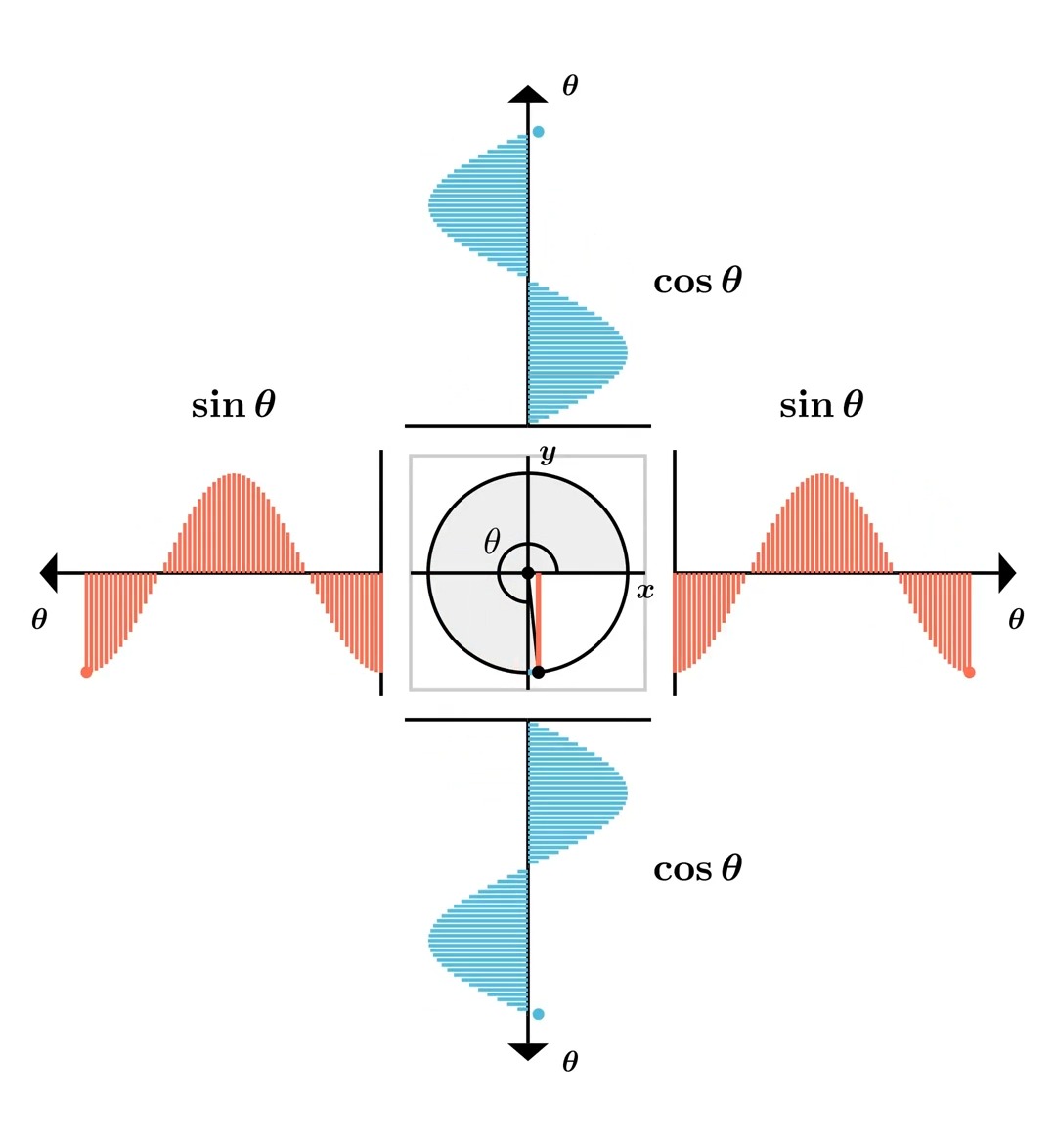
This is how a circle produces sine and cosine waves.

98,291 views • 3 months ago •via X (Twitter)
0 Comments
No comments available
Comments from the original post will appear here
Loading video...
98,291 views • 3 months ago •via X (Twitter)
No comments available
Comments from the original post will appear here




![Discrete Fourier Transform by hand ✍️ ~ 12 steps walkthrough below Here is a little-known secret about the DFT and the inverse DFT: it is just matrix multiplication in both directions, one the transpose of the other, exactly like the forward pass and backpropagation I drew in other examples. Goal: recover which cosine waves a signal is made of, using nothing but multiplication and addition. = 1. Given = Three signals written as sums of cosines, and a fourth, X, that we do not know yet. = 2. Frequency matrix F = Let us write the coefficients as a matrix. Each signal is a row, each frequency a column, so A = cos(w) + 2cos(2w) becomes [1, 2, 0, 0]. = 3. Sample the waves = We read the four cosine waves at ten discrete time points. That word "discrete" is the whole difference between this and the continuous transform. = 4. Cosine matrix W = Let us write those samples as a matrix: each frequency a row, each time point a column. = 5. Frequency to time = We multiply F by W. That combines the four cosine waves in the proportions F specifies, and the result T is the three signals as they would look in time. = 6. Transpose = Let us stand each signal up as a column. = 7. Time to frequency = We multiply W by that transpose. Every cell is the dot product of one signal with one cosine wave, which measures how much of that wave the signal contains. Zero means none of it. = 8. Scale = Let us multiply by 2/n, with n = 10. The projections come out five times too large, and this is the correction. = 9. Transpose back = We turn it back around, and it is F again, exactly. That is the check: the transform recovered the coefficients we started from. = 10. Now solve for X = Let us run the same multiplication on the one signal whose recipe we never knew. = 11. Scale = We divide by 5 again. = 12. Transpose back = And X reads [0, 0, 3, 2], which says X = 3cos(3w) + 2cos(4w). Note: I originally drew this to show that the DFT is a special case of a convolution layer, its filters fixed to sine and cosine waves rather than learned. No wonder, then, that a convolution layer free to learn its own filters can be trained to process signals. 💾 Save this post!](https://image.24vids.com/tw-2096604730453577857/ext_tw_video_thumb/2096604718290120705/pu/img/Uxa9xebSM4EBcEzP.jpg)
![Discrete Fourier Transform by hand ✍️ ~ 12 steps walkthrough below Here is a little-known secret about the DFT and the inverse DFT: it is just matrix multiplication in both directions, one the transpose of the other, exactly like the forward pass and backpropagation I drew in other examples. Goal: recover which cosine waves a signal is made of, using nothing but multiplication and addition. = 1. Given = Three signals written as sums of cosines, and a fourth, X, that we do not know yet. = 2. Frequency matrix F = Let us write the coefficients as a matrix. Each signal is a row, each frequency a column, so A = cos(w) + 2cos(2w) becomes [1, 2, 0, 0]. = 3. Sample the waves = We read the four cosine waves at ten discrete time points. That word "discrete" is the whole difference between this and the continuous transform. = 4. Cosine matrix W = Let us write those samples as a matrix: each frequency a row, each time point a column. = 5. Frequency to time = We multiply F by W. That combines the four cosine waves in the proportions F specifies, and the result T is the three signals as they would look in time. = 6. Transpose = Let us stand each signal up as a column. = 7. Time to frequency = We multiply W by that transpose. Every cell is the dot product of one signal with one cosine wave, which measures how much of that wave the signal contains. Zero means none of it. = 8. Scale = Let us multiply by 2/n, with n = 10. The projections come out five times too large, and this is the correction. = 9. Transpose back = We turn it back around, and it is F again, exactly. That is the check: the transform recovered the coefficients we started from. = 10. Now solve for X = Let us run the same multiplication on the one signal whose recipe we never knew. = 11. Scale = We divide by 5 again. = 12. Transpose back = And X reads [0, 0, 3, 2], which says X = 3cos(3w) + 2cos(4w). Note: I originally drew this to show that the DFT is a special case of a convolution layer, its filters fixed to sine and cosine waves rather than learned. No wonder, then, that a convolution layer free to learn its own filters can be trained to process signals. 💾 Save this post!](https://image.24vids.com/tw-2083194764485153128/ext_tw_video_thumb/2083194751193403393/pu/img/xPTCxxe0pHHx3B7I.jpg)

