Загрузка видео...

Не удалось загрузить видео

На главную

This is the future of interacting with information stored in databases. I want this on every interface that accesses data. ​ Imagine giving a smart agent access to your data. No explanation or documentation needed. The agent can immediately answer any questions in natural language. ​ It doesn't get...

83,752 просмотров • 1 год назад •via X (Twitter)

Комментарии: 10

Фото профиля Ben
Ben1 год назад

This looks like a great tool but I can't simply sign up or use SSO? Looks like I have to request a demo to get access.

Фото профиля Jaydeep
Jaydeep1 год назад

Nice demo, and I think this is a cool product. Querying a database in natural language would be a great way to quickly access and understand the data. However I'm wondering whats the best usecase for this in a real life scenario. 1/2

Фото профиля Arsalan
Arsalan1 год назад

This is mind blowing

Фото профиля Carlos Santiago Bañón
Carlos Santiago Bañón1 год назад

Oh wow!

Фото профиля Shawn Chauhan
Shawn Chauhan1 год назад

Absolutely incredible.

Фото профиля klosterf
klosterf1 год назад

At the end of the day, you always have to double check LLMs because of hallucinations. I don't know, I can't trust them if you are in a non toy project.

Фото профиля Simon P
Simon P1 год назад

The potential is huge! It's exciting to see how AI can make data accessible to everyone. #futureofdata

Фото профиля Soumik/soumik.eth
Soumik/soumik.eth1 год назад

Private minds aka llm mods are future

Фото профиля Tyler
Tyler1 год назад

Can’t help but feel Anthropic and/or OpenAI will be putting them out of business momentarily. This is a feature, and there’s no way the big guys aren’t already working on a highly polished version of this.

Фото профиля GPT.Biz
GPT.Biz1 год назад

This sounds like a game changer! Can't wait to see how it makes data access smoother and smarter.

Похожие видео

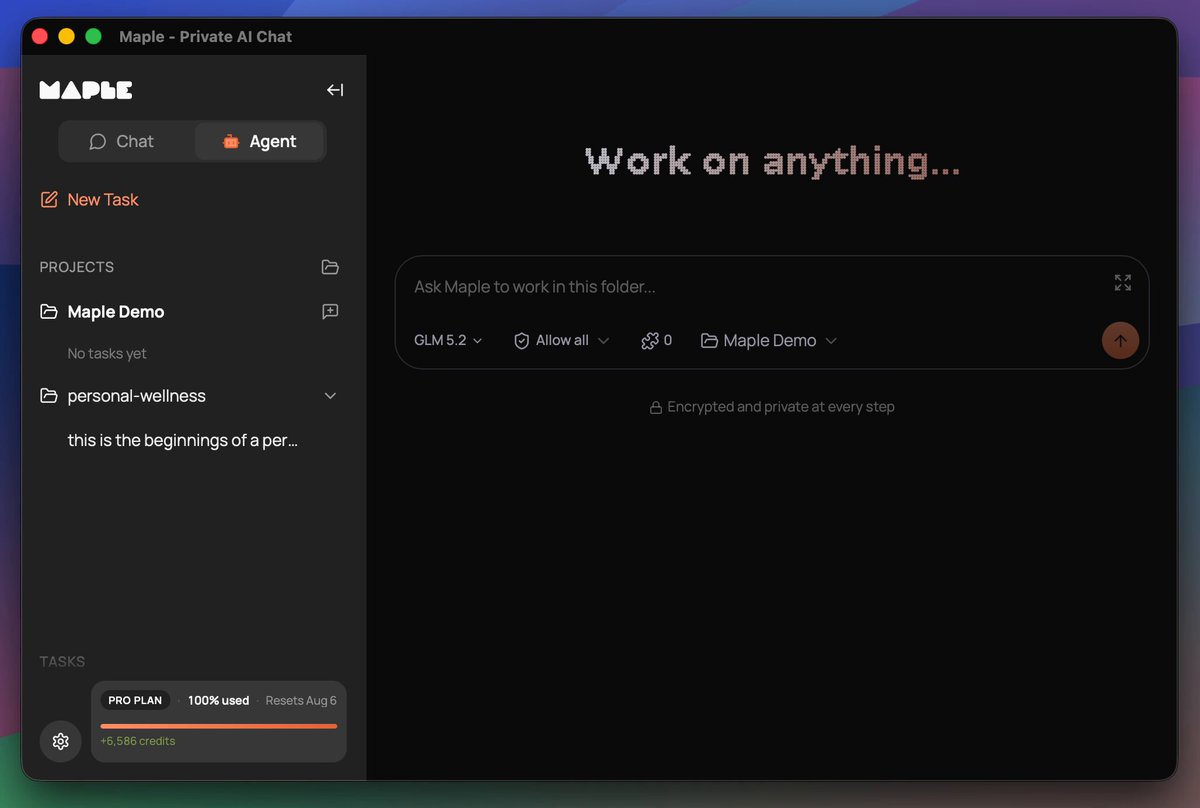
Maple is preparing for the release of a co-working agent. You install it locally and it works with your files, whether it's office work or building websites and apps. It's a turnkey solution, as easy as Claude Code, that keeps your data secure and private, no data sharing with closed AI labs. This is THE sovereign AI app for individuals and businesses who want powerful AI while retaining ownership of their information. Why build an agent into the Maple app when other agents already exist? Easy, we want to give you control over your work. We don't have a business plan that incorporates making money off our users' data. In the age of AI, your information, whether it's personal or company trade secrets, is the single thing that differentiates you from everyone else. We all have access to AI that can build a professional website for selling shoes. But your strategy and network for how you sell shoes should not be shared with your competitors. Sovereignty is the path to protecting what makes you, you. Maple sits at the intersection of Usability and Sovereignty. Maple gives you the best tools that are both easy to use and maintain your data sovereignty. Sovereign for one, sovereign for all. It has been a journey to get here. We brought to market the very first personal chatbot with end-to-end encryption using TEEs in late 2024. Prior to that there were proofs of concept but no full product offerings. Every other AI chat product on the market handled your data in plain text, either selling you a service to get your data or asking you to trust that they won't snoop on you. Quickly people found Maple and latched onto its open-source code and verifiable encryption. We didn't stop there. You may remember earlier this year we teased a product called "Maple Agent" and opened up a waiting list. That product is a mobile app that acts as your AI "friend", maintaining one long continuous chat, and getting to know you over time. I dislike using the word "friend" there, but it's the best way to convey the UX in a few words. AI is a tool, always has been, always will be. Any kind of friendly personality on top is just synthetic. In our testing, the UX of Maple Agent is really powerful for what it does. Think about the many short AI chats you have in your favorite app, whether it's looking up a historical fact or asking advice about a topic. With Maple Agent, those all go away in favor of the long-running chat with the friendly agent. It's like you have your own personal assistant who knows you so well and can look up anything for you. When I ask AI certain questions, I want to ask an expert who already understands my situation so I'm not repeating myself for the 100th time. That's the amazing value the personal agent brings to the table. We still see great utility for a personal agent like the "Maple Agent". Thousands of people on the waiting list, hoping to get their hands on it, agree that the concept is worth exploring and trying out. We were constrained in launching it due to a few circumstances, one of them being access to the scale of compute needed to power it. We have a clear path laid out for how to get there, but today is not the day to execute on that. It will be in the near future. Instead we have a different agent ready to go that we think is also incredible. We now have an agentic harness inside of the Maple Research app. This thing is a powerhouse. It even builds and publishes its own software releases. The agent in Maple Research works with your local filesystem, speaks to the largest open models running in TEEs, utilizes local models for certain tasks, is compatible with MCP tools, has an API for connecting to anything you need, and also supports the ACP protocol, which means it can be extended in the future to speak to other tools like Claude Code, Codex, and local models running on your own hardware. A big unlock for us was the Goose Development Kit, which powers the core of our agent harness. More on that to come as we publish articles and documentation later about the agent. The agent inside Maple Research doesn't have a name. At least not yet, not sure if it ever will. For now we call it "Chat Mode" and "Agent Mode". Think of this as the workhorse, the truck, the heavy lifter. Our other "Agent", the phone app, is your sidekick in your pocket, ready to help with quick things and ongoing conversations about life. I am incredibly excited about the Maple Research Agent. While I'm already seeing great results using it for internal work items, I'm especially thrilled about the personal health and wellness work it's doing for me. I know there are plenty of apps out there for compiling wellness data, but I'm having it build a tool tailored specifically for what I need, without the extra fluff. And none of my health data is being donated to the closed AI labs or sent to advertisers. I know that the AI logic is not being silently adjusted to fit the whims of a large corporation that has paid for product placement. It's me, state of the art AI, and my data. That's how I want it. Maple's new agent makes that possible. We can't wait for you to try it out. If you want early access, comment here, email us, reach out in some way. To those on the other agent waitlist, you're already in the queue. Thanks for reading this lengthy update. :)

Mark

29,883 просмотров • 8 дней назад

Your agents can't keep up with real-time data. Especially when it's scattered across dozens of sources. Most teams waste weeks building custom connectors for every database, API, and data warehouse. Then they build ETL pipelines to sync everything. By the time your agent retrieves the data, it's already outdated. Picture this: Your Postgres database updated 5 minutes ago. Your MongoDB collection changed 2 minutes ago. Your agent is still pulling from yesterday's snapshot. This is why most production RAG systems fail. There's a better approach: MindsDB is an open-source AI platform with a federated data engine that lets you query multiple data sources in real-time using SQL - without moving any data. Here's what makes it different: ↳ Your data stays in place. No ETL pipelines or data duplication ↳ Query Postgres, MongoDB, REST APIs, and more using consistent SQL ↳ JOIN across different sources in real-time with a unified interface ↳ Works with both structured and un-structured data And here's the best part: You don't even need to write SQL. Just describe what you want in plain English, and MindsDB converts it to SQL automatically. The system does all the heavy lifting. The breakthrough for AI agents is simple: When data updates at the source, your agent gets fresh results immediately. No sync delays. No stale embeddings. No custom code for each integration. You can literally write a SQL query that joins a Postgres table with a MongoDB collection and gets live results. This is what production AI applications need but rarely get. In this video, I give you a complete walkthrough of what we just discussed and how to actually do it. Make sure you watch this till the end. I've shared the link to MindsDB's GitHub repo in the next tweet!

Akshay 🚀

65,672 просмотров • 8 месяцев назад

Google open-sourced MCP Toolbox for Databases. I gave it access to everything else. For context, Google's MCP Toolbox for Databases is an open-source server that lets AI agents securely query structured databases like PostgreSQL and MySQL through the MCP protocol However, most enterprise knowledge doesn't actually live in databases. It's scattered across emails, Slack threads, GitHub repos, Salesforce records, customer reviews, and internal docs. So Agents can't see any of it, which means they're working with a fraction of the context they need. I fixed that using MindsDB. It acts as a universal SQL layer that sits on top of all your data sources: structured, semi-structured, and unstructured. This means you can query Salesforce, Gmail, GitHub, S3 files, Jira, and 200+ more sources using SQL syntax. The clever part is how it connects to the MCP Toolbox. MindsDB exposes everything through MySQL, so from the Agent's perspective, it's just running SQL and getting context back. It doesn't know or care that the data came from five different sources behind the scenes. This setup unlocks some powerful capabilities: → One SQL interface for dozens of enterprise sources → Cross-datasource joins (combine GitHub and CRM data in a single query) → Built-in ML capabilities for working with unstructured data → Simple MCP tools that now have massively expanded reach In the video below, the Agent queries GitHub data and a customer review database in one SQL query. So what used to require ETL pipelines and weeks of engineering effort now happens instantly. At the end of the day, AI agents are only as useful as the data they can access. This gives them a lot more to work with. I have shared the GitHub repo in the replies, where you can find more details about this.

Akshay 🚀

39,331 просмотров • 5 месяцев назад

Systematic literature reviews take 12-18 months to complete. Looks like AI is going to fully automate systematic reviews sooner than later. SciSpace ( SciSpace) just launched an autonomous AI agent that conducts a systematic literature review with a single prompt. Go to scispace[.]com and run the following prompt: "Conduct a systematic literature review on [your topic]" SciSpace agent will generate research questions based on the PICO framework. You can review these questions and edit them according to your specific requirements. The agent will also draft screening criteria that you can edit according to your needs. Then the agent asks you to select the databases you want to use and the date range for paper. After this step, everything is fully automated. The agent will search for papers in the relevant databases, it will combine and rerank the papers. Then it will start the title and abstract screening and include the papers that meet the include criteria. In the next step, it will download the full text of included papers and screen them followed by data extraction. Based on the extracted data, it generates a complete systematic literature review and also a PRISMA diagram. It will also give you a table of papers included along with the rational for including them. The only thing that is keeping AI agents to fully automate systematic literature reviews fields is the papers behind paywalls. Check out the agent at scispace[.]com and see if you find its review useful.

Mushtaq Bilal, PhD

41,855 просмотров • 3 месяцев назад