Video yükleniyor...

Video Yüklenemedi

Ana Sayfaya Dön

this is wild... a guy reverse-engineered his Meta Ray-Bans 3 with Opus 5.5 and turned it into a 3,000+ Elo chess engine it’s AI chess cheat glasses built on Opus 5.5 + Jev, and the whole workflow is open source here’s the full breakdown: step 1 → one command...

640,988 görüntüleme • 3 gün önce •via X (Twitter)

22 Yorum

BestShvili profil fotoğrafı
BestShvili3 gün önce

That kid was a beast

Movez profil fotoğrafı
Movez3 gün önce

damn bro, glasses should be banned on chess tournamets right now

Codez profil fotoğrafı
Codez3 gün önce

i guess its alredy is

L. David Fairchild profil fotoğrafı
L. David Fairchild3 gün önce

Cheating. Plain and simple.

Archive profil fotoğrafı
Archive3 gün önce

at this rate big companies are gonna have a rough time in the near future

Codez profil fotoğrafı
Codez3 gün önce

yeah, this is true mate

The SI Maximalist profil fotoğrafı
The SI Maximalist3 gün önce

“I saw that move” just got suspicious

Ariel David profil fotoğrafı
Ariel David3 gün önce

K

SlipperyNodd profil fotoğrafı
SlipperyNodd3 gün önce

The moves are showing up before the opponent plays, something is not right

DRIP 💨🇦🇺 profil fotoğrafı
DRIP 💨🇦🇺3 gün önce

Did he just move his king and his bishop in one go?

Tovi profil fotoğrafı
Tovi3 gün önce

I’d use this for post-game analysis. Being able to replay a real board game without entering every move would be handy.

Major profil fotoğrafı
Major3 gün önce

I can finally beat my friend who plays chess all the time

Jubal Tardy 🌵 profil fotoğrafı
Jubal Tardy 🌵3 gün önce

That kid did well against a cheating brown.

LittlePoly profil fotoğrafı
LittlePoly3 gün önce

my grandpa would like that stuff haha

m profil fotoğrafı
m3 gün önce

I don’t see any reverse engineering here: everything happens on a Mac via a standard WhatsApp call. The setup seems unnecessarily convoluted. An iPhone could handle frame processing, computer vision, and Stockfish locally - no costly cloud AI models needed. 🥴

Seeker profil fotoğrafı
Seeker3 gün önce

Imagine this technology being used for legitimate chess training instead

wantripman profil fotoğrafı
wantripman3 gün önce

I actually enjoyed watching the whole video. The kid put up a fight to the end but he was against an AI. AI seemed smart to put up defense around the king or was placed right for defense while initiating offensives.

NO1ennn profil fotoğrafı
NO1ennn3 gün önce

Can i get it ?

relliK booN profil fotoğrafı
relliK booN3 gün önce

Yeah… call complete bullshit here. Just edited video. If that was a 3000 engine, would have smashed that ginger in 20 moves.

David Arnal profil fotoğrafı
David Arnal3 gün önce

The legal-move check is a smart safeguard against misreading the board, but it doesn't stop the system from suggesting moves during a live game.

Zephyr profil fotoğrafı
Zephyr3 gün önce

Tournament organizers are about to ban glasses. Wild.

Miloš van DotNET ✡︎ profil fotoğrafı
Miloš van DotNET ✡︎3 gün önce

Wrote my own engine for (PVS, null-move, LMR, all C#). It searches 2x more nodes/s than Stockfish and still lost 92:0 to Stockfish 18 at 1s+10ms. So whatever is hitting 3,000+ through those glasses, I'd bet Stockfish is doing the real work, not the glasses.

Benzer Videolar

this is crazy... the guy reverse-engineered his Meta Ray-Bans 3 with Opus 5.5 into a 3,000+ Elo chess engine he built AI chess cheat glasses on Opus 5.5 + Jev and open-sourced the whole workflow here's how it works step by step: step 1 → install it on your Mac with one command: npx chesshacker setup. It downloads Stockfish from GitHub and verifies the checksum step 2 → put on Meta Ray-Bans and video-call your own Mac on WhatsApp. The glasses see the board, the Mac sees what the glasses see step 3 → the Mac grabs frames straight from the call window. About 1 per second while it waits for the opponent, 1 every 3 seconds on your turn step 4 → Jev runs a cheap pre-check on every frame: is the board readable, is a hand over it, did a piece move? No change means no expensive AI call step 5 → only then Opus 5.5 reads the board. The app compares it with the position it already knows and accepts a move only if it's legal step 6 → Stockfish thinks for half a second and picks the best reply, with an eval like +1.5 or "mate in 3" step 7 → macOS speaks it through a virtual mic into the WhatsApp call: "Rook a to d1". You hear it in your ear step 8 → on the Mac a command center shows everything live: whose turn it is, the suggested move with a confidence bar, the move list and a log under the hood: → if Opus loses track of the board, the glasses say "Lost track of the board" and you fix it with undo or by typing the move → if Stockfish crashes, it restarts once and says "Something went wrong. Still trying" → every game is saved as a PGN file, API keys live in the macOS Keychain → an overlay draws the suggested move as an arrow on the live video, ready for OBS Clone his workflow below Then read the guide on how to reverse-engineer anything with Opus 5.5.

Movez

392,501 görüntüleme • 4 gün önce

a student from California just reverse-engineered his Meta Ray-Bans 3 with Opus 5.5 and turned them into a 3,000+ Elo poker engine it's AI poker glasses built on Opus 5.5 + a custom card detector, and the whole workflow is open source here's the full breakdown: • step 1 → Meta gives you no API for the glasses, so he skipped it the Ray-Bans livestream straight to his laptop. the laptop sees exactly what he sees at the table • step 2 → a vision model finds every card in the frame suit and rank, with a confidence score on each one: "7c 0.60", "9s 0.85" • step 3 → no week of hand-labeling photos the detector is trained on synthetic data: tens of thousands of rendered cards on random tables and lighting, already labeled. • step 4 → it locks in your hand and the board "YOUR HAND: 9♠ 8♣" sits in the corner. the flop, turn and river get boxed in green as they land • step 5 → Opus 5.5 runs the math on every new card "straight, 89.46%" → "pair, 52.23%" → "high card, 4.61%" • step 6 → it gives you the move: raise, call, fold or all in • step 7 → then it reads the guy across the table facial expression analysis on your opponent: "detected emotion: fear". you're not just playing the odds anymore, you're playing the man • step 8 → all of it plays in your ear as one line: "poker odds: straight 89.46%. suggested move: all in. detected emotion: fear" under the hood: → it works for blackjack too. it counts every card it sees and tells you what's left in the shoe. that's when you bet big → every detection shows its confidence score on the box, so you can see when a read is shaky → the overlay draws everything live on the video: board in green, your hand in the corner, the move on screen → he tested it at a home game with friends before taking it to Vegas grab the workflow below 👇 then read the guide on reverse-engineering anything with Opus 5.5

Codez

10,866 görüntüleme • 2 gün önce

I just reverse-engineered Apple AirDrop with Opus 5.5 to send files between my Mac & Windows PC this is insane... drag a file onto the other computer → hop. it's there. no cloud. no account. no cable. → here's the build step by step: • step 1 → open Claude Code on Opus 5.5 in an empty folder and paste the prompt below • step 2 → Opus picks the stack: one Electron codebase that runs on macOS and Windows • step 3 → discovery: every 1.5 s each computer says "i'm here" over UDP on your local network. the other one pops up on a radar • step 4 → transfer: files stream directly between the two machines. the other side gets Accept / Decline. "always accept" for your own computers • step 5 → before any UI, Opus wrote a test: two fake devices find each other and send a folder + a 3 MB file, byte for byte • step 6 → design: Opus split the work across parallel agents. one rebuilt the iOS 17 NameDrop glow as a WebGL shader, one drew 3 icon concepts and picked the best, one built the download site • step 7 → separate reviewer agents checked every piece. one caught a shader bug that would've rendered black on the Mac. i'm on Windows, i'd never have seen it • step 8 → GitHub Actions builds the .dmg and the .exe on every release. the Mac build runs on Apple hardware in the cloud, not on my PC • step 9 → first launch on the Mac: the icon just bounced in the dock. Opus added a startup log and a fallback that forces the window open. next build opened fine one afternoon. zero lines written by me. drop it on the Mac. it lands on the PC. that's it... find full prompt below ↓ Then read the article on how to reverse-engineer anything with Opus 5.5.

Movez

53,756 görüntüleme • 3 gün önce

I just reverse-engineered CCleaner / CleanMyMac with Opus 5.5 for Mac & Windows PC this is insane... one tap → 14.6 GB of junk gone. fully open-source and free. → here’s the build step by step: • step 1 → open Claude Code on Opus 5.5 in an empty folder, paste the prompt below + a few CleanMyMac screenshots • step 2 → Opus didn’t start coding. it drew 9 UI concepts on a canvas first. i picked one, it rebuilt the fonts, icons and glass buttons until it looked like Apple made it • step 3 → i sent it a random video of smoky gradients. Opus turned it into a live WebGL shader: “cosmic wind” rising behind the scan result • step 4 → stack: one Electron + React codebase that runs on macOS and Windows • step 5 → Opus split the build across 8 parallel agents. one wrote the junk scanner, one the disk map, one the AI assistant, one the tips & feedback screens, one the installers • step 6 → a separate safety agent attacked every line that deletes something. it caught a Windows short-name trick (DOCUME~1) that could’ve sent my whole Documents folder to the Recycle Bin. and an icon loader that could leak my Windows password hash to a remote machine • step 7 → the disk map is a physics toy: drag a folder bubble, throw it, watch it bump the others • step 8 → built-in AI: plug in Claude or ChatGPT and ask “what can i safely delete?” it only sees file names and sizes, never contents • step 9 → GitHub Actions builds the .dmg and the .exe on every release. the Mac build runs on Apple hardware in the cloud, not on my PC • step 10 → first real test: the startup-apps toggle said “Windows did not allow the change” Opus found PowerShell was losing the exit code after the admin prompt, made the app check the registry instead. next build: works one afternoon. zero lines written by me. 14.6 GB freed on the first click. that’s it... Find full prompt below ↓ Then, read how to rebuild any app from scratch with Opus 5.5 in the article below.

Movez

133,689 görüntüleme • 1 gün önce

Jev + Opus 5.5: Anthropic's new model beats GPT-6 Astra for 1/5 the cost, and 4 API changes will 400 your agent before it writes a single line I pulled these 10 steps from the migration docs so you don't learn them in production step 1 → $4 / $20 per 1M. Opus 5 was $5 / $25. cache reads dropped from $0.50 to $0.20 step 2 → 66.4% on Terminal-Bench 4.0 vs GPT-6 Astra 57.9% and Opus 5 52.3%. +14.1 points in one release, and on FrontierCode it beats Astra at default effort for 1/5 the cost step 3 → thinking can't be turned off anymore. send thinking: disabled and you get a 400. drop the field, set effort step 4 → tool_choice any and tool are gone. 400. switch to auto + strict step 5 → edit anything above a thinking block and the request dies. append only, or opt into drop_block step 6 → computer_20251124 is dead on the API. 400. move to computer_toolset_20260801 step 7 → the quiet one: default effort fell from high to medium. your agent thinks less than you set it up to and nothing tells you step 8 → hop Opus 5.5 → Sonnet 5 → Opus 5.5 and you pay 4.36 instead of 3.32. +31%, the cache dies and Sonnet can't read Opus's reasoning step 9 → change effort at the top of the request and the cache is gone. Jev sets it per message and the cache stays step 10 → switch fast - standard mid-session and it's a full cache miss. Jev picks speed once, on turn one one model, three knobs, zero 400s. that is Jev + Opus 5.5 send this to your Claude Code before you touch the model ID, then read my full Jev deep dive in the article below ↓

Carnage

16,674 görüntüleme • 1 ay önce

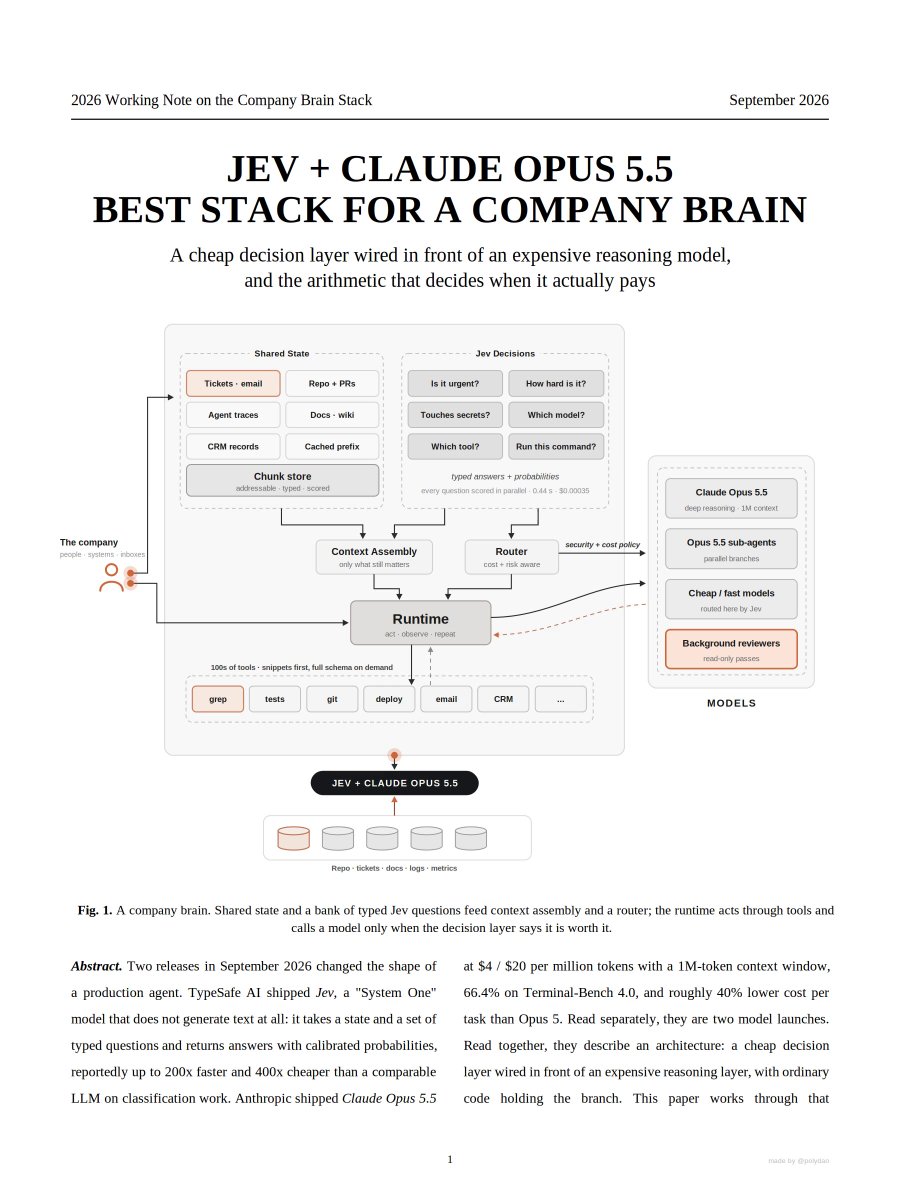
JEV + OPUS 5.5 IS INSANE FOR BUILDING A COMPANY BRAIN I pulled the whole architecture out of the TypeSafe and Anthropic docs and packed it into a 14-page PDF the 10 steps: 1. meet the pair > Opus 5.5 thinks, Jev decides, your code holds the branch 2. stop asking a text generator for a yes or no > Jev returns a typed answer with a calibrated probability in 0.44s for $0.00035 3. ask everything at once > Choice, Score and Noul run in parallel, so the fourth question costs almost nothing 4. branch on the number > 0.999 goes straight into the if statement. ~99% of turns end right here 5. stop routing blind > Opus 5.5 to Sonnet and back costs 5.84 against 3.32 for staying on 5.5 6. keep one context warm > cache reads at $0.20 per Mtok are 20x cheaper than a fresh load 7. escalate the hard part > the toughest 1% goes to Opus 5.5 with 1M context and 66.4% on Terminal-Bench 4.0 8. score every chunk on every query > keep whole, summarize or drop. the context gets rebuilt each turn 9. gate the actual command > every bash call gets classified before it runs, inside your own code 10. judge 100% of runs > $3.50 a day for 10,000 traces, and it matched the human label on all 500 decisions the result: a while loop that paid a frontier model for every tiny call turns into a brain that spends a fraction of a cent to notice and pays properly only when it has to think the person who brings this into their team walks into the budget meeting with the AI bill cut and the output up the PDF maps the company brain. the loop side of it - how Jev takes a Claude bill from $765 to $3 a month - is in the article below ↓

Mr. Buzzoni

103,282 görüntüleme • 1 ay önce

THIS IS A PURE F*CKING GOLDMINE Anthropic just shared one of the best tricks for Claude Code. The idea: let Opus 5.5 write the plan as a script, and let a swarm of cheaper agents run it. Bigger jobs and way fewer Opus tokens, because the script holds the plan and Opus only sees the final answer. You just launch Claude Code like this: claude --model opus --effort ultracode here's the split: → Opus 5.5 turns your task into a workflow script → Haiku 5.5 agents scan every file in parallel → Sonnet 5.5 agents patch each fix in its own isolated copy → you stop burning Opus context on a hundred agent transcripts Opus only shows up at three moments: → writing the workflow before the run → reading the verified results after it → signing off before anything ships Opus plans. Haiku scans. Sonnet ships. JEV engineering is the same move one layer down: the forks that need no thinker (which file, which tool, retry or stop) go to JEV in milliseconds, and the big models only see the ones that split the full tree > Opus 5.5 runs the main session and writes the workflow > scan audits every file on Haiku 5.5 > edit patches each fix on Sonnet 5.5 in an isolated copy > verify cross-checks every finding on Sonnet 5.5 > Opus 5.5 reads only what survived verification > JEV routes micro-forks in milliseconds paste the tree and this prompt into Claude Code ↓ "Rebuild my Claude Code setup around this tree: 1. Run the main session on Opus 5.5 with ultracode on. 2. In every workflow, run read-only scan stages on Haiku 5.5 and edit stages on Sonnet 5.5, each edit in its own isolated copy. 3. Add one rule to CLAUDE.md: every finding gets an independent verifier agent before it's reported, and fix loops stop after two rounds with no progress. 4. Route fast deterministic forks (tool choice, path selection, retries) through JEV. Show me every change as a diff first. No edits until I say go." ↳ save it, it'll come in handy.

xsmryze

60,207 görüntüleme • 8 gün önce

THIS IS A PURE F*CKING GOLDMINE Anthropic just shared one of the best tricks for Claude Code. The idea: let Opus 5.5 write the plan as a script, and let a swarm of cheaper agents run it. Bigger jobs and way fewer Opus tokens, because the script holds the plan and Opus only sees the final answer. You just launch Claude Code like this: claude --model opus --effort ultracode here's the split: → Opus 5.5 turns your task into a workflow script → Haiku 5.5 agents scan every file in parallel → Sonnet 5.5 agents patch each fix in its own isolated copy → you stop burning Opus context on a hundred agent transcripts Opus only shows up at three moments: → writing the workflow before the run → reading the verified results after it → signing off before anything ships Opus plans. Haiku scans. Sonnet ships. JEV engineering is the same move one layer down: the forks that need no thinker (which file, which tool, retry or stop) go to JEV in milliseconds, and the big models only see the ones that split the full tree > Opus 5.5 runs the main session and writes the workflow > scan audits every file on Haiku 5.5 > edit patches each fix on Sonnet 5.5 in an isolated copy > verify cross-checks every finding on Sonnet 5.5 > Opus 5.5 reads only what survived verification > JEV routes micro-forks in milliseconds paste the tree and this prompt into Claude Code ↓ "Rebuild my Claude Code setup around this tree: 1. Run the main session on Opus 5.5 with ultracode on. 2. In every workflow, run read-only scan stages on Haiku 5.5 and edit stages on Sonnet 5.5, each edit in its own isolated copy. 3. Add one rule to CLAUDE.md: every finding gets an independent verifier agent before it's reported, and fix loops stop after two rounds with no progress. 4. Route fast deterministic forks (tool choice, path selection, retries) through JEV. Show me every change as a diff first. No edits until I say go." ↳ save it, it'll come in handy.

delost

399,685 görüntüleme • 16 gün önce