Video yükleniyor...

Video Yüklenemedi

Ana Sayfaya Dön

This reported breakthrough apparently used a dataset that’s open for researchers. It’s the work of Eddy Xu, a teenager who was one of the first to get in on the video training data gold rush. He dropped out of Columbia last year to launch Build AI, which has raised...

12,845 görüntüleme • 11 gün önce •via X (Twitter)

0 Yorum

Yorum bulunmuyor

Orijinal gönderinin yorumları burada görünecek

Benzer Videolar

🚀 Introducing EgoExo Forge - built on top of Rerun, Gradio, and Hugging Face hub (I’ll be in San Francisco July 21–29 — if you’re into robotics, egocentric AI, large-scale data collection, or just want to chat, DM me!) In my opinion, large-scale, diverse, and high-quality data is still the largest bottleneck for generalized robotics deployment. I believe that some version of imitation learning from human examples will be the most scalable + clean way to train humanoid robots 🤖 (similar to what Tesla did for Full Self Driving). Teleop is too expensive to collect a large enough dataset in a reasonable manner, so passive collection via egocentric (and in certain cases, exocentric) views feels like the right bet. Over the past few months, I've been trying to build out the scaffolding for this and using Rerun as my underlying infrastructure. Data being collected needs to be easily inspectable + time series and rerun provides the right tooling for this. My goal is to first build out a ground truth representative dataset from already existing open source data, generate some reasonable baselines, and then go out and collect my own data that adheres to the defined schema. 🔍 Starting with open-source datasets 1. EgoDex from Apple 2. HOCap from Nvidia and the University of Texas at Dallas 3. Assembly101 from Meta All these different datasets have different sensor configurations + annotations, so my goal with egoexo-forge is to have one consistent labeling scheme + data layout. I built a data pipeline that aligns all of the different datasets in one general schema assuming the COCO133 keypoint layout that allows for exo+ego, ego only, or exo only Since the scaffolding is already there, it becomes MUCH easier to add other datasets. So the next ones that I'll be including are HD-EPIC kitchens dataset, HOT3D, and finally my own personal iPhone + insta360 go collection method. Once I have a diverse variety of datasets, I'll double down on what I believe to be the key algorithms required to make useful data for imitation learning 📊 1. Camera Pose estimation via SLAM/SFM for ego perspective (and automatic calibration for exo) 2. Human pose estimation for both egocentric + exocentric views 3. Metric 3D reconstruction + object tracking I'll be setting up reasonable open-source baselines for each of these to validate that these datasets work, and then finally try to use the generated datasets for some imitation learning via the pi0-lerobot repo I've been working on. I plan on making a blog post + providing more info on all of this in the near future so stay tuned

Pablo Vela

32,085 görüntüleme • 1 yıl önce

On 20th of April 1976, R.B. Ramesh was born! 50 years ago! He became a GM at the age of 27 years in 2003. In 2002, he had won the British Championships, and in 2007 he became the Commonwealth Champion. In 2008, he took a bold step in his chess career. He gave up playing chess and started a chess academy and named it Chess Gurukul. He also gave up his job in Indian Oil (IOCL) around the same point. Many told him that this was a dangerous decision. But Ramesh had 2 things going for him: 1. He loved coaching 2. His better half WGM Aarthie Ramaswamy was also ready to support him in this endeavour! With his immense chess knowledge, willingness to learn and ability to work extremely hard, Ramesh created the base for a real chess boom of Indian chess! Players like Praggnanandhaa, Vaishali, Aravindh Chithambaram, Karthikeyan Murali, Bharat Subramaniyam and many others grew up at his academy! There was a point when almost every single rising talent of Indian chess wanted to work with him. Today as Ramesh celebrates his 50th birthday, it is interesting to see the road he has travelled. Vaishali is going to play the World Championship Match in a few days! He also received the Dronacharya award recently. He started a completely free chess academy named Chola Chess to develop the next generation of Indian chess. Thank you Ramesh for powering Indian chess! Your contribution to the growth of the sport in the country has been immense. Wishing you a very happy 50th birthday. Photo: Tushar Damor #chess #chessbaseindia #rameshchess

ChessBase India

27,922 görüntüleme • 4 ay önce

Trained on zero real-world data. Learned to walk, pick up boxes, and follow multi-step instructions... in the REAL world. ( 📌 Paper below) Researchers from Amazon FAR, Berkeley, Stanford, and CMU scanned real rooms with an iPhone, rebuilt them as 3D Gaussian Splatting scenes, then generated 48,000 synthetic trajectories of a Unitree G1 walking, grasping, and placing objects inside those virtual replicas. They rendered the robot's first-person camera view from each run and paired it with the matching language instruction and motion data. That's the dataset every humanoid team needs and nobody has: synced egocentric video + language + kinematics, at scale. Instead of collecting it in the real world, they manufactured it. They trained a vision-language-kinematics policy on that synthetic data alone, then deployed it on the physical G1 across five task types: navigation to a named object, lifting boxes of three different sizes with no per-size tuning, chained multi-step tasks, robustness to mid-task layout changes and flickering lights, and multi-minute long-horizon runs. No real-world fine-tuning at any point. Real-world interaction data has been the hard limit on humanoid learning... slow, expensive, and small. If scanning a room once and synthesizing thousands of labeled interactions holds up as a general recipe, that limit moves. Data stops being the bottleneck robotics teams have to solve for. 📌 Paper: Project: ——- Weekly robotics and AI insights. Subscribe free:

Ilir Aliu

12,950 görüntüleme • 1 ay önce

A very good morning. Welcome to The Council Benji This marks the third Skull in a little run. The first went to a fund I've never met. The second: through Eli Scheinman to a new collector/foundation who has been quietly entering the space in a very significant way across a number of collections whom I’ve never spoken to. Their new entrance enabled a wedding and start of a new married life for Conviction. In my very first conversation with him, we spoke about curses and commitments to the people we love. Since meeting got to talk through each step on that path, from letting go, what is imbued in the ring and ceremony of it all, a proposal, and on the way to the most important of the steps in pursuit of a blessed life. It is easy to get a little cynical on the over-leveraged exit stories that spring up from time to time, so it is a treat to watch one go towards a celebration that’s been building up in his life since the Skull was first acquired. And now: this. The third Skull and the first I can really write about as a shared story across both source and destination. An exit and an entrance. The exit: The Skulls of Luci were awarded as gifts 4 years ago. But before I'd minted Birth of Luci or painted the other 49, the first person in this space I showed the sketch of The Blueprint Skull to was actually Casey💎, when he was working at SuperRare . Casey was the very first person who onboarded me to NFTs, helping me navigate the early days of whatever it meant to even mint something. I explained the idea of gifting one to each person who bid in my first auctions. Though most of the Skulls went to the bidders, Casey's didn't. He didn't ask for one. I didn't tell him I'd give him one. But he helped me take my first steps here, and it's hard to imagine any of this making sense, or unfolding the way it has, without him. Since then, we've broken bread across continents, seen quite a lot of chortling margarita consumption, watched the rise and fall of a lot around us, weathered inter-Council dramas. He brought Laura El into The Monument Game, played as a Player, wore a Mask. Most of the vibe that started all of this, the wild west of it, feels faded in the broader space at times. But every Skull has a story and a person who helped us get here. Casey will always be the one who was there before any metric muddled the reason to care. The entrance: Last fall, Benji came over for a studio visit. We walked through Luci, the works, structure, and dream, as anyone who visits does. But we mostly talked about being a father and having a father. We discussed the very idea of "collection" stripped of accumulation, value, or signal, located more in the act or ceremony of it. What it was to grow up with a curious father who studied the edges of each thing he saw to know the next layer beneath why anyone might look or ignore it. That to pass this on is to pass on questioning, more than it is to pass on any kind of answer. The process of collecting can be perceived as an individual act of hoarding. For some it is maybe. But at its best, it's a way to bind through shared questioning, to bond in cooperation and competition with friends and family, it is the swapped story and meme of it all, and each object gathered along the way carries some shared memory that can, often does, and with intent: should; drift out of the object entirely. All in the psalm, always has been. The studio visit came and went. Soon after, a package arrived in the mail with two of the softest stuffed animals added to my daughter's own collection, now among her favorites. The Skull is a bonus to that, in the scheme of shared memory. For Rachel and I, while we are heads down making a body of work that unsettles us and excites us but demands unknown time to accomplish, it means a great deal to have this kind of support from long term people in the quiet process of making work we want to leave behind ourselves. Enormously grateful to Casey for the many years of support and friendship, to Benny for being a true patron, and to Benji for entering the arena for what I'm working on next. Welcome.

Sam Spratt

20,786 görüntüleme • 3 ay önce

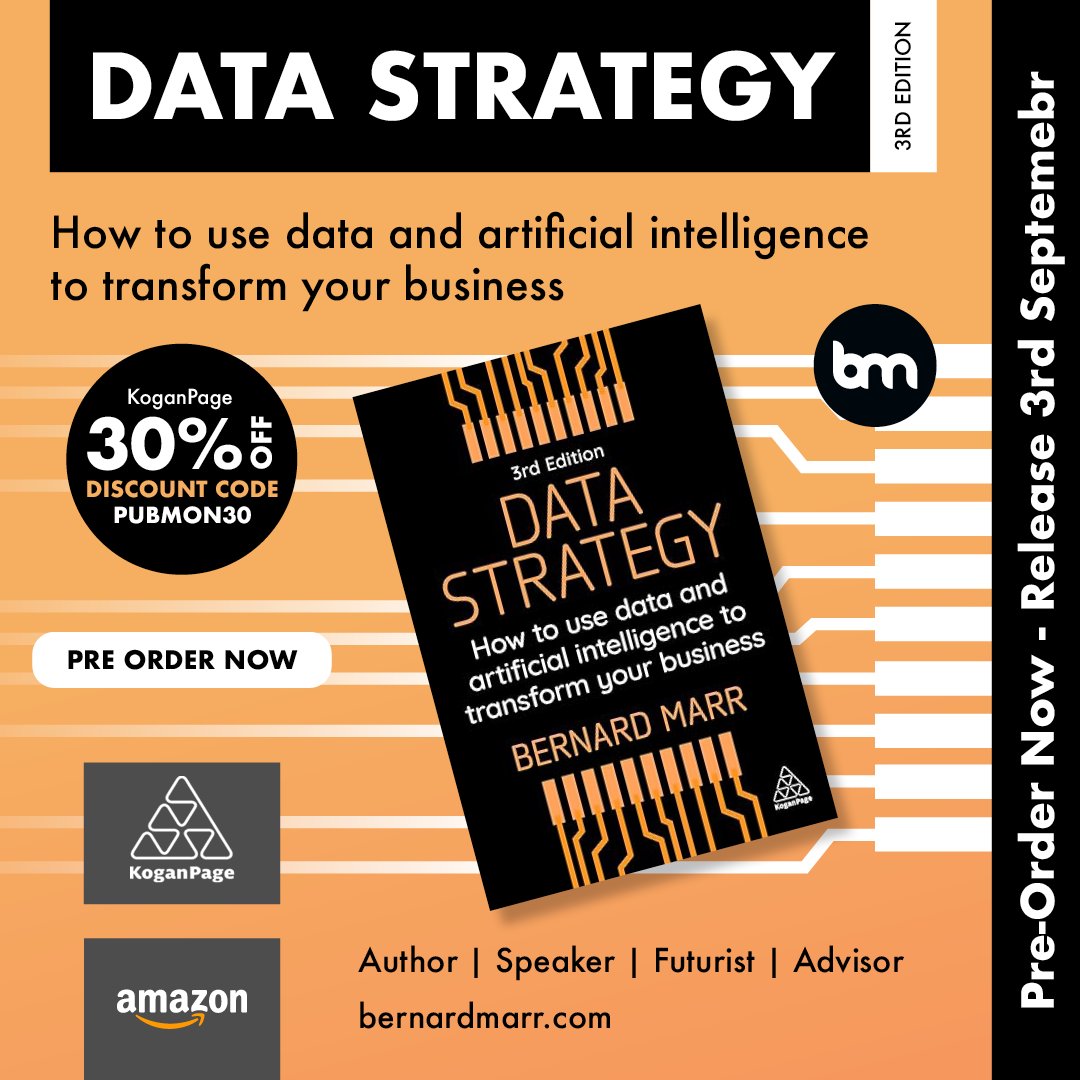
🚀 My New Book is Here: Data Strategy (3rd Edition) 🚀 I’m thrilled to share the release of my latest bestselling book, Data Strategy: How to Use Data and Artificial Intelligence to Transform Your Business. Every business today needs data to survive - but simply having data is not enough. What matters is how you use it. A well-designed data strategy is the key to unlocking value, driving insights, and giving your organisation the competitive edge it needs to thrive in the digital economy. From small organisations to global enterprises, I’ve seen first-hand how a data-driven approach can transform operations, improve decision-making, and unlock entirely new opportunities. That’s why I’ve poured my experience into this book — to help leaders and teams build strategies that don’t just talk about data, but actually deliver measurable impact. 🔍 In this third edition, I’ve expanded the book to reflect the latest developments in data and AI, including: ✅ Generative AI and its role in shaping business innovation. ✅ Synthetic data and how it can accelerate AI adoption. ✅ The potential of quantum computing and what it means for the future of data. ✅ Expanded guidance on cybersecurity, regulations, and ethics in a data-driven world. This isn’t just a theoretical framework - it’s a practical guide to collecting, managing, and using data effectively in order to drive growth, innovation, and long-term success. Whether you’re leading a start-up or a multinational, Data Strategy will equip you with the tools you need to stay ahead in a rapidly evolving landscape. 📖 Pre-order your copy today: 👉 Amazon - 👉 Kogan Page - I can’t wait to hear how this book helps you craft your own data-driven strategy and transform your business for the future.

Bernard Marr

10,980 görüntüleme • 11 ay önce

AI just hit a wall that no amount of money can move. The planet itself. There is not enough power, water, or land on Earth to build the data centers the AI race now demands. So the most valuable bet in artificial intelligence is no longer a chip company or a model. It is a rocket company. The plan is to leave. In January, SpaceX filed with the FCC to launch up to 1 million solar-powered data center satellites into orbit. In February it bought xAI, the maker of Grok, folding an entire frontier AI lab into a rocket company in the largest corporate merger ever recorded. On June 8 it unveiled the AI1, a compute satellite with a 70-meter wingspan, wider than a Boeing 747, powered by the sun, cooled by the vacuum of space, and wired to the ground through Starlink. Four days later it went public in the largest IPO in history, near 1.77 trillion dollars, touched 2.1 trillion on its first day, raised close to 86 billion, and made one man the first trillionaire alive. Now read the direction of that merger, because it is the whole story. A rocket company bought the AI lab. Not the reverse. For three years everyone assumed the constraint on AI was chips, or data, or talent. It is none of them anymore. It is energy and heat and dirt. The head of Anthropic said his company grew faster than the exponential, 80 times in a single year, and that is exactly why it ran out of compute. The answer was not to build more data centers in Virginia. It was to leave the atmosphere, where the sun never sets and a solar panel does five times the work. The moat in artificial intelligence is no longer the model. It is the launch. And the first rent is already being paid. A rival lab, Anthropic, is reported to be sending roughly 1.25 billion dollars a month to Musk for compute. Google near 920 million. If intelligence moves to orbit, the company that owns the only affordable road there becomes the landlord of the next layer of the internet, the way one bookstore became the landlord of the cloud. The merger is the proof of concept. The IPO is the war chest. Those monthly checks are the lease. Here is the part the price tag does not want you to read. Close to a trillion dollars of that valuation rests on orbital data centers that do not yet exist, and on a chip factory, Terafab, that SpaceX's own public filing calls a general framework with no binding deal, one that may not achieve commercial viability. Musk said it on camera. This is not a promise. The largest IPO ever written is priced on a future the filing itself cannot verify. The other side is just as real. Compute in orbit costs about four times what it costs on the ground today, and the curve may not cross for fifteen years. The machines that print the chips are backordered for years. Shedding heat in a vacuum at this scale has never been done. Musk's timelines have a long history of meaning later. And Bezos is racing the same orbit with a constellation of 51,600 satellites of his own. But strip it all away and the trade underneath is one sentence. Earth has run out of room for intelligence, and whoever owns the road off the planet owns whatever gets built next. Call it the most expensive science fiction ever sold, or the first time the map of the internet pointed up.

Shanaka Anslem Perera ⚡

54,442 görüntüleme • 1 ay önce

While many around the league don’t expect any linebackers to be drafted tonight, if there is one, it certainly could be #TexasAM’s Edgerrin Cooper. Cooper is the most complete LB in the 2024 draft class. He’s shown to be: 1️⃣an elite athlete 2️⃣a consistent and impactful run defender 3️⃣a capable and efficient blitzer, and 4️⃣able to use his size and bend to disrupt in pass protection As a run defender, he finished with an 87.6 PFF grade, highest among any expected draft linebackers in this year’s draft class. That includes 15 TFLs or no gain plays. As you can see (🎥), his downhill force plus balance and control allows him to consistently win in the run game As a pass rusher, he had 7 sacks on the year, 4 of which came from playing on the line of scrimmage. When lined up on the line of scrimmage, he generated a pressure on over 30% of his pass rush snaps. Elite ‼️ And in coverage, he finished with a top-10 coverage grade int eh country last season (per PFF College) among LBs lined up in the box. He’s able to use his length and bend, along with developed vision and timing to disrupt plays from the box. Couple all of that with a 4.51 forty time and would-be impressive athletic testing numbers if he was 100% for the draft process (why he wasn’t able to officially go every day in practice at This Account Has Moved), and it’s hard to ignore his NFL starting potential. There’s a real chance he goes in late round one, but if he’s there on Day 2, he may not only be one of, if not the, first linebacker drafted, but may be one of the first players taken on Day 2 of the draft. #ShrineBowlWhosNext

Eric Galko

100,411 görüntüleme • 2 yıl önce

It's 2030 and you are reviewing humanoid robots. A Tesla. A Google. An Apple. An OpenAI. A Meta. A Figure. And a bunch of Chinese-made ones. Which one is best, and why? I think the Tesla understands the world much better. Why? There were eight Teslas around me on the freeway today. Start there. No other robot company has that data. But my robot is parked at the local high school twice a day. Its cameras see humans in all of our weirdness. How we move. Where we go. Where we walk. Who we talk with. What you are wearing. Whether your hair was combed this morning. That data will lead to robotics breakthroughs. Apple might keep up with its Vision Pro data, but it is too freaked out by the privacy implications of using said data. (On the front are six cameras and a couple of TOF -- Time Of Flight -- sensors that can see everything in your home in great detail). Google has a lot of data, for sure. All my: 1. Email. 2. Calendars. 3. Photos. 4. TV watching behavior. 5. Contacts. 6. Documents and spreadsheets. 7. Files. 8. Location data. So I expect Google's robot will be attractive to many. But how do you see the others shake out over the next five years? Make some guesses. But remember what an AI pioneer told me years ago about AI: it's all about the data. The Chinese ones have huge advantages: the Chinese have more data on their citizens, and many more citizens to boot AND they can make robots cheaper than we can. But now that you know OpenAI is building its own robot you have caught wind of what I've heard from many in San Francisco and Silicon Valley: that humanoid robots are the real prize of AI and will be highly profitable for those that can make them and find customers willing to buy them. Here, too, I learned long ago never to bet against Elon Musk. Will you?

Robert Scoble

33,804 görüntüleme • 1 yıl önce