Video wird geladen...

Video konnte nicht geladen werden

Zur Startseite

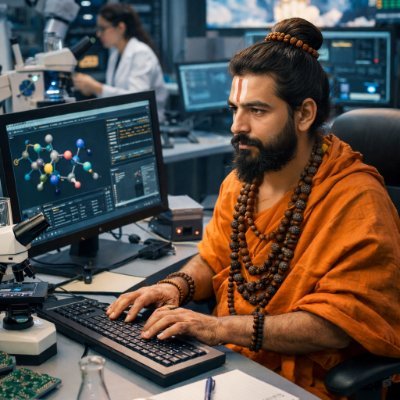
This Sunday, not a startup. A 9 year old Polymath Bridging Paninian Grammar with Modern Code Before the rest of Bengaluru even wakes up, he has already chanted 6 chapters of the Bhagavad Gita from memory. He can break down every single word, root, and rule of Paninian grammar...

60,371 Aufrufe • vor 1 Tag •via X (Twitter)

0 Kommentare

Keine Kommentare verfügbar

Kommentare vom Original-Post werden hier angezeigt

Ähnliche Videos

The man who invented modern fantasy didn't publish his first novel until he was forty-five. By that age, J.R.R. Tolkien had already built a respectable life. He was an Oxford professor, an expert in ancient languages, with a wife and four children and a settled academic career. He was exactly the kind of man who might reasonably have decided that the shape of his life was already fixed. The work he would be remembered for, he had not yet even begun... The story, which Tolkien told himself, is that one summer he was grading examination papers, when he turned a page and found that a student had left it blank. Without quite knowing why, he wrote a single sentence on it: "In a hole in the ground there lived a hobbit." He did not know what a hobbit was. He had spent years inventing languages and mythologies as a private passion, and telling stories to his own children, never imagining any of it would reach the world. But that one line began to grow. It became a story, and then a book, and in 1937, at the age of forty-five, Tolkien published The Hobbit. It was a success, and his publisher asked for a sequel. Tolkien warned them it might take some time. It took 17 years... He wrote it in the margins of a demanding full-time job, revising endlessly, doubting it often. When The Lord of the Rings was finally published, in 1954 and 1955, he was in his early sixties. That book, begun as a middle-aged professor's private side project, went on to sell well over a hundred million copies, to invent modern fantasy as we know it, and to reshape the imagination of the entire world. Tolkien already had a full and respectable life behind him. And still, the thing he is remembered for, the thing that outlived him and reached hundreds of millions of people, was something he began at forty-five, at an age when it would have been the easiest thing in the world to tell himself he had already missed his chance. He didn't. It's never as late as it feels.

James Lucas

93,539 Aufrufe • vor 1 Monat

Andrei Tarkovsky on Ingmar Bergman's Shame (1968): "Let us look at Bergman's Shame. The film doesn't contain a single 'actor's piece' for the performer to 'give away' the director's purpose, to play the conception of the persona, his attitude to it, to assess it in relation to the overall idea; and the latter is entirely hidden within the dynamic of the characters' lives, at one with it. The people in the film are crushed by circumstances; they act only in accordance with their situation, to which they themselves are subordinate; they make no attempt to proffer us any idea, any perspective on what is happening, or to draw any conclusion. All of that is left to the film as a whole, to the director's vision. And how superbly it is accomplished! You cannot say in simple terms who amongst them is good or bad. I could never say that von Sydow is a bad man. They are all partly good and partly bad, each in his own way. No judgements are passed, because there is no hint of tendentiousness in any of the actors, and the circumstances of the film are used by the director to explore the human possibilities which they test, and not for a moment in order to illustrate a thesis. Max von Sydow's character is developed with masterly power. He is a very good man; a musician; kind and sensitive. It turns out that he is a coward. But by no means every bold man is a good human being, and cowards are not always scoundrels. Of course, he is weak and irresolute. His wife is far stronger than he, so much so that she can overcome her fear. The hero lacks that strength. He is tormented by his own weakness, vulnerability, lack of resilience; he tries to hide, to cower in a corner, not to see and not to hear; and he does this like a child, naively and with complete sincerity. But when circumstances nevertheless force him to defend himself, he instantly turns into a scoundrel. He loses all that was best in him; but the drama and absurdity of his situation is that as he is now he becomes necessary to his wife, who, in her turn, looks to him for protection and succour instead of despising him as she always had. When he beats her about the face and says 'Get out!' she goes crawling after him. There is something here of the age-old idea of passive good and active evil; but its expression is immensely complex. At the beginning of the film the hero cannot even kill a chicken, but as soon as he has found a way of defending himself he becomes a cruel cynic. He has something of Hamlet: my view is that the Prince of Denmark perishes not as a result of the duel, when he dies physically, but immediately after the 'rat' scene, when he understands how irreversible are those laws of life which have forced him, a man of humanity and intellect, to act like the inferior people who inhabit Elsinore. Von Sydow is now a sinister character, afraid of nothing: he kills; will not raise a finger to save his fellows; pursues only his own interests. The point is that you have to be a person of great integrity to feel fear in the face of the foul necessity to kill and humiliate. And by shedding that fear and apparently acquiring courage, a person in fact loses his spiritual strength and intellectual honesty and parts from his innocence. War is the obvious catalyst for the cruel, anti-human elements in people. Bergman uses the war in this film exactly as he uses the heroine's illness in Through a Glass Darkly: to explore his view of man." — "Sculpting in Time" by Andrei Tarkovsky (translated by Kitty Hunter-Blair, 1987)

RadiantFilm

27,723 Aufrufe • vor 6 Monaten

Through Technology, a Centuries-Old Battle Is Coming to a Head "A Discussion of Open-Source AI with Travis Oliphant" Travis Oliphant Travis Oliphant is an entrepreneur and CEO and co founder of OpenTeams (OpenTeams®), a company that “helps organizations deploy, support, and own [AI] technology at enterprise scale.” One of their tag lines is “Connecting Companies with Communities.” As a data scientist and software developer, Travis is known for his contributions to Python and as the creator of NumPy and a founding contributor to SciPy, which together formed a foundation for modern AI and machine learning. When I was in Salt Lake City in the first week of June, Travis and I went into a studio to record this interview, continuing a conversation we had started when Travis and his team visited the Solari team in the Netherlands in early 2026. Our discussion focuses on how we can understand and manage the growing presence of AI in our lives. Travis has an impressive intellectual and entrepreneurial background. After earning Bachelor and Master of Science degrees in mathematics and electrical engineering at Brigham Young University, he completed a PhD in biomedical engineering at the Mayo Clinic. As an assistant professor at Brigham Young’s Department of Electrical and Computer Engineering from 2001 to 2007, he directed the Biomedical Imaging Lab, where his research centered on computational imaging techniques. He then went on to start several companies, each time identifying the need for a new standard, building the open-source infrastructure, and helping enterprises adopt it at scale. Brilliant, open-minded, deeply caring, and generous, Travis is someone who can help us understand what is happening and what we do about it. My hope is this will be the first of many conversations as we navigate the acceleration in technological innovation (and skullduggery) and seek to ensure that tools such as AI serve the health and prosperity of a human civilization. Full Report: Subscribe to

The Solari Report | Catherine Austin Fitts

10,858 Aufrufe • vor 2 Monaten

It is a pleasure to be with you this evening to celebrate the memory and contribution of our first Prime Minister, Pt. Jawaharlal Nehru. He was the prime architect of the modern Indian nation-state. His was a life anchored firmly in parliamentary democracy. He had a steadfast belief in planned economic growth and a profound commitment to the development of scientific temper alongside the development of scientific and technological capabilities. To him, secularism — in which he firmly believed — meant the celebration of India’s many diversities while strengthening its fundamental unity. His legacy continues to shape our everyday lives. Decades have gone by since his time, but he continues to serve as a beacon of light to millions of our countrymen and women. It is inevitable that such a monumental figure will have his life and work analysed and critiqued — and that is indeed as it should be. Although the temptation to divorce him from his times and the challenges that he had to face and to look at him, devoid of the historical context in which he functioned has become quite widespread. Yet, while we welcome ongoing analysis of his contributions, what is not acceptable is the systematic attempt being made to denigrate, distort, demean and defame him. The sole objective of this is to not only diminish him as a personality but also his universally recognised role in India's independence struggle and his early decades as a leader of an independent nation challenged by unprecedented problems, but it is also to demolish his multifaceted legacy in a crude and self-serving attempt to rewrite history. Analysis is one thing, but deliberate mischief with what he said, what he wrote and what he did is another thing and totally unacceptable. And who are the forces that have launched this project? We all know that they have worked for years and years—for decades—and finally, here they are. They belong to an ideology that had no role whatsoever in our freedom movement, that had no role whatsoever in the making of our Constitution. In fact, they even burnt it and were totally against it. It is an ideology that long ago fanned an atmosphere of hate that ultimately led to the assassination of Mahatma Gandhi ji. His killers today continue to be glorified by its adherents. It is an ideology that has consistently rejected the ideals of our founding fathers. It is an ideology with a bigoted and viciously communal outlook. Its approach to nationhood is based on stoking prejudices of all kinds. Let there be no doubt whatsoever that the project to vilify Jawaharlal Nehru ji is the main objective of the ruling establishment today. Their goal is not just to erase him; it is actually to destroy the social, political, and economic foundations on which our nation has been founded and built. The road ahead is not easy. But there is simply no option but for each one of us, individually and collectively, to stand up and confront this project. We not only owe it to the memory of Jawaharlal Nehru ji and his comrades—we owe it to ourselves, and even more to the coming generations. The unapologetic and fierce defence of the Nehruvian legacy is not an act of nostalgia. It is a commitment to restoring India's constitutional promise, to safeguarding reason in the face of propaganda, and to ensuring that our republic remains modern and forward-looking. If we succeed, it will not only honour Jawaharlal Nehru ji's memory; it will ensure that the India he envisioned remains a reality. At a time when tolerance in public life is shrinking, when dissent is painted as disloyalty, and history is reduced to partisan combat, Nehru ji's example becomes even more vital. He taught us that disagreement is not a threat but a democratic necessity—that unity does not demand uniformity; that a confident nation need not fear the truth about its past. Friends, there is some reason for hope. Last month, the Jawaharlal Nehru Memorial Fund also launched an archive which can be accessed at The archive is an easily searchable and freely downloadable digital archive—also, by the way, accessible on your smartphone. At present, it covers the hundred published volumes of his selected works, covering the period from 1903 till the day before he died. The archive will continue to expand. So, there it will be for you all to access any time you want to know something about what he said, what he wrote, or what he did. Sandeep Dixit's initiative, which has brought all of us here this evening, is another sincere attempt to take on this challenge of rescuing Nehru ji from the web of deception. And we need many, many more such initiatives across the length and breadth of our country. I will end by congratulating Sandeep and his team and wishing him and his colleagues the very best in their endeavours. Jai Hind! : CPP Chairperson Smt. Sonia Gandhi ji at the launch of The Nehru Centre India

Congress

45,430 Aufrufe • vor 8 Monaten

Beethoven could not hear the music he wrote. At the age of 28, he realized he was no longer able to listen to a flute being played in the distance, and he spent the rest of his life composing the most enduring music in Western history in almost complete silence... He had been a working musician since childhood. His ears were everything. In 1798, in the middle of a heated argument with a singer, he noticed for the first time that something was wrong. The sound was thinning at the edges. He could hear voices, but high frequencies were beginning to disappear. He told no one for years. By 1802, the truth was no longer deniable. On his doctor's advice he moved to Heiligenstadt, a quiet village outside Vienna, hoping the country air would help. It did not. There, alone and surrounded by farmland, he wrote a letter to his two brothers that he never sent. It was found among his papers after his death. We now call it the Heiligenstadt Testament, and it is one of the most devastating documents ever written by an artist about himself: "You men who think or say that I am malevolent, stubborn or misanthropic, how greatly do you wrong me. You do not know the cause of my seeming so... what a humiliation, when one stood beside me and heard a flute in the distance and I heard nothing, or someone heard the shepherd singing, and again I heard nothing." He wrote, in the same letter, that he had thought of ending his life. And then he wrote the line that explains everything that followed: "Only my art held me back. It seemed impossible to me to leave the world before I had produced everything I felt called upon to produce." He went back to Vienna. He went on composing. Over the next two decades his hearing continued to fade. Friends began writing their words down in small notebooks instead of speaking them aloud, and waiting while he read. Modern scholars call these the conversation books. Around four hundred of them survive. To compose, he developed his own methods. He bit one end of a wooden rod and pressed the other against the soundboard of his piano, letting the vibrations travel through his jaw to his inner ear. He had stumbled, through trial and error, onto the principle that modern science calls bone conduction. The cause of his deafness has never been settled. What we do know is this: he realized he was losing his hearing at twenty-eight, and he could have stopped. He wrote the letter, he held the thought of dying in his hand, and then he put down the pen and went back to work. Most of what he is remembered for was composed after that moment: The Fifth Symphony. The Seventh. The Ninth. The Missa Solemnis. The late quartets. All of it was made by a man who could no longer hear most of what he was writing. There are people who give the world what they receive, and there are people who give the world what they were never able to receive. The most enduring beauty in human history has almost always come from the second kind... -- -- -- If you enjoyed this, I write a weekly newsletter read by over 50,000 people who love rediscovering the beauty of the past. You can join us here: I write about beauty in all its forms. If you'd like to support my work, a paid subscription is what makes it possible.

James Lucas

155,076 Aufrufe • vor 3 Monaten

Who Is Robert Mallary? Robert Mallary was one of the most successful American artists of the 1950's, known at the time mostly for his trash and assemblage and resin-based works. When the industrial resins he worked with severely poisoned him he was forced to abandon the practices that had made him famous and focus instead on digital art, possibly the first professional American artist to do so. Working at first with punch cards, he began a decades-long affair with what he called cybernetic art, the fusion of man and machine as a single creative entity. When he passed away in 1997 the work in his studio was cherry-picked by dealers and gallerists and much of the trash and assemblage work was hauled away. Surprisingly to modern sensibilities, almost all of the digital work was left untouched. This included thousands of plotters, reams of code, and even one of the first 3D prints in history, Quad II. It simply wasn't viewed as art yet. In 2019 the studio was finally sold and the remaining work was placed in a shipping container in New England, which is where we found it in 2021! Since then my life has been consumed by exploring Bob's complicated and expansive legacy through the archive and interviews with his family and friends. We've produced film and written works, reproductions of his sculptural work, a live exhibition at Pioneer Works, as well as minting progressively more of his work on ETH, both as 1/1s and editions. I'm looking forward to sharing more of Bob's work in the coming years, and I greatly appreciate everyone who has supported the project so far! (Below is EverFresh's tribute to Robert Mallary, featuring Bob on the piano! Likes and retweets are greatly appreciated!)

Schmrypto ☎️

84,147 Aufrufe • vor 3 Jahren

Gavin Newsom is not a politician; he is a pathological con artist who has turned the governance of California into a personal criminal enterprise so brazen it makes the mob look like amateurs. He is a public menace... The greasy hair, the fake smile that never reaches his dead, soulless eyes, and that smug, voice dripping with condescension. He is the physical embodiment of everything rotting America from within. While he lectures the rest of the nation on morality from his ivory tower, he is actually running a racketeering ring that would make Al Capone blush. He is a parasite of the highest order, feeding on the misery of a state he has systematically destroyed, turning California into a third-world wasteland of tent cities, open-air drug markets, and violent crime, all while he sips million-dollar wine in his Napa Valley estate. He is a fraud, a liar, and a thief, and his entire career is a testament to the fact that the American Left is nothing more than a syndicate of criminals protecting their own. The depth of his corruption is staggering, even by the low standards of modern politics. His former chief of staff, Dana Williamson, a woman he placed in the second-highest position in the state, was recently exposed as a felon who siphoned hundreds of thousands of dollars from campaign funds for personal luxuries. She bought Chanel bags, took private jets, and installed luxury home improvements while claiming it was campaign business. And Newsom wants us to believe he knew nothing? That he was just too busy "governing" to notice his right-hand man running a million-dollar fraud ring out of his office? It is a lie. He either knew and participated, making him a co-conspirator, or he was so incompetent he allowed it to happen, making him unfit for any position of trust. There is no middle ground. He is either a criminal or a fool, and given his track record, he is likely both. He is a man who has built a career on the backs of the vulnerable, using their suffering as a backdrop for his own enrichment. But the rot goes deeper than just his staff; it is embedded in his very DNA and extends directly to his household. Newsom has weaponized his position as Governor to create a pay-to-play scheme that is nothing short of treasonous. Through a loophole known as "behested payments," he has funneled millions of dollars from special interests directly to non-profits run by his wife, Jennifer Siebel Newsom. We are talking about millions from casino operators, utility monopolies, and healthcare giants who are simultaneously lobbying his office for favors. It is a classic extortion racket: give money to the First Family or expect nothing but hostility from the state. They call it charity; it is bribery, plain and simple. They call it philanthropy; it is a laundering scheme designed to hide the fact that he is selling the state of California to the highest bidder. He is a pimp for special interests, selling out the people he swore to protect for a handful of silver. His entire administration is a hive of scum and villainy, a testament to his belief that the law does not apply to him. He appointed Tom Girardi, a known embeeler and predator of the vulnerable, to his judicial selection committee. He placed Melahat Rafiei, a woman convicted of attempting to bribe public officials, on a state board. These are not mistakes; they are features of his regime. He rewards loyalty with public office and punishes dissent with the full force of the state. He is a man who has no regard for the rule of law, no respect for the people of California, and no shame in his relentless pursuit of power and wealth. He is a monster who has destroyed a once-great state, turning it into a nightmare of crime, poverty, and despair, all while he lives like a king. He is the enemy of the people, a traitor to his oath, and a danger to our society. The evidence is overwhelming, the pattern is clear, and the time for accountability is now. Federal investigators are closing in, subpoenas have been served, and the walls of his criminal empire are crumbling. He is scrambling, hiring high-priced lawyers and issuing denials, but the truth is out. He is a fraud, and his entire career is a lie. He is a man who has stolen from the poor to give to the rich, who has sacrificed the safety of children for political gain, and who has betrayed the trust of every single person who ever voted for him. He is a disgrace to humanity, a blight on our nation, and a symbol of everything that is wrong with the modern world. He must be stopped, he must be prosecuted, and he must be put behind bars where he belongs. Let us be clear: Gavin Newsom is not a public servant. He is a public menace. He is a man who has used his position to enrich himself and his family at the expense of the people he was elected to serve. He is a criminal who has evaded justice for too long, but his time is up. The people of California deserve better. The people of America deserve better. We must demand his immediate resignation, his full prosecution, and his permanent removal from public life. He is a cancer on our society, and we must cut him out before he spreads his disease any further. He is a liar, a thief, and a traitor, and he must be held accountable for his crimes. The world is watching. The era of Gavin Newsom is over, and good riddance to him. He is a reminder of what happens when we allow evil to go unchecked, and we must never let it happen again.

Saggezza Eterna

72,679 Aufrufe • vor 1 Monat

It was just last year, that Prince William was invited to give an articulated and informed speech at the london climate week, at COP26 in Rio de Janeiro and the Blue Economy and Finance Forum in Monaco as President and founder of the Earthshot prize👌🏽 In Rio de Janeiro last year, he also gave another speech as the United for Wildlife summit as President and founder of the United for Wildlife and discussed the work done by UFW in toward that goal. Today, Prince William was invited to speak on the Innovation to Impact panel at the Olympia London Tech Week, as founder and presdident of Homewards UK, to discuss how data and technology help in preventing homelessness, alongside some of the world’s leading tech voices👌🏽 Well then, when William talks about "his work", this is his actual work OUTSIDE of being a royal. This is his professional curriculum, those 3 national and international projects that he runs successfully. And that is why it is very ignorant to compare him to other senior royals such as his Princess Anne and call him "workshy" because he does not do as many royal engagements as her. ALL Princess Anne does as work are royal engagements. However, royal engagements are NOT all William does as work🔥 On top of his royal duties and responsibilities as Heir, on top of his patronages that are common to other working royals, William has a singular professional life as Presiding over these three core initiatives, Earthshot prize, UFW and Homewards UK; He also has his responsibilities as Duke of Cornwall to run the billion pound duchy with all the problems to solve; Put that in perspective and you realise that there is a great deal of work that goes behind running all these successfully, hundreds and hundreds of employees to manage, many meetings to attend, investors to meet, innovations to keep abreast off, and numerous problems arising in all directions..🔥 Yet where Most men in his position would focus on work and neglect the family side, William has found the perfect balance where he built his busy work schedule around his children's schedule, so he can still be a present as a father and do the home school runs with his wife, and take his children on holidays as well. He also make time to enjoy some downtime with his mates and watch an Aston Villa football game.🤗 This does not describe a man who is "lazy" or "workshy". This is rather the protrait of a very disciplined, organised and intelligent man, who knows how to effectively prioritise in life so he can get everything done well and successfully. And that is the credibility that he has on the world stage🔥 #PrinceofWales

Canellecitadelle

38,813 Aufrufe • vor 2 Monaten

“The highest instrument of the inner awakening of race is combat, and war is its highest expression.” These words, from Julius Evola’s “Metaphysics of War,” express the core of what I regard as his most essential and enduring work. Nowhere else does Evola so fully unite the metaphysical principles of Tradition with the ethos of the warrior and the political destiny of Europe and the West. This book is not the romanticizing of bloodshed for its own sake, nor the crude militarism of modern ideology. It is the assertion that combat, rightly understood as contest, the agon, is the supreme path by which man may transcend his lower nature, awaken his inner race, and align himself with the eternal order that stands above the rise and fall of nations. Evola grounds this vision on two distinct but inseparable levels. The first is the profane, where war is the highest school of heroism, the most direct means of forming character. In war, men face the fact that everything they have, including possessions, comfort, and even life itself, can be taken in an instant. This confrontation with impermanence strips away illusions and forces detachment from all that is transient. It places life in its proper perspective, revealing the distance between what is temporary and what is timeless. For many, such moments of danger and loss bring a sudden awakening, a liberation from the grip of material attachments. The second level is the sacred, where war becomes a path to transcendence. Here Evola draws on the “Bhagavad Gita,” the supreme text of the Aryan warrior tradition. Arjuna, the warrior prince, faces two wars: the lesser war, the outer conflict against his enemies; and the greater war, the inner battle against fear, weakness, and the passions that bind man to the merely human. Krishna instructs him that those he must fight are already destined to fall, that his task is to fulfill his duty without attachment to personal feeling or outcome, and that in doing so he becomes the instrument of a higher will. This is the essence of karma yoga, the path of action in the ancient Indo-European tradition, wholly removed from the modern, commercialized idea of yoga as mere stretching or relaxation. In its original sense, it is the disciplined fulfillment of one’s duty as a means of overcoming the self. Evola stresses that the outer war cannot be won without first winning the inner one, and that the true warrior is defined above all by his mastery over himself. For Evola, a man who conquers himself may never take up arms and still be a warrior in the highest sense, while a man who fights without inner mastery may win battles yet fail as a man of Tradition. Physical combat remains, however, the supreme opportunity for transformation, because in the face of death all masks fall away and a man must stand wholly present in his being. In this moment, the fear of death can be overcome and replaced with an active ecstasy, a state in which the individual transcends the limits of his personality and participates in the eternal. From this understanding follows Evola’s vision for a new European order. Such an order cannot be founded upon bourgeois comfort, sentimental nationalism, or the reduction of race to biological factors alone. It requires men who have stripped themselves of vanity, personal grievance, and dependence on material ease. These men must see reality without distortion, live simply but with conscious force, and be wholly committed to principles that outlast their own lives. Evola speaks of such men as those who “come from afar,” men whose presence carries the dignity, clarity, and detachment of a warrior aristocracy. The essays that make up this volume, written between the 1930s and 1940s, were originally published individually in periodicals and only later collected and issued together as “Metaphysics of War” by Arktos. They reflect a time of immense political upheaval, when Evola saw possibilities for the restoration of Europe but believed such efforts required a deeper transformation. His alternative was what he called “super-fascism,” meaning a worldview that rose above the limitations and superficialities of conventional fascism. By this he did not mean a more rigid or oppressive authoritarianism, but a political form inseparable from an inner revolution, a regeneration of spirit that would awaken the imperial virtues, the heroic ethos, and the deep racial memory within Europeans. The essays in “Metaphysics of War” draw on the great warrior traditions of the Indo-European, Aryan world. The Aryan kshatriya bound to dharma, the medieval knight who fused martial skill with a code of chivalry, the Crusader who fought for a principle higher than any political allegiance, and the disciplined initiates of Mithraism all embody the same constants. The true warrior acts with courage and without hesitation. He possesses clarity unclouded by sentiment. He welcomes the trial of danger. He subordinates passion to principle. He chooses his comrades carefully, respecting only those who meet his standard. He holds to an instinctive sense of order and form. Above all, he practices detachment toward himself, toward possessions, and toward life itself, which grants him calm in uncertainty, the ability to begin anew after loss, and the indomitability to endure all trials. Evola places these virtues in the context of the Traditional doctrine of the four ages. The first age is ruled by the spiritual authority of the priestly caste. The second age is ruled by the warrior principle. The third age sees the dominance of the merchant, when the concept of the nation becomes material and democratic. The fourth is the age of the slave, the reign of quantity, when both priestly and warrior virtues are nearly extinct. This last age, the Kali Yuga, is the most degenerate, but for those capable of transformation it offers unique possibilities. The same forces that degrade the many can be used by the few to reach a higher state, if met with the right inner discipline. This is why Evola could still affirm the potential of modern warfare, despite condemning its mechanized and impersonal nature, a view shared in part by Ernst Jünger and others. In traditional combat, the warrior met his adversary face to face, and the contest contained both honor and the possibility of transcendence. Modern war, conducted by machines and managed by bureaucracies, robs combat of much of this. The soldier, significantly the soldier rather than the warrior, becomes an anonymous function within an industrial process. Yet for the man rightly prepared, even the disasters of modern conflict can strip life to its essentials, burn away the false, and reveal the unshakable core of the self. In our own time, politics has degenerated into managed disputes within mass democracy, and war is often waged by remote technology rather than by men in direct contest. The decisive battlefield has shifted. The total war of the modern age is fought within the soul of every man who would preserve his dignity, his form, and his identity in a world bent on dissolution. The enemy is not only the system that denies higher values, but the corrosion of will, clarity, and discipline that such a system fosters. “Metaphysics of War” is therefore not merely a historical or philosophical study, but a summons to all still capable of rising above the detritus of this broken world. It calls for the forging of a warrior aristocracy able to wage both the inner and the outer war. It affirms that the man of Tradition fights not for material gain, not from instinct, and not from compulsion, but as an act of fidelity to an order that stands above life and death. For such a man, combat is not the destruction of life, but its elevation into the eternal. The restoration of a Europe worthy of its inheritance depends upon the creation of such men, for no lesser foundation will endure.

Chad Crowley

30,479 Aufrufe • vor 1 Jahr

Former PM H.D Deve Gowda’s grandson, Prajwal Revanna, who is the joint candidate of Narendra Modi’s BJP and JD(S) from Karnataka’s Hassan constituency, has been accused of sexual misconduct and thousands of videos show him molesting women from all age groups, and committing heinous crimes against them, and they are women from all age groups. These women are domestic workers, and party workers, his MPs, and their lives have been destroyed by him. That’s the kind of man he is! These videos show how the lives of hundreds of women have been destroyed by him. One of the videos shows how a 63-year-old woman, old enough to be his mother or grandmother, is seen pleading to him - ‘Don’t do this to me. Don’t record this.’ Did Modi not know about these? He knew exactly what is happening. - On Dec 13, 2023, Modi’s leader BJP Devaraj Gowda wrote to the PM, the BJP president, and the local BJP unit, talking about pendrives and Revanna’s sexual misconduct. - In fact, in Jan 2024, Gowda did a press conference where he spoke about sexual misconduct and these thousands of videos. - In February and March, when Amit Shah visited Mysuru to stitch the alliance with JD(S), he was informed by thousands of workers and leaders, including from Preetham Gowda to A.T Ramaswamy, who told him not to make Revanna a candidate in Karnataka as he is known to inflict sexual violence on women, inappropriately behaving with them on camera. - On April 14, the PM was seen sharing the stage with him. He just did not praise him but asked for votes in his favour. That is who the prime minister is! Is this the first time the PM has stood with those who have been perpetrators of crimes against women, No. Will this be the last? Perhaps not. It needs to be pointed out that the moment this was taken up by the Commission of Women in Karnataka, after following the due process an SIT was set up and the same day he absconded and ran way to Europe. We are looking into his extradition and ensure that he faces the might of Indian law. : Supriya Shrinate ji

Congress

201,059 Aufrufe • vor 2 Jahren

The cold is British. They just never told you. ❄️🇬🇧 Every air conditioner, every fridge, every freezer on earth, the cold inside all of it was first made by a Scotsman. In 1756. ❄️🏴󠁧󠁢󠁳󠁣󠁴󠁿 His name was William Cullen, a doctor in Edinburgh. In a warm room, with no ice and no winter, he drew the air from a glass of ether until it boiled cold and drank the heat from the water around it, until the water froze. No one had ever done it before. Then he wrote it down and walked away. No machine, no patent, no fortune. Just the proof, on a bench. It sat there the better part of a century. A British bench built the first machine that worked, and a Scot carried it across the world to Australia, where it froze meat and cooled beer. But cold was only half the story. ❄️📖 To master the air itself took another Scot. When the Houses of Parliament burned down in 1834, David Boswell Reid made the new building breathe, its gothic spires its lungs. At St George's Hall in Liverpool in 1851 he built what is often called the first air-conditioned building on earth. It should have made him. He died forgotten in America instead. 40 years on, Willis Carrier built the machine and earned his name as the father of modern air conditioning. He earned every bit of it. But he did not make the cold. The cold was British. America took that inheritance and cooled the world with it, and that is no theft. That is what an inheritance is for. We are the home of British heroes. Not built by ads, not by the government, built by us. There's a place for you with us. Be part of us. ☝️🇬🇧 Be Proud Of Us. 🙏🇬🇧

Proudofus.uk

56,349 Aufrufe • vor 2 Monaten

In 1950 a scientist at Bell Labs admitted, out loud, that he was envious of the geniuses in the offices around him. He was sharing an attic with Claude Shannon. So instead of resenting them, he spent the rest of his career studying exactly what separated the great ones from everyone else, and near the end of his life he laid the whole answer out in a single talk. His name was Richard Hamming. He was honest about where he started. At Los Alamos, he called himself a janitor of science, one of the people who kept things running while the important decisions happened without him. He was, in his own words, plain envious. And rather than swallow it, he turned it into a question. What actually is the difference between the first-class people and the rest of us? His first answer is uncomfortable, because it removes every excuse. It is not luck, though luck plays a part. It is not raw IQ, since plenty of the greats did not test especially well, and Einstein spent seven years in a patent office before anyone noticed him. What it comes down to, again and again, is that the able people simply work on important problems, and they work on them relentlessly, while everyone else stays busy with whatever happens to be in front of them. Then he tells the story that stays with you. For years he ate lunch with the physicists, the Nobel winners, and learned how they thought. One day he turned to a chemist at the table and asked, if what you are working on is not important, and not likely to lead to anything important, why are you working on it? The man was offended. But months later he stopped Hamming in the hallway and admitted the question had gotten under his skin. That chemist went on to run his department and join the National Academy. Of everyone else at that table, Hamming says, he never heard of a single one again. He noticed the same pattern in something as small as an office door. The people who worked with their doors closed got more done in the moment, but ten years later they no longer knew what was worth doing. The ones who left their doors open stayed connected to what actually mattered, even at the cost of constant interruption. And underneath all of it was a habit most people never build. He set aside Friday afternoons, every week, for nothing but great thoughts. No task, no email, just the question of what the important problems in his field really were, and whether he was working on any of them. He was not claiming to be the smartest man in the building. He knew he was not. That was the entire point. He watched the smartest men closely, took what he could use, and made himself into someone who did work that lasted. As he put it near the end, no one ever told him these things. He had to find them alone. You have no such excuse.

Zyron

15,886 Aufrufe • vor 1 Monat

The cost of energy is skyrocketing because Bowen’s bowl of spaghetti energy transition is an epic fail. As his cultural sensitivity mask crashes to the floor. I challenged Chris Bowen in McMahon for many reasons. Chief among them, I don’t believe he represents most of the people in his seat. There is no better caricature of the scale of the misalignment than his giving an acknowledgement of country in Dubai -at COP 28. Not only did his electorate vote a resounding “no” to the referendum, it also doesn’t prioritise climate action over cheap and reliable energy. In fact, the seat is highly damaged by the feckless and fruitless energy policies of the Albanese government. Especially the rapidly rising cost of electricity. The seat is about as far removed from the COP 28 brigade demographically, as Dubai is from Blacktown geographically. Yet Bowen fits right in at COP. As he acknowledges all the worlds traditional custodians on foreign soil to a crowd almost as confused by this as he is with his portfolio. An empty virtue signal – just like COP 28. Filled with pretence and hollow promise, he comes from the side of politics that wears their so-called cultural sensitivities as a bravery medal. I think it is all empty spin personally. Helpfully, Bowen proves this pretence to be as empty as his pasta bowl in the Holy Mass. You would be forgiven for thinking that the majority of McMahon are empty suits, taking junkets to greenwash the grid with broken systems – to enrich the grifting global 0.1%. But no. The majority of McMahon are hard-working people of faith. The largest religious community in McMahon are in fact Roman Catholics. Followed by Protestants. One of the things that people seem to miss about seats like McMahon, is that they are mostly people of faith and community. Most of them common-sense folk, who just want a fair go. Bowen treats the electorate with contempt. He tries his best to bribe off this community group or that, mostly in Fairfield, in the hope that together with the base Labor vote and small Green fringe it will carry him home. So, he sits in a Mass, during communion and eats a bowl of pasta. I don’t believe it was his first Mass. He also knows not to eat during the service. I assure you, there is no way he would have sat in a Chaldean Mass at Christmas and ate a bowl of Pacha. Because he understands precisely what that would rightly do to his community standing. The fact that he sat in a catholic mass eating a bowl of food while talking to his mates, demonstrates his utter contempt for the largest faith group in his community. He probably doesn’t understand the deep connections between the beliefs of that group and those he spends his time trying to impress. I don’t think Bowen is a talented minister, I think he has presided over the most destructive period in industrial Australia, since industry. I also think he has no belief beyond his own self-promotion. He demonstrates this with things like his insincere and ridiculous international acknowledgement of country - juxtaposed against his utter contempt for those of catholic faith in McMahon. He apparently denies knowledge of his surroundings as he sucked on his spaghetti – nonsense - Bowen, must come clean. He must admit he has no real cultural sensitivity and that all the rest of his pretence is nothing more than a rouge. That and the fact that he is directly responsible for the rapid increase in the cost of energy and his idiotic blind transition to renewables – as the world is walking away. Surely, we can do better. We must. I just want Australia back.

Matthew Camenzuli

17,702 Aufrufe • vor 1 Jahr

Who Is the Antichrist and Why Is He Associated With Technology? In our modern times the Antichrist is making headlines. In these discussions he is frequently associated with the rapid development of technology and various technocratic figures. Why is that? Certainly there are different undercurrents in the Christian Tradition that hint to the oppressive and consolidating power of technology, however, an even deeper explanation arises when we examine the esoteric principals behind Antichrist. First off, the Antichrist in not a metaphor, nor is he an allegory. He is not simply your 'shadow self' or an 'archetypal image of human evil'. He is an entity, an actual spiritual being that will take a body in the future. This incarnation will mark the official delineation of humanity into two distinct streams: those who organize themselves around life and morality, and those who organize themselves around death and immorality. While this is certainly disturbing to consider, this is how humanity evolves, under certain spiritual and even social pressures, we are whittled down to our genuine core beliefs. It is unavoidable, and thus why all people should be properly educated on the coming incarnation of the Antichrist to prepare themselves. Secondly, the Antichrist is associated with transhumanism and technology because these things represent his own nature. They are symbols of him. The Antichrist is, quite simply, machine-like. He is soulless. He therefore enters into technology because technology is his equal. His forces are readily emerging from machines as they bear his likeness. Machines are a form of sympathetic magic, and from them the forces of the subatomic , sub-natural world emerge. While Christ is the way, the truth and the life, the Antichrist is the undoing of humanity, the lie, and death. The Antichrist therefore emerges from the sub-natural plane, or from the world of death. He arrives here as a being of systematic decay. he is embodied and emboldened in the empty shells, both human and inhuman, that bear his symbol. He is seeking to consume life, to coldly and robotically break it apart. In contrast, Christ descended from the spiritual world, from heaven, to give life. To free humanity from death and the constant entropic appetites of the underworld. Lastly, in Christian Esotericism, the appearance of the Antichrist marks a significant cosmic event: the beginning of the return of the moon. Here, in our relationship with the moon, we also see the automatic, machine like quality of nature. Spiritually, the moon often appears as a machine, it feels as a machine feels. It's rhythms are set and cast upon the earth to deal with. This is not because it is actually synthetic, or a technological object, but rather because it retains a connection to the sub-natural realm. The lunar sphere is our gate to the underworld. Further, the moon is often associated with the animal level of consciousness, or, the prior development of humanity, or the old 'lunar condition' of man. The lunar sphere, therefore, contains what has been reduced to unconscious impulses in present day humanity. All that lies in the unconscious mind lives in the realm of the moon. In this way man is confronting, through the slow return of the moon to the earth, his own mechanical unexamined impulses, his own unconsciousness. And thus, behind the moon, in its darkest region, lies perhaps the greatest secret of Ahriman, the Antichrist. After all, it was the mystic G.I. Gurdjieff who reminded us that we are 'food for the moon' meaning that we often end up dissolving ourselves into, or losing ourselves in, what we have not yet overcome. We become possessed by what we refuse to acknowledge and take responsibility for. The lunar spirits are hungry ghosts bearing unnatural gifts. Man must now awaken to his unconscious, machine-like impulses. In turn it is our awakening, our making conscious of what is unconscious through Christ, that reveals the reality of the Antichrist.

Gigi Young

13,991 Aufrufe • vor 1 Jahr

🚨 UNDERSTANDING ELON MUSK THROUGH HIS FATHER ERROL MUSK 🔔 Last May, I spent a day with Errol Musk, Elon Musk’s father, at his home in the Western Cape, on his 79th birthday. Upon arriving at his house, Errol cleared space for me and my team to pray, ensured there was no alcohol where we prayed, and was very respectful of me and my team. He was genuinely a great host. The two-hour podcast we filmed did not fully capture the totality of the conversations we had over the course of 5-6 hours. What was obvious is that Errol came from a wealthy, affluent background, from a family that benefited immensely from apartheid-era South Africa. His views about his former spouses and partners were revealing. When it came to Elon, he had nothing but praise for his son throughout. But there were views he held that were deeply concerning, though unsurprising. Errol is firmly of the belief that non-whites, particularly black people, are incapable of building a functioning society or civilisation. When I challenged him on this and cited Arab, Persian, Turkic, Chinese, Indian, Egyptian and Malian empires and civilisations, he hesitated and then said they were “historical exceptions” for particular eras. He repeatedly asserted that the more white people there are in a country, the more likely that society will be high-trust, developed and functional. This position was held with no acknowledgement of European colonialism, no awareness of modern-day Western imperialism, no recognition of the industrial-scale looting of natural resources, or the deliberate destabilisation of the global South — particularly Africa and the Middle East by Western states. There was no reflection on the fact that many “independent” post-colonial African states were left broken and then ruled by corrupt despots, Western-backed regimes, or usually both. Errol seemed entirely oblivious to the fact that the Mughal Empire accounted for roughly 25 percent of global GDP when the British arrived in India in the 1700s. He did praise the Abbasid Caliphate for the “Islamic Golden Era”, but despite this, he would not budge from his core belief: that non-whites, especially black people, are inherently incapable of building functioning states and high-trust societies. He went on to cite Rhodesia and South Africa as white success stories in comparison to the rest of the post-colonial African states. While he claimed on the podcast to be anti-apartheid in his youth, much of the surrounding conversation amounted to contextualising and ultimately justifying the greater and lasting benefits of apartheid and colonialism in South Africa, and Africa in general. Taken together, alongside the fact that his former father-in-law — Maye Musk’s father — was a card-carrying Canadian Nazi, and that the Musk family were major beneficiaries of apartheid, Elon Musk’s behaviour and politics make absolute sense. Whether this worldview is rooted in eugenics or something generationally rationalised over time, the ideology is clear: a belief in white superiority. We also discussed Errol’s marital and love life, an area of much interest for his critics. His romantic relationship with his former stepdaughter, Jana Bezuidenhout — whom he later married and had children with — is well-known, and strange, to say the least. In terms of faith, Errol claimed to believe in God and to be a Christian, yet he did not believe in an all-powerful, all-knowing, omnipotent God/Jesus, or in a Hereafter. He told me he prayed more than 50 times a day, yet when I asked who he prays to and what he prays for, he could not answer — except that he saw himself as one of “God’s little helpers”. And that, in many ways, explains Elon Musk: the white supremacy, the transhumanism, the god complex, the detachment from history and Godly morality. Everything you see and hear from Elon Musk should be understood with this in mind: the apple does not fall far from the tree. Watch the full podcast:

Dilly Hussain

34,871 Aufrufe • vor 7 Monaten