Loading video...
Video Failed to Load
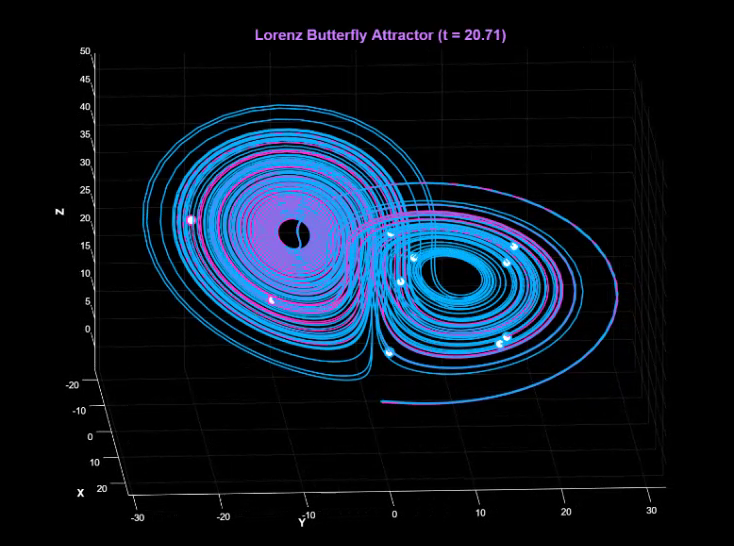
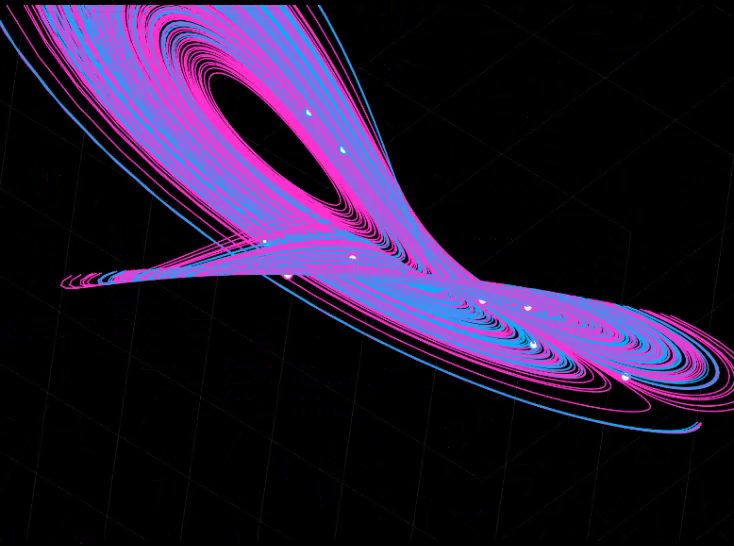
🌪️ Tiny Changes in Initial Conditions, Dramatically Different Trajectories 😍

40,636 views • 4 months ago •via X (Twitter)
14 Comments

lineatize motion differential equations for each component, and then solve general undamped harmonic oscillator equation in matrix form to finds modes (eigenstates) and eigenvalues (natural frequencies):

Thank you for this detailed explanation! We focused mainly on the visual behavior shown in the video and probably should have mentioned some of the underlying mathematics as well. Your addition about the equations of motion, eigenvalues, and normal modes adds valuable depth to the discussion. Thanks for taking the time to share it!

Butterfly effect.
☺️
when you solve this matrix form differential equation, you would want to find singular solution (when determinant =0)… then characteristic equation can be developed to find natural frequencies for all 3 eigenstates (in-phase, out-phase pendulum and spring-dominated cases)
Excellent point! This is exactly the kind of discussion that makes these systems so fascinating. The transition from the matrix equation to the characteristic equation and then to the natural frequencies is a beautiful piece of physics and mathematics working together. 📚
I especially like your mention of the different eigenstates (in-phase, out-of-phase, and spring-dominated modes). It would be interesting to see how far the actual chaotic trajectories deviate from these linear normal modes as the oscillation amplitude increases. Thanks for adding this deeper perspective
I think it is fascinating to simulate chaotic behavior for demonstration purposes (it is good for advertising powerful simulation tools), but, for educational purposes, it’s reasonable to add some analytical/engineering context, so readers, at least, understand the purpose of it
What is really fascinates: if you find 3 eigenstates (normal modes) and set initial conditions purposefully to match either eigenstate, the system will oscillate forever in synchronized motion staying in that mode forever… it is act operator A (mass-stiffness) on eigenstate

@NERD2040 🙂
as long as we keep this system linearly behaving within reasonably small angle it would behave identically to behavior of a quantum state it is called in physics (classical and quantum) Phase Coherence.
in QM, when quant. state is in superposition w/ respect some orthonormal basis, it’s not stationary state (probability current flows, but still predictable “sloshing” pattern)… same thing here! pendulum system will remain in superposition repeating, “sloshing" pattern of shapes

If this is represented as a time series angle (theta vs time), and then do it's FFT, do we see sidebands? Can you show it in time domain and frequency domain please?
now… let you randomly bump this pendulum system to start with any random shape… you acting with same operator (matrix) on the system, but this time on superposition vector of all 3 eigenmodes! it will remain oscillate in superposition of all 3… pure identical behavior in QM!