Video yükleniyor...

Video Yüklenemedi

Ana Sayfaya Dön

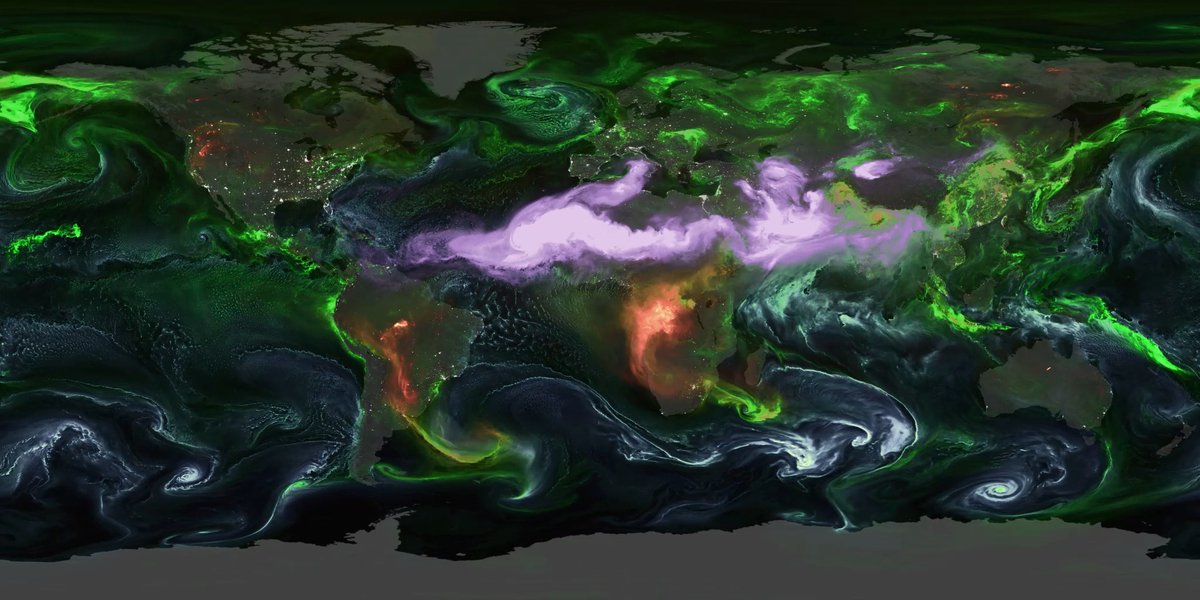
Tiny particles floating in our air. This visualization shows how tiny particles called aerosols move through Earth's atmosphere from August 1 to September 14, 2024, using NASA's Goddard Earth Observing System (GEOS) model. These particles, which include sea salt, dust, smoke, and sulfates, can travel thousands of miles and...

42,507 görüntüleme • 11 ay önce •via X (Twitter)

0 Yorum

Yorum bulunmuyor

Orijinal gönderinin yorumları burada görünecek

Benzer Videolar

Making the Invisible Visible: A Walk for Clean Air This morning, at the invitation of Public Square, I had the honor of using the WalkTalkConnect platform to highlight a cause that touches every breath we take — clean air. I walked with Eng.Tabaro and Ruth, two young professionals passionately advocating for clean air and climate justice. We used a small AirCasting monitor to track real-time PM2.5 pollution levels along our route through Kampala Central Division. The results were sobering: much of the air we breathed was classified as “Unhealthy for Sensitive Groups.” What does that mean in real terms? It means that children, the elderly, and people with respiratory conditions are at risk—just by walking through their own city. This is a serious health risk. “Why does this matter?”, you ask…. Because what we can’t see can hurt us. Fine particle pollution comes from vehicles, open burning, construction dust, and industrial emissions. These tiny particles get deep into our lungs and bloodstream, increasing the risk of asthma, heart disease, strokes, and even cancer. It’s a silent health crisis hiding in plain sight. As a country, we need to enact national air quality legislation, invest in clean public transport, regulate industrial emissions, and increase green spaces in our cities. Clean air is not a luxury. It’s a right. Today reminded me that we all deserve to breathe freely. Clean air is not a luxury. It’s a right. #WalkTalkConnect #KampalaBreathes #WalkForCleanAirUG Joseph Beyanga Joe Walker Anthony Natif Mujuni Raymond

Jacqueline Asiimwe

28,844 görüntüleme • 1 yıl önce

So, when I took this aurora, at first I thought that my settings were not correct because the aurora appeared white. I thought maybe the ISO was off, or I picked the wrong lens. Turns out, what I thought was white is actually light pink, and this led me down a path of learning. Aurora colors are the result of solar particles (think: microscopic sun bullets) interacting with Earth’s magnetospheric electrons (think: a bunch of charged particles which act like a force field around Earth that protect us from direct hits from the sun bullets). When there is a strong solar storm, which is basically a grouping of solar particles headed in our direction, the magnetospheric electrons get bombarded. While they still do their job of protecting us, they get super energized and are accelerated toward our poles. These now high-velocity electrons then hit different gases in the Earth’s atmosphere, mainly oxygen and nitrogen. When this happens, the gas molecules get excited, jump to a different energy level, and emit light at different wavelengths when they return to their original state. The color of that wavelength depends on the collision impact, type of gas molecule, atmospheric density, and altitude. Green is the most common aurora color, and it occurs when the electrons hit oxygen molecules between 60-150 miles altitude. If the solar particles hit oxygen but at a higher altitude, above 150 miles, the resultant color is red. This only happens under intense solar storm activity because of the lower density of atomic oxygen at higher altitudes. At lower altitudes during these intense storms, below 60 miles, auroras can appear purple or blue due to electrons hitting nitrogen molecules or pink when they hit slightly higher nitrogen around 60 miles. Auroras can appear other colors due to mixing of these phenomena. Now when I watch this video, I am amazed by the color variations. This one was very pink-hued!

COL Anne McClain

48,976 görüntüleme • 1 yıl önce

ADDING GARRI FLOUR TO TANKERS FILLED WITH PMS To many of us, this isn't new. I say let me take time to call the attention of NMDPRA that this is still ongoing. Field Observation There is a trend among oil tanker drivers in Nigeria: when a petroleum product (like PMS) tanker develops a slight leak, they often pour Garri into the filled tank. The belief is that the Garri will sink and settle at the point of leakage, effectively sealing the leak and preventing product loss. What’s the Science Behind It? This practice is not based on a chemical reaction but rather a mechanical phenomenon. Here's how it works: 1. Density-Driven Settling: Garri has a higher density than petrol (PMS), so it sinks rapidly to the bottom of the tank where leaks typically occur. 2. Particle Bridging and Plugging: As the Garri particles reach the leak, the flow of fuel through the hole draws particles into it. These particles begin to bridge across the hole, with more particles packing behind to form a plug or cake, effectively reducing or stopping the leak. This is similar to how lost circulation materials (LCMs) work in oil & gas well drilling. 3. Swelling in the Presence of Water: We all know that Garri can absorb water and swell. Even tiny amounts of water at the tank bottom (from condensation or trace water in the fuel) can hydrate the cassava particles, causing them to expand and tighten the seal. 4. No Chemical Reaction: Garri is made of starch and fiber, both of which are polar compounds and insoluble in non-polar hydrocarbons like PMS. So there is no chemical reaction between the Garri and the fuel—only a physical interaction. SAFETY CONCERNS 🦺 There is High Risk of Fuel contamination. Cassava particles mix with the fuel, leading to sediment in vehicle tanks, clogging filters, strainers, and injectors. And among others, PMS contaminated with Garri fails NMDPRA/SON fuel quality specs, especially on sediment content.

Dr. Hidima

34,096 görüntüleme • 1 yıl önce