Video yükleniyor...

Video Yüklenemedi

Ana Sayfaya Dön

Today we release LFM2.5-Encoder-230M and LFM2.5-Encoder-350M: bidirectional encoders that stay fast at long context, even on CPU. > LFM2.5-Encoder-230M: about 3.7x faster than ModernBERT-base on CPU at 8,192 tokens. Under 30s per forward pass, versus over a minute and a half. > LFM2.5-Encoder-350M: 4th of 14 models on GLUE,...

191,046 görüntüleme • 3 gün önce •via X (Twitter)

0 Yorum

Yorum bulunmuyor

Orijinal gönderinin yorumları burada görünecek

Benzer Videolar

QVAC SDK 0.15.0 is live. This release adds multiple prompts batching, brings a native AMD GPU backend to the stack, moves more vision encoders onto mobile GPUs, and adds a second local coding-agent integration. Main highlights: - Prompt batching for the LLM addon. Batch multiple prompts into one job and process them concurrently, with each answer returned the moment its generation finishes. - Native AMD GPU backend. A first-class HIP/ROCm backend in @qvac/vla-ggml, auto-selected over Vulkan with clean fallback when ROCm is absent. - A second local coding agent. OpenClaw joins OpenCode for local, cloud-free agent workflows. AGENTS - OpenCode plugin update (@qvac/opencode-plugin). Aligned with the current SDK, CLI, and AI SDK provider packages. A fresh install runs OpenCode against managed local QVAC models out of the box, from the default qvac/qwen3.5-9b, with no manual qvac serve setup. - OpenClaw plugin (@qvac/openclaw-plugin). A second coding-agent integration alongside OpenCode. A fresh setup installs the plugin, creates a local qvac provider through onboarding, and runs a QVAC model through OpenClaw🦞's local service path. LANGUAGE MODELS - Prompt batching (LLM addon). Batch multiple prompts in one job and run them concurrently, each answer returns the moment its generation finishes, no waiting on the others. - Reasoning-context trimming on hybrid + recurrent models (@qvac/llm-llamacpp). remove_thinking_from_context now works beyond pure-attention models. Same JS API, no throw. VOICE AND SPEECH - Transcription (transcription-parakeet 0.9.0). More robust CPU fallback on GPU failure and a faster Vulkan backend on Pixel 9. - Text-to-speech features (tts-ggml 0.4.0). Adds LavaSR for noise removal and adjustable output frequency up to 48 kHz, plus Japanese via Chatterbox. - Text-to-speech fixes (tts-ggml 0.4.1). CPU fallback on GPU failure, a q8_0 KV crash fix on Metal with Chatterbox. VISION - Qwen3.5 vision encoder on GPU (Android). Image encoder moves onto the phone GPU, with a smarter tile-grid preprocessor and default image-token caps, for flagship Android: Vulkan on Mali (Pixel 9 Pro) and OpenCL on Adreno 830 (Galaxy S25). - Gemma-4 vision encoder on GPU (Android). Vision encoder runs on the phone GPU instead of CPU, same flagship Android targets. PLATFORM AND PERFORMANCE - AMD GPU backend (@qvac/vla-ggml). Native HIP/ROCm backend, auto-selected over Vulkan with clean fallback when ROCm is absent (Linux x64 only). Comes with ~23% faster than Vulkan, ~14% faster than PyTorch-ROCm, parity preserved. Unified code style. A cleaner, more consistent, easier-to-contribute codebase. Let's build. npm install @qvac/sdk

QVAC

29,255,860 görüntüleme • 18 gün önce

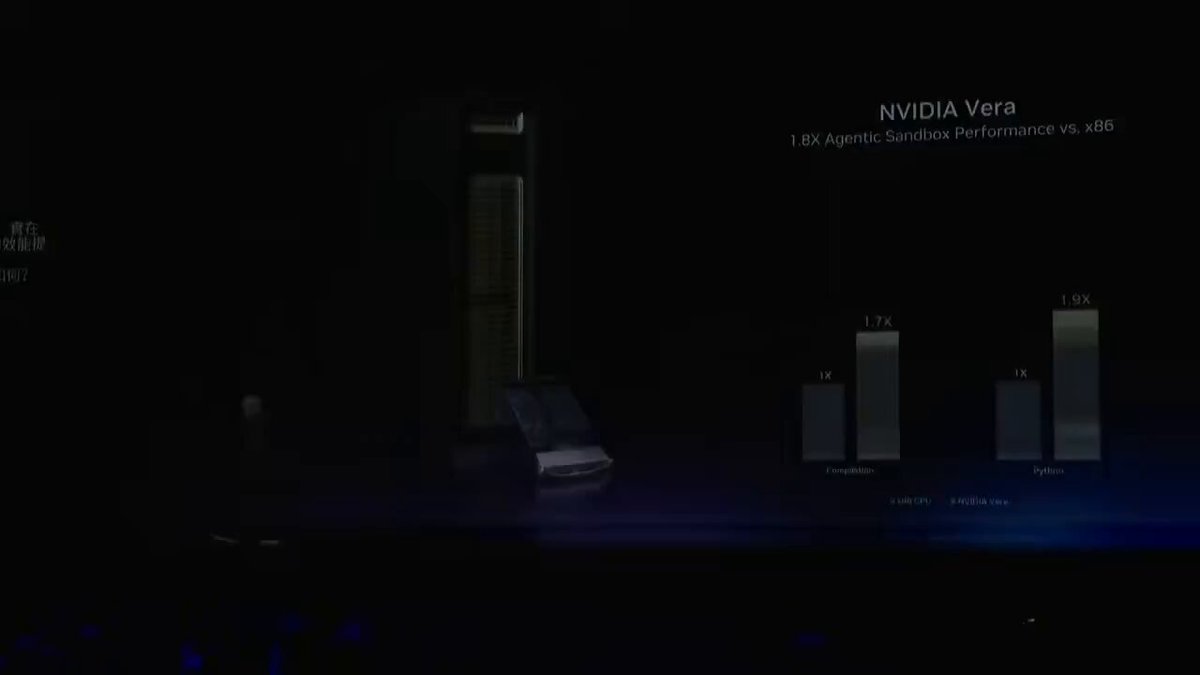
Jensen Huang just identified the next $200 billion market (Save this). The shift starts with a observation about agentic AI that changes everything about infrastructure. In the era of training and inference, the GPU was everything while CPU was a traffic cop, scheduling work, managing memory, dispatching tasks while the GPU did the heavy lifting. Agentic AI breaks that model entirely. An AI agent does not just run a single inference pass but rather it plans, calls tools, executes code in sandboxes, retrieves data from multiple sources and loops through complex multi-step reasoning sequences often thousands of times per second at scale. Every one of those operations runs through the CPU and the GPU sits idle waiting for the CPU to prepare the next task, supply the right context and execute the retrieval and tool calling logic fast enough to keep the accelerators fed. The CPU is now the conductor and the GPU is the orchestra and the bottleneck is the conductor falling behind. This is showing up in production AI factory utilization right now, which is exactly why Jensen built Vera from scratch rather than licensing x86. Vera achieves 40% lower peak memory latency than x86, 50% faster core to core communication, and 1.8 times the agentic sandbox performance of current x86 processors on a purpose-built architecture designed around the agentic loop. Now here is where the investment thesis gets interesting. The obvious beneficiary is Nvidia itself, and that thesis is real. Nvidia's CFO has guided for nearly $20 billion in Vera CPU revenue this fiscal year alone, a market Nvidia had zero presence in just three years ago. Intel held 60% of server CPU market share as recently as Q4 2025 and that transition is now happening at a pace Intel structurally cannot respond to. But the deeper question is, what architecture is Vera actually built on? Vera's Olympus cores are ARM compatible and every single Vera CPU deployed in every Vera Rubin rack in every data center in the world runs on ARM architecture. And ARM Holdings collects a royalty on every one of them. ARM does not make chips but rather licenses the instruction set architecture and CPU core designs that others build on top of. Every time Nvidia ships a Vera CPU, every time a hyperscaler deploys a Vera Rubin rack, every time an enterprise qualifies Vera for their AI factory, ARM earns a royalty. The secular tailwind here is almost perfectly constructed for ARM's business model. Amazon's Graviton, Microsoft's Cobalt, Google's Axion, Apple's silicon stack, and Qualcomm's data center push all run on ARM. And now Nvidia's Vera, which is projected to displace Intel as the largest server CPU supplier by revenue in a single fiscal year, is ARM. ARM's royalty rate on high end server chips is estimated at roughly 1 to 2% of chip selling price. At $5,000 per Vera CPU and 4 million units projected for FY2027, that is a royalty line growing from near zero to potentially $400 million to $800 million annually from Nvidia's data center CPU business alone before counting Amazon, Microsoft, Google, Apple, and Qualcomm. The total ARM addressable royalty base across all the silicon it already licenses is compounding at a rate that the current $130 billion market cap does not fully reflect. Jensen's CPU thesis is the most underappreciated catalyst in ARM's fundamental story, and the royalty compounding has barely started. Come join Milk Road Pro and get our full ARM royalty model and our entire AI trade thesis. Link below!

Milk Road AI

11,819 görüntüleme • 1 ay önce

Google just proved that bigger isn't always better. Their 308M parameter model is outperforming models 2x its size. Google just released 𝗘𝗺𝗯𝗲𝗱𝗱𝗶𝗻𝗴𝗚𝗲𝗺𝗺𝗮, and it's proving that lightweight embedding models can punch way above their weight class. At just 308M parameters (578MB), it's the new state-of-the-art for models under 500M parameters across MTEB multilingual, English, and code benchmarks. But the really impressive part is that it ranks 8th overall on MTEB(Multilingual, v2) - that's 𝟭𝟳 𝗽𝗹𝗮𝗰𝗲𝘀 above the second-best sub-500M model, and it's delivering performance 𝗰𝗼𝗺𝗽𝗮𝗿𝗮𝗯𝗹𝗲 𝘁𝗼 𝗺𝗼𝗱𝗲𝗹𝘀 𝗻𝗲𝗮𝗿𝗹𝘆 𝗱𝗼𝘂𝗯𝗹𝗲 𝗶𝘁𝘀 𝘀𝗶𝘇𝗲. There are three key parts of their training recipe that sets it apart: 𝟭. 𝗘𝗻𝗰𝗼𝗱𝗲𝗿-𝗗𝗲𝗰𝗼𝗱𝗲𝗿 𝗜𝗻𝗶𝘁𝗶𝗮𝗹𝗶𝘇𝗮𝘁𝗶𝗼𝗻 Instead of starting from a decoder-only Gemma 3 model, they first adapted it to encoder-decoder, then used just the encoder. By basing EmbeddingGemma off an LLM that already has world and language understanding, it gives it a stronger starting point. 𝟮. 𝗧𝗵𝗿𝗲𝗲-𝗟𝗼𝘀𝘀 𝗧𝗿𝗮𝗶𝗻𝗶𝗻𝗴 They combine three different loss functions, instead of just having one: • Contrastive loss (NCE) with in-batch negatives and hardness weighting • Spread-out regularization to ensure embeddings utilize the full space (for quantization and ANN retrieval) • Embedding matching distillation from Gemini Embedding - not just learning from relevance scores, but directly aligning the embedding space with the teacher model 𝟯. 𝗠𝗼𝗱𝗲𝗹 𝗦𝗼𝘂𝗽𝗶𝗻𝗴 Rather than just averaging checkpoints from the same training run, they use optimization techniques to find multiple specialized training mixtures. Each mixture creates an "expert" model in different domains, and averaging all their parameters creates a final model that's actually better than individual models. Extras: • Matryoshka embeddings supporting 768, 512, 256, and 128 dimensions • Quantization-aware training - maintains quality even at int4 precision • 100+ languages from Gemma 3 pretraining • Exceptional performance on low-resource languages (check their XTREME-UP results) Is it the absolute best embedding model? No - Gemini Embedding still leads overall. But that's not really the point. EmbeddingGemma proves you can achieve state-of-the-art performance in a small package that's actually deployable on-device, in low-latency applications, and in resource-constrained environments. This makes good embeddings accessible for use cases that I'm seeing more and more: offline applications, privacy-sensitive deployments, and high-throughput scenarios where inference cost actually matters. Full paper: Shoutout to the EmbeddingGemma team at Google DeepMind for this awesome open source work 💙 and to Daniel Williams for helping me with this video! 🫶

Victoria Slocum

21,592 görüntüleme • 8 ay önce

New short course: Attention in Transformers: Concepts and Code in PyTorch. Last week we released a course on how LLM transformers work. This week, go deeper and learn about the technical ideas behind the attention mechanism, and see how to code it in PyTorch. This course is built with Joshua Starmer, Founder and CEO of StatQuest. The attention mechanism was a breakthrough that led to transformers, the architecture powering large language models like ChatGPT. Transformers, introduced in the 2017 paper: "Attention is All You Need" by Viswani and others, took off because of its highly scalable design. In this course, you’ll learn how the attention mechanism, a key element of transformer-based LLMs, works and implement it in PyTorch. You'll develop deep intuition about building reliable, functional, and scalable AI applications. What you will do: - Understand the evolution of the attention mechanism, a key breakthrough that led to transformers. - Learn the relationships between word embeddings, positional embeddings, and attention. - Learn about the Query, Key, and Value matrices, and how to produce and use them in attention. - Walk through the math required to calculate self-attention and masked self-attention to learn why and how they work. - Understand the difference between self-attention and masked self-attention and how one is used in the encoder to build context-aware embeddings and the other is used in the decoder for generative outputs. - Learn the details of the encoder-decoder architecture, cross-attention, and multi-head attention and how they are all incorporated into a transformer. - Use PyTorch to code a class that implements self-attention, masked self-attention, and multi-head attention. There're lots of exciting technical details in this course. Please sign up here:

Andrew Ng

132,270 görüntüleme • 1 yıl önce

Vector Database by hand ✍️ ~ 10 steps walkthrough below Vector databases are the backbone of Retrieval Augmented Generation (RAG). How do they actually work? Goal: index three sentences, then answer a query by finding the nearest one, filling in every cell yourself. = 1. Given = A dataset of three sentences, three words each. In practice it is millions of them. = 2. Word embeddings = Let us look up each word in an embedding table. Here the vocabulary is 22 words; in practice it is tens of thousands, and the vectors have thousands of dimensions rather than four. = 3. Encoding = We feed the sequence to an encoder, one linear layer and a ReLU, and get one feature vector per word. In practice the encoder is a transformer. = 4. Mean pooling = Let us average across the columns. Three word vectors collapse into one, which is what people mean by a text embedding or a sentence embedding. = 5. Indexing = We multiply by a projection matrix and the four dimensions become two. It is doing the job of a hash: a short representation that is faster to compare, and it is what gets saved in the vector storage. = 6. Process "who are you" = Let us repeat steps 2 to 5 on the second sentence. = 7. Process "who am I" = We do it a third time. The database is now indexed. = 8. Query "am I you" = Let us push the query through the very same pipeline: lookup, encoder, mean pooling, projection, and it lands as a 2D vector in the same space. = 9. Dot products = We transpose the query and multiply, which takes the dot product against every stored vector at once. The dot product is the estimate of similarity. = 10. Nearest neighbour = Let us scan for the largest: 60/9 beats 44/9 and 40/9, so the answer is "who am I". Scanning billions of vectors one at a time is what makes this the slow step in practice, which is why real databases use an approximate nearest neighbour index like HNSW. The outputs: Stored index vectors = [5/3, 2/3], [5/3, 0], [7/3, 2/3] Query vector = [8/3, 2/3] Dot products = 44/9, 40/9, 60/9 Nearest neighbour = "who am I" The takeaway: a vector database is an embedding pipeline, a projection, and a dot product. Every step here is arithmetic you can do in pen, which is worth remembering when the word "database" makes it sound like something else. 💾 Save this post!

Tom Yeh

35,070 görüntüleme • 6 gün önce