Loading video...

Video Failed to Load

Go Home

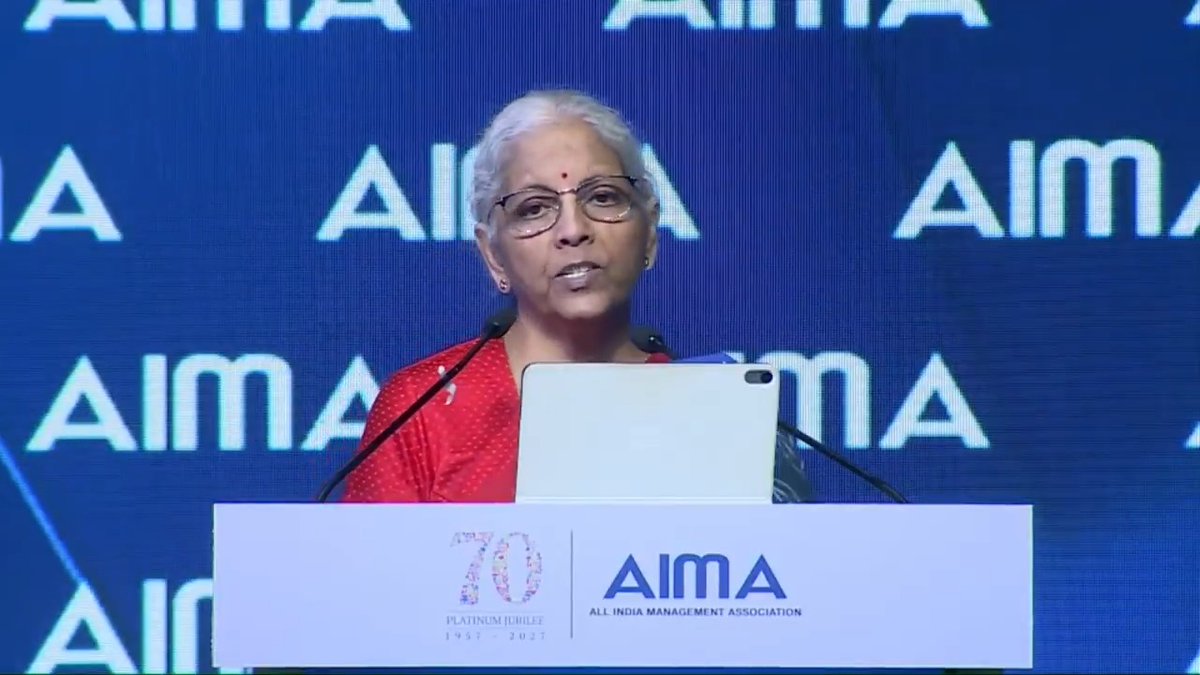
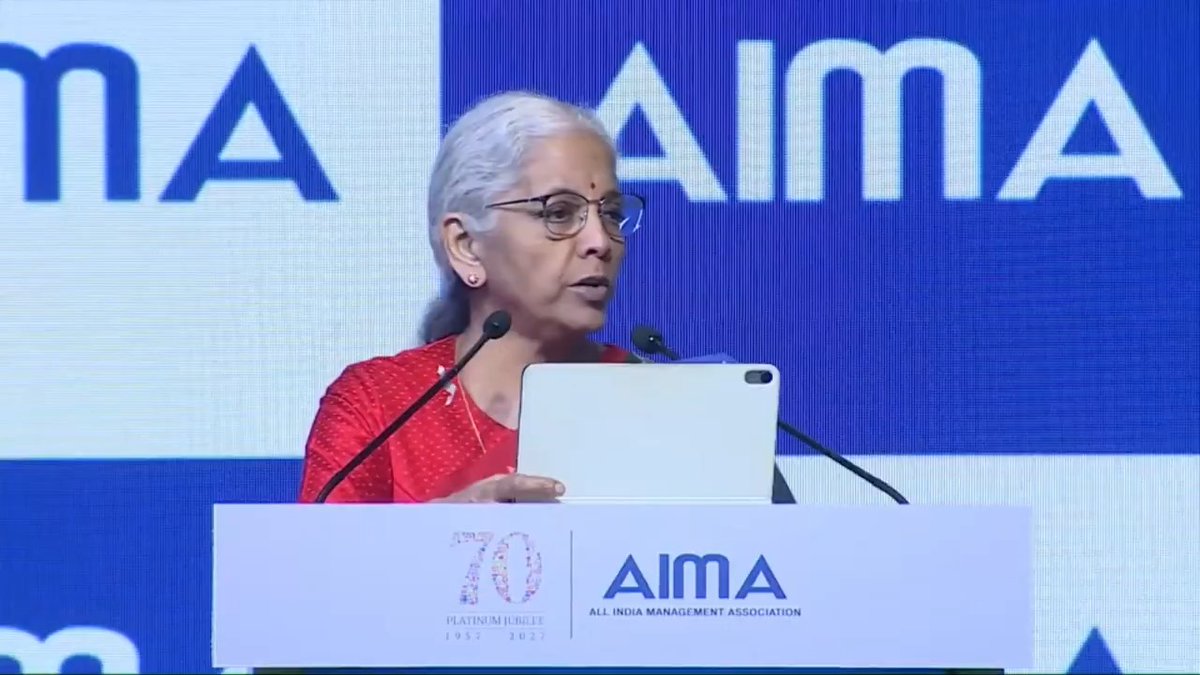
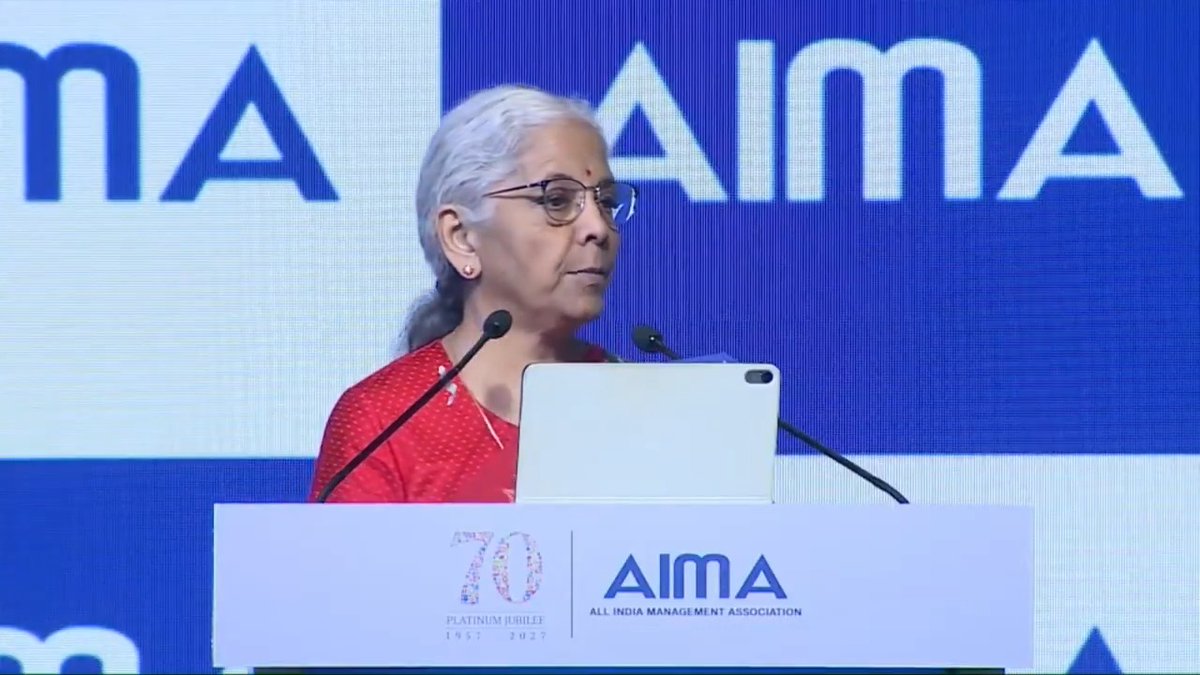
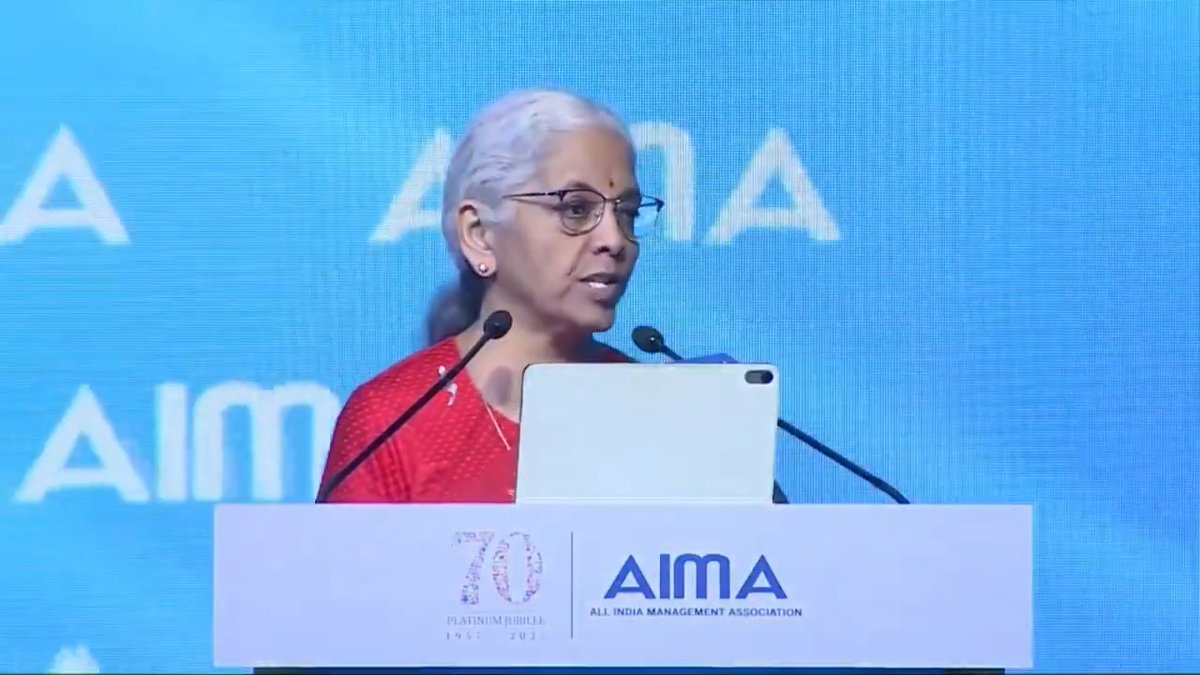
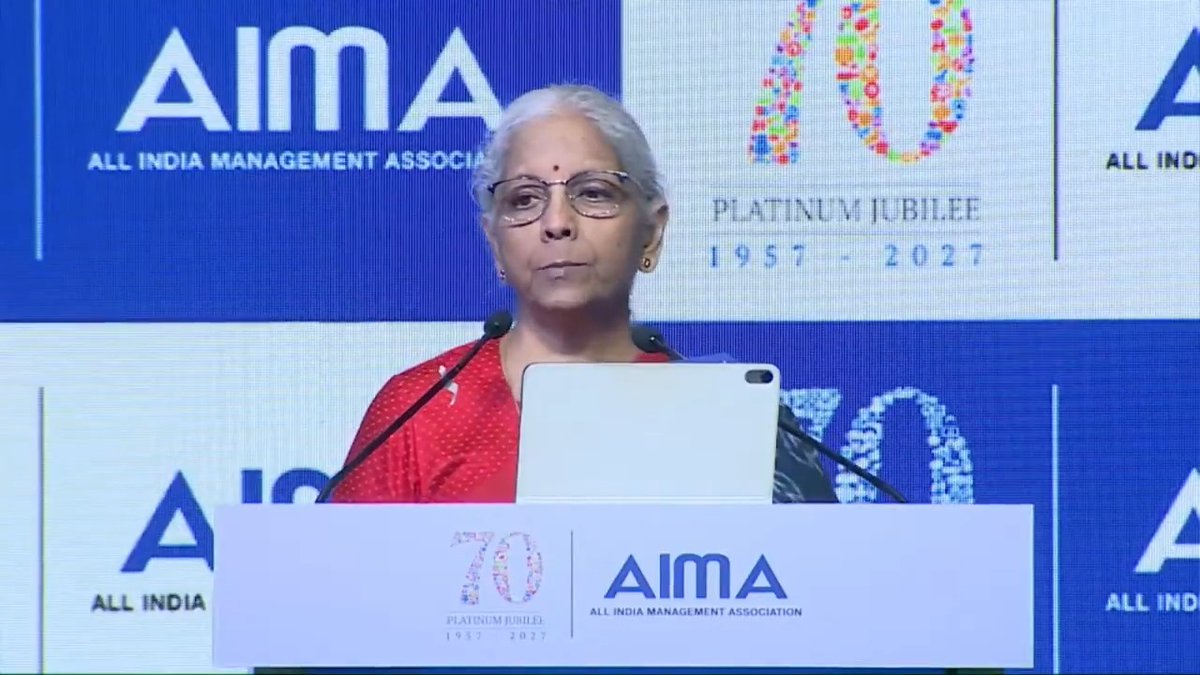
Today’s managers require rigorous grounding in geopolitical supply-chain risk, climate risk, behavioural science, data & regulation and tech-aided project execution. AIMA should drive an industry-wide curriculum reform that aligns business education with actual contemporary challenges. We must produce leaders who can connect disciplines rather than operate within functional silos....

12,578 views • 21 days ago •via X (Twitter)

19 Comments

Nirmala Sitharaman Office's profile picture
Nirmala Sitharaman Office21 days ago

Our ambition should be to lead, not only to adopt. For decades we have learned from practices developed elsewhere, from Kaizen to lean manufacturing. The next step is to create management practices here that the world studies and to set standards that become global norms. It will take sustained effort, but as a nation we are more than capable, we should trust ourselves and go forward. - Smt @nsitharaman at the 53rd National Management Convention of @aimaindia in New Delhi (2/n)

Kapil Mehra's profile picture
Kapil Mehra21 days ago

Shame shame koi tho best fm hoga india mai ya koi fm nahi hai 147 crore logo mai ek bhi fm nahi hai. Jisko knowledge ho finance ki.

Name cannot be blank's profile picture
Name cannot be blank21 days ago

Can your office please take cognisance of the appeals made by the professionals please? It will be extremely kind of you

dxb's profile picture
dxb20 days ago

The destruction created by you will be remembered as dark chapter in capital markets for decades to come

Macc's profile picture
Macc20 days ago

Waste of taxpayers money....

Xavier's profile picture
Xavier20 days ago

She has mental issue

CA Munish Goel's profile picture
CA Munish Goel20 days ago

Mam please the ground reality. The Trade Associations are demanding something which does not have any revenue loss to the government. If all are demanding then there must be genuine reasons. #extendduedateimmedietly

Amit Amit0's profile picture
Amit Amit020 days ago

Madam strike ka kya update h

Sharath Gowdru's profile picture
Sharath Gowdru20 days ago

#shame #shame Tell that arrogant lady to reduce the taxes

Peace Lover's profile picture
Peace Lover20 days ago

#5DaysWeekandFairPLI can u comment on this ? Or you wanna say I am not working in bank so that is not my worry ?

vst's profile picture
vst20 days ago

Share Market blood bath @narendramodi

ASINGH's profile picture
ASINGH20 days ago

Significant words you added like behavioural sciences and data, it shows you are critical thinker

Cheated_by _Samsung's profile picture
Cheated_by _Samsung20 days ago

Need stringent standards for car not lip service which our Respectable @nsitharaman is good at

Wonderpus Photogenicus's profile picture
Wonderpus Photogenicus20 days ago

What about the impact of incompetent policymakers who are so greedy for taxes they have sent the economy into a tailspin by killing taxation. What to do with such idiots?

Abhishek Gupta's profile picture
Abhishek Gupta20 days ago

If you tax people who work and pay people who dont work, do not be surprised a lot of people not working.

deen's profile picture
deen20 days ago

Genuine question, why are you always grumpy mam?

silent eyes..✨'s profile picture
silent eyes..✨20 days ago

Vo 5 days banking me kya issue hai apko?

Vijay Sankhla's profile picture
Vijay Sankhla20 days ago

#5DaysBanking

Musdilalabankwale's profile picture
Musdilalabankwale20 days ago

#5DayBankingNow #UFBUStrike #BankStrike
Related Videos

Introducing FundByHook. A new way to support projects. No round to close. No deadline. No fundraising target. Building doesn’t stop when a funding round ends. We think funding should be able to keep going too. FundByHook is an incubator where each project gets its own token and a funding pool that stays open. People can back a project as it develops. The team draws from the pool over time to fund its work. The first fund is $RISK, the official token of FundByHook and Risk Labs, our studio. It comes with RiskLAB:500 generative compositions drawn onchain. CA: 0xbF0347cB1347B58e11Cd2Ba60854E0DD60d5F12F Here is how it works. FUNDING THAT STAYS OPEN A conventional raise has a finish line: a date, a target, a round to close. The work that follows rarely fits that calendar. On FundByHook, each pool runs through a Uniswap v4 hook. The hook controls a single liquidity position. External liquidity providers cannot add to it or pull liquidity out. You back a project by buying its token. You can sell through the same pool, subject to its available liquidity and the sell tax. The team receives funding in three ways: → 1% on buys, paid to the team → 10% of the ETH paid out by sells, paid to the team → A manual draw of 1% of the pool’s current ETH reserve, available at most once every seven days The draw does not accumulate. Waiting three weeks does not unlock three withdrawals. The team must trigger it, and each draw starts a new seven-day wait. Tokens remain in the pool. ETH leaves to fund the work. Each draw lowers the pool price slightly. After launch, the fund contracts have no admin setters, pause or upgrade functions. Only the team can trigger the draw. The funding rules stay fixed. Contracts by Tim and Risk Labs. FUND 1: $RISK $RISK has a fixed supply of 500 tokens. 400 seed the pool. It starts with no ETH: buyers bring it in. Buys move the price up; sells move it down. The remaining 100 $RISK are allocated to Risk Labs to reward people who help move our projects forward. The first 5 go out this week to people who helped move ELA forward. Those 100 tokens are not locked by code. We are responsible for how they are used. $RISK also has a visual form. RiskLAB is a collection of 500 generative compositions built from frames, cells and nodes. Both the images and their metadata are generated onchain. ONE TOKEN. ONE PIECE. With NFT mirroring enabled, each whole $RISK in your wallet corresponds to one RiskLAB piece, an ERC-721. 12.93 $RISK = 12 pieces + a 0.93-token fraction. Transfer a piece and one whole $RISK moves with it. Sell 1 $RISK from that balance and you are left with 11 pieces and 0.93 $RISK. One piece is burned; its ID can later be reissued. Your tokens and pieces are two representations of the same holding. NFT mirroring is enabled by default for ordinary wallets, and holders can change their own setting. THE PLATFORM TOKEN $RISK is the official token of FundByHook. Each fund launched on the platform will have its own token; $RISK remains the token of the platform and Risk Labs. It is also how we want holders to participate in what Risk Labs builds next. Our commitment: every future Risk Labs project will share a portion of its fees with $RISK holders. That commitment comes from the lab. It is not enforced by the $RISK contracts. The percentage, timing, eligibility and distribution mechanism are still to be defined. There is no fee-sharing mechanism live in these contracts today. On $RISK itself, all buy fees, sell taxes and team draws go to the team. THE DOOR For the first 10 blocks after the pool is seeded, buying is restricted to enlisted wallets. There is a door hidden in a site that was live long before the contract. That is all we will say. WHAT COMES NEXT $RISK is Fund 1. The next funds will come from ideas worth building, whether they come from Risk Labs or anyone else. Eventually, anyone will be able to launch a fund on FundByHook. Today, only the lab can launch. Permissionless launches are not live yet. For the lab, two rules apply: 01 / Each project must run autonomously before we start the next. 02 / Nothing launches without a good idea. $RISK remains the platform and studio token as those projects take shape. That is the experiment: Can funding stay open as long as the building does? Risk Labs starts with $RISK. What we build next has to earn your continued support. FundByHook is open now: Explore RiskLAB on FundByHook: Back the ones you believe in.

Risk Labs

29,308 views • 13 days ago

Yesterday the Portfolio Committee on Police engaged SAPS and IPID on their 2026/27 Budget and Annual Performance Plans. SAPS has a budget of about R127 billion, but more than 80% goes to compensation. That leaves too little for vehicles, technology, infrastructure, investigations, equipment and basic tools of trade. That is a serious concern. SAPS must also stop confusing activity with impact. Arrests and visibility matter, but the real test is whether murders come down, illegal firearms are traced, gang networks are dismantled, corrupt officials are removed, and strong cases lead to convictions. SAPS integrity management must become real. Lifestyle reviews, discipline, procurement oversight and consequence management must lead somewhere. The Divisional Commissioner of Supply Chain Management remains a serious stumbling block and, in my view, must be suspended and further investigated. It is also worrying that so much is still spent on VIP protection while ordinary communities suffer critical policing shortages. VIP protection must be based on clear threat and risk indicators, not status. Last night I joined the City of Cape Town Metro Police gang and drug team on a ride-along in the Athlone area. The operation followed information shared by neighbourhood watch members two nights earlier during foot patrols around Athlone police station. That is the lesson: we need all hands on deck. Imagine if the City of Cape Town could work more directly on gang-related firearm investigations and even support ballistic testing. That would be a massive force multiplier for SAPS. We welcomed the way General Dimpane, the Acting National Commissioner, led the SAPS team with the Acting Minister in Parliament, as well as the improvement under Dr Bila at IPID. But plans are not enough. People need police stations that work, detectives who can investigate, intelligence that leads to convictions, clean procurement and leadership that accounts for results. IC

Ian Cameron

10,464 views • 5 months ago

It’s a wrap! The Innovation Summit North America 2025, which was powered by Schneider Electric, was an incredible, thought-provoking experience. As I share in this video, one of the highlights of my time at the event in Las Vegas was touring the Innovation Park (three times, I think!). The Innovation Park was a large, 45,000-square-foot exhibit space where attendees could engage in hands-on demonstrations and explore cutting-edge technologies and solutions related to energy management, automation, AI, and sustainable infrastructure. Industry leaders and experts provided insights and practical strategies within this interactive environment. I am pretty sure I left the Park with 3 new certifications. However, two of my favorite themes that emerged from ISNA2025 weren’t necessarily technology-focused - - and they really reinforced what I already know to be true: - - The most successful companies in the world know that one of the best ways of optimizing innovation & resilience is by investing in their supply chain ecosystem. I think Schneider Electric illustrates that perfectly. As just one example, the company is working closely with thousands of its suppliers to explore new supply chain decarbonization approaches. Innovations & outcomes certainly come out of these investments, but more importantly, they build trust. And you can move mountains with trust. - - Digital transformation starts with the powerful human factor. And there are tremendous opportunities available, especially to those who are willing to: Learn, Apply, & Volunteer. Those amongst us who are willing to learn and apply something new every day, as well as volunteer for new projects & initiatives: the sky is the limit. As Tom Wilk with Plant Services mentioned to me, the theme of this golden age of supply chain tech should be the lyrics from a John Fogerty song: “Oh, put me in, coach! I'm ready to play today.” Stay tuned for upcoming interviews, details & perspectives via Supply Chain Now in the weeks ahead. We’ve got a lot of good stuff coming up, including my sit-down with Mourad Tamoud, CSCO at Schneider Electric, where, amongst many things, I get his proven perspective on how to build supply chains that perform under pressure. Mourad’s response would make David Bowie & Freddie Mercury proud!

Scott W. Luton

109,709 views • 10 months ago

Gojek completes more food deliveries than GrubHub, Uber Eats, and DoorDash combined, and more rides per day than Lyft. Vikrama Dhiman (Vikrama Dhiman) heads all things product at Gojek Tech, including product management, design, and research, across teams in Indonesia, Singapore and India. He is among the most well-known and respected product leaders in all of Asia, and one of my most requested guests. In our conversation, we discuss: 🔸 The most common traits of successful PMs 🔸 The 3 W’s framework for PM career growth 🔸 The right way to push back as a PM 🔸 The Four A’s of leveling up in product management 🔸 Common pitfalls that stall PM careers 🔸 Advice for transitioning into PM 🔸 Why intent alone is not enough 🔸 Much more Listen now 👇 - YouTube: - Spotify: - Apple: Some key takeaways: 1. As a PM—especially early in your career—make sure you’re nailing execution before you spend too much time on strategy. Effective strategic thinking requires context on the company, product, and stakeholders that you might not have yet. But you always have opportunities to execute and make your team members’ lives easier. As you execute more, you’ll begin to understand the strategic needs more deeply, and you’ll have more opportunities to contribute at that level. 2. Three traits that make you a great PM to work with: a. Raise difficult issues without being difficult to work with b. Bring up important topics without drawing importance to yourself c. Remember that you are in charge of getting decisions made, not making the decisions yourself 3. Good PMs produce good artifacts: PRDs, product notes, design briefs, etc. These demonstrate your proficiency across core PM skills, and they are your opportunity to “have impact on the impact”—to add value to a team that is adding value to the company. If you’re not sure what to focus on next in your PM career, go scrutinize your recent artifacts and ask how they could be improved. 4. To push back on ideas without being difficult to work with, ask clarifying questions and bring the conversation to a logical space rather than an emotional one. Here are some of Vikrama’s favorites: a. Why has this become suddenly important? b. So that I am clear, can you help clarify xyz? c. What would success look like? d. What time frame do you need this in? 5. Vikrama’s 3 W’s framework for PM career growth comprises (1) what you produce, (2) what you bring to the table, and (3) what your operating model is. Strong product managers excel at two of the three W’s. Product managers who rise in their career excel at all three. 6. Three mindset shifts that can enable faster growth: a. Focus on things you can control: Concentrate your efforts on aspects of your role that you can influence or control, especially as you advance in your career. b. Always embrace change: As an IC PM, you experience rapid change. It’s important that as you get to mid/senior level, you never stop looking for ways to improve. c. How you see yourself: Cultivate a positive and growth-oriented mindset about yourself and your capabilities. 7. Three core competencies to focus on when transitioning into PM roles are (1) data, (2) design/research, and (3) technology. Someone from a design background should focus on strengthening data or tech skills to complement their existing expertise. Similarly, someone from a tech background should pick a design skill to focus on. This approach allows for maximum leverage.

Lenny Rachitsky

115,463 views • 2 years ago

A central bank. And Bitcoin. My speech at The Bitcoin Conference 2026 in Las Vegas on 28 April 2026. Video and text; the slide link is below: Today, I want to talk about a strange combination: A central bank. And Bitcoin. Most people do not put these two things together. I do. In monetary policy, a central bank must be conservative. But it must think ahead. When I became Governor of the Czech National Bank in mid-2022, inflation in my country was close to 20 percent. Twenty percent. It was a serious moment. When I took office, I said we would bring inflation back to 2 percent within two years. And we did. Not with magic. With discipline. I said this clearly: Even before covid, money was too cheap for too long. For too long, the system promoted borrowing. For too long, the currency was weakened. We changed that. We kept policy tighter for longer. We supported saving. And the koruna became strong. That, for me, is conservative monetary policy. Our rule is simple: stay hawkish forever. We also manage very large foreign exchange reserves. Very large. We manage about 180 billion dollars in reserves. That is about 44 percent of GDP. Relative to the size of our economy, our reserves are among the largest in the world. So we have to build the right portfolio for the future. Here, you can see the long-term risk and return. It is based on Czech koruna data, the currency in which our books are kept. Bonds are at the low end. Low risk. Low return. Stocks and gold can offer higher returns. But they also bring higher risk. The next point is the Czech National Bank’s portfolio. Over the past four years, we increased the share of equities from 15 to 26 percent. We also increased the share of gold from almost zero to 6 percent. We built a diversified portfolio. A higher expected return than before. Lower risk than an all-stock portfolio. And even lower risk than an all-bond portfolio. But then came the next question. Can we do more? Can we build an even stronger portfolio for the future This is where Bitcoin comes in. The first time I used Bitcoin, I bought a coffee in Prague about ten years ago. Today, that coffee comes to about 350 dollars. It was the most expensive coffee of my life. Bitcoin has had very high returns. But honestly, it looks risky. It is much more volatile than other assets. One day, its price may be much higher. Or it could go to zero. Yes, zero. And that is true for other assets too. A stock can go to zero. Even a bond can fail. That is why it is not wise to bet on just one asset. We have to think about the whole portfolio. The next point on the chart is what we found in our new analysis. This is our model portfolio with 1 percent in Bitcoin. And here comes the interesting part. With 1 percent in Bitcoin, the expected return goes up. And the overall risk stays about the same. That is what our new study shows. Why? Because Bitcoin has low long-term correlation with many traditional assets. It does not move in the same way. And that matters. When you add an asset like this, the whole portfolio can work better. The return can go up. And the risk can stay about the same. That is diversification. Over the long term, Bitcoin can provide returns that are not closely linked to other assets. In some ways, it is similar to venture capital. But it is much more liquid. So we started a separate test portfolio with Bitcoin. A test portfolio. Not a revolution. Not a political statement. A test. We will run it for two years. Then we will publish the results. Then we will decide what comes next. Be conservative in monetary policy. Be innovative in how we work. This is the future. Česká národní banka

Aleš Michl

68,813 views • 5 months ago

Did you know that 2 NBM/Aye/Black Ax£ cultists, Burna Boy and Davido, performed at the start of the ongoing World Cup event? These are the kinds of scores NBM should be counting, not the scores of human lives. NBM is one of the largest cult groups in Nigeria, with many good and bad members within its ranks, yet it has allowed the bad ones to dominate the narrative, causing its destruction by its own self. A group with all the potential to break away from violence and become a force for peace has instead chosen to follow the same path of violence and destruction we continue to witness today in Nigeria and across the world. A group led by confused, corrupt, and weak leaders with histories of violence, controlling members who continue to d!£ daily while remaining afraid to speak out. Cult groups must start electing only national leaders whose voices carry weight and can be obeyed. Leaders who can release a statement during clashes and bring violence to an end. Leaders who can approach rival cult leaders to resolve problems before they even escalate. July 7 is a good time to remind all NBM cultists that there is nothing left to prove. NBM must start addressing problems through lawful means rather than violence. They must start counting positive achievements rather than de@ths. If NBM refuses to change its bad ways, its violent orientation, and its weak leaders, more NBM cultists will continue to d!£, and NBM risks being labeled a terr0rist organization very soon - when that day comes, association with the name NBM/Aye/Black Ax£ could damage your name, your reputation, and your brand, whether you are a celebrity or not, and whether you are good or bad. NBM celebrity cultists like Davido and Burna Boy must also know that their time will not last forever. Tomorrow, others will take over, and they will remind them and NBM of what they used their time to do. Start using your platform, voice, and resources to speak out against the cult violence that is mostly affecting members of your own cult group. You still have time. This message is only for cultists. Reject Violence.

Naija Confra

50,048 views • 3 months ago

Vision, Growth, Opportunity — Maharashtra at IABCA 2025! It was a momentous occasion to be at the India–Australia Business and Community Alliance (IABCA) Global Leaders Forum 2025 in Mumbai today. A forum that brings together vision, leadership, and opportunity on a single stage. The energy in the room reflected the growing strength of India–Australia ties, with business, education, and innovation shaping a future of collaboration. India and Australia stand firm on a strong wicket; the time has come to play a 20-20 game in business and cooperation. In today’s dynamic geopolitical environment, both countries must work closely to deepen their partnership. Maharashtra powers India’s growth with 15% GDP, 20% exports, 30% FDI, and 60% data centre capacity. Leading in start-ups and unicorns, it is set to become the EV and steel capital. The comprehensive economic treaty signed recently has opened new doors for mutual growth, and Maharashtra is ready to lead this journey. Our Government is committed towards helping industry and entrepreneurs. All permissions are now given quickly through an online system. Australian businesses should make use of this and invest in Maharashtra. Hon PM Narendra Modi Ji has rightly said that India thrives in its States, and Maharashtra exemplifies this spirit. Already past the half-trillion-dollar economy mark, the State is steadily progressing with robust infrastructure, and global partnerships, positioning itself to become India’s first trillion-dollar sub-national economy by 2029. Vadhavan Port will rank among the world’s top ten, making Maharashtra a maritime superpower. Super expressways will cut logistics costs, while the Navi Mumbai International Airport opens on 30th September 2025. Nearby, Educity will host 12 global universities, with the University of Western Australia and Curtin University already on board, partnering with Gondwana University for Gadchiroli’s steel hub. This collaboration across sectors is reshaping the India–Australia bond. As Hon PM Modi Ji reminded us, the relationship once defined by the three C’s (Commonwealth, cricket, curry), then three D’s (democracy, diaspora, dosti), and later three E’s (energy, economy, education), now stands on the stronger pillars of mutual trust and respect. Maharashtra is proud to be at the forefront of this journey, driving opportunities that will strengthen India–Australia relations and ensure shared prosperity. Minister Jaykumar Rawal, Australia's High Commissioner to India, HE Philip Green OAM and other dignitaries were present. Narendra Modi Jaykumar Rawal Philip Green OAM Gandhi Creations #Maharashtra #Australia #IABCA

Devendra Fadnavis

17,123 views • 1 year ago

This message by the MD/CE Federal Airports Authority of Nigeria Mrs Olubunmi Kuku is an important one. I can feel her frustrations; even from this video. I really do hope it does help to make some change happen. That said, even if these officials behave, even without the begging and soliciting, nothing will ever make seeing 18 officials in uniforms of many colours welcoming for even Nigerians returning home, let alone new visitors to Nigeria. I know this bit is beyond the FAAN. 1. NDLEA should have no business with searches or questioning of passengers. I should have no business seeing an NDLEA official except my luggage triggers their interest. Then, AVSEC can hand the passenger over to NDLEA. NDLEA can be at the airport but to be seen by a passenger means that passenger is already in trouble. 2. Customs should have limited role. This is on the back of the ruling Dr Joe Abah, OON just tweeted. It means Customs should only be required to deal with passengers who bring goods that require their attention. My small luggage should not have to be opened by customs officials ALL the time. It’s a waste of national resources and a waste of passengers’ time. 3. After the scanners, when leaving Nigeria, passengers have no business with any official except their luggage triggered a need. That means all the NDLEA, Customs and whatever else others waiting to ask pointless questions right after the scanner, they should be posted where they can do actual jobs and not the make-belief consular one. 4. DSS have no business with documenting passports in or out. Leave that to Immigration. DSS and Immigration already exchange data. That process must become robust enough to keep DSS away from arriving and departing passengers. Again, except when needed. 5. Arriving passengers should only be engaged based on suspicion. The current practise of engaging EVERY arriving passenger and asking that they open their luggage is anachronistic and frankly speaking, barbaric. I can imagine the sort of headache someone who heads the FAAN will have just wishing to deliver an airport with world class experience or at least a respectable one. However, it’s quite clear than they do not have as much control over the airport as they ought to. The “Authority” in their name is only as far as the FG helps to organise this system to serve Nigeria and its visitors. The airports have a design problem that requires big paradigm shifting solutions from above. All the best to everyone, like Mrs Kuku, doing their best with the design they have been handed.

JJ. Omojuwa

86,364 views • 1 year ago

Today’s testimony before the Madlanga Commission lays bare the rot that runs straight to the top of the SAPS, confirming what the Democratic Alliance has warned South Africans about for the past two years: corruption within the South African Police Service’s procurement environment was never the work of a few rogue officials. It appears to have been systemic, involving senior officials entrusted with safeguarding public funds who instead orchestrated a predatory procurement network for personal enrichment. While violent criminals terrorise communities across South Africa, those sworn to protect the public were allegedly running a procurement mafia, diverting millions intended for policing into their own pockets. This is a betrayal of the highest order, and there can be no more excuses those responsible must be held fully accountable. The DA therefore calls on the relevant law enforcement authorities to move swiftly. If the evidence supports the allegations emerging before the Commission, Lt Gen Molefe Fani must be arrested and criminally charged alongside every individual involved in this corrupt network. Today's evidence paints an alarming picture of how individuals were allegedly communicating with Fani while he was still serving within Supply Chain Management at National Treasury. This raises a deeply troubling question that can no longer be ignored: was Fani deliberately positioned within SAPS Supply Chain Management to ensure that CAT ultimately secured the R360 million health tender? This allegation strikes at the heart of public procurement integrity. If procurement officials were strategically placed to manipulate tender outcomes for politically connected companies, then this was not merely maladministration it was the deliberate capture of the SAPS procurement system. For the past two years we have repeatedly warned that serious irregularities within SAPS procurement required urgent investigation. At the end of 2024, following the Auditor-General's findings exposing serious procurement failures, the DA specifically challenged Fani to account for these glaring irregularities. He was unable to provide satisfactory answers. Instead of confronting the evidence, there was silence and evasion while public money continued to be placed at risk. Today's testimony gives even greater weight to those concerns. The evidence emerging before the Commission demands more than internal disciplinary processes or further excuses. It requires immediate criminal investigation. Anyone who abused their public office to manipulate procurement processes, facilitate corruption or unlawfully influence the awarding of state contracts must face the full might of the law. South Africans deserve a police service that fights corruption not one that is itself compromised by corrupt procurement officials enriching themselves at taxpayers expense.

Ian Cameron

108,719 views • 3 months ago

"Courage is far shorter in supply than genius." - Peter Thiel "One of the challenges in writing a book about entrepreneurship or teaching a class on this is that there is sort of no formula. And I think science always starts with a number two. It starts with experiments you can repeat, things you can do over and over again. But there's sort of a sense in which every moment in the history of business, every moment in the history of technology happens only once. The next Mark Zuckerberg will not be starting a social networking company. The next Larry Page will not start a search engine. The next Bill Gates will not be starting an operating system. And so if you are trying to copy these people, you're in some sense not learning from them. And so I think one of the really big challenges in teaching or writing about entrepreneurship is what can you say about being an entrepreneur at all when the key thing is always to do something new, different, that's not precisely been done before. And so the point of departure I start with in Zero to One is a somewhat indirect approach by asking a series of contrarian questions. The business question is, what great company is nobody starting? The more intellectual version of this question is, tell me something true that very few people agree with you on. And this is a fantastic interview question. It turns out to be quite a hard question, even when people can read on the internet that you ask of everybody who comes in the door, it still is a hard question. It's one of those unusual questions where if you know it's on the test, it's still hard. And it's hard not just because we sort of think that new things require brilliance or something like that, but because it's socially difficult. If I ask you that question, if you tell me something like the education system is screwed up or our political system doesn't work very well, those are true answers, but they're not actually good answers because all of us already know them to be true. The good answers are ones that are somehow uncomfortable that the person interviewing you does not actually want to hear. And I think we live in this world where courage is in far shorter supply than genius. And so it is sort of this, it is in a sense this problem of political correctness properly understood, is this very deep, very, very broad sort of a problem."

Founder Mode

12,339 views • 8 months ago

THE JOHANNESBURG PROPERTY COMPANY’S GRACE AND FAVOUR LAND DEALS In the final instalment of my series on the foreign takeover of what was once an upscale, leafy suburb neighbouring the affluent Bedfordview enclave in the East Rand and Kensington in Johannesburg, we can now more openly explore the potential corruption linked to Helen, the CEO of the Johannesburg Property Company, and the suspiciously low-priced fire sales of valuable city-owned land in Johannesburg. One likely explanation involves the extent to which these and other properties have been offloaded under dubious circumstances, when they should never have been sold at all. A recurring theme is the acquisition of properties that serve as key transport hubs. The suspicion is that the entities behind these purchases, including the Erf 133 properties, are biding their time, expecting Johannesburg will eventually be forced to buy them back—at vastly inflated prices. This is exactly what's unfolding with the Jabulani Property and Calgro M3. A small portion of the Erf that was initially sold for just R1.00 is now allegedly being sold back to the council for R45 million. Similarly, the Chinese owners of the Bruma property, who recently evicted the taxis using the land—with no alternative location for the taxi rank—are now lying in wait for the City of Johannesburg to make them an offer they can't refuse. It is important to understand that Johannesburg Property Company does not have the authority to dispose of land at will and that rules do apply, even to Helen Botes. The authority under which Johannesburg may dispose of land derives from its supply chain management policies; in particular, its “Supply Chain Management Policy: Land” (“SCMP:L”). This is under the auspices of the Local Government: Municipal Finance Management Act, 2003 (the “MFM Act”) The copy of the SCMP:L, which I have been able to locate, is, in fact, unsigned, so its authenticity needs to be established. However, the City of Johannesburg must supply an authentic copy, valid as at the relevant dates (from 2010 onwards). Assuming that my copy is authentic, the following is of relevance: 1. The thrust of the SCPM:L is to ensure that the Johannesburg land is disposed of in a fair and transparent manner. 2. “Available vacant land” is defined in the SCMP:L as “land not necessary to provide minimum municipal services, including but not limited to gardens, parks and similar facilities…..” 3. Section 7 (2) (a), which provides that the accounting officer (the Municipal Manager of Johannesburg) may not delegate his or her power and duty to make an award exceeding R 10 million; 4. Section 12 (1) (b), which states that the alienation strategy should “ensure that irreplaceable land is not lost to COJ (City of Johannesburg) or the public, taking into consideration the principle that COJ land should not be sold, but should rather be made available for use or development purposes by means of long-term and short-term leases;” All of this, of course, hinges on the condition that the land actually generates revenue for Johannesburg, rather than being handed out in grace-and-favour deals to foreign investors. With the taxi rank now forced to use the main road through Bruma for parking, creating a significant traffic issue, and as complaints continue to pour in about the taxis clogging the road, the theory gains traction: it’s only a matter of time before the City of Johannesburg will have to approach the Chinese owners and buy back the land to accommodate the planned transport hub in the area. I reached out to the Johannesburg Property Company for details and comments regarding the alienation of Erf 133 in Bruma. Specifically, I asked whether the City of Johannesburg had indeed been paid for the land, requested evidence of the payment, and inquired about the total amount received and any outstanding balances.... 1/2

Nicole Barlow

65,527 views • 2 years ago

How have the fundamentals of building large, distributed software systems changed the last decade? A conversation with Martin Kleppmann (author of Designing Data-Intensive Applications) - given that the second, updated edition of the book was just released. Timestamps: 00:00 Early career 05:46 Building Rapportive 10:47 Working at LinkedIn 14:09 Writing Designing Data-Intensive Applications 23:00 Reliability, scalability, and repeatability 26:24 DDIA: the second edition 30:50 Tradeoffs of using cloud services 39:02 How the cloud changed scaling 42:53 The trouble with distributed systems 49:02 Ethics for software engineers 52:45 Formal verification 1:00:12 Academia vs. industry 1:03:50 Local-first software 1:09:50 Computer science education 1:18:32 Martin’s current research and advice Brought to you by: • Statsig – ⁠ The unified platform for flags, analytics, experiments, and more. • Sonar – The makers of SonarQube, the industry standard for code verification and automated code review. Check out Sonar's new architecture management capabilities that ensure both humans and AI agents respect your system’s blueprint. • WorkOS – Ship enterprise features – SSO, directory sync, RBAC, audit logs – in days, not months. Three things worth considering, as discussed with Martin, in this episode: 1. Multi-region and multi-cloud are risk/cost trade-offs, not best practices. Martin does not believe that there is a “best practice” in deciding whether to go multi-region or multi-cloud. This decision is a tradeoff between risk and costs. It’s a business decision to be made. Designing Data-Intensive Applications gives engineers the vocabulary to articulate the tradeoffs, not to dictate answers. 2. Replication for fault tolerance is more relevant for most engineers these days than sharding. Though the book has a full chapter on sharding, Martin said that the cloud has reduced the need for manual sharding for the majority of teams. This is also because machines are increasingly bigger, and more workloads fit on a single machine. Sharding across machines is increasingly a specialist concern; replication for fault tolerance, however, is still relevant at every scale. 3. Knowing system internals as a superpower for application developers. Martin maintains that Designing Data-Intensive Applications is not a book for people who build databases or even infrastructure, but it’s helpful for application developers to develop an intuition for making good design decisions and debugging performance issues we will eventually encounter.

Gergely Orosz

79,406 views • 5 months ago

BAN HQ Medical Committee presents Diabetic Awareness - World Diabetes Day 2024. World Diabetes Day is observed every year on November 14th, marking an important opportunity to raise awareness about diabetes and advocate for better prevention, diagnosis, and management of the disease. The day became an official United Nations (UN) day in 2006. This year’s theme, "Access to Diabetes Education," underscores the need for better information and resources to help prevent and manage diabetes effectively. The Medical Team of Brothers across Nigeria (BAN) worldwide is proud to recognize World Diabetes Day by supporting the established framework for diabetes education, which includes: 1. Learning and Knowledge Sharing. 2. Prevention. 3. Identification and Treatment. UNDERSTANDING DIABETES Diabetes is a disease that results from excess sugar in the blood, causing serious health problems over time. The Types of Diabetes: 1. Type 2 Diabetes: The most common form, accounting for about 90% of cases. It occurs when the body doesn’t use insulin effectively or doesn’t produce enough. 2. Type 1 Diabetes: An autoimmune condition, usually diagnosed in childhood, where the body cannot produce insulin. 3. Gestational Diabetes: Occurs during pregnancy and usually goes away after childbirth, but it increases the risk of developing type 2 diabetes later in life. 4. Prediabetes: A condition where blood sugar levels are higher than normal but not high enough to be considered type 2 diabetes. 1 in 3 adults has prediabetes, highlighting the need for early intervention and lifestyle changes. SYMPTOMS OF DIABETES The symptoms of diabetes vary, and some people (especially those with prediabetes, gestational diabetes, or type 2 diabetes) may not experience symptoms at all. In type 1 diabetes, symptoms usually appear quickly and are more severe. Common symptoms include: I. Increased thirst or urination II.Fatigue III. Blurry vision IV. Slow-healing sores or infections RISK FACTORS A variety of factors contribute to the risk of developing type 2 diabetes, including: Age and genetics, Lifestyle factors:, poor diet, lack of physical activity, and smoking increase the likelihood of developing diabetes. Social factors: Access to healthy food, healthcare, and safe spaces for exercise also play a significant role in managing and preventing diabetes. Race and Ethnicity: People from certain racial or ethnic backgrounds, including Black, Hispanic, American Indian, and Asian American populations, are at higher risk for type 2 diabetes. Discrimination and stigma: These factors can exacerbate the challenges faced by marginalized communities in managing diabetes. COMPLICATIONS When diabetes is not properly controlled, it can cause serious and even life-threatening complications, including Heart disease and strokes, Nerve damage (neuropathy), Kidney damage, Eye problems, Foot issues, Skin and mouth infections, Hearing loss, Memory issues, Depression and Anxiety. PREVENTION Preventing or delaying type 2 diabetes is possible through early lifestyle changes. The following strategies can help reduce the risk of developing diabetes: 1. Eat a Healthy Diet 2. Get Active 3. Maintain a Healthy Weight 4. Quit Smoking 5. Limit Alcohol Intake 6. Get Regular Checkups 7. Manage Stress 8. Sleep Well CONCLUSION World Diabetes Day is an important reminder of the growing global impact of diabetes and the urgent need for education, awareness, and action. This year’s theme highlights the critical need for better information and resources to prevent and manage the disease. By focusing on education, early detection, and lifestyle changes, we can work together to reduce the burden of diabetes and create a healthier future for all. #BANWorldwide, #BrothersAcrossNigeria #WorldDiabetesDay, #WDD2024, #DiabetesAwareness, #KnowYourNumbers, #DiabetesPrevention, #14November, #AccesstoDiabetesCare

Brothers Across Nigeria International

13,735 views • 1 year ago

🚨 ECHR LEGALISM IS THWARTING LEASEHOLDER LIBERATION 🚨 A fascinating The Spectator Michael Gove Madeline Grant interview with Dominic Cummings explores how the Human Rights Act (the HRA) and judicial review can produce perverse outcomes that undermine the public interest and faith in our democracy. Lord Gove calls the HRA and the ECHR’s Article 1 of Protocol 1 (A1P1) an “effective blocker” to liberating leaseholders, laws that government lawyers invoked during his time as Housing Secretary to constrain policymaking, effectively prioritising the rights of the rich and corporations over those being looted in their own homes. The discussion is directly pertinent to the leaseholder liberation movement now. Everyone should watch it in full, but here’s a snippet if you’re short for time. If ministers and civil servants won’t admit that the HRA, ECHR, and judicial review regimes are blocking reforms that would help voters, leaseholders, and the economy, and are instead protecting leasehold extortionists by keeping policies that benefit the people off the table, we will. There has been an invisible policymaking process unfolding since the general election. It is an internal process that voters and leaseholders are not being allowed to see. This works in tandem with the secretive lobbying campaign by Big Freehold centred on Number 10 and the Treasury. We are talking about a framework shaping policymaking on leasehold and commonhold reform. This framework takes its cues from the Human Rights Act and the ECHR, specifically A1P1, as well as the Attorney General’s new legal risk guidance, which encourages ministers to avoid measures that carry a risk of judicial review. Rather than doing right by voters and the economy by ending leasehold, a The Labour Party manifesto commitment, this government is leaning into a legalistic approach, prioritising its weird HRA/ECHR politics and letting fear of judicial review by big-money lobbyists kill off policymaking in the public interest. In his recent review of the ECHR for the Conservative Party, top British barrister Lord Wolfson KC observed that the convention, particularly A1P1, which we know affects leasehold reform, is an invisible hand in government decision-making today and has the effect of “ossification of public policy”. Lord Wolfson added: “Article 1 of Protocol 1 (protection of property) will have had significant effects in terms of Government decision-making in all sorts of contexts that affect ‘prosperity’, but these will not necessarily be ‘visible’: some policies will be left on the cutting-room floor, or not even considered in the first place, in order to avoid potential challenges down the line.” What policies materialise over the coming weeks in the Draft Leasehold and Commonhold Reform Bill will largely depend on whether ministers have successfully pushed back against Whitehall’s weird legalism and reasserted parliamentary sovereignty. We know that the freeholder lobby has, all this time, been using a dog whistle to engage Number 10, the Treasury, the Attorney General, and the Cabinet Office, talking almost obsessively about “legal risk” and “legal uncertainty”. Whether we get peppercorning of ground rents, a £250 per annum cap, or neither will depend on whether this government has ultimately chosen to put HRA, ECHR, and judicial review ahead of the interests of voters and leaseholders. Alongside these measures, other vital reforms to end leasehold as an exploitative money-making racket in people’s homes and to phase out third-party freeholders in a mass shift to commonhold are also at stake. We are exposing this and will continue to do so because it’s what democracy demands, and others are going to great lengths to control the debate, smear, and intimidate those who seek the truth. To watch the interview in full, see link in post below 👇

Free Leaseholders

11,647 views • 9 months ago