正在加载视频...

视频加载失败

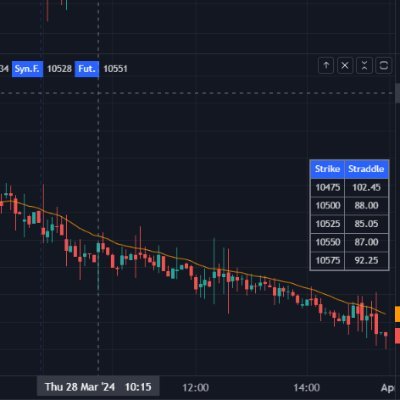
Trading View - Option Chain Experimental Indicator that shows CE/PE Ltp, Volume, Traded Value (Ltp x Volume) for the chart timeframe Once OI data is available on Trading View , OI data will be added as well. Link [ Animation - Traded Value per min.
46,583 次观看 • 2 年前 •via X (Twitter)

11 条评论

Keshav Arora 的头像
Keshav Arora2 年前

Ek hi Dil hai Kitni baar jeetoge sir 🙏

blackswan 的头像
blackswan2 年前

Oh wow this looks cool 👌

Aniket jain 的头像
Aniket jain2 年前

What are benefit of it 🤔

AKM 的头像
AKM2 年前

Great work 👍

TradingAlgo 的头像
TradingAlgo2 年前

This looks 🔥

Arghya Ray 的头像
Arghya Ray2 年前

Excellent

Mr. आत्मनिर्भर बेरोजगार 的头像
Mr. आत्मनिर्भर बेरोजगार2 年前

Very nice

Aman Jain🫰🏻 的头像
Aman Jain🫰🏻2 年前

Kya baate hai Sir. Ek number

Shivam Pardeshi 的头像
Shivam Pardeshi2 年前

Damn 🙌🏻

Rajesh.D 的头像
Rajesh.D2 年前

It's only for bank nifty??

I Luv Markets 的头像
I Luv Markets2 年前

Go to Inputs and adjust the Ref Strike and Expiry Date

相关视频

My conversation with Tarun Chitra As a co-founder of Gauntlet and GP at Robot Ventures, Tarun has one of the sharpest frameworks for understanding market structure across both crypto and AI. In this episode we dig into why open source AI is unbundling faster than most people expect, and how the resulting stack looks surprisingly similar to DeFi. We spend time mapping the AI infrastructure layers directly onto crypto primitives and examining where value is actually going to accrue as models, harnesses, routers, and inference providers separate. At the center of the conversation is the belief that AI’s unbundling is creating a new competitive order-flow market (data centers competing like nodes, MEV-like dynamics for tokens/GPUs) while crypto itself has settled into a more mature “TradFi plus+” phase focused on trading, payments, and bringing real assets on-chain. We discuss: - The current state of crypto as TradFi+ and the decline of speculative narratives - Why AI is killing Bitcoin mining economics and weakening ETH value accrual - The architectural parallel between AI stacks and DeFi (Harnesses = Wallets, Routers = DEX aggregators, Models = Protocols, Inference Providers = LPs) - Why open source models are unbundling faster than traditional software - Agents as the next interface layer and the potential unbundling of ETFs -Cryptography, verifiable compute, and turning GPUs into digital assets - Onchain compute trading as the real crypto × AI opportunity - Sustainable business models and where value will ultimately capture Timestamps: 0:00 – Introduction & State of the Crypto Market 2:00 – Speculative Narratives Fade, Trading & Payments Remain 7:00 – AI’s Impact on Bitcoin Economics & Data Center Opportunity Cost 9:00 – ETH Value Accrual, Solana Positioning & DeFi Token Sustainability 15:00 – Trading Design Space & On-Chain Volume Upside 25:00 – AI Unbundling Thesis: Open-Source Models vs Data Centers 35:00 – The DeFi Mapping (Harnesses, Routers, Models, Inference) 48:00 – Agents, Preference Expression & Unbundling Traditional Products 1:00:00 – Real-Time Harness Generation & Active Learning 1:05:00 – Cryptography, Verifiable Compute & On-Chain GPU Markets 1:10:00 – Closing Thoughts: Where Value Accrues Next Enjoy!

Logan Jastremski

23,499 次观看 • 2 天前

Why did Ian Whiffin agree to give expert testimony on Jen McCabe’s cellphone extraction, when the state refused to let him look at or even give him the full, original extraction OR its verification hash? A thread🧵 Full cellphone extractions, sometimes called forensic images, generate what’s called a “hash value”, which serves as a unique digital fingerprint necessary for ensuring the integrity of data. Any discrepancy between the hash values indicates tampering with or corruption of evidence, alerting forensic examiners to potential issues with the evidence. Hash verification is a fundamental principle and a rather ubiquitous practice in the world of digital forensics, where data validation and verification are key. It is the gold standard across the industry, and has also become so in the courtroom, whereby admissibility of digital evidence is determined by its relevance, authenticity and reliability. In court, the hash value can be used to demonstrate that the evidence has not been altered since its collection, and is a universal way for experts to authenticate and validate the reliability of data for the trial Court. But, an extraction that’s missing a hash value altogether is a huge red flag. 🚩 Who removed the hash value? And why? It’s necessary to the chain of custody, and as Gaurino and Tully would be well aware, it’s also an element of the data that an expert would require in order to verify and validate it. There’s no “good” reason for why someone would remove a hash value, and the extraction can’t be characterized as a forensic image as its origin is unknown. This was a deliberate step taken to hide something, which one could argue shows consciousness of guilt. If the data are true and accurate, why would you bring their integrity into question by removing the hash? However, if the data were altered or tampered with, and let’s say, hypothetically speaking, you wanted a digital forensic expert to provide testimony supportive of your “Google search” theory. . . In that hypothetical, you’d have to remove the hash value. Otherwise, the expert would immediately detect that the data were altered, as they would not be able to verify the hash against the original. #KarenReadTrial #JusticeForJohnOKeefe #FreeKarenRead #CantonCoverup #PoliceCorruption #KarenRead #Cellebrite #DFIR

Olivia

270,376 次观看 • 1 年前

CSS in 2024 🤯 You can create a range slider with updating value tooltip and color changing track without using any JavaScript 🤯 ::-webkit-slider-thumb{ view-timeline: --thumb inline; } Scroll animation on the slider thumb that animates a number between the "min" and "max" of the range 😅 @​property --value { syntax: ' '; } @​keyframes sync { to { --value: 100; }} Tie that up to the contain animation-range ⚡️ .control { animation: sync both linear reverse; animation-timeline: --thumb; animation-range: contain; } Hoist the view timeline so the tooltip can use the value too! :root { timeline-scope: --thumb; } Then use it in the counter which goes in the tooltip 😇 .tooltip { counter-reset: val var(--value); } .tooltip::after { content: counter(val); } Then the accent color is based on the value too 🎨 [type=range] { accent-color: hsl(var(--value) 90% 65%); } The magic from the quoted post is using anchor positioning on the range thumb to position that tooltip 👏 Never thought of that when working on the spec for this API. This API lets you tether elements to other elements. Using the pseudo is a clever move! ::-webkit-slider-thumb { anchor-name: --thumb; } .tooltip { position: absolute; anchor-default: --thumb; left: anchor(50%); bottom: calc(anchor(top) + 25%); } The last piece is the little bounce transition... OK. I used a line or two of JavaScript for that 🙏😬 const updateDelta = ({ movementX }) => { document​.documentElement​.style.setProperty('--delta-x', movementX) } document.body.addEventListener('pointermove', updateDelta) But only so you can pass the movement delta to CSS and then reset the position with linear() to get that bouncy transition 😎 .hint { rotate: calc(clamp(-60, var(--delta-x) * -1, 60) * 1deg); transition: rotate 1s linear( 0, 0.2178 2.1%, 1.1144 8.49%, ... ); } Should probably do a video on this one. Lots of little tricks to break down with it for sure! 💯 As always, any questions, let me know! Also, this one only works in Chrome Canary with the Experimental Web Platform Features flag enabled ✅ This one almost feels like rocket science ha 🚀 CodePen.IO link below! 👇

jhey ʕ•ᴥ•ʔ

251,867 次观看 • 2 年前