Loading video...

Video Failed to Load

Go Home

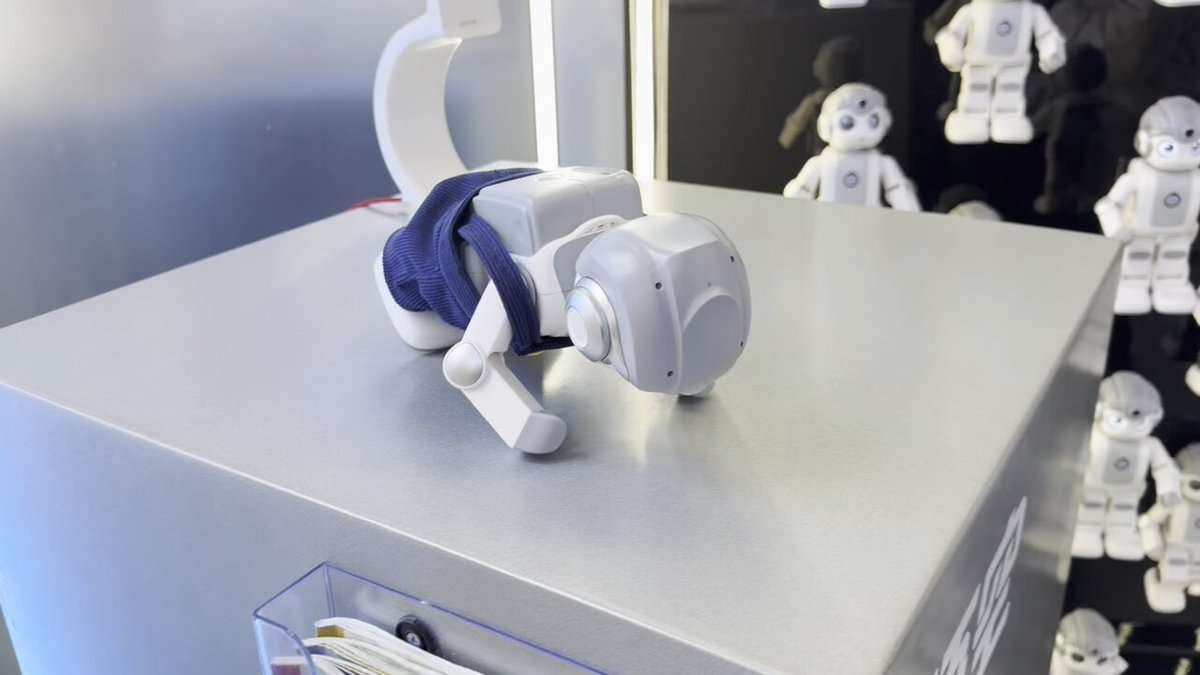
Two months ago, at an RSS workshop panel, I said that general real2sim reconstruction is still far from solved, especially for articulated objects, which will be a major bottleneck for robotics. But now that has totally changed with Astra; using several photos as input, we can easily reconstruct vivid...

18,339 views • 3 days ago •via X (Twitter)

0 Comments

No comments available

Comments from the original post will appear here

Related Videos

It's 2030 and you are reviewing humanoid robots. A Tesla. A Google. An Apple. An OpenAI. A Meta. A Figure. And a bunch of Chinese-made ones. Which one is best, and why? I think the Tesla understands the world much better. Why? There were eight Teslas around me on the freeway today. Start there. No other robot company has that data. But my robot is parked at the local high school twice a day. Its cameras see humans in all of our weirdness. How we move. Where we go. Where we walk. Who we talk with. What you are wearing. Whether your hair was combed this morning. That data will lead to robotics breakthroughs. Apple might keep up with its Vision Pro data, but it is too freaked out by the privacy implications of using said data. (On the front are six cameras and a couple of TOF -- Time Of Flight -- sensors that can see everything in your home in great detail). Google has a lot of data, for sure. All my: 1. Email. 2. Calendars. 3. Photos. 4. TV watching behavior. 5. Contacts. 6. Documents and spreadsheets. 7. Files. 8. Location data. So I expect Google's robot will be attractive to many. But how do you see the others shake out over the next five years? Make some guesses. But remember what an AI pioneer told me years ago about AI: it's all about the data. The Chinese ones have huge advantages: the Chinese have more data on their citizens, and many more citizens to boot AND they can make robots cheaper than we can. But now that you know OpenAI is building its own robot you have caught wind of what I've heard from many in San Francisco and Silicon Valley: that humanoid robots are the real prize of AI and will be highly profitable for those that can make them and find customers willing to buy them. Here, too, I learned long ago never to bet against Elon Musk. Will you?

Robert Scoble

33,804 views • 1 year ago

In the summer of 2023, I cold emailed Jensen Huang and asked to capture a NeRF of him at SIGGRAPH. He responded in about an hour and said yes. A radiance field is, in the simplest terms, akin to a 3D photograph. A moment in time, so completely reconstructed that you can move through it and see it from angles the original cameras never occupied. NeRFs were the original method. Gaussian splatting, which debuted at that same SIGGRAPH, has since become the dominant form of radiance field. I called my late friend James, who told me we needed to begin practicing immediately. We ran capture after capture for weeks until we consistently got the capture time down to ~30 seconds with one camera. Later, in a hallway at the LA Convention Center during SIGGRAPH, I captured the portrait you're seeing now, a full 360° gaussian splat of Jensen, rendered here as a 2D flythrough. Afterward, I continued the conversation with him and members of his team to make the case for radiance fields as a foundational representation for imaging. To my surprise, they listened. Three years later, NVIDIA has several works, including NuRec, fVDB, 3DGRUT, and gsplat all utilizing radiance fields. The landscape has evolved enough that the reasoning is obvious. Gaussian splatting has begun to ship across some of the world’s largest industries, including autonomous vehicles, AEC, geospatial, media and entertainment, robotics, e-commerce, hospitality. It’s become clear that lifelike 3D is here to stay. And yet I think we will look back and be disappointed by how late we started taking 3D portraits of the people around us, just like how we have sparse 2D photos of our grandparents and great grandparents. We have billions of photographs of the people we know and love, but almost no radiance fields of them. I'll be returning to SIGGRAPH in LA where this was initially captured three years ago, with the landscape looking significantly different. Radiance fields are more under deployed than ever relative to what they can do. I'm excited for the future of imaging, and for 2D to transition into 3D. I have a few things up my sleeve that I think will make that case plainly.

Radiance Fields

18,084 views • 3 months ago

Universities and High Schools have not moved rapidly enough to guide students to have skills for the next decade. THEY HAVE FAILED. It is a massive crisis that can be averted by understanding what AI and Robotics will bring about. Solutions are knowing how to use these tools and new industries that will rise. But this situation is also on ALL OF US. No “job” is safe from founder to entry level in most industries. You and I, by what we do, will be “replaced” ultimately. What to do? AI and Robotics are tools, the next decade is owned by those who know how to use them expertly, but this is also temporary. We have to understand that what we do for “work” will change giving ultimately a greater value to those that are: Creative Flexible Always learning Willing to be wrong Love being human Love being alive Know history Covet wisdom Knowing all tech has downsides Building strong family and friends Realize many institutions have failed The first four are required for you to be able to live through this period with your sanity intact. The rest will allow you to thrive. There are no true careers at this point anymore. There are advocation and vocations which will either earn you money or give life meaning. We will learn that we are not “what we do”, just like we knew for 99% of human existence. Let that sink in. — You and I are far, far ahead of knowing this and we can do two things: 1) Laugh at the “clueless” 2) Help people understand with grace Go to Reddit if you are 1, in fact don’t follow me because you will not like this next decade and what I post. You are 2 and thank you. Even if you and I have not solved this issue, we can help people understand what is ahead and with determination and creativity bound together to solve it locally. Or human family has done this millions of times. The evidence is: you are here. The Neo Luddite movement has not even begun and it will potentially rip apart society even more than all the fashionable moment in the recent past has. These Luddites will have a good point with the wrong answers cooked up by dying academics that cling to labels, “virtues” and victim hood. It will be readymade for some governments to enter in as “big daddy” to “help us”. You will not like what they do, but you will only know when it is too late. It will include YOU “volunteering” to “leave” by 60, to “help out” CanadaPod style. “Brian, I’m 24 what do I do?”. I hope to do much more here to help. But I do know this: 1) Learn a trade or vocation because it’s valuable. It may also be free to low cost if you do it right. 2) Learn everything you can about USING AI and TRAINING YOUR AI. Your expertise will be in the top 1% for a decade. But not forever. 3) Understand Bitcoin and how it will rise while other things sink. This is a short list for now. We will know more moving forward. When you see videos like this posted below, know one thing: Many of these folks had no real family of mental and physical support. Maybe no parent or one parent. Maybe only a broke system to prepare them for—nothing. This was not their doing. Now it is not your “job” to help them, it is your survival to help them if that is what you need. See some day after the dust settles these 20 year olds will be 40 year olds and running YOUR world. And at some point you may need them more than you think you do. You will need them, as they need you now. THIS IS WHAT PAST WISDOM KNEW. The elders of the past never found the need to piss on the youth and hope for the best. THE YOUTH ARE OUR BEST, let us all find ways to change it, even if every aspect of “the system” wants us to berate them into the ground.

Brian Roemmele

37,681 views • 1 year ago

I spent a month in Shenzhen visiting factories and robotics companies, and the contrast with the U.S. was striking. While Figure and Boston Dynamics hide their humanoids behind closed doors, Chinese companies have massive showrooms open to the public. But what really stood out wasn't just the transparency, it was how good they are at selling. Take UBTech: they've already sold 1,200 humanoid units at $200k each to factories. And here's the kicker, these robots aren't even that useful yet. They can only pick up and drop boxes at 1/10th the speed of a human, and factories still need to hire system integrators to train them for specific tasks. My theory is that these factories are terrified of getting left behind in the robotics/AI wave. They're investing in new tech not because it's ready, but because they can't afford to wait. The second surprise was the breadth of their robotics portfolio. These companies aren't just building humanoids, they're deploying service robots everywhere: restaurants, hotels, apartments. Consumer robots are cleaning houses, pools, pet waste, dishes. They're covering the entire spectrum. But the education piece shocked me most. I picked up what I thought was a high school or college robotics textbook, it was for primary school. The government mandated AI and robotics education starting in elementary school. Almost every single school in China now has AI and robotics curriculum, complete with education robots so kids can learn by building. They're creating a generation that grows up fluent in robotics and AI. China owns the supply chain and the hardware stack. But here's what I think people are missing: the race isn't just about who can build robots faster or cheaper. The U.S. advantage has always been in the layer between hardware and human, the interaction design, the software intelligence, the intuitive interfaces that make complex technology feel natural. China is building the physical infrastructure, but they're also learning fast. Every deployed service robot, every classroom full of kids building with education kits, every factory running humanoids, that's all data collection at scale. The window for the U.S. to establish its wedge is narrowing. It's not enough to be better at AI or software anymore. We need to be building the integration layer, the intelligence that makes physical AI actually useful, not just impressive in a showroom. Because right now, China isn't just manufacturing robots. They're manufacturing a robotics-native culture, and that might be the most defensible moat of all.

Miyu Horiuchi

90,718 views • 7 months ago

If there is a BJP-DMK alliance, I will support, campaign and vote for Chief Minister Joseph Vijay’s party! I have been saying that BJP Tamilnadu is the only force that can challenge CM Vijay ideologically, for which the party has to start working hard and look for long-term dividends. But if the party acts as an extension, or even as part and parcel, of the Dravidian ecosystem by trying to piggyback on one of the Dravidian parties, what is the use of backing such a spent force that doesn’t have any vision or desire to bring about change? Let me make it clear that anti-DMK sentiments run through my blood, and if BJP, a party that I sympathize with, tries to have an alliance with DMK, then I will be compelled to disown BJP too. There can be some compromises in Parliament while passing bills such as the National Investigation Agency (Amendment) Act, 2019, where the DMK supported the Bill. But an electoral alliance between BJP & DMK will not sit well with a hardcore nationalist like myself. Why should I vote for the DMK and help in its empowerment? I’d rather support CM Vijay and his party and send MPs from Tamil Nadu to Parliament who I believe will work in the best interests of the state. I can afford to take this stand because, as a sympathizer of Narendra Modi, I am confident that he can still secure a simple majority, without depending on Tamil Nadu, as he demonstrated in 2014 and 2019. 2024 was an aberration because of several factors. To conclude, in 2029, I will still remain a sympathizer of PM Modi, but if there is a BJP-DMK alliance, I will support, campaign and vote for CM Vijay’s TVK Party HQ

Praveen

113,037 views • 1 month ago

Two weeks ago I fixed one of my teeth with algorithms I wrote a couple of years ago! I got hooked by 3D scanning when I started to work for a software shop in Zurich that was programming 3D computational geometry algorithms for denture scanning to produce crowns (and more). Back then, a typical reconstruction pipeline was like: scan the patient’s teeth using an intraoral scanner, reconstruct the surface mesh, design the restoration digitally, and finally mill the crown out of ceramic. We were working mostly with point clouds and meshes, but it wasn’t just math, it was craftsmanship translated into a digital process. Every micron mattered. You could literally see how a good algorithm meant a better fit in someone’s mouth. Gaussian Splatting isn’t about surface reconstruction, it’s about appearance reconstruction. It doesn’t care about explicit topology, it captures how light interacts with the scene. In a sense, it’s the opposite philosophy of the dental world: instead of modeling what the object is, it models how the object looks. 3D Gaussian Splatting enables applications like training self driving cars, teaching robots to understand their environment, creating virtual worlds, or monitoring real sites. It represents scenes as millions of small Gaussians rendered in real time without the need for meshes or textures. Coming from a world where precision geometry was everything, this shift felt natural. It’s still about reconstruction, but with a different goal: not manufacturing a perfect object, but reproducing how the world actually looks. Two weeks ago I got my first dental crown, made with the same software, reconstruction algorithms, and Swiss precision I once helped develop. I haven’t worked there in two years, but sitting in that chair and seeing the process from the other side was a proud moment. It reminded me why I love this field.

MrNeRF

290,257 views • 10 months ago