Loading video...

Video Failed to Load

Go Home

Uber founder Travis Kalanick’s advice for startups that need to fundraise “If you're a seed stage company, go for funding as late as you possibly can. Go as long as you can scrapping. Get your technology and your traction as far as you can, and you will guarantee yourself...

34,829 views • 2 years ago •via X (Twitter)

2 Comments

Startup Archive's profile picture
Startup Archive2 years ago

Watch the full 2010 Tech Cocktail Startup Mixology Conference featuring Travis Kalanick, presented by @TechCoHQ here:

Startup Archive's profile picture
Startup Archive2 years ago

Want even more startup insights from the world's best founders? Join the 8,000+ founders who read our free newsletter here:

Related Videos

Q: Should startups always raise as much money as possible? In the clip below, Marc Andreessen shares a framework that Benchmark co-founder Andy Rachleff taught him called "The Onion Theory of Risk". You can think of a day 1 startup as having every conceivable kind of risk: founding team risk, product risk, technical risk, market acceptance risk, revenue risk, cost of sales risk, viral growth risk, etc. A startup is basically just a long list of risks, and as Marc explains: "The way I think about running a startup is the way I think about raising money. It's a process of peeling away layers of risk as you go." You raise seed money to peel away the first two or three risks (e.g. founding team risk, product risk, initial launch risk). You raise the Series A round to peel away the next layer of risks (e.g. recruiting risk, customer risk, revenue risk, cost of sales risk) And so on. Basically, you're peeling away risk as you're achieving milestones. And as you achieve milestones, you're both: making progress on your business and justifying raising more capital. So in terms of fundraising, you should be calibrating the amount of money you're raising to the risks you need to pull out of your business for you to raise your next round. For example, if you're raising your Series A round, the best way to do that is to say to investors: "I raised a seed round then achieved ____ milestones and eliminated ____ risks. Now I'm going to raise $X for the Series A to achieve ____ milestones and eliminate ____ risks. This will get the company to ____ state for the Series B round. " This seems fairly obvious, but as Marc points out, it's a much more systematic way of going about things versus just raising as much money as possible, renting fancy offices, and hiring as many people as you can to grow as fast as you can. The more money you raise, the more you dilute your ownership stake in your business so it pays to be thoughtful. Raise the capital you will need to achieve the milestones and eliminate the risks required for your next financing round. It also probably makes sense to give yourself some margin as safety because things never go exactly as planned in startup land. Follow Startup Archive for more tactical startup advice!

Startup Archive

178,597 views • 2 years ago

Q: Should startups always raise as much money as possible? In the clip below, Marc Andreessen shares a framework that Benchmark co-founder Andy Rachleff taught him called "The Onion Theory of Risk". You can think of a day 1 startup as having every conceivable kind of risk: founding team risk, product risk, technical risk, market acceptance risk, revenue risk, cost of sales risk, viral growth risk, etc. A startup is basically just a long list of risks, and as Marc explains: "The way I think about running a startup is the way I think about raising money. It's a process of peeling away layers of risk as you go." You raise seed money to peel away the first two or three risks (e.g. founding team risk, product risk, initial launch risk). You raise the Series A round to peel away the next layer of risks (e.g. recruiting risk, customer risk, revenue risk, cost of sales risk) And so on. Basically, you're peeling away risk as you're achieving milestones. And as you achieve milestones, you're both: making progress on your business and justifying raising more capital. So in terms of fundraising, you should be calibrating the amount money you're raising to the risks you need to pull out of your business for you to raise your next round. For example, if you're raising your Series A round, the best way to do that is to say to investors: "I raised a seed round then achieved ____ milestones and eliminated ____ risks. Now I'm going to raise $X for the Series A to achieve ____ milestones and eliminate ____ risks. This will get the company to ____ state for the Series B round. " This seems fairly obvious, but as Marc points out, it's a much more systematic way of going about things versus just raising as much money as possible, renting fancy offices, and hiring as many people as you can to grow as fast as you can. The more money you raise, the more you dilute your ownership stake in your business so it pays to be thoughtful. Raise the capital you will need to achieve the milestones and eliminate the risks required for your next financing round. It also probably makes sense to give yourself some margin as safety because things never go exactly as planned in startup land.

Michael McGuiness

735,645 views • 3 years ago

Marc Andreessen explains the “Onion Theory of Risk” “I think the single-biggest thing entrepreneurs are missing — both on fundraising and how they run their companies — is the relationship between risk and cash. I’ve always been a fan of something Andy Rachleff taught me years ago. He calls it the ‘Onion Theory of Risk.’” You can think of a day 1 startup as having every conceivable kind of risk: founding team risk, product risk, technical risk, market acceptance risk, revenue risk, cost of sales risk, viral growth risk, etc. A startup is basically just a long list of risks, and as Marc explains: "The way I think about running a startup is the way I think about raising money. It's a process of peeling away layers of risk as you go." You raise seed money to peel away the first two or three risks (e.g. founding team risk, product risk, initial launch risk). You raise the Series A round to peel away the next layer of risks (e.g. recruiting risk, customer risk, revenue risk, cost of sales risk) And so on. Basically, you're peeling away risk as you're achieving milestones. And as you achieve milestones, you're both: making progress on your business and justifying raising more capital. So in terms of fundraising, you should be calibrating the amount money you're raising to the risks you need to pull out of your business for you to raise your next round. For example, if you're raising your Series A round, the best way to do that is to say to investors: "I raised a seed round then achieved ____ milestones and eliminated ____ risks. Now I'm going to raise $ X for the Series A to achieve ____ milestones and eliminate ____ risks. This will get the company to ____ state for the Series B round. " This seems fairly obvious, but as Marc points out, it's a much more systematic way of going about things versus just raising as much money as possible, renting fancy offices, and hiring as many people as you can to grow as fast as you can. The more money you raise, the more you dilute your ownership stake in your business so it pays to be thoughtful. Raise the capital you will need to achieve the milestones and eliminate the risks required for your next financing round. It also probably makes sense to give yourself some margin as safety because things never go exactly as planned in startup land. Video source: Y Combinator (2014)

Startup Archive

63,294 views • 1 year ago

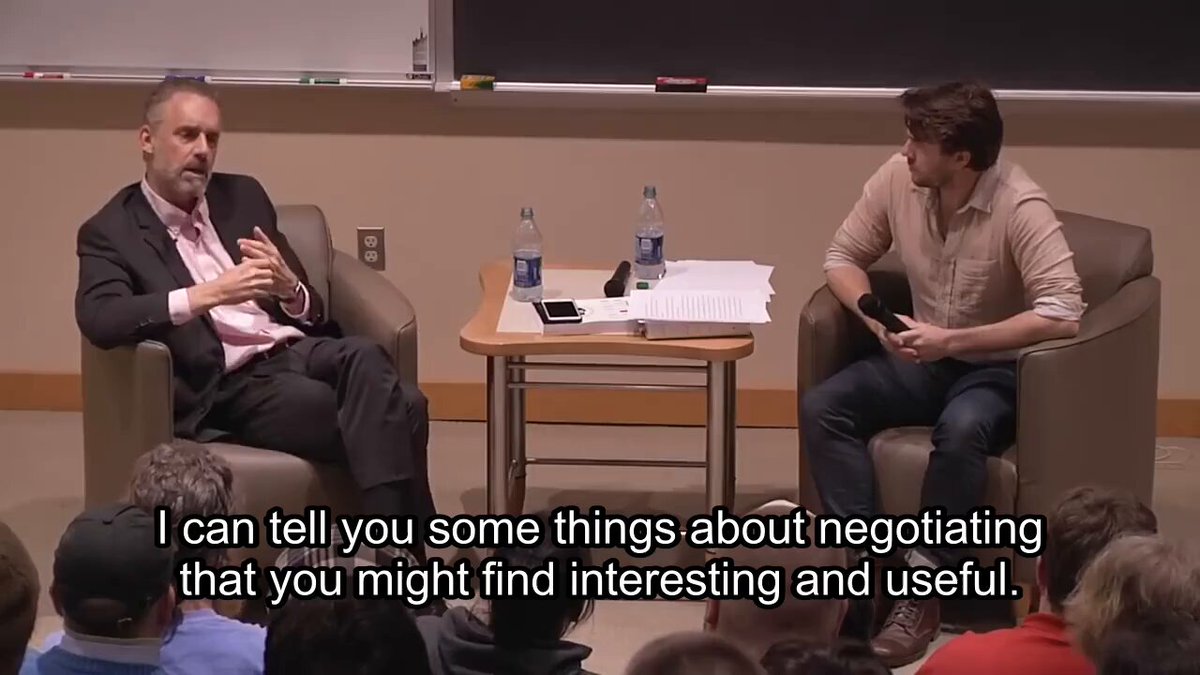
Jordan Peterson: "If you're competent and silent you will be ignored." "You might think well people should reward you because you're competent. And yes of course they should. But if you're competent and silent then you're just part of the background that's keeping everything functioning" On why you cannot negotiate from a position of weakness: "If you want to push your career forward you have to push it forward. You have to be competent and you have to be strategic" "To be strategic when you negotiate for a new position or a new salary you have to be able to say if you don't give me what I want then something you don't like will happen to you" "It's not a physical threat. It's that you have an option" "You have your CV in order. You're educated and competent and desirable to people outside of your immediate job. You're willing to instantly put yourself on the job market" "So that when you go talk to the person you're negotiating with you're credible" On the one thing most people completely miss about negotiation: "It's very seldom that you're talking to the person who's at the top of the pecking order. What you need to do is tell them a story that they can tell to their boss to make you not a problem" "A good story is look we really need this person because they're hyper competent and they have a better offer" "If you go in there with no power you're going to lose. Obviously" He concludes with the one thing every competent person needs to hear: "The first thing you need to know if you're going to negotiate is that you have to be able to say no. And what no means is that you're not going to do it"

Brad

35,334 views • 1 month ago

Don’t Scroll—God Is Calling You to Submit and Move Praise the Lord that He has given us such a commission and such a call and we should be humbled by that and we should want to go out for His kingdom and do that. All of you are usable by God. There is not one of you that is not usable if you're only willing to submit. We all fall short. It's a matter of who is willing. Here I am, Lord, send me. That's what Isaiah said. Here I am. Send me. You are all usable. When a lot of you out there go, well, what can I do for God in my life? There's a lot you can do. If you're only willing to be picked up as an instrument in his Hands and implemented the way you were created to move. Many of you are operating outside the realm of what you were created to be. And in this season, that's going to be reconciled. And many of you are going to change course in this season drastically. Because you're in jobs, you're in areas, you're doing things, you were not created to do. You have gifts for it, but you weren’t created to do it. And there's going to be massive shifts in many of your lives and a sudden turn. And the Lord is going to realign. And this is going to be quick when He does it. Realign you into the position, redirect you and put you on that course because time is short and He needs you operating in what you were created to do. He needs that right now. And many of you are going to enter that process in this season. So praise the Lord because you are. You will enter that process and you will be redirected. And you will do what is written about you in the books of heaven, what you were created to do on this earth. Because many of you know and feel uncomfortable and know you're not in your call. You know you are just trying to try to endure, you're trying to survive. And it's because you're not in your call. Surrender to God, allow Him to redirect you into your call and your purpose that you were beautifully created to do. Because it's needed in this season and we cannot dilly dally anymore and go dabbling in things we are not created to do. It's time for us to go to work and it's time for us to be willing to go there.

Amanda Grace

12,379 views • 4 months ago

jihoon answering teumes’ worries at dawn live 👤: I really wanted to receive a psychiatric (treatment) but I don’t have the courage to do it. Should I go? I think I’m going to have a hard time accepting that I am falling apart. 🐶: but I recommend going to the psychiatrist, whether if it’s receiving a psychological counselling or a psychiatric examination, it’s good to receive a treatment for it. Everyone, going to the psychiatrist doesn’t make you weird. If you caught a cold, you go to the internal medicine department, If your joints or bones hurts, you go to the orthopaedics. It’s just a cold that come to the mind. It’s not that going to the psychiatrist makes me a weird person, no it’s not that. It’s just that I’m exhausted for a while, it’s just a hospital. There’s more people going there more than you think, if you go to hospital, the queuing are the longest. Nowadays, it’s the same as the past too but there’s no one who doesn't have a hard time. In this hard world, although there are people who look at the hard times in a good way, & there are also people who don’t look at it in a good way… but since it’s a world where we lived together, there's nothing we can do about it, right? But those kind of, “ah I went to the psychiatrist & I collapsed” I don’t think you have think of that. It’s just, “I am having a hard time these days so I’m just going to get help for it” just think of it as if you caught a cold. I hope you don’t think of this deeply. Of course you can go. If your stomach hurt, you can go to the internal medicine, if your head hurts, you can go to the Otolaryngology. It’s just that your heart is having a hard time for a while. This is not something to be ashamed of, you don’t need to read the air with the people around you for this. Always cheer up, even if you collapse, let's practice the strength that can make you rise again slowly, treasure makers. You can do it, everyone, I know you can do it.

ain

376,990 views • 2 years ago

The Onion Theory of Risk by Marc Andreessen: "I think the single biggest thing entrepreneurs are missing, both on fundraising and how they run their companies, is the relationship between risk and cash. The relationship between risk and raising cash, and then the relationship between risk and spending cash. So I've always been a fan of something that Andy Ratcliffe taught me years ago, which he called the onion theory of risk. Um, which basically is, you can think about a startup like on day one, um, as having every conceivable kind of risk, right? And you can basically just make a list of the risks. And so you've got, you know, founding team risk. You know, do the founders, are the founders gonna be able to work together? Do you have the right founders? You're gonna have product risk. You know, can you build a product? You'll have technical risk, right? Which is maybe you need a machine learning breakthrough or something to make it work. Are you gonna be able to do that? Um, you'll have, you know, launch risk. Will the launch go well? You'll have, you know, market acceptance risk. You'll have revenue risk. A big risk you get into in a lot of businesses that have a sales force is, can you actually sell the product for enough money to actually pay for the cost of sale? So you have the cost of sale risk. If you're a consumer product, you'll have a viral growth risk. Well, you get the thing of viral growth. And so, a startup at the very beginning is basically just this long list of risks. And then the way that I always think about running a startup is also the way I think about raising money, which is it's a process of peeling away layers of risk as you go. And so you raise seed money in order to peel away the first two or three risks. The founding team risk, the product risk, and maybe the initial launch risk. You raise the A round to peel away the next level of product risk. Maybe you peel away some recruiting risk because you get your full engineering team built. Maybe you peel away some customer risk because you get your first five beta customers. And so basically the way to think about it is you're peeling away risk as you go. You're peeling away risk by achieving milestones. And then as you achieve milestones, you're both making progress in your business, and you're justifying raising more capital. And so you come in, and you pitch somebody like us, and you say you're raising a B round. The best way to do that with us is you say, okay, I raised a seed round, I achieved these milestones, I eliminated these risks. I raised the A round, I achieved these milestones, and I eliminated these risks. Now I'm gonna raise a B round. Here are my milestones, here are my risks. And then by the time I go to raise a seed round, here's the state that I'll be in. And then you calibrate the amount of money that you raise to spend to the risks that you're pulling out of the business. And I go through all this, in a sense this sounds kind of obvious, but I go through all this because it's a systematic way to think about how the money gets raised and deployed. As compared to so much of what's happening, especially these days, which is just, my God, let me go raise as much money as I can. Let me go build the fancy offices, let me go hire as many people as I can, and just kind of hope for the best."

Founder Mode

106,909 views • 8 months ago

Jordan Peterson: "If you can't fix your room, you can't fix your life" "Why should you even bother improving yourself? The answer is something like: so you don't suffer anymore stupidly than you have to. And maybe so others don't have to either. It's not some casual self-help doctrine. If you don't organize yourself properly, you'll pay for it. In a big way. And so will the people around you." Peterson continues: "You can say, 'Well, I don't care about that.' But that's actually not true, you do care about it. Because if you're in pain, you will care about it. It's very rare that you can find someone in excruciating pain who would say, 'Well, it would be no better if I was out of this.' Pain brings the idea that it would be better if it didn't exist along with it. It's incontrovertible." On how to start: "Look around for something that bothers you and see if you can fix it. You can do this in a room. Sit in your bedroom and think: 'If I wanted to spend ten minutes making this room better, what would I have to do?' You have to ask yourself that, it's a genuine question. And things will pop out. There's a stack of papers bugging you. Some rubbish behind your computer monitor you haven't attended to for six months. Cables tangled up." He explains why this matters: "If you were coming to see me for psychotherapy, the easiest thing would be to get you to organize your room. You think, is that psychotherapy? It depends on how you conceive the limits of your being. Start where you can start. If something announces itself as in need of repair that you could repair, fix it. Fix a hundred things like that, your life will be a lot different." On fixing what you repeat every day: "People tend to think of their daily routines as trivial. You get up, brush your teeth, have breakfast. Those probably constitute 50% of your life. People think, they're mundane, I don't need to pay attention to them. No, that's exactly wrong. The things you do every day are the most important things you do. Hands down. Just do the arithmetic." On staying within your competence: "Sometimes you don't know how to fix something. Imagine you're walking down the street and there's a guy who's alcoholic and schizophrenic and has been homeless for ten years. That's a problem. It would be good if you could fix it, but you haven't got a clue. You walk around that and go find something you could fix. Just because something announces itself as in need of repair doesn't mean it's you, right then and there, who should repair it. You have to have some humility. You don't walk up to a helicopter that isn't working and just start tinkering away." Peterson shares the key insight: "As soon as you give your mind a genuine aim, it'll reconfigure the world in keeping with that aim. That's actually how you see to begin with. You've all seen the video where you watch basketballs being tossed back and forth, and while you're doing that, a gorilla walks into the middle of the video and you don't see it. If you thought about that experiment for five years, that would be about the right amount of time to spend thinking about it." He explains what it reveals: "What it shows you is that you see what you aim at. If you can get one thing through your head, that would be a good one. You see what you aim at. One inference you might draw from that is: be careful what you aim at. What you aim at determines the way the world manifests itself to you. So if the world is manifesting itself in a very negative way, one thing to ask is: are you aiming at the right thing?"

Jaynit

68,799 views • 4 months ago