Video yükleniyor...

Video Yüklenemedi

Ana Sayfaya Dön

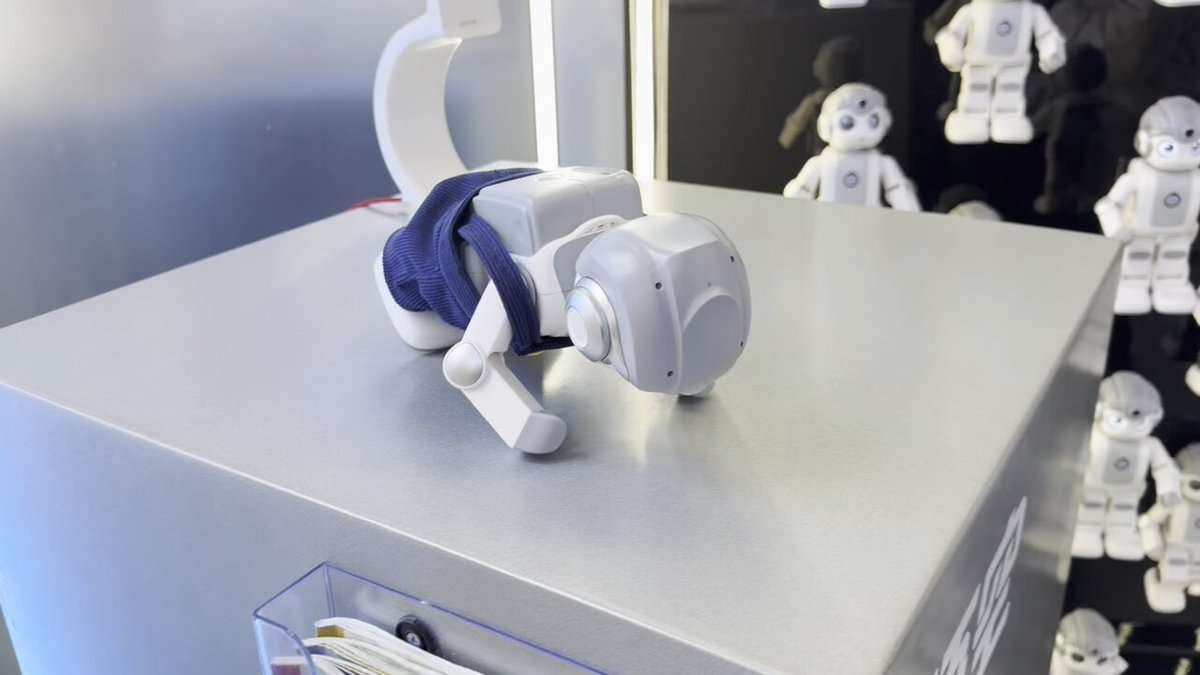
UBTECH just released Walker C1, its next-generation full-size humanoid robot built for “urban co-existence” 🤖 At the upcoming China International Supply Chain Expo, it will serve as the event’s first official “silicon spokesperson,” handling navigation, reception, information queries, and host-style interaction.

37,322 görüntüleme • 4 ay önce •via X (Twitter)

0 Yorum

Yorum bulunmuyor

Orijinal gönderinin yorumları burada görünecek

Benzer Videolar

$BNB turns 9 today! On July 14, 2017, $BNB launched as an ERC-20 token on Ethereum. It started out as a utility token for a young exchange, and nine years later it sits at the center of one of the most active onchain ecosystems in crypto. Here’s a quick breakdown of that journey: 2017 - Launched on Ethereum at $0.15 with a 200M total supply 2019 - Migrated to its own chain and became a native asset for the first time 2020 - Binance Smart Chain went live, bringing EVM smart contracts and making $BNB the gas of a fast-growing dApp ecosystem 2021 - The DeFi and GameFi boom put the chain at the center of onchain activity, and $BNB reached $690 2022 - Binance Smart Chain became BNB Chain, and BNB took on a new meaning: Build N Build 2023 - The stack expanded with opBNB for scale and BNB Greenfield for storage 2024 - Beacon Chain fusion brought staking, governance, and everything else onto one chain 2025 - Pascal, Lorentz, and Maxwell cut block times from 3s to 0.75s, DEX volume set records, and $BNB hit a new all-time high of $1,370 2026 (so far) · Blocks now land in 450ms with 650ms finality, roughly double the throughput the chain had in January Along the way, over 65M of the original 200M $BNB supply has been burned, on the road to a final supply of 100M. The H2 2026 roadmap keeps the focus where it has been all year: doubling mainnet throughput again, and building a next-generation L1 designed for 100K+ TPS with transactions confirmed in under 50ms. Nine years in, and $BNB has never been faster to use, cheaper to move, or scarcer to hold. Happy birthday, $BNB.

BNB Chain

95,995 görüntüleme • 2 ay önce

Acclaimed metal band BABYMETAL has signed to Capitol Records, the first Japanese artist to sign a frontline deal with the label. The group will release new album METAL FORTH, globally via Capitol Records on June 13. “BABYMETAL’s groundbreaking sound and compelling artistic vision have not only cultivated a worldwide following, but have also demonstrably shifted global music culture. We at Capitol Records are privileged to join them in this next chapter as we continue to amplify their international reach and influence with the upcoming release of Metal Forth.” – Tom March, Chairman & CEO, Capitol Records “This year, BABYMETAL celebrates its 15th anniversary and embarks on an exciting new chapter. With Capitol Records as our global partner, the sound of BABYMETAL will resonate across the world as we take on bolder, more dynamic endeavors than ever before. Stay tuned for what’s to come.” - Key “KOBAMETAL” Kobayashi, Producer & Manager of BABYMETAL CEO, BABYMETAL WORLD, LLC As BABYMETAL celebrates its 15th anniversary this year, the band has mapped out a world tour that will include numerous firsts. In May, they’ll embark on their first-ever headline arena tour in the UK and Europe, playing 12 shows across eight countries and concluding at The O2 Arena in London. BABYMETAL is the first Japanese group to headline a show at this iconic venue. The band will kick off its biggest North American tour yet on June 13. The 24-date run will include a June 24 show at The Theatre at Madison Square Garden in New York City. Check for more information. Arena shows in Japan and a tour of Asia will follow.

BABYMETAL

283,372 görüntüleme • 1 yıl önce

NEWS: SpaceX has released a statement after today's successful 11th Starship test flight. "Every major objective of the flight test was achieved, providing valuable data as we prepare the next generation of Starship and Super Heavy. The flight test began with Super Heavy igniting all 33 Raptor engines and ascending over the Gulf. The successful first-stage ascent was followed by a hot-staging maneuver, with Starship’s upper stage igniting its six Raptor engines to continue its flight to space. Following stage separation, the Super Heavy booster completed its boostback burn to put it on a course to a pre-planned splashdown zone off the coast of Texas using 12 of the 13 planned engines. Under the same angle of attack tested on the previous flight, the booster descended until successfully igniting all 13 planned engines (including one that did not relight during the boostback burn) for the high-thrust portion of the landing burn. The booster successfully executed a unique landing burn planned for use on the next generation booster. Super Heavy hovered above the water before shutting down its engines and splashing down. After completing a full-duration ascent burn, Starship achieved its planned velocity and trajectory. During flight, Starship successfully deployed eight Starlink simulators and executed the third in-space relight of a Raptor engine, demonstrating a critical capability for future deorbit burns. Starship re-entered the Earth’s atmosphere and was able to gather extensive data on the performance of its heatshield as it was intentionally stressed to test the limits of the vehicle’s capabilities. In the final minutes of flight, Starship performed a dynamic banking maneuver to mimic the trajectory that future missions returning to Starbase will fly. Starship then guided itself using its four flaps to the pre-planned splashdown zone in the Indian Ocean, successfully executing a landing flip, landing burn, and soft splashdown. Focus now turns to the next generation of Starship and Super Heavy, with multiple vehicles currently in active build and preparing for tests. This next iteration will be used for the first Starship orbital flights, operational payload missions, propellant transfer, and more as we iterate to a fully and rapidly reusable vehicle with service to Earth orbit, the Moon, Mars, and beyond."

Sawyer Merritt

273,302 görüntüleme • 11 ay önce

40 hours of human work. That’s what this humanoid could save every month! A construction company is already testing a Unitree G1 on a real job site, using the robot for site inspections, 360° imaging, data collection and progress monitoring. The robot starts at around $13,500, while the company says its deployment can save roughly 40 hours of work every month. That adds up to around 480 hours a year from a machine that costs a fraction of traditional industrial equipment. The interesting part is that this isn't about replacing an entire construction worker. It's about removing hundreds of repetitive hours from the workflow, including walking inspection routes, documenting progress and collecting information across the site. Humans can then spend their time on decisions and tasks that actually require them. This is where humanoid robots become economically interesting. Construction sites are already designed around human movement, so a robot with two arms, two legs and a human-sized body can potentially work in the same spaces without rebuilding the entire environment. Every additional task it learns turns those same hardware costs into more productive hours. And the economics get even more interesting as prices fall and production scales. A robot that saves 480 hours per year doesn't need to be perfect or replace a full-time employee to justify its existence. It just needs to reliably take over the boring, repetitive work that companies are already paying humans to do. 480 hours saved. Thousands of dollars in hardware. One construction site. This is how humanoids will enter the workforce, not by replacing everyone overnight, but by quietly taking over the hours nobody wants to spend.

Future Memo

18,925 görüntüleme • 14 gün önce

I spent a month in Shenzhen visiting factories and robotics companies, and the contrast with the U.S. was striking. While Figure and Boston Dynamics hide their humanoids behind closed doors, Chinese companies have massive showrooms open to the public. But what really stood out wasn't just the transparency, it was how good they are at selling. Take UBTech: they've already sold 1,200 humanoid units at $200k each to factories. And here's the kicker, these robots aren't even that useful yet. They can only pick up and drop boxes at 1/10th the speed of a human, and factories still need to hire system integrators to train them for specific tasks. My theory is that these factories are terrified of getting left behind in the robotics/AI wave. They're investing in new tech not because it's ready, but because they can't afford to wait. The second surprise was the breadth of their robotics portfolio. These companies aren't just building humanoids, they're deploying service robots everywhere: restaurants, hotels, apartments. Consumer robots are cleaning houses, pools, pet waste, dishes. They're covering the entire spectrum. But the education piece shocked me most. I picked up what I thought was a high school or college robotics textbook, it was for primary school. The government mandated AI and robotics education starting in elementary school. Almost every single school in China now has AI and robotics curriculum, complete with education robots so kids can learn by building. They're creating a generation that grows up fluent in robotics and AI. China owns the supply chain and the hardware stack. But here's what I think people are missing: the race isn't just about who can build robots faster or cheaper. The U.S. advantage has always been in the layer between hardware and human, the interaction design, the software intelligence, the intuitive interfaces that make complex technology feel natural. China is building the physical infrastructure, but they're also learning fast. Every deployed service robot, every classroom full of kids building with education kits, every factory running humanoids, that's all data collection at scale. The window for the U.S. to establish its wedge is narrowing. It's not enough to be better at AI or software anymore. We need to be building the integration layer, the intelligence that makes physical AI actually useful, not just impressive in a showroom. Because right now, China isn't just manufacturing robots. They're manufacturing a robotics-native culture, and that might be the most defensible moat of all.

Miyu Horiuchi

90,718 görüntüleme • 7 ay önce

We are building the home of the doge economy Projects across every major vertical are already gearing up to launch on DogeOS. Builders are cooking. Here's what the community should be excited to explore.... Much Thoughts ✍️ Very 🐕 So Soon... 💱 DeFi Swaps, lending, yield, memes all running on DogeOS with Dogecoin at the heart of it all. This means the most beloved and recognized asset in crypto finally gets a real financial system built around it. Doge stops being just a vibe and starts being productive. The community has been asking for this for years. 🎮 Gaming On-chain games built on DogeOS: play, compete, unlock with Dogecoin. Doge was born from meme and gaming culture. Bringing games on-chain is just Doge coming home. Play to unlock, play to grow, play because it's fun. Gaming is one of the strongest onramps in all of crypto. It's how you turn curious onlookers into active participants. This is a chance to bring the fun and the love of this community to a whole new wave of users, and remind the old ones why they fell in love with Doge in the first place. 🤖 AI Builders are already positioned to ship AI powered dApps, agents, and tools natively on DogeOS. Think automated trading agents, AI assistants that manage your wallet, dApp builders, and solutions that get smarter the more the ecosystem grows. Agents benefit from fast and cheap transaction environments, and that's exactly what DogeOS is built for. DogeOS becomes the rails for the next wave of on-chain AI, with Doge as the fuel. 📣 Community and Social Apps built for the culture. Social tools, creator platforms, community coordination, all on-chain and all for the Doge economy. Dogecoin has always had the strongest community in crypto. Now that community gets its own social layer instead of living as a guest in another chain's world. Dogecoin should be the focal point, not just another asset being served. 🐕 All your desires. One ecosystem. We are building toward the future this community has dreamt of, making Dogecoin the central piece of a real on-chain economy. This is just the start. Much building. Prepare your paws.

DogeOS

43,132 görüntüleme • 18 gün önce