Video wird geladen...

Video konnte nicht geladen werden

Zur Startseite

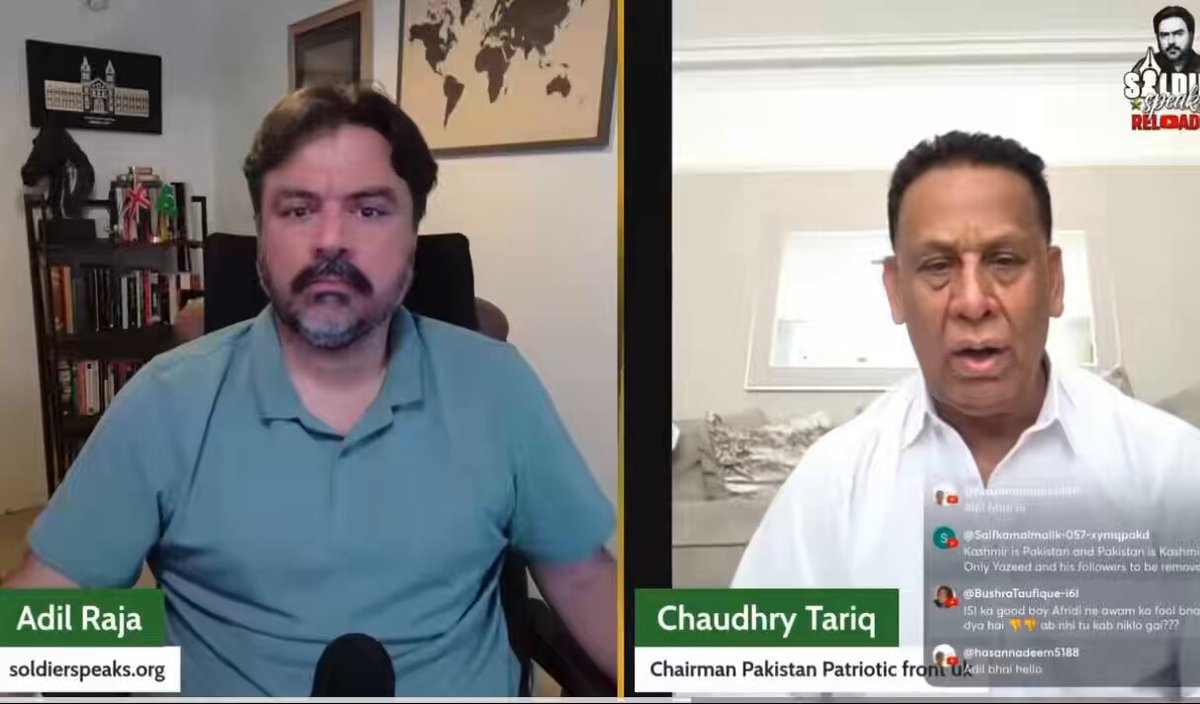
UK-based journalist Adil Raja claims that under the ‘third-party validation’ component of Pakistan’s $1.2 million, two-year lobbying contract with Washington-based Ervin Graves Strategy Group, LLC, some Indian thinkers, columnists, and voices based in the U.S. and within India have also been brought on board. The lobbying agreement, reportedly worth...

20,900 Aufrufe • vor 1 Monat •via X (Twitter)

0 Kommentare

Keine Kommentare verfügbar

Kommentare vom Original-Post werden hier angezeigt

Ähnliche Videos

Siddhant Nagrath’s core line in that Oxford Union “India vs Pakistan” debate is that Pakistan’s structure and incentives make sustained hostility and even war with India politically and economically attractive for those who hold power there, and that this is stabilised not restrained by its nuclear posture. ​ Nagrath argues that for 77 years Pakistan’s ruling establishment has had strong incentives to maintain confrontation with India, including the possibility of military action. ​ He contends that Pakistan’s nuclear weapons do not create responsible restraint but instead enable aggressive behaviour under a protective umbrella. ​ He claims it is “politically infeasible” and “economically infeasible” for those who hold the money, power, and politics in Pakistan to avoid war, because conflict sustains their position. ​ According to him, when there is Indo‑Pak conflict, it is not Indian leaders like Narendra Modi whose electoral prospects improve most, but Pakistan’s power brokers, who gain legitimacy and resources from crisis. ​ Terrorism and security argument Nagrath asserts that Pakistan has systematically given terrorists a home, weapons, training, military aid, intelligence support, and guidance on where and how to strike India. ​ On this basis, he argues India faces a security environment in which Pakistan-backed terrorism and the threat of escalation are entrenched tools of state policy rather than aberrations. ​ Rebuttal to “nuclear stabiliser” claim Responding to the proposition’s portrayal of Pakistan as a “great nuclear” stabilising power, he suggests nuclear capability has not translated into responsible de‑escalation. ​ Instead, he frames Pakistan’s nuclear status as part of a bargaining strategy that allows it to internationalise crises and shield itself while continuing support to terror networks. Debate Context The event occurred amid prior Oxford Union controversies, including a collapsed India-Pakistan debate where Nagrath and peers like Viraansh Bhanushali participated after Indian leaders withdrew. Nagrath has debated Kashmir issues before, opposing independence motions. The video has garnered views on the Oxford Union channel, reflecting interest in India-Pakistan geopolitical discourse. Credit : Oxford Union.

Augadh

23,879 Aufrufe • vor 7 Monaten

For decades, Chaudhry Tariq Mahmood, who is associated with the Pakistan Patriotic Front UK, has been a familiar face at sponsored protests outside Indian diplomatic missions in Britain. He has taken pride in participating in and helping to organise agitations attended by hundreds, often marketed as pro-Kashmir demonstrations but frequently featuring Islamists and Khalistani militants, some of whom are wanted in India over acts of terror and violence. Now, in an interview with ex-Pakistan Army Major Adil Raja, he says he regrets siding with the Pakistani military and organising events at its behest because ‘they use and then abuse people’. Adil Raja, who now lives in the United Kingdom and has become a vocal critic of Pakistan’s military, has himself faced legal and political controversies in Pakistan and abroad. According to Tariq’s account in the interview, he believes he was used by the very establishment he supported until days ago. The irony is difficult to miss. A man who spent years protesting outside the Indian High Commission in London and advancing causes aligned with Pakistan’s strategic interests now finds himself abandoned and vilified by the very same system. This is especially revealing because, in an earlier appearance on Adil Raja’s YouTube channel, Tariq repeatedly referred to Indian security forces in Jammu and Kashmir as ‘kafir forces’, language that reflects a deeply sectarian worldview and suggests that, for some activists, hostility towards India is not political but merely rooted in religious antagonism. Such rhetoric has long raised questions about whether these overseas protests, marketed as human rights or pro-Kashmir demonstrations, are, in reality, vehicles for a more divisive ideological agenda. And this is where the story becomes larger than one man. History is full of people who believed they were serving a cause, only to discover they were being used as instruments. Hatred can be a powerful mobilising force, but it is rarely a stable foundation for a life or a movement. Tariq has also been designated a terrorist by the Pakistani authorities. In the interview, he appears amused that India never did the same and takes credit for it, saying it was because he was innocent. Maybe, Tariq, you were not so innocent. India simply chose not to be as harsh on you as the people you served, even though you spent years protesting against it and vilifying its institutions. And perhaps that is the final irony of all: the people you hated so much as ‘kafirs’ were not, after all, the villains of your story.

Sonam Mahajan

20,847 Aufrufe • vor 1 Monat

#ISPR A delegation of the United States Congress, led by Honourable Jack Bergman alongwith Honourable Thomas Souzzi and Honourable Jonathan Jackson called on General Syed Asim Munir, NI (M), Chief of Army Staff (#COAS), #Pakistan Army, today. Discussions during the meeting encompassed a range of issues of mutual interest, with particular emphasis on regional security and defence cooperation. Both sides reaffirmed the importance of sustained engagement based on mutual respect, shared values, and converging strategic interests. The visiting U.S. lawmakers commended the Pakistan Armed Forces for their pivotal role in combating terrorism and acknowledged Pakistan’s enduring contributions to regional peace and stability. They also expressed deep appreciation for Pakistan’s resilience and the strategic potential of its people. Underscoring their respect for Pakistan’s sovereignty, the U.S. Congressional delegation conveyed a strong commitment to advancing broad-based bilateral cooperation, particularly in the domains of security, trade, investment, and economic development. General Syed Asim Munir conveyed his appreciation to the delegation for their visit and reiterated Pakistan’s desire to further deepen and diversify its longstanding partnership with the United States in a manner that is mutually beneficial and respectful of each other’s national interests. During the meeting MoUs were also signed for training collaboration in the field of Information Technology.

Pakistan Armed Forces News 🇵🇰

15,374 Aufrufe • vor 1 Jahr

Deputy Prime Minister/Foreign Minister Senator Ishaq Dar briefed the Diplomatic Corps on the first anniversary of #MarkaEHaq, describing it as a symbol of Pakistan’s unity, resilience, and the unwavering resolve of its Armed Forces to defend the country’s sovereignty and territorial integrity. He emphasized that Pakistan’s response during Operation Bunyan-um-Marsoos was measured, lawful, and consistent with the UN Charter—targeting only military installations—while warning of the risks of escalation, harm to civilians, and threats to regional peace and security. Reaffirming that the Jammu & Kashmir dispute remains central to regional instability, he called for a just resolution under UN auspices. He also cautioned against unilateral actions affecting the Indus Waters Treaty and highlighted Pakistan’s commitment to multilateralism, peacekeeping, and global engagement. The DPM/FM also briefed participants on Pakistan’s facilitative and mediating role in supporting ceasefire efforts and promoting peace in the Gulf region and the Middle East. Concluding, he reiterated Pakistan’s commitment to dialogue, diplomacy, and peaceful coexistence in South Asia, while underscoring the nation’s and Armed Forces’ resolve to safeguard sovereignty, territorial integrity, and political independence. Held on the first anniversary of Marka-e-Haq, the briefing was part of the DPM/FM’s regular engagement with the Diplomatic Corps on key regional and global developments.

Ministry of Foreign Affairs - Pakistan

11,868 Aufrufe • vor 2 Monaten

Pakistan’s Parliamentary Delegation interacts with Chatham House A high-level Pakistani parliamentary delegation, led by former Foreign Minister and Chairman Pakistan’s People Party Mr. Bilawal Bhutto Zardari Bilawal Bhutto Zardari, engaged with eminent members of the British think tank, academia, and policymaking community at the prestigious Chatham House Chatham House, one of the UK’s leading think tanks focused on foreign and security policy issues. The closed-door discussion was held under the “Chatham House Rules,” which is used around the world to encourage inclusive and open dialogue in meetings. Mr. Bhutto Zardari and other delegation members conveyed Pakistan’s perspective on the recent escalation in South Asia while expressing serious concern about India’s unprovoked military aggression that resulted in civilian casualties and posed a significant threat to regional stability. They underscored that India’s actions constituted a clear violation of Pakistan’s sovereignty, international law, and the United Nations Charter. The #Pakistan delegation said that Pakistan’s armed forces, with the full support of the people of Pakistan, had given a befitting response to India, demonstrating Pakistan’s resolve to defend its sovereignty, and thwarting India’s ambitions to set any new so-called “normal” in the region. Mr. Bhutto Zardari strongly denounced India’s unilateral and illegal suspension of the Indus Waters Treaty. He warned that the weaponisation of water undermines international norms and sets a perilous precedent. He urged the international community to take notice of this alarming development and hold India to account for its actions. The delegation noted that the pending resolution of the Jammu and #Kashmir dispute remains the principal stumbling block to lasting peace and stability in the region. They urged the international community to support meaningful dialogue and ensure respect for international commitments and human rights. The other members of the delegation include Minister for Climate Change and Environmental Coordination, Dr. Musadik Masood Malik Dr. Musadik Malik; Chairperson, Senate Standing Committee on Climate Change and Environmental Coordination and former Minister for Information and Climate Change, Senator Sherry Rehman SenatorSherryRehman; Chairperson, National Assembly Standing Committee on Foreign Affairs and former Foreign Minister, Hina Rabbani Khar Hina Rabbani Khar; former Minister for Commerce, Defence and Foreign Affairs, Engineer Khurram Dastgir Khan Engr. Khurram Dastgir-Khan (HI) ; MQM's Parliamentary Leader in the Senate and former Minister for Maritime Affairs, Senator Syed Faisal Ali Subzwari Faisal Subzwari; and Senator Bushra Anjum Butt Senator Bushra Anjum Butt, Former Foreign Secretaries, Ambassador Jalil Abbas Jilani Jalil Abbas Jilani, who also served as Caretaker Foreign Minister, and Ambassador Tehmina Janjua Tehmina Janjua. Pakistan’s High Commissioner to the UK Dr. Mohammad Faisal Dr Mohammad Faisal was also present during the round table conference. Ishaq Dar Prime Minister's Office Ministry of Foreign Affairs - Pakistan Public Diplomacy Pakistan External Publicity Wing (EPW) Ministry of Information & Broadcasting Press Information Department, Govt of Pakistan PTV News APP Radio Pakistan

Pakistan High Commission London

21,227 Aufrufe • vor 1 Jahr

Time for Kabul to recognize Balochistan independence and reclaim on Pashtunistan 22 February 2026 Afghanistan is a sovereign nation, rich in geography and natural resources, possessing all the necessary means for rapid development and prosperity. Yet, time and again, Pakistan has obstructed Afghanistan’s path toward progress, stability, and lasting peace. For Kabul, the moment has arrived when only one decisive option remains: to put an end to Pakistan’s repeated violations of Afghan airspace and to reclaim the vast territories that, by force, remain under Pakistan’s control. The artificial Durand Line an imposed colonial boundary must be erased, and decisive steps must be taken to reunite Pashtunistan and Southern Pashtunistan with Afghanistan, burying forever the legacy of British imperial division. Until Afghanistan regains its historic lands under Pakistan’s occupation, no matter which political party governs in Kabul, Pakistan will not cease its aerial and other forms of interference in Afghan affairs. Afghanistan has defeated powerful invading empires throughout history. If Afghan forces were to abolish the Durand Line and extend their borders toward Balochistan and near Islamabad, the peoples of Balochistan and Sindh would stand in defense of their lands and airspace, bringing an end to Pakistan’s continued interference in Afghanistan. By recognizing Balochistan as an independent country, Afghanistan could free itself from Pakistan’s economic coercion and expand its direct trade through Gwadar Port, ushering in economic transformation and paving the way for durable peace in the region. Afghanistan and Balochistan, through the strength of their people, have already challenged Pakistan’s military power. Today, Pakistan relies primarily on air strikes. If Afghanistan unites with other like-minded countries particularly India that have suffered from Pakistan’s terrorism and proxy wars and destabilizing actions and succeeds in reclaiming occupied territories, Pakistan would face severe economic and political consequences. Its vast military structure would confront an uncertain future, as the balance of power in the region shifts decisively. Hyrbyair Marri Hamid Karzai Ashraf Ghani S Haidar Hashmi برهان الدین ‏| Burhan uddin Afghan Journalist AfghanBhai U.S. Mission to Afghanistan Kabul Municipality / کابل ښاروالۍ / شاروالی کابل

Mir Yar Baloch

19,450 Aufrufe • vor 4 Monaten

#ISPR Rawalpindi, 2 July 2025 In a significant development aimed at strengthening bilateral defence cooperation and advancing mutual interests, Air Chief Marshal Zaheer Ahmed Baber Sidhu, Chief of the Air Staff, #Pakistan Air Force, undertook an official visit to the United States of America — the first by a serving PAF Air Chief in over a decade. The high-profile visit marked a strategic milestone in Pakistan-U.S. defence cooperation and proved instrumental in deepening institutional ties in addition to addressing key regional and global security issues. During the visit, Chief of the Air Staff held a series of high-level meetings with senior U.S. military and political leadership. At the Pentagon, he called on Ms. Kelli L. Seybolt, Secretary of the Air Force (International Affairs), and General David W. Allvin, Chief of Staff of the United States Air Force. During the meetings the discussions centered around advancing bilateral military cooperation, enhancing interoperability and exploring avenues of joint training & technology exchange. Chief of the Air Staff highlighted the historic and multifaceted relationship between Pakistan and United States, particularly in the domains of defence and security cooperation. He reiterated his resolve to further enhance the existing ties in the realms of military-to-military cooperation and training between the Air Forces of the two countries. The two sides also agreed upon the continuation of high-level military engagements in future through senior-level interactions. These interactions are deemed crucial for maintaining momentum in the ongoing cooperative endeavours in the areas of joint training, operational exercises and military exchange programs between the two nations. At the U.S. State Department, the Air Chief met with Mr. Brown L. Stanley from the Bureau of Political-Military Affairs and Mr. Eric Meyer from the Bureau of South & Central Asian Affairs. The meetings served as a forum to underscore Pakistan’s constructive role in promoting regional stability, its firm commitment to counterterrorism efforts and its nuanced perspective on the evolving geopolitical dynamics of South and Central Asia. As part of his engagements at Capitol Hill, Chief of the Air Staff held substantive dialogues with prominent members of the U.S. Congress including Mr. Mike Turner, Mr Rich McCormick and Mr Bill Huizenga. These interactions reinforced the importance of robust engagement in strengthening bilateral relations and provided a valuable opportunity to share Pakistan’s views on strategic challenges, regional security frameworks and the impact of emerging technologies on defence cooperation. Emphasizing Pakistan’s status as a peace-loving nation, the Air Chief reaffirmed the country’s enduring sacrifices and notable operational achievements in the global war on terror, while also outlining Pakistan’s evolving security calculus in response to the rapidly shifting regional geopolitical landscape. The landmark visit not only reaffirmed Pakistan Air Force’s commitment to promoting regional and global peace, but also laid the groundwork for renewed institutional collaboration, strategic dialogue and enhanced interoperability between Pakistan Air Force and the United States Air Force.

Pakistan Armed Forces News 🇵🇰

13,969 Aufrufe • vor 1 Jahr

FLASHBACK Sept 22, 1965 ZA Bhutto In UN Security Council : Indian Occupied Kashmir, A Disputed Territory: "..... Jammu and Kashmir is not an integral part of India and has never been an integral part of India...." (Watch Historical Footage). Asim Iftikhar Ahmad, PR of Pakistan to the UN Permanent Mission of Pakistan to the UN Ishaq Dar 6 January 2025 - SFJ Communique To Prime Minister of Pakistan Re: Pakistan’s Election to UN Security Council Seat Sub:Support The Right to Self-Determination through Referendum For People Of Indian Occupied Punjab and Kashmir. Honorable Prime Minister: Sikhs for Justice (SFJ) ( is an international human rights advocacy group which believes in and adheres to UN Charter and works to promote the Right To Self Determination and human rights as enshrined in Universal Declaration of Human Rights (“UDHR”) and the International Covenant on Civil and Political Rights. To this end, SFJ is holding the first ever global non-governmental Khalistan Referendum under the supervision of a nonaligned panel of experts - the Punjab Referendum Commission - on the question “Should Indian Governed Punjab Be An Independent Country?”. We are writing to extend our warmest congratulations to you and the nation of Pakistan on Pakistan’s successful election to a seat in the United Nations Security Council. This significant achievement reflects Pakistan’s dedication to international peace, justice, and the principles enshrined in the UN Charter. Your recent statement reaffirming the right to self-determination for the people of Kashmir through the plebiscite as prescribed in UNSC Resolution 21 of 1948 is both timely and commendable. It is a reminder to the international community of the moral and legal imperative to support oppressed peoples’ right to seek freedom and justice. While unequivocally supporting the right self-determination for the people of Kashmir through UN backed plebiscite to which India has reneged on, SFJ urges your government to consider extending its support to the Sikh community’s ongoing quest for self-determination. The global referendum being organized by SFJ is a significant effort to highlight and advocate through peaceful and democratic means, their demand for a sovereign homeland Khalistan in the Indian Governed region of Punjab. We firmly believe that Pakistan’s leadership at the Security Council can pave the way for constructive dialogue and meaningful resolutions that uphold the right of all peoples to determine their own destiny and political future of their homeland. Pakistan’s support for Sikh people’s movement to achieve Khalistan through Referendum, will further strengthen Pakistan’s longstanding stance of right to self-determination for the people of Kashmir through a UN backed plebiscite.

Gurpatwant Singh Pannun

13,861 Aufrufe • vor 1 Jahr

In recent years, what has been happening in Khyber-Pakhtunkhwa is not just a military conflict, it is a deep-rooted social reaction. 1/ The growth of Tehrik-i-Taliban #Pakistan (#TTP) cannot be explained solely by ideology or external influence, this phenomenon is the direct result of oppression and harsh measures by Pakistan’s military in Pashtun regions. 2/ Every time the Pakistani military conducts operations, arbitrary arrests, civilian killings, humiliation, and economic deprivation, public anger turns into organized resistance. For many in the region, this process has become a “natural response,” not something planned from outside. /3 TTP cannot be seen as an imported group, it is a movement emerging from the Pashtun community itself. There are 30 million Pashtuns living in Khyber Pakhtunkhwa, and another 20 million in other parts of Pakistan. This large population has long felt treated as second-class citizens by the central government and military. /4 When such a population experiences decades of oppression, losing land, rights, economy, and security, it is not surprising that armed resistance emerges. /5 The Pakistani army has consistently tried to blame Afghanistan for internal instability, but the reality is clear: •The Durand Line is fully fenced and controlled by Pakistan’s military •All border crossings are under strict surveillance •No one can enter or exit without monitoring, /6 So, claims that TTP enters from Afghanistan are simply a political excuse to avoid domestic responsibility. The truth is, TTP originates from the oppressed areas of Khyber Pakhtunkhwa and has nothing to do with Afghanistan. /7 As long as Pakistan’s policies continue to involve, •Shelling Pashtun villages •Bombing weddings •Kidnapping youth without trial •Suppressing Pashtun identity in media and education /8 the growth of this movement will not stop. Tehrik-i-Taliban Pakistan is neither ‘imported’ nor “imposed”, it is the natural outcome of decades of injustice in Pashtun lands. As long as Pakistan’s policy remains based on oppression and militarization, resistance will continue. /9

Najib Farhodi

70,424 Aufrufe • vor 8 Monaten