Video wird geladen...

Video konnte nicht geladen werden

Zur Startseite

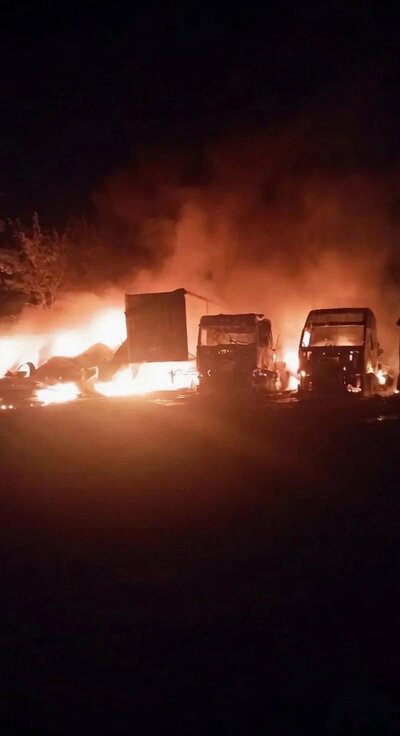
❗️🇷🇺🇺🇦Ukraine has launched a massive, coordinated long-range air campaign, sending a swarm of over 300 kamikaze drones deep into Russian regions and occupied Crimea to systematically dismantle the Kremlin’s military and economic infrastructure. Video is AI

22,281 Aufrufe • vor 1 Monat •via X (Twitter)

0 Kommentare

Keine Kommentare verfügbar

Kommentare vom Original-Post werden hier angezeigt

Ähnliche Videos

‼️🇺🇦🔥🇷🇺 After days of systematically degrading Russian air defenses around Novorossiysk and Gelendzhik, Ukraine launched a massive combined strike on the strategically vital port of Novorossiysk overnight. The operation involved cruise missiles and several types of long-range kamikaze drones, striking multiple high-value facilities across the port complex. Among the targets hit were: ▪️ Oil terminal infrastructure; ▪️ The Russian naval base; ▪️ The grain export terminal; ▪️ The maritime transport terminal. The attack came after Ukrainian forces spent days methodically targeting Russian air-defense and electronic-warfare assets across the Novorossiysk-Gelendzhik area, apparently creating vulnerabilities for the larger strike that followed. With long- and medium-range surface-to-air missile systems apparently unavailable or insufficient in the immediate area, Russian forces spent much of the night attempting to engage incoming Ukrainian drones and missiles with shorter-range anti-aircraft systems and gunfire, without preventing strikes on several key facilities. The sequence illustrates an increasingly sophisticated Ukrainian approach to deep-strike operations: first pressure and degrade the defensive network, then exploit the resulting gaps with a larger combined missile-and-drone attack against strategically important military and economic infrastructure. Novorossiysk is particularly important to Moscow because it combines major energy-export infrastructure with one of the Russian Black Sea Fleet's principal bases. Successfully penetrating its defenses therefore puts pressure on both Russia's military presence in the Black Sea and the infrastructure supporting its economy. See the latest updates with us: Visioner

Visioner

20,885 Aufrufe • vor 11 Tagen

How Ukraine reached parity with Russia in long-range capabilities Analysts from the Back And Alive Foundation analyzed Ukraine's transition from local frontline strikes to the systemic employment of long-range drones. The volume of drones Ukraine has launched has surged from 110 units in January 2024 to over 7,000 in March 2026. Throughout 2025, Ukraine increased our launch frequency fivefold. In March 2026, Ukraine even managed to surpass the Russia in the number of launched and recorded drones. Flight Geography and Extreme Ranges 🔹Ukrainian drones are increasingly detected at facilities located hundreds and thousands of kilometers from the frontline. The number of Russian regions where they are spotted is steadily growing. 🔹This evolution is not just about quantity, but also about a significant increase in operational range. For instance, in February 2026, an oil refinery in the city of Ukhta (Komi Republic) was struck—over 1,800 km from the Ukrainian border. A Nightmare for Russian Air Defense 🔹As Ukraine deploys more drones, Russian air defense forces must track and intercept a vastly higher number of simultaneous targets, leading to system saturation. 🔹The Russian military is forced to make a choice: protect assets near the frontline to cover their troops, or deploy systems deep into the interior to defend industrial and energy infrastructure. Given Russia’s vast landmass, it is physically impossible to cover all critical sites with limited resources. 🔹Furthermore, the Defense Forces of Ukraine continue to degrade Russian air defense capabilities. Over the past year, open-source intelligence (OSINT) has confirmed 172 hits on Russian air defense systems through video footage; however, the actual number of successful strikes is significantly higher. 📹📈Cumulative number of days on which at least one UAV reached the region (from January 2024 to March 2026).

Anton Gerashchenko

51,874 Aufrufe • vor 4 Monaten