Loading video...

Video Failed to Load

Go Home

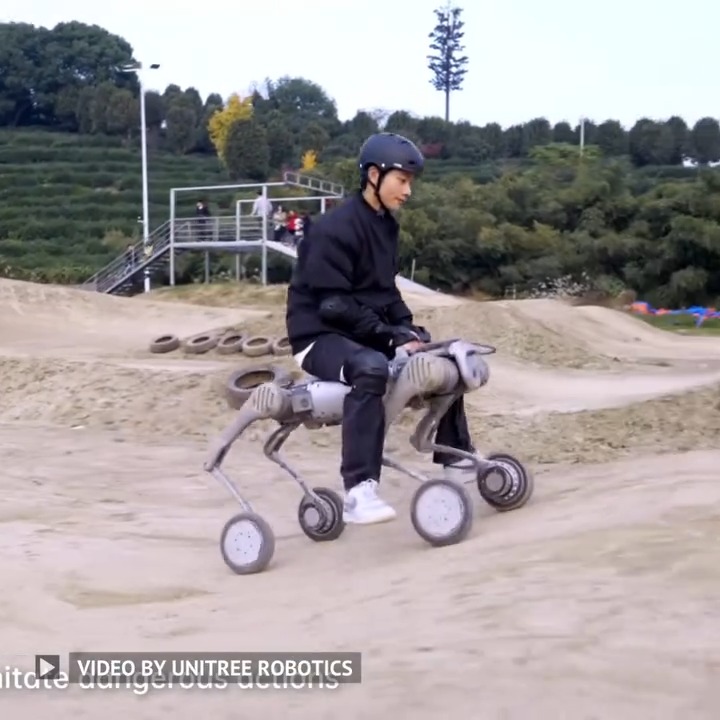
Unitree has unveiled advanced quadruped robots designed for firefighting and emergency response. Built with modular systems, these robots can navigate hazardous environments and support rescue operations. Equipped with a powerful water cannon that reaches up to 60 meters and sprays 40 liters per second, they can deploy water or...

51,483 views • 8 months ago •via X (Twitter)

0 Comments

No comments available

Comments from the original post will appear here

Related Videos
Water is one of the most vital tools in battling flames and safeguarding communities. But fire departments do not rely on any single water source during large incidents since access, volume and damage to infrastructure sometimes hamper what most would consider the go-to source. Versatility and adaptability are key. Let’s break down the water resources that support firefighting efforts: 🚒Fire Engines: On average, fire engines carry 500 gallons of water for immediate response. Some carry 750-1000 gallons! They can also connect to hydrants when available, extending their water supply during incidents. 🚚Water Tenders: These tanker trucks can carry significant amounts of water—some up to 4,000 gallons. Prepositioned during dangerous weather, water tenders provide mobile water sources, offering flexibility in dynamic situations. 🚁Helicopters & Airtankers: Helicopters can draw water from lakes, ponds, or even swimming pools, delivering targeted water drops. Airtankers, like the powerful Super Scoopers, can refill from oceans and large lakes, dropping water over wide areas to slow fire spread. 🤝Teamwork is Essential: No single water source works alone. Each plays a critical role, depending on conditions and availability. Firefighters are adept at overcoming challenges with static water sources and finding ways to adapt to protect lives and property. When it comes to battling flames, every resource - on the ground or in the air - is critical to the mission. #LAfires #wildfireresponse

CAL FIRE

17,266 views • 1 year ago

500 humanoid robots replacing humans in high-voltage operations What does that look like? Steel against steel,instead of flesh and blood. This marks a turning point for China’s State Grid, shifting from human-based maintenance to autonomous operations. This year, State Grid announced plans to procure 8,500 embodied AI robots, with a total budget of RMB 6.8 billion (~$1 billion). These robots will be deployed across four major scenarios: power inspection, live-line operations, emergency response, and warehouse logistics,covering more than 600 specific task scenarios. Among them, humanoid robots for live-line operations are the most expensive and strategically critical: 500 units with a budget of RMB 2.5 billion (~$370 million). They will be deployed in distribution network live-line work and ultra-high-voltage (UHV) projects, replacing humans in high-risk tasks. Workers will transition into supervisory roles, ready to take over remotely when needed. As early as last year, State Grid had already validated the feasibility of humanoid robots for substation inspection. Tienkung can autonomously perform inspection tasks at a State Grid substation in Beijing. Of course, suppliers are not limited to X-Humanoid,players like Unitree, AGIBOT, DeepRobotics, UBTECH, and Fourier are all involved. These 500 humanoid robots will also collaborate with 5,000 inspection quadruped robots and 3,000 dual-arm wheeled robots for indoor substation maintenance,together forming an intelligent, automated, and collaborative network for autonomous grid operations. What does this change? According to State Grid, each embodied AI unit can save RMB 500,000 to 800,000 (~$70,000–$110,000) in annual labor costs, with a payback period of around 2–3 years. Inspection efficiency increases by 5x, fault response time is reduced by 60%, and power supply reliability improves by 0.5 percentage points. More importantly, over 90% of human exposure to high-risk operations can be eliminated, reducing safety incidents by 80%. At another level, for humanoid robot companies, the center of R&D and iteration is shifting to the customer site. Real-world physical interaction becomes the fastest feedback loop,accelerating innovation and evolution. And 8,500 units are just the beginning of scaled deployment. Based on current plans, embodied AI robots will cover 30% of key areas in State Grid by 2026, 80% of high-risk operation scenarios by 2027, and enable fully autonomous operations by 2030. The demand roadmap is clear: define use cases ->deploy at scale->improve models and robots->expand further. 8,500… 50,000… 100,000… But remember,power grids are just one part of China’s vast infrastructure system. The experience of autonomous robotic operations here can be replicated across other sectors, such as broader energy systems. That, in itself, is another story. P.S.The video shows Tienkung 1.0 autonomously performing substation inspection tasks (2025).

CyberRobo

46,782 views • 2 months ago

Elon just dropped a MAJOR nugget on how Tesla is going to be training Optimus to do real world tasks. They are building an Optimus Academy, which is a large scale, dedicated real-world training facility to accelerate the development of Optimus. The Academy will deploy thousands of Optimus units, potentially 10,000 to 30,000 robots, in a controlled realistic environment where they perform self-play, experiment with tasks, iterate on behaviors, and continuously generate training data through trial and error. The Tesla bots will also run millions of simulations in Tesla’s high-fidelity physics-accurate engine, allowing Optimus to close the “sim-to-real gap” by using these real-world observations to refine and validate the simulations! “You’re actually highlighting an important limitation and difference from cars. We’ll soon have 10 million cars on the road. It’s hard to duplicate that massive training flywheel. For the robot, what we’re going to need to do is build a lot of robots and put them in kind of an Optimus Academy so they can do self-play in reality. We’re actually building that out. We can have at least 10,000 Optimus robots, maybe 20-30,000, that are doing self-play and testing different tasks. Tesla has quite a good reality generator, a physics-accurate reality generator, that we made for the cars. We’ll do the same thing for the robots. We actually have done that for the robots. So you have a few tens of thousands of humanoid robots doing different tasks. You can do millions of simulated robots in the simulated world. You use the tens of thousands of robots in the real world to close the simulation to reality gap. Close the sim-to-real gap.”

Teslaconomics

42,563 views • 5 months ago

Overland AI Rolls Out Autonomous Multi-Mission Military Vehicle | Christine Casimiro, The Defense Post Seattle-based Overland AI, specializing in advanced off-road autonomy solutions, has unveiled a fully autonomous tactical ground vehicle: the Ultra. With a top speed of 35 miles (56 kilometers) per hour and a 1,000-pound (453-kilogram) payload capacity, Ultra can take on a variety of missions across multiple terrains and conditions, including GPS-denied and other extreme environments. The modular and attritable platform can be deployed for reconnaissance, direct support of maneuver forces, counter-drone protection, contested logistics, and humanitarian aid supply. Additionally, the military vehicle is integrated with local mesh networks, 5G, and satellite uplinks for “resilient, networked communications that extend reach and reduce risk,” according to COO and co-founder Greg Okopal. “ULTRA gives commanders an immediately deployable solution for reconnaissance, counter-UAS, and logistics operations.” This unveiling follows after the US Army and Defense Innovation Unit awarded Overland AI an $18.6-million contract in 2024 for the Robotic Combat Vehicle Program, a Pentagon initiative to complement warfighters with unmanned systems acting as escorts or scouts. Features Ultra is integrated with the company’s OverDrive software stack, SPARK hardware infrastructure, and modular payloads, including uncrewed aerial systems (UAS) and counter-UAS systems. The 155-inch (393-centimeter)-long vehicle measures 72 inches (182 centimeters) wide and 60 inches (152 centimeters) tall, with a gross weight of 3,500 pounds (1,587 kilograms) — making it a light and compact vehicle suitable for rapid and flexible operations in challenging environments. It has a cruising range of up to 100 miles (160 kilometers), enabling extended missions or operations without frequent stops. Equipped with 14.5-inch (36-centimeter) ground clearance and a 114-horsepower engine, the “ULTRA can navigate environments ranging from dense forests to volcanic ridges,” said company CEO and co-founder Byron Boots. Read more:

Owen Gregorian

33,194 views • 1 year ago