Loading video...

Video Failed to Load

Go Home

Unitree Released B2 | Beyond the Limit | Hyperevolution😍Maximum speed of 6m/s, sustained load of 40kg and sustained walking endurance of 5h. The comprehensive performance is two to three times that of existing quadruped robots worldwide!
92,153 views • 2 years ago •via X (Twitter)

8 Comments

iandanforth 🦋 @iandanforth.bsky.social's profile picture
iandanforth 🦋 @iandanforth.bsky.social2 years ago

Price?

R S's profile picture
R S2 years ago

Should we teach AI self-defence? Will AI do it on its own?

Brian Basson's profile picture
Brian Basson2 years ago

@NicklasNilsso14 Wow, impressive!

Master Kenobi's profile picture
Master Kenobi2 years ago

Love it and your work!

Histra 1111's profile picture
Histra 11112 years ago

@Bit3Snake What is the purpose of that?

TheHyperStar's profile picture
TheHyperStar2 years ago

Be nice to him, you don't want him mad with that running speed... (Amazingly impressive by the way.)

TTTom NAFO 🇮🇹 | 🇹🇼 🇺🇦's profile picture
TTTom NAFO 🇮🇹 | 🇹🇼 🇺🇦2 years ago

Price?

Let's learnrobot.com®'s profile picture
Let's learnrobot.com®2 years ago

🤖🤖

Related Videos

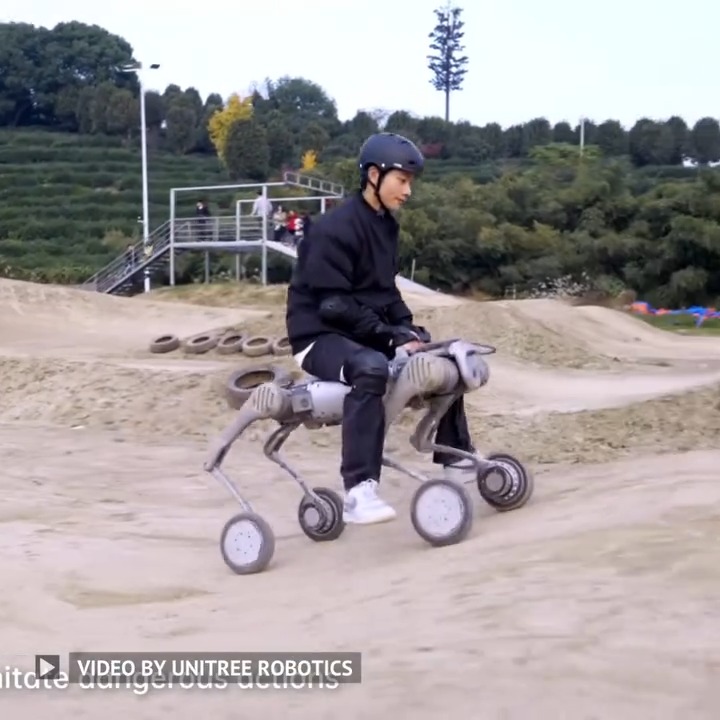
The US needs to start getting really serious about AI and robotics. We can't let China beat us. This is the new Chinese-made Unitree B2-W robot. The Unitree B2-W is turning heads for its ability to walk, roll, climb, and even carry adult passengers across challenging terrain—all in one sleek, futuristic package. At first glance, you might catch yourself thinking, “Is this really real?” because it looks like something straight out of a sci-fi film. Yet, here it is: a Chinese-made robot that’s been engineered to shift seamlessly between legged and wheeled locomotion, push up to 220 pounds of horizontal pulling force, and sprint at speeds of around 12.5 MPH. Some have likened it to a “Boston Dynamics on steroids,” which only scratches the surface of how advanced and versatile it truly is. Beneath the metallic chassis is a sophisticated control system powered by an Intel Core i5 or i7 processor—or, in higher-tier configurations, a NVIDIA Jetson Orin which drives the B2-W’s multitude of onboard sensors, from its 3D LiDAR (with optional 32-wire automotive-grade LiDAR) to an array of depth and optical cameras. These sensors lets it perceive the environment, avoid obstacles, and adapt to uneven terrain, a capability further bolstered by its IP67-rated weather and dust protection. In real-world settings, that means it can climb 45-degree staircases, cross rocky paths, and transition seamlessly from indoor to outdoor operation without missing a beat. Arguably the most buzzworthy trick in its repertoire is the ride-on feature. While "quadruped" robots usually conjure up images of helpful mechanical “dogs” trotting beside you, the B2-W can support the weight of an adult, turning it into a legitimate personal transport over rough or slippery ground. This is all made possible by its formidable load capacity of up to 120 kg in standing mode, combined with a battery system of more than 2 kWh. Under ideal conditions, it can keep going for up to 50 km with a 40 kg load, though your mileage may literally vary. Unsurprisingly, all this power and agility have sparked a wave of conversation—both fascination and worry. People imagine scenarios where a B2-W might chase intruders or become militarized, carrying weapons rather than passengers or equipment. As technology marches forward, these concerns aren’t completely unfounded, but it also opens doors for legitimate uses in research, construction, rescue operations, and beyond. The B2-W’s adaptability, speed, and load-bearing capacities make it a compelling platform for anyone investigating the boundaries of legged robotics. Ultimately, the B2-W’s debut underscores just how quickly Chinese robotics—indeed, robotics worldwide—is evolving. From advanced AI navigation to all-terrain endurance, it’s pushing the envelope of what’s possible in the quadruped robot space. While it might look like a mechanical cousin of nature’s best pack animals, the B2-W is very much a product of cutting-edge engineering.

Ed Krassenstein

177,320 views • 1 year ago