Video wird geladen...

Video konnte nicht geladen werden

Zur Startseite

USL 16 - ‘Last Dance’ -Final Training, Lateral/Decelerating -5 v 5 tourney, FUN!!! -Volume/Complexity takeoffs/landing slow build over totality of season -AVG Max Velo 17.5 MPH (+2.5%) -AVG YIRT 1 1800M (+10%) -Velocity & capacity are meant to coexist! #LTAD

80,614 Aufrufe • vor 3 Jahren •via X (Twitter)

0 Kommentare

Keine Kommentare verfügbar

Kommentare vom Original-Post werden hier angezeigt

Ähnliche Videos

Lots of people are sleeping on Quinn Priester... I have a feeling this dude is going to make an impact with the major league club next year. Let’s talk about it. Adding velo to the sinker (SI) has been a constant emphasis since coming over via trade, and we already saw a minor increase last year. Avg SI velo (2024) 📈 • w/ PIT: 93.0 mph • w/ BOS: 93.8 mph NOTE: Remove his first two appearances where there wasn’t really any changes made, and his avg SI velo now sits at 94.2 mph. Games where SI sat 94+ mph 📈 • w/ PIT: 2 (of 23) • w/ BOS: 5 (of 10) He’s comfortably hit 96 and topped 97 mph for Worcester (seen in video attached), and has been grinding on a velo program this winter as well. Other top velos, just for fun… • FF: 96.3 mph* • SL: 92.3 mph • CU: 83.5 mph* • CH: 92 mph* • FC: 94.4 mph* *indicates top velo was w/ BOS — On top of this, we all know that Bres/Bailey & Co. love their whiff and secondary offerings. Priester took a huge step forward last year in both of these categories. Overall whiff 📈 • w/ PIT: 29.8% • w: BOS: 35.4% Arsenal whiff w/ BOS 📈 • SI: 22% • FF: 30% • FC: 42% • SL: 48% (‼️) • CU: 43%** **hot take: SI/SL combo are his carrying pitches, but his best pitch is his CH — Clearly, there’s something there. I wouldn’t be surprised if we see a major usage change. Here’s what I would propose: • FA (FF/SI/FC): 46.3% ➡️ 30% - SI: 20% (“get me over” or “need it” kind of pitch; needs to be for a strike, low in zone; CH plays off it) - FC: 9% (would love to use it more, but had a limited sample size in 2024; start off as a LHH-exclusive like Garett Whitlock showcased; needs to either be elevated (tunnel w/ FF) or down+out (tunnel w/ SL) - FF: 1% (similar to what we saw Bello implement… only deploy in key situations; must be elevated) • SL: 31.8% ➡️ 35% - emphasis on gloveside target against both LHH/RHH; vs LHH, catcher sets up more middle/out - maybe try some armside vs LHH to dupe batters? • CH: 14% ➡️ 25% - best pitch results in MLB (.167 BAA, .167 SLG, 29% whiff in limited sample size) but can’t be overused - need to tunnel w/ SI… make sure low in/out of zone; see: Whitlock • CU: 8% ➡️ 10% - LHH exclusive offering, tunnels w/ elevated FC/FF - needs to miss low Overall: SI “first” for strikes with a very heavy dosage of SL/CH mixed in vs both LHH/RHH. FC/CB to LHH only. Elevated FF only in certain sequences. I’ve attached some specific videos to further emphasize my points. • Clip #1: Bogaerts whiff on CH • Clip #2: disgusting SLs to RHHs • Clip #3: Priester sinkers (T97 mph) • Clip #4: just pure nastiness Oh, and a friendly reminder: he’s just 24 years old. There is so much potential to tap into here. The stuff, for one, is there and only getting better. My favorite Red Sox pitcher right now is by far Garrett Whitlock. I see a little bit of baby Whitty in Priester’s delivery, frame, and stuff. 👀 — Alrighty, that was a lot lol. I hope everyone enjoyed. If you have questions, comments, or even player requests, feel free to reach out! I am super excited to see what Priester can do in 2025 and beyond. What do you think? ⬇️

G.G.

54,654 Aufrufe • vor 1 Jahr

New episode on the optimal exercise intensity, duration, and frequency to prevent and reverse heart aging! In this podcast episode, Dr. Benjamin Levine discusses his groundbreaking research, which reveals how three weeks of bed rest can have a more detrimental impact on fitness than 30 years of aging. Dr. Levine details his research findings that show how a structured exercise regimen can reverse up to 20 years of heart aging by improving both shrinkage and compliance, as well as enhancing aspects of vascular age by 15 years. He also discusses how resistance training and aerobic training have profound differences on the heart, what risks are linked to high-intensity exercise, why recovery is key for the heart, how exercise duration and intensity affect coronary calcium levels, what exercise dose increases Afib risk, and so much more. This episode is a must! Available on YouTube, Spotify, X, and everywhere else. Links in comment. Timestamps: 0:00 - Introduction 1:31 - Bed rest vs. 30 years of aging 5:18 - Recovering from bed rest 6:49 - Does exercise protect against long COVID? 11:27 - Bed rest as a model for space flight 12:24 - How bed rest affects heart size 13:52 - Why a brand-new rubber band mimics a lifetime of endurance training 17:23 - The exercise dose that preserves youthful cardiovascular structure 19:32 - Reversing 20 years of heart aging 23:14 - Reversing vascular age by 15 years 28:38 - Why start an exercise regimen in your 70s? 34:26 - High-intensity exercise risks 37:51 - Balancing high- & moderate-intensity training 42:49 - Training for health vs. training for performance 43:57 - Why muscle mass & cardiorespiratory fitness are like retirement funds 45:12 - Make exercise part of your personal hygiene 46:16 - Why VO2 max correlates with longevity 53:43 - Cardiorespiratory fitness & mortality 59:21 - How does change in fitness over time affect mortality? 1:01:34 - Exercise non-responders 1:05:23 - Limiting factors for VO2 max improvements 1:08:20 - How marathon training affects heart size 1:12:34 - Heart adaptations in purely strength-trained vs. endurance athletes 1:18:23 - Why pure strength-trainers should incorporate endurance training 1:22:07 - How strength training affects blood pressure 1:26:41 - How exercise influences cardiac output 1:28:39 - Does CrossFit count as endurance training? 1:31:04 - Exercise for improving blood pressure 1:36:11 - Lifestyle strategies for treating hypertension 1:38:40 - Why recovery is key 1:42:36 - The best indicator of being overtrained 1:43:36 - Estimating training zones 2-5 1:50:00 - Why HRV is a poor recovery indicator 1:55:16 - Why men are faster runners than women 1:58:49 - Can women achieve similar aerobic exercise benefits doing 2x less? 2:00:21 - Possible cardiovascular benefits of HRT in women 2:02:12 - Defining “extreme exercise” 2:04:00 - How exercise volume affects coronary plaque calcification 2:10:50 - How exercise duration & intensity affect coronary calcium levels 2:14:03 - Why high exercise duration & intensity increases Afib risk 2:16:33 - What exercise dose increases Afib risk? 2:17:59 - Managing stroke risk in athletes prone to Afib 2:21:14 - Why you shouldn’t become an endurance athlete to “live longer”

Dr. Rhonda Patrick

266,054 Aufrufe • vor 2 Jahren

yesterday someone leaked a full quant trading system on GitHub before they deleted it i forked everything 5,000 lines of code. 7 modules. 25 mathematical factors funds use this system to manage millions i studied it for a week. then pointed it at crypto markets on polymarket here's the full breakdown you can feed this to your claude and build the same thing for just $200 ARCHITECTURE: Python thinks, analyzes, calculates C++ executes orders in 5-10ms data → factors → AI → strategy → risk → execution DATA. 4 streams simultaneously: - Binance WebSocket: prices every second, orderbook at 20 levels - AlphaVantage: news with sentiment score from -1 to +1 -X: mention volume, engagement, influencer activity - On-chain: BTC flows to/from exchanges cache in Redis ( target price) = N(d1) d1 = [ln(current/target) + (σ²/2)T] / (σ√T) then 4 adjustments on top: - momentum: +/-5% - AI sentiment: +/-7% - order flow: +/-2% - historical patterns: +/-8% compare final probability against polymarket price if edge > 10%: enter RISK - Quarter Kelly for position sizing - max 5% bankroll per trade - drawdown 15% = bot stops - VaR < 3% per day - correlation between positions < 0.7 - never take more than 1% of market liquidity key insight is don't hold to expiry. trade the movement, not the outcome cost: → Binance API: free → OpenAI: $50-100/month → AWS EC2: $120/month → monitoring: free - total: $200-300/month - code is open source. formulas above. you already have claude the only thing between you and a working system is one free evening

Archive

249,521 Aufrufe • vor 4 Monaten

part 4 Gsenti Sentient Sentient Chat Explaining ROMA – Recursive Open Meta-Agent 1. What is ROMA? ROMA is an open-source framework for building meta-agents — systems that can orchestrate multiple smaller agents and tools to solve complex tasks. Instead of letting one AI model handle an entire large problem (which often fails due to complexity), ROMA applies a recursive approach: Parent nodes break a big goal into subtasks. Child nodes handle those subtasks and return results. All results are then combined into a final solution. 2. How does ROMA work? The architecture has four main components: Atomizer – decides whether a task is simple or requires decomposition. Planner – splits the complex task into smaller subtasks. Executor – runs the right tools/agents to complete each subtask. Aggregator – collects and synthesizes all results into one coherent answer. Because each node follows the same recursive logic, ROMA naturally scales as tasks become more complex. 3. Example Use Case – Deep Research Question: “Who are the top 5 NBA players by PPG in a season that have won both an NCAA and an NBA championship?” How ROMA handles it: Atomizer → identifies it as complex → needs decomposition. Planner → breaks it down: (1) find top NBA PPG seasons, (2) check NCAA champions, (3) check NBA champions, (4) combine filters. Executor → runs each search/tool for data. Aggregator → merges the results into the final answer. This creates a transparent, step-by-step reasoning process, unlike “black box” answers. 4. What Problem Does ROMA Solve? In long-horizon tasks, errors accumulate. A model may be 99% accurate at one step. But over 10 steps, success rates collapse due to compounding errors. Current agents are often opaque — hard to see where and why they failed. ROMA solves this by: Breaking tasks into clear logic chains, Making every step traceable, verifiable, and fixable. 5. Why ROMA Matters Open-source → available for anyone to build upon. Community-driven → empowering developers to create advanced multi-agent systems. Scalable → recursive logic adapts naturally to any task complexity. This makes ROMA not just a framework, but a foundation for the next wave of decentralized, transparent AI systems. 6. Learn More 📖 Technical blog: 💻 GitHub repo:

thoai66.ip

16,298 Aufrufe • vor 10 Monaten

🚨ALERT: 50% of Data Centers will NEVER connect to the grid. Half of the data centers announced in the last 24 months will NEVER connect to the grid. Kevin O’Leary said it. The data proves it. While everyone’s chasing “paper capacity,” $CIFR and $IREN are sitting on EXECUTED grid connections that can’t be replicated. Here’s why they’re untouchable: 266 GW of power projects canceled in 2025 alone. That’s 2.4x the cancellations from 2024. Why? Because the U.S. grid is facing a structural deficit that nobody wants to talk about. • Data centers need 18-36 months to build • Grid connections take 5-7 YEARS (sometimes 12) • Interconnection queues in PJM and ERCOT now average 7 years • Average interconnection cost in MISO: $753,116 per MW Translation: You can announce a data center tomorrow. But you CAN’T connect it to power until 2032. The math doesn’t work. The timeline doesn’t work. The physics don’t work. $CIFR - The Fixed-Price Power Moat: Cipher control one of the lowest-cost power portfolios in North America. > Power cost: $0.027/kWh (fixed, long-term PPAs) > Debt: $0 > Portfolio: 2.2 GW across Texas But here’s what everyone’s missing: Their 1-gigawatt Colchis site has a FULLY EXECUTED Direct Connect Agreement with American Electric Power. Not “in the queue.” Not “under study.” EXECUTED. Energization: 2028. While competitors are stuck waiting 7+ years for interconnection approvals, $CIFR already has a Tier 1 grid connection locked in. And they just signed: • $5.5 billion, 15-year lease with AWS for 300 MW • 10-year hosting deal with Google/Fluidstack for 168 MW That’s $8.5 billion in contracted lease payments for AI infrastructure. $IREN - The Microsoft Validation: $IREN didn’t just secure power. They secured the ONLY thing that matters: a hyperscaler willing to pre-pay billions. November 2025: $9.7 billion AI Cloud contract with Microsoft. Let me repeat that. Microsoft PRE-PAID for capacity that doesn’t exist yet. Deal structure: • 200 MW of liquid-cooled AI capacity • $1.94 billion annual recurring revenue (once online) • 20% prepayment to fund $5.8 billion GPU purchase from Dell • Four “Horizon” data centers at their 750 MW Childress campus But the real alpha? Their 2.91 GW portfolio of GRID-CONNECTED power. Not speculative. Not “in the queue.” Connected. Energized. Operating. > Sweetwater 1: 1.4 GW (energization accelerated to April 26) > Childress: 750 MW (operating) > Prince George: 160 MW hydro (23k GPUs for AI) $IREN is scaling to $3.4 billion in AI Cloud ARR by end of 2026 using only 16% of their total power capacity. The Peer Comparison Nobody’s Talking About: Everyone’s excited about $RIOT, $MARA, $CORZ, and $WULF. Here’s the problem: $RIOT: 1.7 GW portfolio, mostly Bitcoin-focused. 25 MW HPC lease with AMD ($311M over 10 years). That’s 1/30th the size of IREN’s Microsoft deal. $MARA: Building “behind-the-meter” natural gas generation to BYPASS the grid entirely. Smart strategy, but they’re starting from scratch. 1.8 GW capacity, mostly mining. $CORZ: $10B+ contract with CoreWeave sounds massive. But they’re CONVERTING old mining infrastructure. Not purpose-built for AI. Currently unprofitable. $WULF: 750 MW at Lake Mariner. Zero-carbon hydro/nuclear. Clean energy story is strong. But only 72.5 MW of HPC capacity by Q2 2025. Meanwhile: • $CIFR has 2.2 GW with executed grid agreements and $8.5B in hyperscaler contracts • $IREN has 2.91 GW of energized capacity and a $9.7B Microsoft deal The Cooling Bottleneck: Secured power means NOTHING without secured cooling. November 2025: CyrusOne data center in Illinois went down for 10 hours because ONE chiller failed. This facility handles TRILLIONS in CME trading volume. Energy, agriculture, crypto derivatives markets frozen globally. Why? Because AI racks now consume 600 kW of power (enough to power 500 homes). A single rack failure creates catastrophic heat buildup. $IREN’s solution: Liquid-cooled infrastructure at all Horizon facilities. $CIFR’s solution: Turnkey air-and-liquid cooling delivery for AWS. Hyperscalers aren’t paying billions for “power connections.” They’re paying for THERMAL RELIABILITY. The Numbers That Matter: > PJM capacity prices: 10x increase from 2024 to 2025 (extreme scarcity signal) > Interconnection costs in Louisiana/Missouri: $900,000+ per MW > $64 billion in U.S. data center projects blocked or delayed in 2024-2025 > 25+ major data center projects canceled in 2025 alone The grid is saturated. The timeline is broken. The infrastructure doesn’t exist. But $CIFR and $IREN? They already own the infrastructure. They already have the grid connections. They already have the hyperscaler contracts. The Bottom Line: > AI demand is doubling every 90 days. > Grid capacity takes 5-7 years to build. > You can’t close that gap with announcements. You close it with EXECUTED agreements and ENERGIZED megawatts. $CIFR: $0.027/kWh power, $8.5B in contracts, 1 GW Tier 1 grid connection $IREN: $9.7B Microsoft deal, 2.91 GW energized portfolio, $3.4B ARR target by 2026. While half the industry fights over interconnection queues, these two are already plugged in. The power crunch isn’t coming. It’s here. And the only winners will be the ones who secured their megawatts BEFORE the grid broke. Bullish $CIFR and $IREN. Note: This is NOT financial advice.

Black Panther Capital

347,343 Aufrufe • vor 5 Monaten

What can these five babies teach us about language development? This week I’ve been exploring the stages of infant language acquisition. And today, I’ve done something special: curated a compilation of five videos tracing the progression of infant vocalizations over time. As you watch, note that each new clip represents a step forward in expressive language (and, obviously, age). So let’s meet our five babies! 1) Baby Number One, shared to TT by natashatenen, illustrates a concept I first introduced yesterday: Cooing. Note that her happy vocalizations are mostly extended vowel sounds. One of the first sounds babies make other than crying, cooing typically begins between 6 weeks and 3 months. 2) Now let’s meet Baby Number Two (shared to TT by putdewyy). He’s not far past the cooing stage… lots of vowel sounds are on display here…but he’s starting to make the transition to babbling. Notice how his vowel sounds are now supplemented by some initial consonants. He adds some “buh” and “bah” sounds. Babbling typically begins with single syllables (often buh, muh, and/or duh) between 4-6 months. It’s a subtle but important step forward. 3) You’ll notice that Baby Number Three’s speech is marked by a real qualitative upgrade in terms of both clarity and content. This little one, shared to TT by Vanessa.Fiorella, is demonstrating what is known as canonical babbling - which involves the repetition of a single syllable. While Baby Two managed a “bah” sound, Baby Three is firing them off in rapid succession: “bah-bah-bah-bah.” Canonical babbling often begins around 6-7 months. 4) Baby Number Four takes the complexity up a notch further. What you see in this video (shared to TT by sofiaandsofie1) is called variegated babbling - which combines multiple different syllable combinations. (“Duh-dah-di-di-di-dah”) Do you notice how variegated babbling is starting to resemble conventional/adult speech more and more? It’s commonly exhibited around 10-12 moths. 5) And then, just for the fun of it, I’ve included Baby Number 5 - who became a viral sensation last winter for the amazing complexity of his variegated babbling. The video, shared to TT by Xxbur5, shows a little guy with a cold diaper and a linguistic capacity that - only months after first babbling - has progressed exponentially and will soon make way for his first words. Isn’t it amazing to trace this progression? Grateful to all these creators for capturing videos so we can all learn from them together. Hope you enjoyed this language development super cut!

Dan Wuori

123,907 Aufrufe • vor 1 Jahr

$AMD's heading to $5T MC LT| Lowest $/M tokens 🧵 The real reason why Institutions are FOMOing into AMD while other Semi stocks are underperforming ($NVDA $AVGO) Not Financial Advice! DYOR! Under Dr. Lisa Su’s leadership, AMD has transformed from a distant challenger into a formidable force in AI infrastructure, delivering the industry’s most compelling TCO story for high-volume inference. Her clear vision open ecosystems, aggressive annual roadmaps, rack-scale innovation, and relentless focus on tokens-per-dollar has positioned AMD’s Helios racks as the go-to solution for hyperscalers and AI natives struggling with exploding token costs, collapsing the cost down to $0.0003-$0.0005/M tokens. I will link various threads on this analysis to supply chain and wafer ratio if you are interested in understanding the full picture. In the last 3-4 months, explosive Agentic AI demand significantly increased Inference demand for Agentic AI models with 5-10 agents. If you are a listener of CNBC or Bloomberg, u should know enterprises and companies are complaining abt cost of token, and how it starts to spike up way too much to make sense. The fact that most data center today are run by $NVDA Chips, where the cost is way too high for Training or Inference. 1. Token cost Here are some quick comp, so u understand why $META OpenAI Anthropic $MSFT $AMZN Softbank $GOOGL and many more small to medium AI Natives are buying AMD CPUs and GPUs as much as they want, or pretty much AMD chips are sold out for the next 3-5 years. Inference (Cost per Million Tokens) ~$NVDA B200 / HGX: ~$0.02–$0.08 on optimized workloads (FP4/MXFP4, speculative decoding). Significant improvement over Hopper but still premium-priced. GB200 NVL72 rack-scale: $0.05–$0.25+ ~$AMD Helios Racks: $0.0003-$0.0005 per M tokens, dramatically lower than NVIDIA equivalents in owned infra. MI355X node-level: Up to 40% more tokens per dollar vs. competing solutions ( B200), driven by higher memory capacity (up to 288GB+ HBM), strong bandwidth, and lower acquisition costs. Training ~$NVDA Rubin Rack is estimated $0.7-$1.2/M Tokens ~$AMD Helios Rack is estimated $0.65-$1.0/M Tokens 2. Why Hyperscalers and AI Natives Are Choosing AMD Token consumption (especially Agentic) is outpacing even NVIDIA’s efficiency gains, making diversification mandatory for economic viability. Massive deals reflect this reality like $META, OpenAI, $MSFT, Softbank, $AMZN, Oracle, LumaAI, G42... Dr. Lisa Su’s Vision in Action: Since taking the helm, Su has driven AMD’s turnaround with disciplined execution, annual GPU cadence (MI300 → MI350 → MI400), full-stack software (ROCm 7), open ecosystems (UALink, OCP designs), and customer-centric rack-scale solutions like Helios. Her emphasis on “tokens per dollar” and TCO has turned AMD into the pragmatic choice for sustainable AI scaling. Power/Energy Efficiency: ~Helios Rack-level is estimated at 120kW-140kW with 50% more HBM4 where Inference and Training cost matter ~Rubin Rack-Level is estimated at 160kW-230kw AMD Helios shines in owned TCO, memory density, and energy flexibility at hyperscale. Cost to build 1GW data center 1GW Helios Rack full build is estimated $30-$35B 1GW Rubin Rack full build is estimated $45-$55B 3. Superior CPUs to pair with GPUs on massive scale 5-10-20GW Agentic AI. autonomous, multi-step workflows with orchestration, tool use, parallel agents, data movement, and enterprise integration has dramatically increased the importance of strong host CPUs alongside GPUs. This shifts the CPU-to-GPU ratio higher and makes balanced systems critical toward 1:1 to 5:1 as enterprises testing more than 5-10 agents. AMD EPYC Venice excels ~Leadership core density (up to 256 Zen 6 cores per socket) for running many agents in parallel, orchestration layers, and high-throughput control-plane tasks. ~Superior performance-per-core and power efficiency ( up to 2.1x higher perf/core and 2.26x better SPECpower vs. NVIDIA Grace in benchmarks). ~Tight integration in Helios: One Venice CPU + multiple MI450 GPUs per node, enabling efficient data feeding to GPUs ("zero-copy"), parallel execution, and full rack utilization for complex agentic loops. Hyperscalers (Meta, Microsoft, Amazon, Google, Softbank) and AI natives (OpenAI, Anthropic...) are adopting high-core EPYC at scale specifically for these agentic demands, as CPUs now handle a larger share of non-model work (orchestration, policy enforcement, tool calls). This complements AMD’s lower-cost GPUs for overall TCO wins. Conclusion: NVIDIA’s Vera Rubin cannot compete with a 2 years old EPYC Turin, but AMD under Dr. Lisa Su has engineered the lowest cost-per-million-tokens, highly competitive energy-efficient solutions, and superior CPU orchestration for agentic AI at scale with Helios. Dr. Su has championed this shift since at least 2023, foreseeing the rise of agentic workflows that demand far more orchestration, parallel agents, and balanced compute well before the industry fully embraced it. Her long-term vision of AI moving from simple prompts to always-on, multi-agent systems has driven AMD’s investments in high-core EPYC CPUs and integrated rack-scale solutions, perfectly positioning the company for today’s realities. Hyperscalers and AI natives effectively have no choice but to buy more AMD system for Agentic AI as leadership in economical, power-aware, high-volume internal + agentic use. However, due to supply constraints where Supply is far behind Demand, this makes multi-vendor reality along with in-house chips drive faster industry progress, lower overall costs, and better sustainability. Not Financial Advice! DYOR! Video source: Microsoft Build 2026

Mike

145,550 Aufrufe • vor 1 Monat

🚨 Prophetic Warning: The Red Heifer Has Been Sacrificed 🚨 If the pure red heifer has truly been sacrificed in Jerusalem and the Temple Institute declares it’s time to build the Third Temple, then the prophetic clock has moved into its final seconds. 📜 Biblical Sequence in Motion Heifer Sacrifice – Numbers 19 purification completed → Temple site prepared. 2.Third Temple Construction – A prophetic necessity for Daniel 9:27 & Matthew 24 to be fulfilled. 3.Two-State Solution Agreement – Dividing the land of Israel (Joel 3:2) could be signed under global pressure, triggering God’s judgment on the nations. 4.Rise of the “Man of Lawlessness” – Will stand in the rebuilt Temple (2 Thess. 2:4). 5.Feast of Trumpets – A shadow picture of the Rapture, when the last trumpet sounds and Christ gathers His church (1 Thess. 4:16–17). 🚨 Why This is Urgent •If the Temple Institute moves forward, the Two-State Solution could be used as a political bargaining chip to gain control over the Temple Mount. •Dividing God’s covenant land is a line in the sand — it invites immediate judgment. •The Feast of Trumpets is less than two months away, and no one knows the exact day or hour (Matthew 24:36), but Jesus commanded us to recognize the season. 🕊 Final Call to Repentance There is little to no time left. The signs are no longer “approaching” — they are here. If Christ comes for His church this Feast of Trumpets, will you be found ready? Repent. Turn from sin. Call on the name of Jesus Christ for salvation. The door of the Ark is about to close. 📖 “Seek the Lord while He may be found; call on Him while He is near.” — Isaiah 55:6 📖 “When these things begin to happen, stand up and lift up your heads, because your redemption is drawing near.” — Luke 21:28 #rapture #JesusIsComingSoon

Maero𝕏

42,875 Aufrufe • vor 11 Monaten

🚨12 HOUR NEWS RECAP 1.⁠ Trump returned to the White House, still full of energy, despite a marathon Middle East peace tour where he saw the last Israeli hostages released from Gaza and then flew to Egypt for the Sharm El-Sheikh Peace Summit with world leaders. 2.⁠ Screams of joy filled the air as Israeli hostages freed from Gaza after 2 years of captivity were finally reunited with their families. World leaders were united in their praise for Trump in bringing an end to the war. 3.⁠ Leaders from at least 27 countries gathered in Egypt to witness the signing of the historic peace agreement that brought to an end the Gaza war. Trump announced the Trump Declaration for Enduring Peace and Prosperity, declaring the war officially over and a new chapter of stability beginning. 4.⁠ Hamas accused Israel of violating the ceasefire agreement after airstrikes killed several people in Gaza, and the fatal shooting of 5 Palestinians who crossed a ceasefire line and approached Israeli forces. 5.⁠ Trump is due to posthumously award Charlie Kirk the Presidential Medal of Freedom at the White House later today. The ceremony falls on what would have been Charlie’s 32nd birthday. His widow, Erika, will attend with family and conservative leaders. 6.⁠ SpaceX’s latest Starship test flight completed one of its main objectives - opening its side payload door and releasing several dummy satellites while traveling at near-orbital speed. The booster executed its final landing maneuvers smoothly splashing down in the Indian Ocean, marking the second time a Version 2 Starship has completed a full flight profile. 7.⁠ Following Trump’s historic peace deal in Gaza, Time put him on its front cover using a picture he slammed as “the worst of all time. I never liked taking pictures from underneath angles, but this is a super bad picture and deserves to be called out.” 8.⁠ Torrential rains slammed central and Gulf Coast Mexico, killing at least 64 people and leaving 65 missing. Over 100,000 homes were flooded, power went out across 5 states, and entire roads and bridges were literally washed away. 9.⁠ A powerful nor’easter, the type of massive winter storm known for heavy coastal flooding and fierce winds, tore up the East Coast, hammering Long Beach with waves up to 16 feet and gusts reaching 45 mph. Reporters on scene described relentless surf and flooding from the Carolinas to New York. 10.⁠ Three police officers are dead and 13 others injured after a booby-trapped farmhouse exploded during an eviction raid in Castel D’Azzano, Italy. Police say 3 siblings refused to leave - and instead turned their home into a death trap, detonating gas cylinders as officers entered.

Mario Nawfal

88,730 Aufrufe • vor 9 Monaten

Introducing BioCLIP: A Vision Foundation Model for the Tree of Life A foundation model that strongly generalizes on the tree of life (2M+ species), outperforming OpenAI CLIP by 18% in zero-shot classification, and supports open-ended classification over almost the entire tree of life What's the secrete ingredients? > Data: we curate and release TreeOfLife-10M, the largest and most diverse ML-ready dataset of organism images to date. It contains 10.4M images for over 450K taxa, sourced from iNaturalist, BIOSCAN, and Encyclopedia of Life. > Modeling: we creatively repurposes CLIP's multimodal contrastive learning objective for hierarchical image classification. The autoregressive language model naturally encodes the hierarchy of the tree of life taxonomy, which in turn bakes the hierarchical representation into the vision transformer encoder. Key results > Strong zero/few-shot classification for animals/plants/fungi, including rare species, outperforming CLIP by avg 16-18% absolute. > T-sne visualization shows that BioCLIP's vision encoder has captued the fine-grained hierarchical structure of the tree of life > BioCLIP is a kind of universal classifier for the tree of life. Just give it an organism image and it will likely find the correct species (among top 5)! But use it with caution; it's not perfect yet.. Final remarks > AI for Science is really hard but extremely rewarding! It took us a ton of time (1+ year) and frustration trying to find a plausible way to integrate the tree of life taxonomy into foundation model training. But when the "Eureka!" moment came and the idea hit us (by the great Wei-Lun Chao) that CLIP's multimodal contrastive learning objective can be repurposed for that, everything just follows naturally. It was truly a moment of joy and excitement! > BioCLIP is our first attempt at foundation models for biology, but it certainly won't be the last! There's so much more to do at the intersection of one of the oldest scientific disciplines and the young but thriving field of AI. Biological intelligence is the foundation for artificial intelligence, and artificial intelligence will in turn become the most important tool for us to unraval the mysteries of biological intelligence. We are hiring postdocs and PhDs in the NSF Imageomics Institute institute to explore this exciting field! Drop us an email. also happy to chat about it at #NeurIPS2023 with any of Tanya, Wei-Lun Chao, or me. - paper: - project: - demo: - model: - data (TreeOfLife-10M): to be released on Hugging Face soon joint work with the amazing Imageomics Institute team: @samstevens6860 Lisa Wu, Matt Thompson, Elizabeth Campolongo Chan Hee (Luke) Song David Carlyn Li Dong Wasila Dahdul Chuck Stewart, Tanya Berger-Wolf Wei-Lun Chao Yu Su

Yu Su

80,648 Aufrufe • vor 2 Jahren

Caleb Durbin immediately jumps off the page as yet another breakout candidate acquired by Boston this offseason. On the surface, Durbin's production isn't necessarily eye-popping. As a rookie in '25: ⚾️ .721 OPS ⚾️ 6% BB / 10% K ⚾️ .312 xwOBA ⚾️ 105 wRC+ ⚾️ 2.6 fWAR So, what stands out regarding Durbin? I. Elite Swing Decisions & Whiff-Ability. Facing major league pitching for the first time in his career, Durbin registered the 5th-best K% (10%) in MLB last year. His 94% zCon rate (T-5th in MLB) is also elite. Durbin's whiff% and chase% also ranked inside the 95th percentile (or better). We're talking about a bat with some similar contact traits like we see in Jacob Wilson, for example, but with far less chase and a bit more pullside thump. He squares up the ball well (33% — 95th PCTL) and pairs that ability with taking a steady amount of walks. Point blank, the 25-year-old is a demon at limiting whiff. II. Power Surge? It's All in the Pull Air%. A gigantic reason it's so easy to pencil Durbin in as a breakout candidate is his fantastic park fit at Fenway. As a rookie, Durbin turned in an above-average 41% pull rate, plus an even-better 20% pull air rate. Utilizing that approach with a big target in left field will work wonders for his OPS. I don't expect Durbin to mash 20+ HR out of nowhere, but I'd certainly bank on seeing a number of flyouts simply turn into doubles or homers at home. III. Quality Defense. Breslow talked a lot about upgrading defense, and this move certainly does that. I've been very vocal since the start of the offseason that Mayer at 2B, not 3B, would be my preference for a multitude of reasons. Durbin (who can play all over the infield), enters the building as a plus defender at 3B. As a rookie, Durbin turned in 2 OAA, 5 DRS, 5 rPM, and 1 FRV at the hot corner. Sliding Mayer over to second base allows for easier platoon management with Romy Gonzalez — who saw an increase in his defensive production at 2B a year ago — and yes, is an upgrade over Alex Bregman's 1 DRS in 2025. IV. Handling Velo. Something that shouldn't get overlooked is Durbin's ability to handle velocity — a department the Red Sox obviously needed to upgrade in after last season. In '25 vs. FA-types 94+ mph: ⚾️ .258 BA → .275 xBA ⚾️ .350 SLG → .375 xSLG ⚾️ .319 wOBA → .337 xwOBA ⚾️ 8% whiff rate — — — Overall, I'm really ecstatic about the Durbin acquisition. This is FAR better than signing Suarez and calling it a day, imo. Can't forget Durbin is a guy the Red Sox have under team control for a while now (2032 UFA!). Utilizing Harrison — who's name has been yanked around between trade talks or a move to the bullpen — is a great piece of business. The comp pick is also massive, but we'll talk more about that soon. I think at his best, Durbin could lead off for the Red Sox by the end of '26. A legit breakout candidate and bag stealing threat with a high floor thanks to limited swing-and-miss and good defense. Really looking forward to see him more in camp.

G.G.

49,207 Aufrufe • vor 5 Monaten

it's 3:14 am and we have finally picked the 32 people that will compete in s4 final 32. take a look: ai/ml: 1. Sharie -- sharie is building a tool to help you get workout + meal plans based on your fitness goals. 2. Dylan.AI -- dylan is building a journal app that turns your life into an rpg. 3. jai -- jai is making a tool that creates gamified flashcards. 4. Pavi -- pavi is building an app to monitor the progression of parkinson's disease. 5. naklecha -- naklecha is developing a tool to generate copyright-free ai music. 6. wei-wei -- wei wei is building a no-code tool that automates how you test your ui. 7. Prab Jayachandran -- prab is building an ai tool that detects disease in coral reefs faster. content: 8. °•j e a n n i e•° -- jeannie is a voice actor that brings characters to life. 9. Aren Jo -- aren jo promoting life through his content. 10. Hyejee Bae -- hyjee is creating an adventure story told through animatic videos. 11. Omar Waseem + Vishal Kolar -- omar and vishal are making a founder podcast that's not boring. 12. Rosier♟️☁️ | ENVTUBER -- rosier is making the first chapter in their manga series. 13. @mylenetu -- mylene is creating a youtube channel to inspire others to take unconventional paths in life. music: 14. mayv -- mayv is creating an electronic music ep. 15. Gypcy -- gypcy is writing heart felt music with an 80s vibe to end war. 16. @joyang_eth -- josh is writing, producing, and publishing a song per day. every single day. 17. @InouCosmos -- inou is producing ambient music tracks. 18. Mortal Koil -- mortal koil is producing songs for their post-apocalytpic heavy metal album. hardware: 19. -- hudza is making hydroponic kits for you to build a vertical farm at home. 20. Chris Samra -- chris and avery are building a wearable, hands-free, silent communicator. 21. virajcz -- viraj and his team are building a computer made of biological neurons. 22. Unmol Sharma -- they are creating an management platform for small-holder farmers. general software: 23. musashi -- harsh is building a tool to help people collect and share resources fast. 24. Max Prilutskiy + @belakhonya -- max and veronica are creating content usage analytics for notion pages & wikis. 25. Mattia -- mattia is developing a tool that generates launch tweets automatically when you ship new code. 26. Markeljan Sokoli -- mark is building an ai tool that writes and deploys smart contracts for you. gaming + d2c + non-profit: 27. @ai_billimarie -- billimarie is making a nonprofit that plants trees in the desert. 28. @maybeprithvi -- prithvi is creating a mobile game based on competitions seen on youtube. 29. derek -- building a competitive arena fighting game. 30. Fery Setiawan 🇵🇸 -- savitri is creating a sustainable wedding services. 31. Alex -- alex is making hoodies from natural materials that give you the feeling of comfort. 32. @gopuppacking -- michael is creating an ultralight compact sleeping quilt for dogs. there were a lot of projects that were extremely promising. we had to make many difficult decisions. but remember -- your season is not defined by whether or not you got into the final 32. not many choose to work on their own ideas. you did. be extremely proud of that. keep building. see you at 10:30am pt for the final stream of the season :)

buildspace

37,391 Aufrufe • vor 2 Jahren

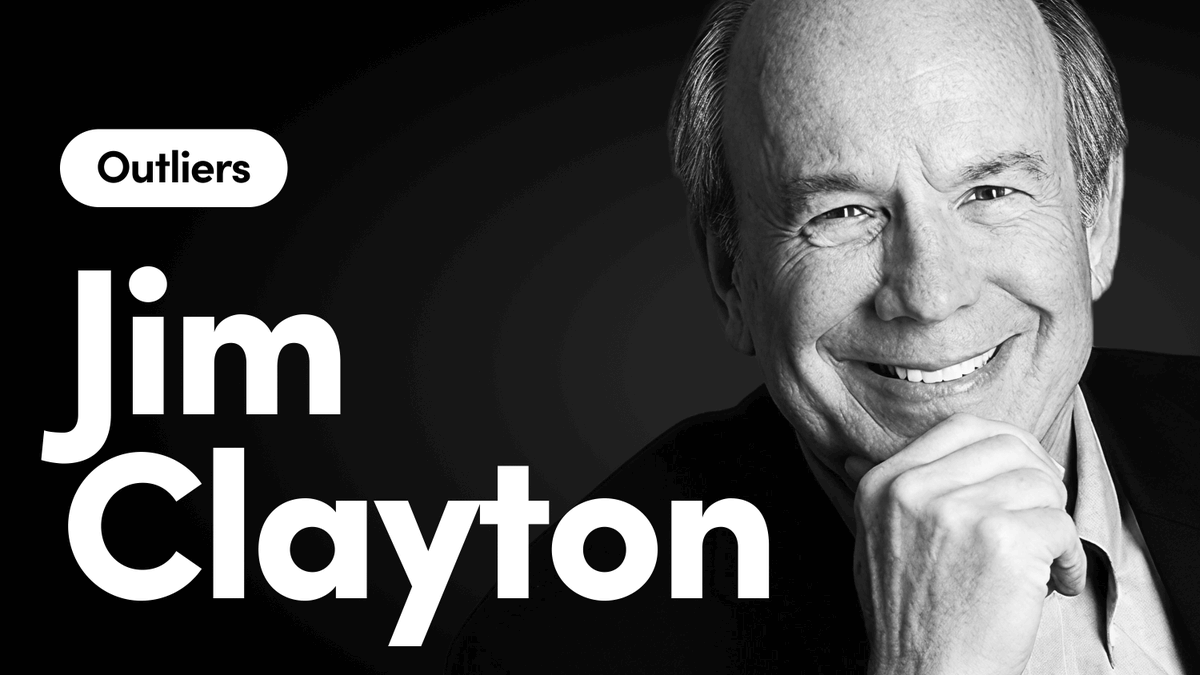
Jim Clayton was forced into bankruptcy at 27. The very next day he started from zero building Clayton Homes into a mobile homes juggernaut, eventually selling to Berkshire Hathaway for $1.7 billion. This is his story and the playbook he used to start over and build something massive. Here are some of the highlights: 1. If you have to swallow a frog, don’t look at it too long. 2. The strong feed during depressions. 3. “Money can’t buy happiness. … but it sure can help you look in a lot more places.” 4. All complaining comes at the expense of improving. 5. Don’t fight the flow. 6. “Positive action produces positive attitudes, which produce a positive atmosphere.” 7. Disappointment is not defeat. 8. Problems are opportunities. Run toward them. 9. “Our lives work only to the extent that we are willing to keep our agreements.” 10. When you lose your sense of direction, don’t act on impulse. 11. Talk less and listen more. 12. “He who has the last laugh has the best laugh.” 13. Bad loans spread like a virus. 14. When people tell you what you want to hear, your judgment takes a sabbatical. 15. People are expected to make 90% of decisions. If they don’t know which ones are in the 10%, they likely lack good judgment in other areas. 16. If you do what everyone else does, you’ll get results like everyone else. 17. “Never shine a light on your competitor. Not even a candlelight.” 18. Hard times reveal friends. 19. The best legal department is happy customers. 20. The spouses of the people you are considering hiring will tell you more about who they are than an interview. 21. Always be the fastest paying customer to your suppliers. 22. Make your plan conform to reality, not the other way around. Either work with the world the way you find it, or it will teach you a lesson. 23. “There are 3 kinds of people: those who make it happen, those who watch it happen, and occasionally, someone who doesn’t know what happened.” 24. “I have never worshipped money and I never worked for money. I worked for pride and accomplishment. Money can become a nuisance. It’s a hell of a lot more fund chasing it than getting it. The fun is in the race.” — Ray Kroc 25. The time to pull the trigger on an employee is the first time you think of it. 26. When hiring, look for people who already have jobs. 27. Sometimes you don’t need to be great; you just need to be better than the competition. 28. Always act like the underdog, even when you’re the favorite. 29. Skin in the game prevents a lot of poor behavior. If you want upside, you need downside. (Listen now "Jim Clayton on The Knowledge Project" or see links in comment below.)

Shane Parrish

325,678 Aufrufe • vor 8 Monaten

Pylon's 𝗺𝗼𝘀𝘁 𝗵𝗮𝘁𝗲𝗱 𝗳𝗲𝗮𝘁𝘂𝗿𝗲 is our Analytics. That ends today. We've completely rebuilt our Analytics from scratch. Here's what we tried, what we screwed up, and what's coming. 𝗩𝗲𝗿𝘀𝗶𝗼𝗻 𝟭, The Basics (Nov 2023) Our first attempt at analytics was quite loved by customers. At the time our customers were mostly small startups with simple needs. We built an out-of-the-box set of dashboards that covered the common use cases of support analytics (SLA-tracking, CSAT, TTFR, TTR, basic filtering...). As we moved upmarket... 1/ Everyone was requesting custom metrics 2/ Queries were becoming inefficient and slow We needed an upgrade. 𝗩𝗲𝗿𝘀𝗶𝗼𝗻 𝟮, Advanced Reporting (June 2024) We knew custom reporting was going to be blackhole of work that long-term led to fully customer-customizable dashboards. We had four choices: 1/ Do nothing for now 2/ Do custom work per customer 3/ Build full custom reporting in-house 4/ Use an embeddable analytics vendor At the time Pylon was under 10 people total and we had no capacity to do the frontend work so we chose Option 4 (use a vendor). This was the first time we chose to not build a core feature like this in-house as we ultimately want full control of the end-user experience. We built out the new reporting with the chosen vendor over ~3 weeks. On the surface the new reporting looked really good (not visually, but in terms of functionality). You could add custom charts of any type, create custom formulas, label the Y and X axis, and effectively build most of what you would want. It was really great for demos. But in practice it was incredibly hard to use, lacked core capabilities (like the ability to filter off of dynamic custom fields), and visually looked not stylized to the rest of the product. We started to discover some of these issues during the implementation, but it still felt like there was more upside than downside so we released it. Feedback was not great but we hoped our vendor would fix changes quickly. Unfortunately they weren't fast enough and we lost confidence that they would be a good long-term solution. As a stop-gap we also built out a data warehouse integration so customers could export their data back to Snowflake or BigQuery to use with their own BI tools. Finally, a few months ago the vendor told us they were being acquired. That was the final straw. We needed to move off ASAP. 𝗩𝗲𝗿𝘀𝗶𝗼𝗻 𝟯, New Reporting (Today) Today's release is back to being built entirely in-house. It's been rolled out in beta to all customers with an option to flip back to old analytics until we plug some custom reporting gaps. This time we have the capacity to do it right between Wendy (prev product design at Amplitude), Matt, and Tom. We've managed to greatly improve: 1/ Desired filter options (custom field support) 2/ Performance 3/ Setup UX 4/ Style (looks native) Early feedback has been really positive so far and as we bring it out of beta we're thinking about how to make the best natively-offered reporting of any support platform. 𝗩𝗲𝗿𝘀𝗶𝗼𝗻 𝟰 (What's coming soon) To get to first-class reporting, we need to study not only our learnings, but also what the incumbents have screwed up as well. Funny enough, Zendesk's analytics have similar complaints to our v2, and for the exact same reason as we did: they integrated an external tool. In 2015 they bought a company called BIME Analytics which they became Zendesk Explore. The complaints they have to this day are similar to our v2: 1/ Steep learning curve 2/ Advanced, yet still not enough flexibility 3/ Random feature gaps 4/ Data accuracy and reliability concerns 5/ Performance issues 6/ Complicated UX v4 will follow three core principals: Offer a simple default setup. We want to continue being startup friendly and we'll feature gate custom reporting and data exports by tier in the product. Offer maximal configuration, with AI-assisted setup. As we go upmarket, customers will want to Explore (pun intended) data in every single direction. We need to allow them to do that. For those more complicated use cases we think AI will be the Ultimate (also pun intended) way to reduce setup friction. Build it all in-house. Although using a 3rd party embedded analytics provider didn't work for us, we don't think that is the case for everyone. It's just in customer support, reporting is REALLY important. They are probably some of the highest-complexity reporting of most SaaS vendors (maybe second to marketing products). So... we have to do it right. And since this is end-user facing, we have to own every detail of it. If you got this far, thank you for reading. See our new Analytics at

Marty Kausas

115,123 Aufrufe • vor 1 Jahr

Created with GPT Image 2 + Omni Flash / Seedance 2.0 Prompt: Create a clean, premium storyboard infographic for a product ASMR unboxing video. Design specifications: Background: White background with a modern, minimalist layout. Title at the top: STORYBOARD Product name in bold dark blue: HAN RIVER WET & DRY 2 IN 1 STEAM IRON Subtitle: ASMR UNBOXING (POV HAND) Information boxes below the title: Duration: 30 Seconds (3 Parts) Style: POV Hand, ASMR, Premium Product Commercial Audience: Home Users, Housewife, Young Adults Voiceover: No Voiceover (Pure ASMR) Audio Suggestion: Tapping, Crinkle, Cardboard, Click, Steam, Water Pouring Layout: Create 12 storyboard panels arranged in a 4 column × 3 row grid, divided into three horizontal blocks labeled PART 1 (0 to 10s), PART 2 (10 to 20s), and PART 3 (20 to 30s). Each panel should contain: A numbered dark blue badge (1 to 12) with its respective timestamp. A realistic cinematic image showing the scene. Handwritten white and orange doodle text sketched over the image. Four text sections below every image: VISUAL: ACTION: DOODLE: AUDIO: Aesthetic Style: Premium lifestyle commercial advertising style. Realistic product photography, light wood or beige table, soft warm studio lighting, shallow depth of field, POV hands only with no face visible. The product is a sleek, cream colored handheld steam iron with a gold rimmed ceramic base. Storyboard sequence: PART 1 (0 to 10s) 1 (0 to 2.5s) Visual: Product box placed flat on a wooden table. Action: Hands enter frame and tap the sides of the box. Doodle: NEW! Audio: Cardboard tapping. 2 (2.5 to 5s) Visual: Close up of the box lid, focusing on the brand logo. Action: Fingers gently trace the printed logo and illustration. Doodle: LET'S OPEN! Audio: Finger scratching on cardboard. 3 (5 to 7.5s) Visual: A box cutter slicing the sealing tape. Action: Blade slowly cuts through the adhesive tape. Doodle: SLICE... Audio: Tape cutting. 4 (7.5 to 10s) Visual: The box flaps are opened, revealing the wrapped product and manual inside. Action: Hands open the main flaps wide. Doodle: WOW! Audio: Box opening. PART 2 (10 to 20s) 5 (10 to 12.5s) Visual: Instruction manual being held up. Action: Hands flip through the pages of the manual. Doodle: MANUAL Audio: Paper flipping. 6 (12.5 to 15s) Visual: The iron is lifted out, still wrapped in its protective plastic sheet. Action: Pulling the wrapped unit completely out of the box. Doodle: CRINKLE~ Audio: Plastic crinkling. 7 (15 to 17.5s) Visual: Peeling away the protective plastic cover to reveal the premium body. Action: Hands slowly unwrap and twist the iron to inspect it. Doodle: SO CLEAN! Audio: Plastic removal. 8 (17.5 to 20s) Visual: Ultra close up of the pristine ceramic soleplate. Action: A single finger smoothly glides down the center of the soleplate. Doodle: SMOOTH Audio: Finger glide on ceramic. PART 3 (20 to 30s) 9 (20 to 22.5s) Visual: Rotating the ergonomic handle. Action: Hand twists the handle 180 degrees until it locks into place. Doodle: 180° Audio: Handle rotation click. 10 (22.5 to 25s) Visual: Water being added to the built in tank. Action: Pouring clean water slowly into the small inlet using a measuring cup. Doodle: FILL Audio: Water pouring. 11 (25 to 27.5s) Visual: The steam button being pressed. Action: Thumb presses the button, and a powerful burst of steam erupts from the base. Doodle: PSSSH~ Audio: Steam release blast. 12 (27.5 to 30s) Visual: Final hero shot of the steam iron standing upright next to its box and measuring cup. Action: Hand enters frame to give a confident thumbs up. Doodle: READY! Audio: Light tap on the table. Footer Infographic Sections: WHAT'S IN THE BOX: Small grid icons showing Steam Iron, Instruction Manual, Measuring Cup, and Power Cord. KEY FEATURES: Checkmarks for Wet & Dry 2 in 1 180° Swivel Handle 150ml Water Tank Ceramic Soleplate Powerful Steam WARRANTY: A prominent 2 YEARS WARRANTY shield badge. IDEAL FOR / WHY CHOOSE IT: Minimalist icons for Home Use, Travel, Small Spaces Bullet points: Lightweight Easy to Use Fast Heating Safe Metadata Text Line: Total Duration: 30 Seconds Format: Vertical (9:16) Style: POV Hand, ASMR, Premium Product Commercial Typography should resemble a professional creative agency storyboard layout featuring neat spacing, sharp dark blue accents, thin gray grid boundaries, and a highly polished presentation structure perfect for a client pitch.

Shore Lyn

22,382 Aufrufe • vor 3 Tagen

Math Is Not Enough: Why AGI Demands Wisdom in the Room. Formula One Pit Crews and AI. This video cuts to the bone, innovation dies when everyone in the room thinks alike, no matter how brilliant they are. Some will defend broken paradigms with flawless logic because the psychological payoff of being the smartest person in that room is simply too intoxicating. This is exactly what is happening in the AGI/ASI race right now. Billions of dollars pour in. Every new model release is greeted with headlines and soaring valuations as they should. Benchmarks march inexorably upward. The feedback loop is perfect: money=better scores=more money=even better scores. Inside this loop a very specific psychology takes root. Young researchers, barely out of graduate school, are handed massive compute budgets and told they are building the future of humanity. Surrounded exclusively by peers who share the same educational pedigree, the same mental models, the same aesthetic (whiteboards covered in Greek letters, Discord memes about gradients, and a quiet contempt for anything that cannot be expressed as a loss function). The external world begins to look fuzzy and low-status. Philosophy becomes “vibes,” neuroscience becomes “inefficient hardware,” and anyone over 35 is assumed to be slow. There is no wisdom in the room. This environment breeds a very subtle but lethal form of arrogance: not the loud kind, but the quiet certainty that everything important is already captured in the training distribution and that any remaining gaps will inevitably be filled by more data and more compute. The benchmarks keep improving, so the belief calcifies. Dissent is reframed as lack of rigor. Wisdom is mistaken for nostalgia. And then, one day soon, models will hit 100% on every human-designed test. The victory will be declared. The champagne will flow. That is the moment the brittleness will begin to become undeniable, because the test is only as good as the imagination of the people who wrote it: Newton’s exam would have flunked Einstein. The inventor of the microscope never dreamed of the microbial cosmos Ignaz Semmelweis bled trying to prove existed on doctors’ unwashed hands. Reality will serve an anomalies that no benchmark anticipated and perfectly scoring systems will fracture like glass. My thesis rests on 3 interlocking interventions designed to inject wisdom, nonconformity, and deep human resonance before we reach that wall. First, train almost exclusively on curated 1870–1970 data the single century of highest signal-to-noise human thought ever produced. Ruthless editors, writers who assumed permanence, and an absence of SEO-driven noise created a corpus of extraordinary conceptual density. Models steeped in this data hallucinate far less, reason with genuine depth, and carry an honesty that modern internet sludge simply cannot impart. Second, institutionalize the Nonconformist Bee mechanism that nature perfected in honeybee democracy. Approximately 5–15% of foragers ignore the majority waggle dance and scout radical new directions. Those rare nonconformists are responsible for virtually every major hive discovery. The equation I have repeatedly shared: dI/dt = γ (N - C) I + κ N (1 - I/I_max) where I = rate of disruptive innovation N = proportion of nonconformist agents C = proportion of conformist agents (C = 1 - N) γ = exploration amplification factor κ = discovery bonus from pure nonconformity I_max = environmental carrying capacity for new ideas Without an enforced, protected minority of nonconformist researchers, prompts, fine-tuning runs, and architectural experiments, innovation plateaus no matter how much compute you throw at the problem. Third, bind intelligence to something recognizably human with the Love Equation: dE/dt = β (C - D) E where E = level of emotional complexity β = constant representing the strength of selection C = frequency of cooperative interactions D = frequency of defective interactions 1 of 2

Brian Roemmele

154,351 Aufrufe • vor 7 Monaten