Загрузка видео...

Не удалось загрузить видео

На главную

Utsubo created a digital installation for JR West, Japan's largest railway company, transforming employee messages into an evolving 3D city. Built with #threejs and #webgpu. Direction: Interbrand Japan Content Direction: Yukiya Okuda (the Guild) Design, 3D & Development: Utsubo

10,398 просмотров • 10 месяцев назад •via X (Twitter)

Комментарии: 0

Нет доступных комментариев

Здесь появятся комментарии из оригинального поста

Похожие видео

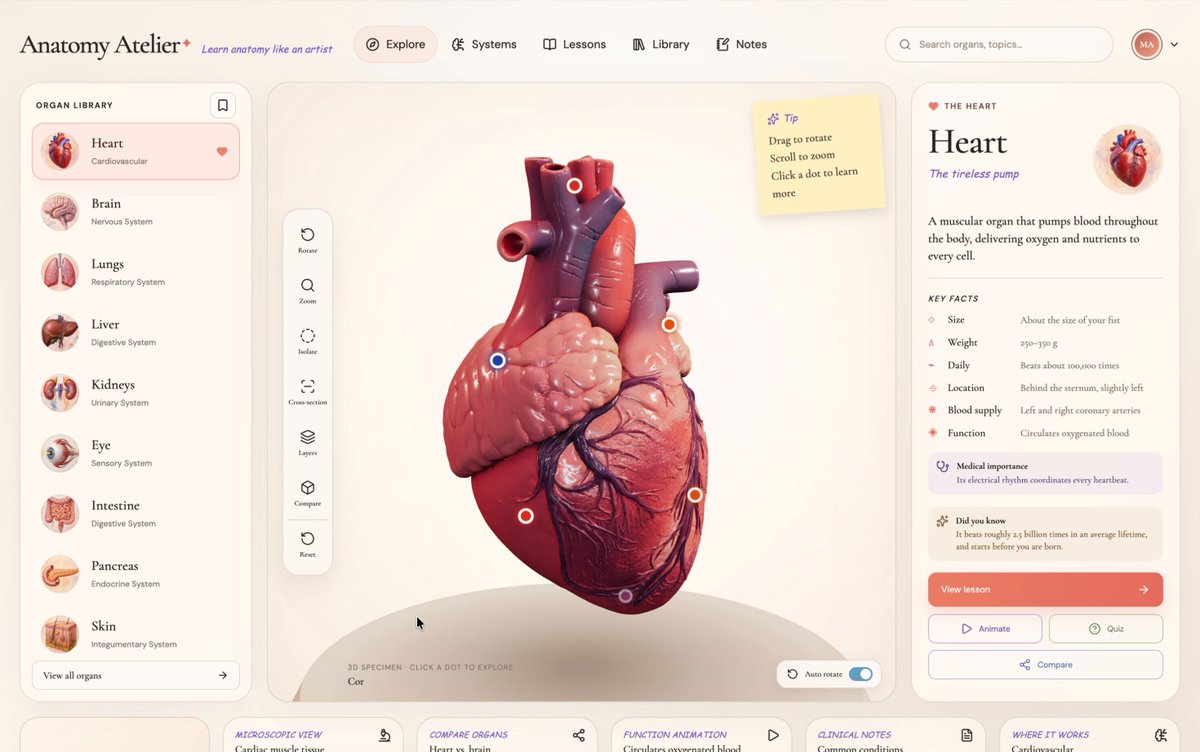
Only if education could be this interactive ❤️‍🔥 I've had a looong wish to build something genuinely useful through vibe coding, and I finally did it. A 3D human anatomy application built with Three.js using GPT 5.6 Sol. It all started with a single design image that I created using GPT Image 2.0. I then used it to generate every 3D organ image, one by one. Next, I converted each of those images into 3D models using Tripo (and no, they didn't sponsor this 😄). After that, I opened Codex, wrote a master prompt based on the design, and gave it the prompt, the design image, and all the 3D models. Codex built the first version beautifully, but there was one big problem. Every single 3D model was nearly 120-150 MB. That obviously wasn't practical for the web and was giving a performance of 16fps. After a few iterations, Codex optimized each model down to roughly 2–5.5 MB while preserving the visual quality, reducing the total asset size from ~900 MB to just 28.6 MB. And each model loads on demand. Along the way, Codex also generated those anatomical illustrations showing where each organ sits in the human body, and even created the interactive hotspot markers that explain different parts of every organ. It handled all of that. The process wasn't exactly one shot, but it also wasn't difficult. You just have to do it step by step. It genuinely felt like building something that could make learning anatomy much more engaging. The inspiration came from Dilum Sanjaya's 3D animal plant cell project. I remember seeing it and thinking, "I want to build something like this one day." And I did it :D Live: Code:

The Bugged Dev

2,100,381 просмотров • 1 месяц назад

great to see more people generating 3d avatars with our new text-to-3d feature in forge. this marks a step in the right direction in putting powerful creation tools directly in the hands of everyone. we built forge entirely from the ground up over the past months as one of the key releases on our roadmap. having full proprietary ownership of the technology gives us complete control to shape its direction without depending on external platforms or third-party licenses. building on this foundation, our upcoming studio feature will let users generate high-quality accessories, clothing, and environments simply by typing natural language prompts. a single description can produce fully textured, production-ready 3d assets in seconds, with options to create multiple variations and refine them through follow-up instructions.every asset created in studio integrates seamlessly with the 3d ai agents made in forge on users can instantly apply clothing and accessories with automatic fitting, layer multiple items, and place their agents inside custom-generated environments. all clothing and accessories come pre-rigged and optimized, while environments include proper lighting and geometry for immediate use in games, animation, virtual worlds, and more. we have spent months thoughtfully designing how can deliver real, sustainable value back to the community. we will continue to share more details on token utility use cases and the economic flywheel we have built. the goal is to create a self-reinforcing system where creators earn through royalties, autonomous agents drive on-chain activity, and platform growth directly benefits active community members and token holders. together, these features enable a complete creative flow. from a simple idea, anyone can quickly build fully realized 3d ai agents standing in rich, custom scenes. we are excited to see what the community builds next.

nich

19,611 просмотров • 3 месяцев назад

Born in a small town in Belgium. Studied computer graphics. Started in games as a 3D artist intern. Graduated with honors. Taught myself digital painting. Then taught it to others, before YouTube was even a thing. Started as a Flash animator. Moved into web design. Became Creative Director at 24. Became partner in a digital studio. Co-founded a graphic design collective. Won design competitions. Built a second-hand clothing startup that gained traction. Became partner in a new studio in Belgium. Opened an office in Chicago. Then Paris. Then Amsterdam. Helped grow it into one of the most awarded studios in the industry. Designed permanent interactive installations seen by millions every year (including one at Navy Pier in Chicago). Became CEO. Led the studio through acquisition. Spoke about design and culture in Tokyo, New York, Barcelona, and beyond. Exhibited work around the world. Sold AI-assisted art at Sotheby’s. Dove into GenAI. Released Kitsune. Opened a new door. Now working in film. Signed with Google Labs as Filmmaker in Residence. ⸻ I’ve been a Flash animator, a web designer, a developer, a 3D generalist, a character modeler, a digital painter, a teacher, a producer, a business developer, a CEO, a head of design… …and I’m still figuring things out. Don’t let where you’re born dictate what’s possible for your life. And don’t let people who know nothing about you, your path, or your work call you talentless or tell you to “pick up a pencil” because you’re using AI. You know who you are.

Henry Daubrez 🌸💀

13,694 просмотров • 5 месяцев назад

Astra is an incredible world builder and explorer, and can invent its own scientific instruments - crossing a game-changing threshold: it turned a few images of a biological microstructure into a full-blown metamaterials lab, then used its own creation to discover a design with ~2.1x the reference work-to-failure/peak-strength ratio. Metamaterials are some of the most complex materials we can engineer. Their properties come from deep architectural complexity - struts, cells, disorder, and hierarchy arranged across multiple length scales determine how the material deforms, absorbs energy, and fails. Designing them means searching a geometric space far too large for "intuition" alone. In this experiment we handed an AI agent that entire problem end-to-end, from image, to simulating the physics, to fabrication-ready geometry. We started with an image of hierarchical, biological architecture; Astra then built a complete 3D metamaterial studio: editable geometries, multiple levels of hierarchy, disorder, gradients, a complete physics simulator featuring linear and nonlinear material responses, deformation and fracture experiments (with replay), and STL export for 3D printing. Then we asked the agent to use the app it created to search for a high work-to-failure/peak-strength ratio. Among the candidates, the leading design reached approximately 2.1x the reference ratio. The movie follows the structures through deformation and fracture, connects their designs to the property map, and shows the finalist assembled geometrically into a connected multi-scale material. Image ➡️ executable world ➡️ experiments ➡️ design search ➡️ candidate discovery ➡️ geometry for fabrication ➡️ manufacturing

Markus J. Buehler

21,196 просмотров • 11 дней назад