Загрузка видео...

Не удалось загрузить видео

На главную

Viewpoint diversity helps academia avoid becoming an echo chamber. HxA President John Tomasi describes how ideological homogeneity is undermining science:

11,834 просмотров • 4 месяцев назад •via X (Twitter)

Комментарии: 0

Нет доступных комментариев

Здесь появятся комментарии из оригинального поста

Похожие видео

Bill Ackman Bill Ackman discusses President Trump's battle with Harvard. Bill Ackman: "The wrong thing to do is receive a letter from the Administration and write back saying: we're doing nothing and in fact, we're going to sue you." "What Harvard should have done is say: President Trump - you make some good points. Taxpayer money coming to Harvard is a privilege, not a right." Taxpayer money going to an institution - an institution cannot have massive amounts of administrative bloat, waste, bureaucracy- we're going to eliminate it." Bill Ackman goes further on the culture at Harvard. "There is not viewpoint diversity at Harvard. Students are self-censoring their remarks in classrooms. Faculty are doing the same - people are afraid to have real conversations. You go to college to be exposed to a broad array of ideas - and that's not happening at Harvard. Free speech is not happening." On Trump trying to make a deal with Harvard. "He (President Trump) wants to make a deal. Make a deal with the President. Commit to fix these things, which by the way, your alumni want you to fix - it's in the best interest of Harvard. Treat shareholder taxpayer money as a fiduciary." Fair or unfair to take the tax exempt status away? "I think it's fair. Harvard became over time a political advocacy organization for one party. When a University goes from being a University to effecting and becoming a political activist organization - it doesn't deserve a non-profit status." "Harvard should be a place where students go to learn and the best research gets done. It shouldn't be a place that is allowing pro-terrorist orgs on campus and only allows certain kinds of thinking and speech on campus - that's a political advocacy organization - not a University."

Barbie True Blue

712,341 просмотров • 1 год назад

ANNOUNCEMENT: WE’RE SAVING SCIENCE! We’re often told that science is “self-correcting.” But that’s not really true. Science doesn’t correct itself like a thermostat adjusting the temperature in your house. Science is a human institution run by human beings. And human beings are vulnerable to career incentives, groupthink, moral fads, political pressure, and fear. And when those forces capture academic journals, peer review stops being a filter for bad ideas and starts becoming more of a credentialing system for fashionable nonsense. This isn’t exactly new. In 1996, the physicist Alan Sokal managed to publish a totally gibberish article in the journal Social Text full of trendy postmodern jargon. His point was simple: if you flatter the ideological commitments of certain academic editors, nonsense can pass as real scholarship. Two decades later, James Lindsay, anti-Communist, Helen Pluckrose , and Peter Boghossian pulled off the “grievance studies” hoax, placing over a half dozen absurd papers in peer-reviewed journals. One paper used dog parks to analyze rape culture and queer performativity. Another rewrote parts of Mein Kampf in the language of feminist theory. The problem wasn’t just that fake papers got published. It was that they were completely indistinguishable from the real thing. And today, the problem is even worse. We now have serious SCIENCE journals publishing papers about feminist lesbians marrying brine shrimp. We have disturbing papers that aim to “queer” and sexualize infants. We have scholarship on “lesbian-queer-trans-canine relationalities” and “trans-dog intimacies.” But while Clown World papers are concerning because it makes a complete mockery of academia, the same broken, ideologically captured system is also publishing research in legitimate science and medical journals that pushes sex and gender pseudoscience, relies on deeply flawed data, and influences policies on the medical transition of children and young adults. That’s not funny. That affects real people. It affects medicine. It affects law. It affects children. And when critics try to respond, they often discover there’s no serious mechanism for correction. Submitted Letters to the Editor often go completely ignored. Contrary evidence is rejected without comment. As a result, the best critiques are often relegated to personal blog posts, social media threads, or newspaper op-eds, while the original paper remains in the literature wearing the armor of “peer review.” That is untenable. So Kevin McCaffree, editor-in-chief of Theory and Society (Theory and Society (Springer Nature)), and I decided to do something about it. Today, in the Wall Street Journal, we announced a first-of-its-kind article type called “Peer Review.” The idea is simple: publication should be the beginning of academic scrutiny, not the end of it. A Peer Review article can critique a paper from any scholarly journal. It can address problems with methods, evidence, logic, definitions, theory, or interpretation. But it has to focus on the claims and arguments, not personal attacks. Submissions are capped at 2,500 words and go through a straightforward merit review instead of endless gatekeeping and ideological screening. We ask just one basic question: Is this critique coherent, serious, reasonable, or even popular enough to deserve scholarly attention? If yes, it gets published. And the authors of the original paper get a built-in right of reply, so readers can see the critique and the response in a legitimate academic venue. That’s how science is supposed to work. Science becomes self-correcting only when real people build the mechanisms that allow correction to happen. That’s what we’ve done. Now it’s time for academics to use it. Read our announcement on the The Wall Street Journal below. 🔗

Colin Wright

1,002,821 просмотров • 3 месяцев назад

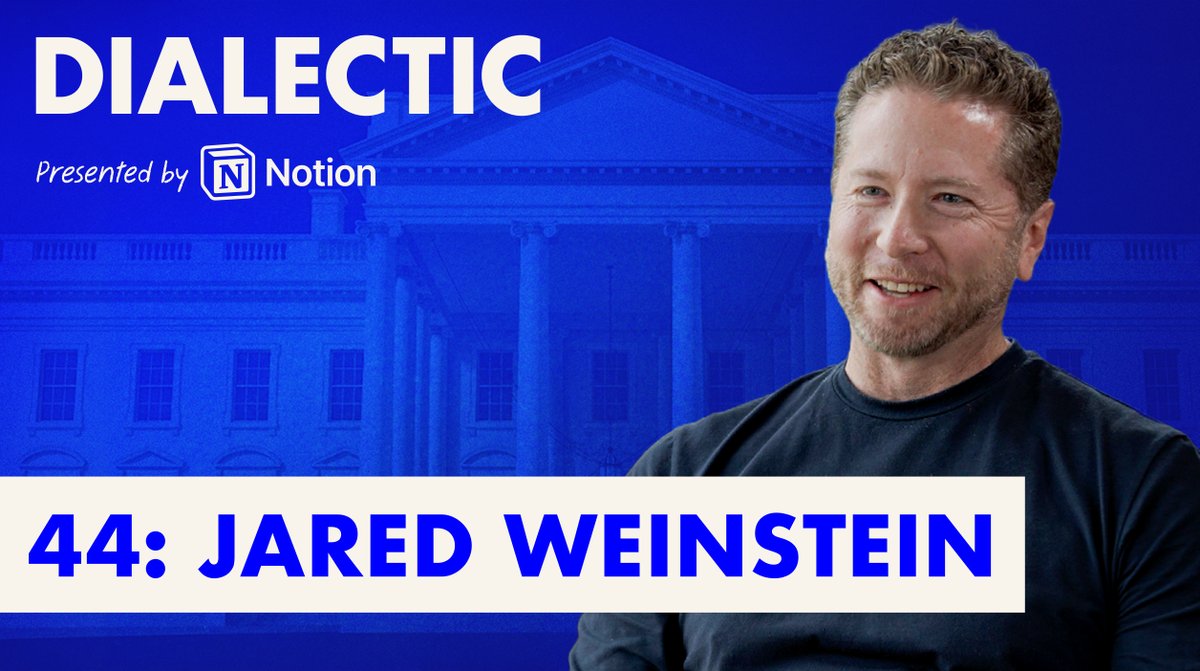
Jared Weinstein is deeply trusted and quietly effective. He is a friend to many. This is his first interview. From President Bush, to Thrive's team and founders, to new leaders building in his hometown of Birmingham and globally, Jared Weinstein is an amplifier of people. We discuss: - Cold-calling the Bush campaign in college, joining them in the run up to 2000, and not dropping out - Becoming the President's personal aide (or "body man") in his mid-20s, what the President does, and how little Jared slept - an unlikely partnership with Joshua Kushner that led to over a decade building the now-legendary Thrive Capital - what it was like helping Palantir in the very early days - Bringing seriousness and humanity to work, whether the West Wing or investing - the three-body problem of ego, ambition, and impact - why people trust Jared and how he helps them become their best selves - east vs. west coast ambition, across DC, SF, and NY - how he's investing in Birmingham, why cities change and thrive, and helping people raise their ambition - championing those who champion you Timestamps: 0:00 - Opening Highlights 1:40 - Intro to Jared 3:32 - Thanks to Notion 4:39 - Start: Being a "Friend" and Bringing Humanity to Serious Work 10:55 - From Duke to the West Wing 31:45 - Riding Shotgun with President Bush 59:27 - Starting Over Out West: Post-WH, Stanford, and Palantir 1:16:05 - Meeting Josh Kushner and Building Thrive Capital 1:44:37 - Founders, Humility, and the Three-Body Problem of Ego, Ambition, and Impact 2:06:41 - Leaving Thrive, Coming Home to Birmingham, and Overton 2:32:40 - Busier Than Ever: Mentors, Life in Acts, and What You Hope to Be Known For Dialectic with Jackson Dahl 44: Jared Weinstein - Within Earshot, Out of Camera Shot - is available below and on all platforms.

Jackson Dahl

88,292 просмотров • 5 месяцев назад

I was one of three parliamentary staff members at The Scottish Parliament who got together in a room to draft the Parliament's first ever Language Policy back in 2004. Here's an archived copy of the policy, as it has obviously been replaced by more recent versions since then: The policy was designed to support use of Gaelic in the work of the Parliament, and to overcome genuine barriers that a minority of people might face in accessing the Parliament or its work because they were not fluent in English. This policy was not designed to prompt politicians to speak any language they liked in the chamber to score points relating to their own identity or ideology. MC would seem to be able to speak English fluently, and therefore I struggle to see any access-based premise for her speaking in Shona in this context. I feel constantly embarrassed by the way in which genuine good-faith work to address genuine barriers to access has been used by people for ideological and political reasons. I feel sad that it has now become difficult to defend inclusion-based activity because it has become associated with virtue signalling and with undermining, rather than strengthening, human connectedness. I wish I had been able to foresee what would happen, so I could have detached myself from equality and diversity work even sooner than I did. This is before we get onto the political symbol Maggie Chapman is wearing around her neck. This whole thing is so unprofessional and embarassing.

Levi Pay

72,471 просмотров • 4 месяцев назад

I absolutely love how Alex pressed Sam on whether OpenAI thinks they’ve already hit AGI internally, and what he actually considers the difference between AGI and ASI. Sam’s answer was basically that declaring AGI doesn’t really mean anything anymore, because every lab and every person uses a different definition. He makes the good point that if you went back to 2020 and showed people a system that could code, help start a company, discover new science and give you a 20 minute win across basically every part of your life, most people probably would’ve called that AGI. I personally still don’t think we’ve hit it, but I agree with his broader point that treating AGI like some single finish line is becoming increasingly meaningless. The way he describes ASI is exactly how I would want him to, AGI is basically a milestone somewhere on the curve, while superintelligence is this continuous ramp of increasing capability that may never really have a final “we won” moment. And importantly, Sam says he sees no sign that this exponential capability curve is slowing down. A few quotes I liked as well: “We’re building AI, but it’s a thing you’re always building. It’s not an end state anymore.” “I don’t want to say we’ve declared victory on the AGI point and moved on.” “The important part of any of this is not any milestone, any term. It’s that we are on this exponential of increasing capabilities and potential.”

Chris

38,143 просмотров • 22 дней назад

If we brought back powdered wigs for elites, luxury beliefs would disappear overnight. Give people an obvious way to display their rank, and perhaps they would feel less need to signal it through their opinions. I’m only partly joking. In some elite circles, openly displaying wealth is considered vulgar. But the desire for status does not disappear just because certain ways of showing it become unacceptable. People find other ways to distinguish themselves. In The Status Game, Will Storr describes three broad forms of status competition. In dominance games, people gain status through force or intimidation. Street gangs and organized crime offer clear examples. In success games, people gain status by showing competence: earning a degree, building a career, or becoming skilled at something others value. In virtue games, people compete to be seen as morally good. This last form of competition helps explain the appeal of luxury beliefs. An unusual or fashionable opinion can make someone seem both distinctive and virtuous. But seeking status through beliefs does not always cause harm. People can also gain admiration by promoting ideas that improve other people’s lives. I’m often asked whether there are any good luxury beliefs. By my definition, the answer is no. Luxury beliefs are ideas and opinions that confer status on elites while inflicting costs on everyone else. If a belief raises the status of the person expressing it and also helps others, it is not a luxury belief. There have been historical examples of elites gaining status by advancing ideas that benefit society. The question is how to encourage more of that kind of competition.

Rob Henderson

31,412 просмотров • 15 дней назад

I have attached this 74-minute documentary film at a time when America is once again threatening to depose the Venezuelan government, this time by advising aircraft to avoid Venezuelan skies. It is a timely reminder of how foreign powers manufacture narratives, engineer crises and justify intervention under the guise of protecting democracy or fighting drugs. In 2006, I won a British government scholarship to study documentary filmmaking at Master’s level at Brunel University in London. One of my lecturers, Prof Michael Wayne, who is still at Brunel University today, introduced us to the concept of propaganda and how film and television are used to shape public perception. One of the films he brought to class for us to watch and dissect was The Revolution Will Not Be Televised. It was made by two Irish filmmakers who happened to be visiting Venezuela in 2002, and before they had even begun their planned filming, a coup erupted. They suddenly found themselves at the centre of the crisis with their cameras rolling. The coup was inspired and encouraged by elements linked to the American government, which had long viewed Hugo Chávez as a threat to its geopolitical interests. The filmmakers captured how the opposition, parts of the military, the private media and external actors collaborated to remove a democratically elected president. They also documented how ordinary Venezuelans and loyal sections of the army mobilised, pushed back and returned Chávez to power within 48 hours. It is one of the most important documentary records of a coup taking place in real time. Today we are witnessing Donald Trump going after Venezuela again, a country with the largest proven oil reserves in the world. Surprise, surprise, the excuse this time is “drugs”, the same way “weapons of mass destruction” were used as an excuse in Iraq. Yet this is the same Trump who is preparing to pardon the former president of Honduras, Juan Orlando Hernández, who was convicted in the United States and sentenced to 45 years for drug trafficking. US prosecutors proved that Hernández helped move hundreds of tonnes of cocaine through Honduras into the United States, undermining Trump’s claim that his crusade against Venezuela is genuinely about fighting drugs. Watch this film to understand how coups are engineered, how narratives are manufactured and how the media is used as a weapon. All the visuals you see in the documentary are real, filmed as events unfolded. It is a powerful reminder of how foreign interests destabilise nations, and how the people of Venezuela resisted manipulation and restored their democracy through collective action.

Hopewell Chin’ono

25,801 просмотров • 9 месяцев назад