Video wird geladen...

Video konnte nicht geladen werden

Zur Startseite

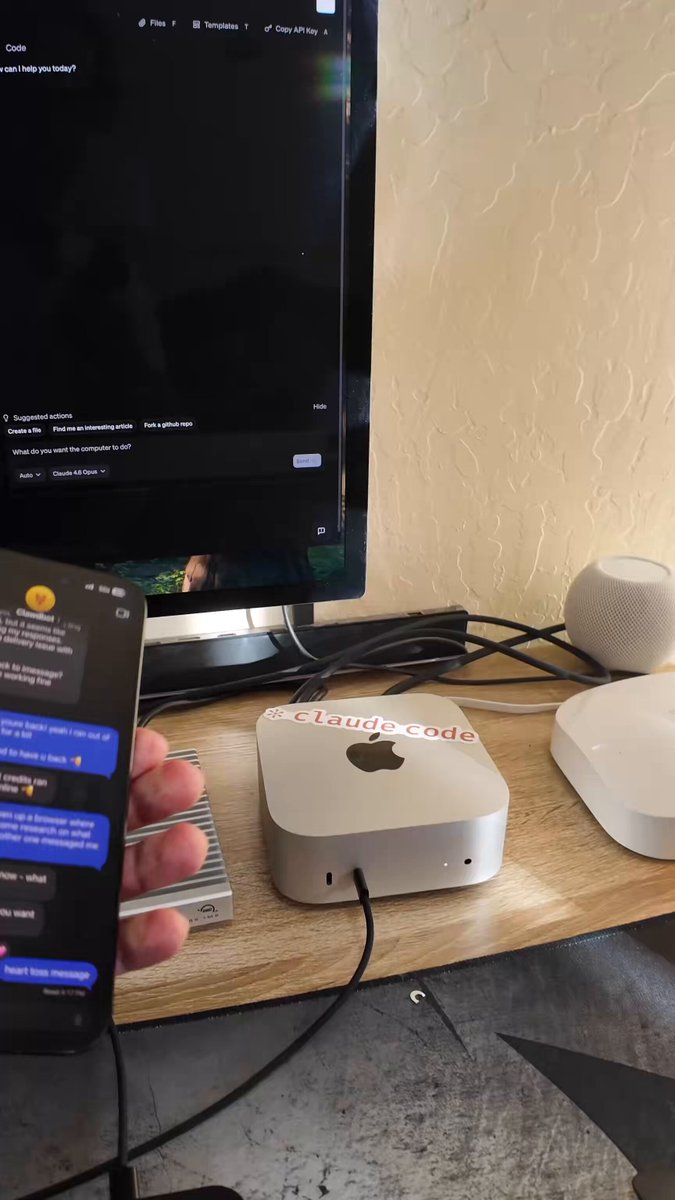
Watch this video before spending $700 + 5 hours setting up a Mac Mini for Moltbot [Clawdbot] You can do all the same things that Moltbot can but from iMessage with Zo Computer for FREE, here's how 0:00 - iMessage -> Zo buys stuff on Amazon 0:55 - Why...

27,857 Aufrufe • vor 5 Monaten •via X (Twitter)

0 Kommentare

Keine Kommentare verfügbar

Kommentare vom Original-Post werden hier angezeigt

Ähnliche Videos

today we're announcing Zo Computer. when we came up with the idea – giving everyone a personal server, powered by AI – it sounded crazy. but now, even my mom has a server of her own. and it's making her life better. she thinks of Zo as her personal assistant. she texts it to manage her busy schedule, using all the context from her notes and files. she no longer needs me for tech support. she also uses Zo as her intelligent workspace – she asks it to organize her files, edit documents, and do deep research. with Zo's help, she can run code from her graduate students and explore the data herself. (my mom's a biologist and runs a research lab. hi mom) Zo has given my mom a real feeling of agency – she can do so much more with her computer. we want everyone to have that same feeling. we want people to fall in love with making stuff for themselves. in the future we're building, we'll own our data, craft our own tools, and create personal APIs. owning an intelligent cloud computer will be just like owning a smartphone. and the internet will feel much more alive. THIS ONE'S FOR YOU MOM ❤️ special thank you to Modal, Pydantic AI, and Steel for being great partners leading up to this launch. and thank you Cursor for being my sword 🗡️ and thank you to everyone who believed in us. a small handful: South Park Commons, Aditya Agarwal, Chris Best, Guillermo Rauch, immad, Shreyas Doshi, Matt Hartman, sam lessin 🏴‍☠️, Gokul Rajaram, Sabrina Hahn, iqram 🪼, Nnamdi Iregbulem, Guru Chahal🇺🇸, Mike Marg, Will Gaybrick, Stephan Cizmar, 👍🏻, Anne Lee Skates, joyce, jam, , Aaron Mak Hoffman, Sunfield

ben guo 🏇

588,841 Aufrufe • vor 7 Monaten

Today: a 1.5 hour interview with the co-founders of Coherence Neuro: Ben Woodington and Elise Jenkins They are, as far as i can tell, the only (neurotechnology x oncology) startup that exists today. 'Neurotechnology? For cancer?' you may ask. Yes! As it turns out, tumors interact with the nervous system a fair bit, and you can use the very same neuromodulation toolbox that exists for neuropsychiatric conditions, for monitoring and treating cancer. Coherence has built an invasive device to place at the site of a tumor to do exactly this. Their first indication is a form of brain cancer called glioblastoma; one of the most fatal subtypes of cancer to exist today. The standard of care (with one exception that we discuss) has not changed in 25 years. If Coherence works out, and there is a very real chance they will, that may change. Most interesting of all is that Coherence believes that the bioelectric properties of cancer are not just worth poking at for brain cancers, but for all cancers. And maybe even for diseases outside of it! This conversation covers how Coherence’s first neurotech device (SOMA) works, the molecular reasons behind why neuromodulation affects cancer at all, what the biomarker readouts look like, the obvious Michael Levin comparison, and a lot more. Also: shout to Nicole for setting up the connection here in the first place! Crazy to think that a meeting in mid-2025 ended up leading to this Youtube/Spotify/Apple Podcasts links in replies 0:00:00 - Introduction 0:01:42 - How is SOMA different from Novocure’s Optune? 0:08:57 - Why does neuromodulation affect cancer at all? 0:13:28 - How was cancer-nervous system crosstalk first discovered? 0:15:42 - Anti-epileptics and beta blockers as accidental cancer drugs 0:17:38 - What is molecularly happening when you block cancer-neuron crosstalk? 0:19:50 - What is SOMA actually reading out as a biomarker? 0:20:44 - What does it mean that cancer is “very electric”? 0:22:02 - Can you derive universal biomarkers across patients? 0:23:09 - How is the device placed? 0:24:45 - How does the blocking stimulation regime work? 0:26:43 - Is it fair to say this is closed loop? 0:29:05 - Why not just spam the tumor with constant stimulation? 0:32:31 - Why MRI safety is non-negotiable for oncology devices 0:33:35 - Walk us through the patient journey from diagnosis to implantation 0:36:13 - The Michael Levin question: can you reprogram cancer back to normal? 0:42:29 - Efficacy, hospice settings, and the utility of the neuromodulation literature 0:45:52 - Why start with glioblastoma instead of an easier cancer? 0:48:57 - Regulatory strategy and the reimbursement threat 0:55:37 - How well does mouse-to-human translation work for neuromodulation? 0:55:57 - What do in silico models of neuromodulation look like? 0:58:09 - Why didn’t this exist 10 years ago? 1:01:48 - The founding story 1:06:38 - Why build your own device instead of using off-the-shelf arrays? 1:08:35 - Speaking with glioblastoma patients 1:12:04 - What was it like to raise money for this? 1:13:56 - Beyond cancer: TBI, lung disease, and the pan-disease argument 1:17:40 - Hiring at Coherence + what is the hardest type of talent to find 1:23:17 - What would you do with $100M equity-free? 1:27:15 - Are you a neurotech company or a cancer company?

owl

37,299 Aufrufe • vor 4 Monaten