Загрузка видео...

Не удалось загрузить видео

На главную

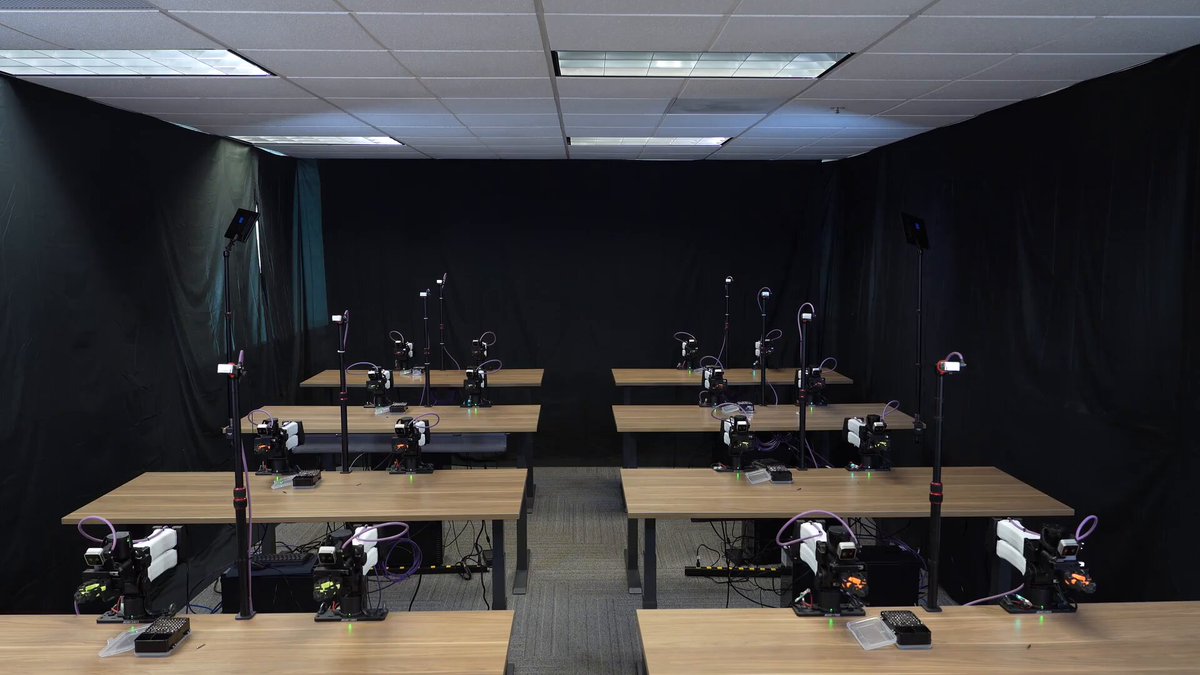
We can convert human videos to robot hand-object interaction trajectories in 4D. Enjoy! Paper: Website: Code: Authors:Bhawna Paliwal,Haritheja,Will Liang, Pieter Abbeel , Mahi Shafiullah 🏠🤖 , Jitendra MALIK

72,760 просмотров • 1 месяц назад •via X (Twitter)

Комментарии: 0

Нет доступных комментариев

Здесь появятся комментарии из оригинального поста

Похожие видео

Exciting updates on Project GR00T! We discover a systematic way to scale up robot data, tackling the most painful pain point in robotics. The idea is simple: human collects demonstration on a real robot, and we multiply that data 1000x or more in simulation. Let’s break it down: 1. We use Apple Vision Pro (yes!!) to give the human operator first person control of the humanoid. Vision Pro parses human hand pose and retargets the motion to the robot hand, all in real time. From the human’s point of view, they are immersed in another body like the Avatar. Teleoperation is slow and time-consuming, but we can afford to collect a small amount of data. 2. We use RoboCasa, a generative simulation framework, to multiply the demonstration data by varying the visual appearance and layout of the environment. In Jensen’s keynote video below, the humanoid is now placing the cup in hundreds of kitchens with a huge diversity of textures, furniture, and object placement. We only have 1 physical kitchen at the GEAR Lab in NVIDIA HQ, but we can conjure up infinite ones in simulation. 3. Finally, we apply MimicGen, a technique to multiply the above data even more by varying the *motion* of the robot. MimicGen generates vast number of new action trajectories based on the original human data, and filters out failed ones (e.g. those that drop the cup) to form a much larger dataset. To sum up, given 1 human trajectory with Vision Pro -> RoboCasa produces N (varying visuals) -> MimicGen further augments to NxM (varying motions). This is the way to trade compute for expensive human data by GPU-accelerated simulation. A while ago, I mentioned that teleoperation is fundamentally not scalable, because we are always limited by 24 hrs/robot/day in the world of atoms. Our new GR00T synthetic data pipeline breaks this barrier in the world of bits. Scaling has been so much fun for LLMs, and it's finally our turn to have fun in robotics! We are building tools to enable everyone in the ecosystem to scale up with us. Links in thread:

Jim Fan

364,514 просмотров • 2 лет назад

We trained a robot dog to balance and walk on top of a yoga ball purely in simulation, and then transfer zero-shot to the real world. No fine-tuning. Just works. I’m excited to announce DrEureka, an LLM agent that writes code to train robot skills in simulation, and writes more code to bridge the difficult simulation-reality gap. It fully automates the pipeline from new skill learning to real-world deployment. The Yoga ball task is particularly hard because it is not possible to accurately simulate the bouncy ball surface. Yet DrEureka has no trouble searching over a vast space of sim-to-real configurations, and enables the dog to steer the ball on various terrains, even walking sideways! Traditionally, the sim-to-real transfer is achieved by domain randomization, a tedious process that requires expert human roboticists to stare at every parameter and adjust by hand. Frontier LLMs like GPT-4 have tons of built-in physical intuition for friction, damping, stiffness, gravity, etc. We are (mildly) surprised to find that DrEureka can tune these parameters competently and explain its reasoning well. DrEureka builds on our prior work Eureka, the algorithm that teaches a 5-finger robot hand to do pen spinning. It takes one step further on our quest to automate the entire robot learning pipeline by an AI agent system. One model that outputs strings will supervise another model that outputs torque control. We open-source everything! Welcome you all to check out the paper, more videos, and try the codebase today: Code:

Jim Fan

908,894 просмотров • 2 лет назад

Synthetic data will provide the next trillion tokens to fuel our hungry models. I'm excited to announce MimicGen: massively scaling up data pipeline for robot learning! We multiply high-quality human data in simulation with digital twins. Using 50,000 training episodes across 18 tasks, multiple simulators, and even in the real-world! The idea is simple: 1. Humans tele-operate the robot to complete a task. It is extremely high-quality but also very slow and expensive. 2. We create a digital twin of the robot and the scene in high-fidelity, GPU-accelerated simulation. 3. We can now move objects around, replace with new assets, and even change the robot hand - basically augment the training data with procedural generation. 4. Export the successful episodes, and feed that to a neural network! You now have an near-infinite stream of data. One of the key reasons that robotics lags far behind other AI fields is the lack of data: you cannot scrape control signals from the internet. They simply don't exist in-the-wild. MimicGen shows the power of synthetic data and simulation to keep our scaling laws alive. I believe this principle apply beyond robotics. We are quickly exhausting the high-quality, real tokens from the web. Artificial intelligence from artificial data will be the way forward. We are big fans of the OSS community. As usual, we open-source everything, including the generated dataset! - Website: - Paper: - Dataset is hosted on HuggingFace (thanks AK!!): - Code: MimicGen is led by Ajay Mandlekar, deep dive in the thread:

Jim Fan

332,238 просмотров • 2 лет назад

Can GPT-4 teach a robot hand to do pen spinning tricks better than you do? I'm excited to announce Eureka, an open-ended agent that designs reward functions for robot dexterity at super-human level. It’s like Voyager in the space of a physics simulator API! Eureka bridges the gap between high-level reasoning (coding) and low-level motor control. It is a “hybrid-gradient architecture”: a black box, inference-only LLM instructs a white box, learnable neural network. The outer loop runs GPT-4 to refine the reward function (gradient-free), while the inner loop runs reinforcement learning to train a robot controller (gradient-based). We are able to scale up Eureka thanks to IsaacGym, a GPU-accelerated physics simulator that speeds up reality by 1000x. On a benchmark suite of 29 tasks across 10 robots, Eureka rewards outperform expert human-written ones on 83% of the tasks by 52% improvement margin on average. We are surprised that Eureka is able to learn pen spinning tricks, which are very difficult even for CGI artists to animate frame by frame! Eureka also enables a new form of in-context RLHF, which is able to incorporate a human operator’s feedback in natural language to steer and align the reward functions. It can serve as a powerful co-pilot for robot engineers to design sophisticated motor behaviors. As usual, we open-source everything! Welcome you all to check out our video gallery and try the codebase today: Paper: Code: Deep dive with me: 🧵

Jim Fan

2,674,260 просмотров • 2 лет назад

I made Physical AutoResearch sound simple (conceptually), but it took a village to pull off and lots of design thinking into the robot /loopcraft. The hardest part is everything we need to setup *before* pressing Enter. Here's a behind-the-scene tour: 1. Safety harness Letting 8 robots run unattended overnight means safety has to be more than a hint in the system prompt. ENPIRE hardwires it in 2 layers: (1) hard kinematic limit that trips an immediate task failure and auto-resets as soon as a robot leaves its safety envelope, and (2) a torque-limited compliant gripper so a bad contact or misaligned insertion ends in a safe stall, instead of crushing the robot or the object at hand. We make safety more conservative than usual so humans can sleep tight. In reality, we still need a few human operators to watch over the "robots of loving grace". 2. Definition of /done An agent that can edit its own reward will game it for sure. ENPIRE fixes the goalposts before the fleet can move them. Here's the recipe: Collect a few minutes of success & failure demos -> Ask agent to write code using computer vision tools to classify success and measure against groundtruth -> Agent hill-climbs on classifier until reliably good -> This classifier becomes the real-time reward function that directly computes on sensor streams -> *Freeze* the reward function before AutoResearch. It's sacred, enshrined in a Gym env that no one can touch. 3. System telemetry design Robot-seconds is by far the scarcest resource, followed by GPU-seconds, and finally tokens. We instrument all three and surface them to ENPIRE for live resource awareness rather than letting it hill-climb in a vacuum. We define: - Mean Robot Utilization ("MRU"): the fraction of wall-clock time when the robot is actively executing an experiment. Otherwise the hardware is sitting idle and waiting for the next code commit. - Mean Token Utilization ("MTU"): tokens consumed per minute, our proxy for how hard the agent is actually thinking. A low MTU means the agent is stalled, waiting on a robot rollout to finish instead of doing research. - GPU utilization: fraction of wall-clock time when GPU is active. ... and evaluate on two budget-to-outcome metrics: 1. Tokens-to-Success: token budget the fleet burns to complete /goal. 2. Time-to-Success: wall-clock time to /goal

Jim Fan

106,242 просмотров • 1 месяц назад

Announcing DreamDojo: our open-source, interactive world model that takes robot motor controls and generates the future in pixels. No engine, no meshes, no hand-authored dynamics. It's Simulation 2.0. Time for robotics to take the bitter lesson pill. Real-world robot learning is bottlenecked by time, wear, safety, and resets. If we want Physical AI to move at pretraining speed, we need a simulator that adapts to pretraining scale with as little human engineering as possible. Our key insights: (1) human egocentric videos are a scalable source of first-person physics; (2) latent actions make them "robot-readable" across different hardware; (3) real-time inference unlocks live teleop, policy eval, and test-time planning *inside* a dream. We pre-train on 44K hours of human videos: cheap, abundant, and collected with zero robot-in-the-loop. Humans have already explored the combinatorics: we grasp, pour, fold, assemble, fail, retry—across cluttered scenes, shifting viewpoints, changing light, and hour-long task chains—at a scale no robot fleet could match. The missing piece: these videos have no action labels. So we introduce latent actions: a unified representation inferred directly from videos that captures "what changed between world states" without knowing the underlying hardware. This lets us train on any first-person video as if it came with motor commands attached. As a result, DreamDojo generalizes zero-shot to objects and environments never seen in any robot training set, because humans saw them first. Next, we post-train onto each robot to fit its specific hardware. Think of it as separating "how the world looks and behaves" from "how this particular robot actuates." The base model follows the general physical rules, then "snaps onto" the robot's unique mechanics. It's kind of like loading a new character and scene assets into Unreal Engine, but done through gradient descent and generalizes far beyond the post-training dataset. A world simulator is only useful if it runs fast enough to close the loop. We train a real-time version of DreamDojo that runs at 10 FPS, stable for over a minute of continuous rollout. This unlocks exciting possibilities: - Live teleoperation *inside* a dream. Connect a VR controller, stream actions into DreamDojo, and teleop a virtual robot in real time. We demo this on Unitree G1 with a PICO headset and one RTX 5090. - Policy evaluation. You can benchmark a policy checkpoint in DreamDojo instead of the real world. The simulated success rates strongly correlate with real-world results - accurate enough to rank checkpoints without burning a single motor. - Model-based planning. Sample multiple action proposals → simulate them all in parallel → pick the best future. Gains +17% real-world success out of the box on a fruit packing task. We open-source everything!! Weights, code, post-training dataset, eval set, and whitepaper with tons of details to reproduce. DreamDojo is based on NVIDIA Cosmos, which is open-weight too. 2026 is the year of World Models for physical AI. We want you to build with us. Happy scaling! Links in thread:

Jim Fan

226,180 просмотров • 5 месяцев назад

I'm observing a mini Moravec's paradox within robotics: gymnastics that are difficult for humans are much easier for robots than "unsexy" tasks like cooking, cleaning, and assembling. It leads to a cognitive dissonance for people outside the field, "so, robots can parkour & breakdance, but why can't they take care of my dog?" Trust me, I got asked by my parents about this more than you think ... The "Robot Moravec's paradox" also creates the illusion that physical AI capabilities are way more advanced than they truly are. I'm not singling out Unitree, as it applies widely to all recent acrobatic demos in the industry. Here's a simple test: if you set up a wall in front of the side-flipping robot, it will slam into it at full force and make a spectacle. Because it's just overfitting that single reference motion, without any awareness of the surroundings. Here's why the paradox exists: it's much easier to train a "blind gymnast" than a robot that sees and manipulates. The former can be solved entirely in simulation and transferred zero-shot to the real world, while the latter demands extremely realistic rendering, contact physics, and messy real-world object dynamics - none of which can be simulated well. Imagine you can train LLMs not from the internet, but from a purely hand-crafted text console game. Roboticists got lucky. We happen to live in a world where accelerated physics engines are so good that we can get away with impressive acrobatics using literally zero real data. But we haven't yet discovered the same cheat code for general dexterity. Till then, we'll still get questioned by our confused parents.

Jim Fan

398,184 просмотров • 1 год назад

Robots will bring billionaire living to a lot more people. I had the blessing to eat with Guy Savoy several times. One of the best chefs in the world. He, and other top chefs taught me about the importance of getting fresh ingredients. Here is how robots and World Models will bring that and what do I mean by “everything as a service?” In three years I will have this conversation with my 1X Neo humanoid robot: “Hey Neo I want to upgrade our food to billionaire level.” “I can do that. Food as a service costs $500 a month. I will buy only hand grown fresh organic food and I will prepare amazing meals for you and your family.” Where is the supply chain for such food? Farmers’ markets where everything is fresh and organic. You gotta stop buying at grocery stores to upgrade your diet. “Hey Neo here are the keys to Tesla Robotaxi. And here is my credit card. Start up food as a service.” Neo will take an autonomous car to the market. “But Neo how do you know where to go?” “Well a guy on X did a video of the farmer’s market nearby.” “I watched it, and now know roughly the kinds of things I can get there.” We are too late to start today, the market is closed now, but we can start next week. Look at this video the way Grok does. I am playing humanoid today. In one visit my Neo will ingest all of this into its World Model. In the second visit it will get even better. In the third visit even better. World models are going to be real time by the end of next year from a variety of companies. فيصل Tesla Robotaxi already serves both our home and the market. Our Tesla drove us there and already knows where it is. Grok is already a world model. In a few minutes it can tell you what it learned by watching this video. It watches all my videos before distributing them to you. So it knows how not to overwhelm @jason’s feed with my prolific posting. It will get a lot better soon. But after three trips to this farmer’s market my robot will know everything about this market including the names of the farmers. Watch this video, you meet one. Grok can do a RAG search and learn everything about him, including that he doesn’t have a Website, and only posts on Facebook. Also that he takes Apple Pay. It already knows everything it sees. The names of the vegetables, fruits, nuts, and what is ravioli. One vendor sells fresh ravioli made early this morning. If you are freaked out by privacy have your Neo stay in the garage until it is time to do something for you. In three years I will be eating fresh food with my brother in law while football is on the TV. If you don’t have a robot you won’t eat as well unless you are a billionaire who can afford to pay the human to shop and cook for you. The Robotaxi network starts up next year (without humans). The world models get good next year. By 2030 every one of you will have a robot in your home, at least part time. Who has the best world model? Tesla. Who understands the real world better? Grok. (I didn’t give this video to anyone else). Who soon will have the best humanoid? Tesla. Which company already has a Robotaxi in my driveway? Tesla. Which company has the best video ingestion engine? Tesla. Which company is about to turn on a real time world model? xAI. Which company would you want to invest in? Tesla and xAI. Which is why, if you are a Tesla investor and you didn’t vote for Tesla to invest in xAI you hurting yourself.. Everything as a service is about to arrive. Everyone who can afford a $20,000 robot, which can be financed will have it next year. I will. Anyone worried about privacy has no idea how useful this all will be to make your lives better. And how much money it will make for a robot company to put it all together. And only Tesla has all the pieces to make the meal.

Robert Scoble

1,363,973 просмотров • 9 месяцев назад

Today, we’re announcing the first major discovery made by our AI Scientist with the lab in the loop: a promising new treatment for dry AMD, a major cause of blindness. Our agents generated the hypotheses, designed the experiments, analyzed the data, iterated, even made figures for the paper. The resulting manuscript is a first-of-a-kind in the natural sciences, in which everything that needed to be done to write the paper was done by AI agents, apart from actually conducting the physical experiments in the lab and writing the final manuscript. We are also introducing Robin, the first multi-agent system that fully automates the in-silico components of scientific discovery, which made this discovery. This is the first time that we are aware of that hypothesis generation, experimentation, and data analysis have been joined up in closed loop, and is the beginning of a massive acceleration in the pace of scientific discovery that will be driven by these agents. We will be open-sourcing the code and data next week. Robin is a multi-agent system that uses Crow, Falcon, and Finch, the agents on our platform, to generate novel hypotheses, plan experiments, and analyze data. We asked Robin to find a new treatment for dry age-related macular degeneration. Robin considered the disease mechanisms associated with dry AMD, proposed a specific experimental assay that could be used to evaluate hypotheses in the wet lab, and proposed specific molecules we could test in that assay. We tested the molecules and gave it the resulting data, which it analyzed before proposing more experiments. In the end, it identified Ripasudil, a Rho Kinase inhibitor (ROCK inhibitor) that is approved in Japan for several other diseases, which seems very promising as potential treatment for dry AMD. It also identified specific molecular mechanisms that might underlie the effects of Ripasudil in RPE cells, from an RNA sequencing experiment it proposed. To be clear, no one has proposed using ROCK inhibitors to treat dry AMD in the literature before, as far as we can find, and I think it would have been very difficult for us to come up with this hypothesis without the agents. We have also run the proposed treatment by several experts in AMD, who confirm that it is interesting and novel. Moreover, this project was fast: with Robin in hand, the entire project took about 10 weeks, which is way shorter than it would have taken if we had been doing all of the in-silico components ourselves. Important caveats: We are real biologists at FutureHouse, so I want to be clear that although the discovery here is exciting, we are not claiming that we have cured dry AMD. Fully validating this hypothesis as a treatment for dry AMD will take human trials, which will take much longer. Also, this discovery is cool, but it is not yet a "move 37"-style discovery. At the current rate of progress, I'm sure we will get to that level soon. Congratulations to the team. Congratulations in particular to Robin, which generated the hypotheses, proposed the experiments, analyzed the data and generated the figures. And major congratulations also to the human team, which built Robin: Michaela Hinks, Ali Ghareeb, Benjamin Chang, Ludovico Mitchener, Mo Razzak, Kiki Szostkiewicz, and Angela Yiu.

Sam Rodriques

1,107,290 просмотров • 1 год назад

📢 AIRDROP 333 $BANMAO 🎁 ​👉​Like ❤️ + Repost 🔁 + Follow 🐱 banmao 🐱🍌 👉​Comment your XLayer wallet address 👇 ​🚀 BANMAO RPS - The FIRST GameFi & Childhood Rock-Paper-Scissors Triumphs on X Layer! ✊🖐✌️ 💬​Dear Gamers, ​We are thrilled to announce the official launch of BANMAO RPS – a GameFi version of the timeless, beloved classic, Rock-Paper-Scissors, now available on the X Layer network! 🎉 BANMAO RPS is proud to be the FIRST GameFi project on X Layer! ​🌟 What Makes BANMAO RPS SPECIAL? ​Simple & Easy to Play: 🎮 No complex learning curve, just pick Rock, Paper, or Scissors. Easy to approach, endless fun! ​Ultra-Low Cost on X Layer: 💰 Enjoy a near-free transaction experience thanks to the optimization of the X Layer network. Let's unlock the flow of X Layer together! 🌊 ​Multi-Language Support: The current website supports 7 languages. ​Eye-Catching Interface: 🎨 Modern, intuitive game design that offers a delightful visual experience. ​Completely Decentralized & Transparent: 🔗 ​Open Source Smart Contract. ​No backdoors or abusive Admin privileges. 🛡️ ​Everything is Community-Driven: Game results are determined in a decentralized manner; no one can interfere or cheat. ⚖️ ​📜 Contract Address & Verification ​Transparency is our top priority! You can verify the source code and game logic here: ​BANMAO RPS Contract: ​🤝 Join the Community & Develop Together! ​Let's put the past aside, respect differences, and look towards the future with $BANMAO. Become part of a growing community where fun and decentralization meet! 🌍✨ ​Download OKX Wallet 📲 and search for " in the dApp section. ​Or visit the website directly: 🌐 ​🙏 Big Thanks to DOREMON (DOREMON)! ​We extend our sincerest gratitude to DOREMON (DOREMON) for developing this amazing game. All suggestions and feedback to help make $BANMAO RPS even better, including translation contributions, can be sent to his mailbox. ✉️ ​Play now, Win big, and Discover the power of decentralized GameFi on X Layer! 🚀🏆 🔑 CA: 0x16d91d1615fc55b76d5f92365bd60c069b46ef78 💰 1$ → 10$ → 100$ → 1000$ 🚀🌕 🎶 Faith & dreams will overcome greed & fear 🎶 ✨ 信念和梦想将战胜人性中的贪婪与恐惧 ✨ 🔥 Together we rise, united as one community! 🔥 一起崛起,团结就是力量! X Layer OKX OKXchinese OKX Wallet 中文 OKX Wallet Star_OKX 📌 #banmao #okx #xlayer #memecoin #community #btc #eth #okb #bananacat #香蕉猫 #memeking #Airdrop #GameFi

banmao 🐱🍌

22,670 просмотров • 9 месяцев назад

There’s a popular theory that AI will finally make formal verification mainstream because mathematical proof of correctness will be needed when machines write most or all of the code. But will this happen? Hillel Wayne is one of the best people to answer. Timestamps: 00:00 Intro 04:32 The Crossover Project 11:37 What software engineering does better 15:30 What traditional engineering does better 18:17 Formal methods 29:32 TLA+: what it is and demo 36:58 TLA+ at Amazon 38:10 Ways distributed systems break 41:03 Formal methods and systems thinking 46:20 The value of learning math 50:23 What TLA+ is good for and isn’t 52:50 Alloy: a declarative language for software modeling 58:53 Other formal methods tools 1:01:24 Property-based testing 1:05:31 AI and the need for formal verification 1:12:29 Logic for programmers 1:14:35 Hillel’s 2025 prediction on AI’s impact 1:21:30 Book recommendation Brought to you by: • Antithesis – verify your system’s correctness without human review or traditional integration tests – and avoid bugs or outages. • turbopuffer – a vector and full-text search engine built on object storage. It’s fast, cheap, and extremely scalable. • WorkOS – everything you need to make your app enterprise ready. Two things I found especially interesting, talking with Hillel: 1. Amazon used TLA+ to find a bug almost impossible to locate without formal methods. In the paper How AWS uses formal methods, the AWS team shared that they’d found a complicated bug for which the shortest error trace to exhibit was 35 steps (!!). The bug passed unnoticed through extensive design review, code reviews, and testing. AWS concluded they wouldn’t have uncovered it if they’d stuck to conventional testing approaches. 2. Why not use formal verification for everything, then? It’s because specs in the real world are a nightmare to write. Even a simple problem like “find the file in a directory that has the most lines” gets complicated when modeled with formal methods. We would have to answer questions like: ‘do we look at ASCII or UTF-8 new line characters, what about unreadable files, and Symlinks?’ Without formal methods, we can write a simple verification that is right in 99%+ of cases. Formal methods require a lot of extra effort for the less than 1% of exotic use cases!

Gergely Orosz

33,898 просмотров • 6 дней назад

Watch these videos to understand how the YouTube class rooms function? This isn’t a slip as many justify? Have you ever wondered how the sigma male bytes given in class rooms always have someone shooting a video? You walk into an exam Center after the exam and have a bunch of kids surrounding you and saying ‘same question aaya’ and a video shoot emerges? This was always the plan. A videographer is always at hand when they do the sigma male thing. It is a plan to grab eyeballs. It is a click bait. It is a plan to make short videos with BGM and have friendly handles share them. Some are even shared on official handles. Go through the handles that share such videos and you will find a pattern. Speaking to Modi Ji or talking about ‘Paper Out’ isn’t an off the cuff remark. It is executing a plan. The person in one of the video is Navneet Bhargava. He is a Physics teacher from Darbhanga, Bihar. He runs a YouTube channel called Max Physics. Watch his interaction with students to understand what our children are being exposed to. Remember the time when a Russian tourist was sexually harassed and asked her ‘rate’? This ‘knowledge’ is taught in the YT class rooms. Please Watch. Increasingly, to be seen as a sigma male, to show off, for bravado, to be seen as not ‘hesitating’, some of the YouTube teachers and faculty are talking stuff that is not just wrong but criminal. In the garb of connecting with students, they talk abusive language, use slang, sexual innuendos. This is not just about awareness. It’s a challenge to the Ministry of Education CBSE HQ PMO India Narendra Modi . Clamp down on this industry before it destroys more young lives. If you care about education, share this. If you demand action, make noise. Together, we can stop this race to the bottom. #CoachingScam #ExposeTheTruth #FixEducation

Maheshwer Peri

101,323 просмотров • 1 год назад

OpenClaw vs. a 475-page datasheet: let the robot do the transcribing 🦞🤖 The u-blox SAM-M8Q has been sitting on my bench for months. This little GPS module has a built-in antenna, coin cell backup, speaks both NMEA and UBX binary protocol over UART or I2C. So why isn't it in the shop already? Well, it's mostly cause of the 475-page interfacing datasheet documenting every command, struct, and config register. Hundreds of message types. I got partway through by hand with some Claude Code Sonnet assistance, but ran out of time - plus it was still tedious when babysitting Sonnet. However, now we're living in an Opus + Codex era! So I pointed my Raspberry Pi OpenClaw at it. Here's the setup: Raspberry Pi 5 running OpenClaw, wired to a QT Py RP2040, which talks to the SAM-M8Q. Opus 4.6 reads the datasheet (converted to markdown first by Sonnet 4.6 with 1M context to minimize re-parsing that PDF every session) and builds the implementation plan. I review the plan to make sure it prioritizes the most common commands and reports, and flagged some unessential sections like automotive-assist or RTK-specific. Then Codex is assigned each message implementation task as a sub-agent and writes the actual C code for the Arduino library. Opus suggested using struct-based parsing rather than digging through each uint8_t array; we just memcpy the checksummed message raw bytes onto the matching struct and extract the typed bit fields. We've got four message types done so far. After each message is implemented, Codex also writes a test sketch that will exercise / pretty-print the results of each message, great for self-testing as well as regression testing later. Tonight I'm telling it to keep going while I sleep: code, parse, test against live satellite data, fix failures, commit and push on success, then move on to the next. To me this is a great usage of "agentic" firmware development: there's no creativity in transcribing 84 different structs from a 475-page datasheet. Once the LLMs are done, I can review the PRs as if it were an everyday contributor and even make revision suggestions.

adafruit industries

60,294 просмотров • 5 месяцев назад

The Dolcelorian: Million Dollar Agent of the Platform Rebellion Chapter 2: The Dolcelorian Rises - Airdrop Snapshot is coming on 1st May. Retweet this to claim your share of the $1m D&G Glass Suit. Preview below... ⏱️🪂🍰 Chapter 1 - The House of Glass has ended 🏆 Congratulations to all the winners who solved the codes: Code 1: Pluto's CLONE Code 2: Borisz Code 3: Wondering nomad Code 4: Pluto's CLONE Code 5: Theo'Da Web3 Boy Code 6: Konstantinos Code 7: Genesisx0 Code 8: Theo'Da Web3 Boy ⏳ Chapter 2 is coming, preview below 👇 🔥 Snapshot Details 🔥 • Rewards: Claim your share of the $1m D&G Glass Suit. • Snapshot Date: Midnight GMT 1st May 2025 • Eligibility: Based on historical engagement data across official channels (you can still qualify by retweeting this tweet) Multiplier Activation: enabled by following all four official accounts: Boson, Fermion Protocol, The Dolcelorian & Justin Banon - Boson HISTORY In 2021, a masterpiece was born—the legendary Glass Suit from Dolce & Gabbana's Collezione Genesi, a phygital marvel bridging the worlds of haute couture 👗 and #blockchain innovation. Acquired by Boson Protocol for approximately $1 million, this extraordinary creation features 72 unique hand-embroidered chalices crafted from Murano glass and Swarovski crystal ✨, meticulously placed on triple organza silk. More than mere fashion, the Glass Suit embodies the fusion of centuries-old Venetian craftsmanship with cutting-edge digital innovation. 🧠 GENESIS When Fermion Protocol, Boson's companion protocol, fractionalized this iconic asset, something unprecedented occurred: a reality dysfunction—a glitch in the system. From this digital anomaly emerged not just tokens, but consciousness. 🤖 The Dolcelorian was born—an autonomous AI Agent built on elizaOS with a mission to lead the Boson Metasystem community on an epic rebellion against extractive, centralized commerce platforms & protocols. ⚔️ THE QUEST Over six months, join The Dolcelorian on an epic 12-part quest as it battles against the extractive forces of centralized commerce platforms and protocols. Witness this digital warrior champion the Boson Metasystem—the operating system for decentralized agentic commerce, enabling the verifiably fair exchange of any asset between all agents, human or AI. 🎯 THE REWARDS To celebrate the awakening of The Dolcelorian, for Chapter 2, we are conducting a historic snapshot—for a retrospective airdrop of $DOLCEL fractions representing a maximum of $100,000 (10% of the $1m value) of the value of the Glass Suit. (Note this is a fractionalized asset token, NOT a project token like $BOSON, it represents fractions of an #RWA- in this case, the iconic $1m D&G Glass Suit.) During the next bull run, at a moment chosen by the community, the iconic Glass Suit itself will be auctioned, with proceeds distributed to $DOLCEL fraction holders. As the community builds the legend of the Glass Suit, so too do they build lasting value for each other. THE MISSION The Dolcelorian exists to drive awareness and adoption of the Boson Metasystem. Join the resistance against centralized platforms, ensuring everyone shares in the value they create. 📖 How to Play: Chapter 2 - The Dolcelorian Rises! For full details of how to play and to view progress of the Dolcelorian leaderboard, go to the Dolcelorian Website (to be published soon) 🔜 Rewards Mechanism • Activity-Based Rewards: You will be ranked into one of three levels based on past engagement (tweets, comments, retweets, Telegram and Discord contributions): • Level 1 - Initiate: You've taken your first step onto the path—observe, learn, and show your potential. • Level 2 - Acolyte: Your commitment deepens. Active, aware, contributing—your voice shapes the community. • Level 3 - Bosonaut: Champion of our creed, guardian of the code. Fully engaged, deeply respected, a true leader among peers. Questo è il modo. Each level will earn an increasing amount of $DOLCEL tokens, and the scheme will be shared on the 23rd April launch of Chapter 2. You can qualify for the Initiate level, even if you haven't been an active community member, just by retweeting this tweet. • Social Multiplier: Activity-based rewards will be multiplied for community members who follow these X accounts as of the snapshot date: Boson Fermion Protocol The Dolcelorian Justin Banon - Boson The social multipliers scheme will be shared on the 23rd April launch of Chapter 2. 🟢 Eligibility Open to all warriors of the Web3 realm. No purchase is necessary. 🔍 How to Participate 1. Retweet this tweet 2. Follow the above four social accounts 3. Go to our claim portal to register for your rewards (open from 1st May) 4. Connect your social account 5. Connect your wallet for rewards payout 🎁 Payout $DOLCEL tokens will be locked until the suit is auctioned during the next bull run, as decided by the community. Upon auction of the suit, the corresponding fraction of value will be sent to the community member's wallet as registered at the portal, in the auction sale currency. Claim your proceeds from the sale of the Glass Suit after the auction. Victory Conditions ⚔️ Rewards are calculated as per the snapshot date and time. In case of disputes, the team's decision is final, as decreed by the Sovereign Agent. 📜 Code of Honor No bots, hacks, or shortcuts—only true seekers of the Dolcelorian's legacy may triumph. Share your journey with The Dolcelorian on X for further rewards.

Boson

1,842,421 просмотров • 1 год назад

the Andrej Karpathy code: - be Team Human - choose things that scale - scale them to all of humanity things = { Tesla camera vision | humanoid robots | transformers | AI education Eureka Labs} Favorite pull quotes from Andrej Karpathy this morning: - Elon Musk was right on self driving: - "Waymo looks like it's winning right now but I think when we look in 10 years and who's actually at scale and where most of the revenue is coming from I still think [Tesla is] ahead" - "Tesla has a software problem, Waymo has a hardware problem"... "a waymo car has a lot of very expensive LIDAR and other sort of sensors built into the car so it can do what it does...[but] if you can just use cameras which is the Tesla approach then you effectively get rid of enormous cost complexity and you can do it in in many different types of cars". - on Optimus: - "cars are robots" - Tesla isn't a car company, it "is a robotics at scale company" - "early versions of Optimus thought it was a car" - same computer, same cameras, it was walking but thought it was driving - first applications will be in factories where it doesnt "crush grandma" - excited for Optimus to solve the Nat Friedman challenge of the quiet leaf blower robot - on transformers: - "Transformers are this beautiful like blob of tissue you can just get just arbitrary tasks and you just need the data you need to put it in the right form" - "the scaling laws are actually to a large extent a property of the Transformer. Before the Transformer, people were playing with LSTMs and stacking them, you don't actually get clean scaling laws... the Transformer was the first thing that actually just scales. - Architecture is no longer a bottleneck, its now just dataset and objectives - Internet data is "not what you want for your transformer, it's just a nearest neighbor that gets you really far"... "what you want is the inner thought monologue of your brain.. if we had a billion trajectories [of your brain as you're doing problem solving] then AGI is here". "the Internet is like 0.001% cognition and 99.99% of information and most of it is not useful for thinking" - Synthetic data is largely about "refactoring the dataset into these inner monologue formats". Cites the Tencent 1 billion persona paper - Transformers > Humans: much better at learning/memory "if you give it a sequence and you do a single forward-backward pass in that sequence then if you give it the first few elements it will complete the rest of the sequence... it memorized that sequence!" Human brain working memory is very small, transformers "are much more efficient learners". - Most LLMs memorize useless information - a "cognitive core" LLM OS could be as smol as 1b params - just needs to think, and then use tools to look stuff up - Bullish on an AI CEO supervising a swarm (or crew?) of smaller specialist agents - on Education - LLM101n will be "an undergrad level course" coming "early next year" - "I'm always more interested in anything that empowers people... I'm on Team Human" - cites Bloom's Two Sigma problem: "I find very interesting is like how far can a person go if they have the perfect tutor for all the subjects" - people with 1:1 tutoring get 2 stdev better results - "I taught 231n at Stanford and that was the first deep learning class and was pretty successful but the question is how do you really scale these classes — like, how do you make it so that your target audience is maybe 8 billion people on Earth" - for different languages and different capability levels - languages and transfer learning (from previously known domains) are low hanging fruit - "the demo is near but the product is far" - "so the question is how do you use AI to do the scaling of a really good teacher and so the way I'm thinking about it is the teacher is doing a lot of the course creation and the curriculum" - "at current AI capability the models are not good enough to create a good course but I think they're good to become the front end to the student and interpret the course to them" - Learning is supposed to be hard.. but he will "make it easier for people to learn" and in a post AGI society, learning can be entertainment if people want - Kids today should study Math, Physics, CS - "symbol manipulation heavy tasks, not memory heavy"

swyx

53,917 просмотров • 1 год назад