Загрузка видео...

Не удалось загрузить видео

На главную

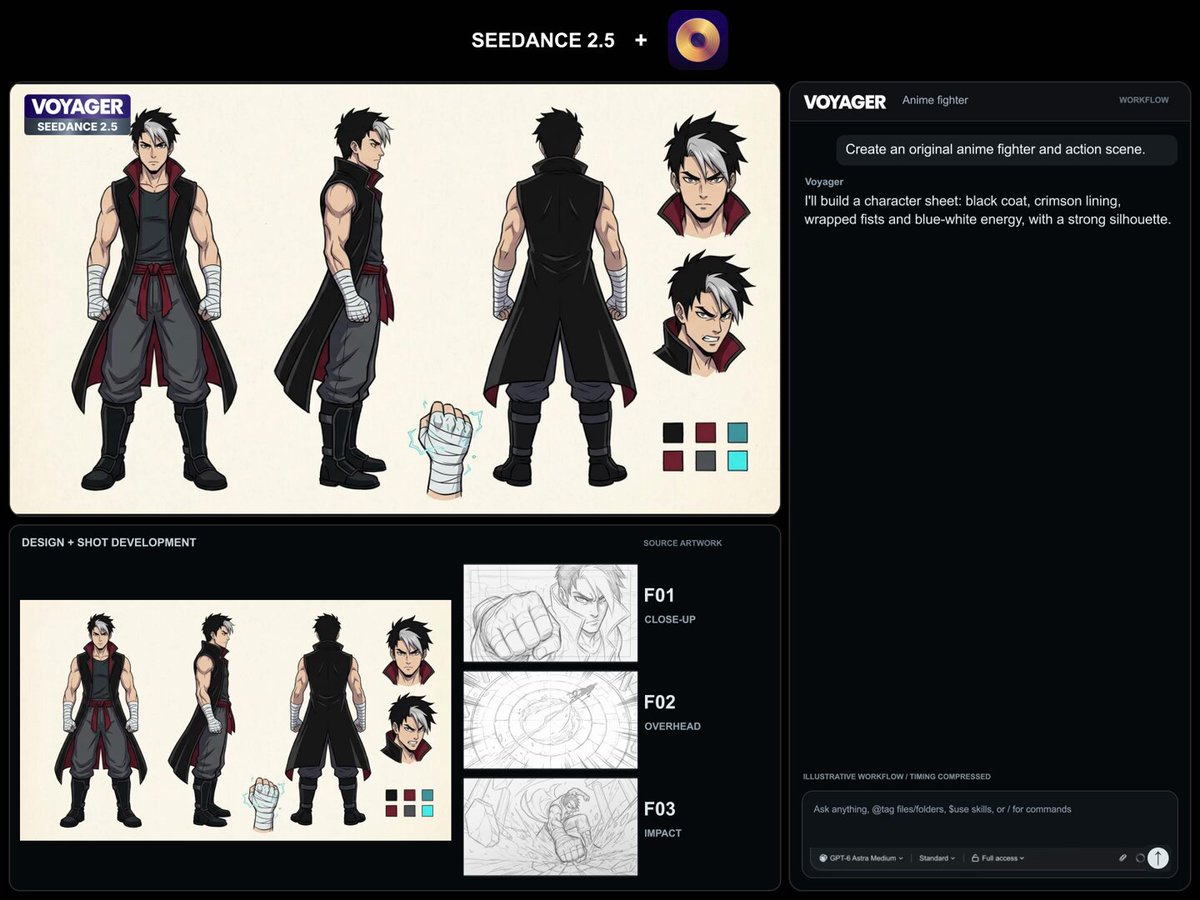
we got used to AI coding agents that can actually work inside a codebase. now imagine that idea applied to creative work. that's the idea behind Voyager that stood out to me. a desktop AI app that can work with your files and orchestrate tools like After Effects, DaVinci...

82,420 просмотров • 15 дней назад •via X (Twitter)

Комментарии: 0

Нет доступных комментариев

Здесь появятся комментарии из оригинального поста

Похожие видео

If you think this is just another silly demo made with AI, read this post. You might change your mind, because this demo is about MATH. What you see on the screen is not a render from Blender (obviously, it’s not that good). It’s a three.js app built with Toolcraft. Available on the web and rendered in real time(link in the comments). But Blender still has a lot to do with it. Blender has Geometry Nodes - a powerful node-based system for creating and manipulating procedural geometry. In other words, it’s math. And math is a universal language. And who do you think is pretty good at math? >>> AI. Now you can download or buy Blender files from marketplaces, and when they contain Geometry Nodes for procedural animations, objects, surfaces, or effects, you can transfer that logic to the web. Make it real-time, make it interactive. Materials are a separate story, of course. They can still suck unless you use the right tricks: PBR, HDRIs, material blending, displacement, and faked surface relief. So why is Blender important here? Blender is open source, and many tools around it are open source too. An AI trained on their code. That means it can translate the math from one environment to another quite accurately. If you’ve been struggling to reproduce some idea with AI that you had in your head or seen in some references, and it has something to do with Geometry Nodes, and you can find that idea or a close one in the Blender ecosystem - it means you can transfer it to the web. Thank me later.

Alex Barashkov

28,300 просмотров • 3 месяцев назад

I think one of the biggest problems with AI agents right now is how much control we give up just to use them. Most AI agent platforms want you to work inside their ecosystem, use their preferred models, and trust them with your files and data. That might be convenient, but I don't think it should be the only option. I recently came across PilotDeck, and I found its approach pretty interesting. It's an open-source AI agent workspace developed by Tsinghua University's THUNLP, ModelBest, OpenBMB, and AI9Stars. The idea is simple: instead of being tied to one AI provider, you should have more freedom to decide how your agent works. And there are a few things worth looking at here. First, model independence. Most people focus on which AI model is the smartest, but I think having the freedom to choose your model is equally important. PilotDeck supports different model providers and configurable API endpoints. This means you're not necessarily stuck with one company's models. You can choose a setup based on your budget, performance needs, or the type of task you're working on. For developers who regularly experiment with different AI models, I think that's a pretty useful approach. Second, privacy and control over your workspace. This is probably the part that interests me the most. AI agents are increasingly being used to handle research papers, financial documents, spreadsheets, presentations, and other personal or business files. And once you start giving an agent access to that kind of information, where your files are processed becomes an important question. PilotDeck supports local workspaces and offers options for local or private deployment. That gives users more flexibility over how their environment is configured, rather than relying entirely on a closed platform. Of course, privacy still depends on which model provider and API you connect. Using a local workspace doesn't automatically mean your data never leaves your device. But having the option to control the setup is a meaningful difference. Third, it's designed to actually complete work. Another thing I like about the approach is that PilotDeck isn't just trying to be another chatbot. It's built around an agent workflow where you describe a task, the system plans the steps, works with files, uses tools, and produces an output you can still edit. For example, imagine giving an AI agent multiple research documents and asking it to organize the information into an Excel spreadsheet and prepare a PowerPoint presentation. Instead of getting a long text response that you need to manually copy into different applications, the goal is to have the agent handle the workflow and deliver usable files. It also supports task history, result previews, switching models, and changing instructions while a task is running. I think this is where AI agents become more practical for everyday work. And finally, there's the open-source aspect. Personally, I think we're going to see more demand for AI tools that don't force users into one vendor's ecosystem. Models are improving quickly, and the best option today might not be the best option six months from now. Having an agent workspace that can work with different models makes a lot more sense to me than rebuilding your entire workflow every time you want to switch providers. There are still things I'd want to test properly, especially how reliable it is on longer tasks, how easy the setup is for non-technical users, and what the actual privacy trade-offs are with different model configurations. But I like the direction PilotDeck is taking. I don't think the future of AI agents should be about which company controls your entire workflow. It should be about how much control you have over the tools doing the work. And that's why I think open-source, model-independent projects like PilotDeck are worth paying attention to. If you're interested in building AI workflows with more flexibility, check it out. Website: GitHub:

Sally Stockholm

13,794 просмотров • 10 дней назад