Video wird geladen...

Video konnte nicht geladen werden

Zur Startseite

We have a precise Earth-Mercury-Mars alignment today, in addition to two other less precise but notable alignments which are Earth-Venus-Saturn-Neptune and Jupiter-Venus-Mars-Pluto. Solar wind density is currently <1/cm^3 as we stay deeply embedded in high-velocity solar wind (~650 km/s). This sort of planetary geometry convergence and space weather occurring...

17,457 Aufrufe • vor 5 Monaten •via X (Twitter)

0 Kommentare

Keine Kommentare verfügbar

Kommentare vom Original-Post werden hier angezeigt

Ähnliche Videos

2034 Earth–Venus–Mars opportunity looks promising. 10–15 on-orbit refueling operations may be needed to make a crewed ship full. Most can be done at an altitude of 180–200 km, made possible by Starship’s size. The final refueling may be performed at a higher altitude of ~2000 km, just below the Van Allen belt. Earth departure on 2034-08-21 from 2000 km orbit. A Trans-Venus Injection burn of ~3.7 km/s will place the ship on an Earth–Venus–Earth free-return trajectory. Venus flyby is expected on 2034-12-19, 120 days after departure. Two weeks before the encounter, if the mission proceeds as planned, a 25-m/s maneuver will shift the trajectory from Earth-return to Mars-bound. If not, the ship will free return to Earth in September 2035. The Venus gravity assist will send the ship into another Earth free-return trajectory, with Mars flyby around 2035-06-02. One week before reaching Mars, a system health check will determine whether to commit to Mars Orbit Insertion. If it’s GO, a small 10-m/s manuever will put the ship to less than 100 km altitude periapsis. Otherwise, a Mars flyby will lead to an Earth return in May 2036. The ship will enter the Martian atmosphere at about 9.4 km/s, performing an aerobrake to slow to 4.88 km/s and capture into a 100x140000 km, 7-day period high elliptical orbit. At apoapsis, a 50-m/s plane change will align the inclination with Mars’ equator, followed by additional aerobraking to remove about 650 m/s of velocity, placing the spacecraft in a 120x6128 km orbit. A 550-m/s burn at 6128 km altitude will then adjust the trajectory into Phobos orbit. The ship will stay at Phobos for about 7 days. The Mars–Phobos L1 point is only about two miles above Phobos’ surface, and Mars would dominate nearly half the sky, appearing about 80 times larger than the Moon from Earth. The ship will depart for Deimos afterward. Two burns totaling roughly 750 m/s will transfer the ship from Phobos to Deimos. And the ship will stay at Deimos for 7 days more. From Deimos, the ship will raise its apoapsis to form a 20000x140000 km altitude, 7-day orbit, requiring about 420 m/s of delta-v. At apogee, a 50-m/s burn will adjust inclination and lower periapsis to ~500 km for final Trans-Earth Injection. If time and propellant allow, the orbit can be aligned to a polar inclination for Mars ice-cap observations before departure. A Trans-Earth Injection burn at 500 km altitude, requiring 1.5–1.6 km/s of delta-v in early July 2035. If departure on the first days in July, Earth arrival is expected in December 2035. If missed that window, a March 2036 arrival may look more feasible. Nominal mission duration: 490 days, with 30 days in Mars orbit and 14 days at Phobos and Deimos. Two planets, two moons for 3.7+0.025+0.010+0.05+0.42+0.55+0.75+1.55=7.06 km/s Δv

Chun

225,068 Aufrufe • vor 10 Monaten

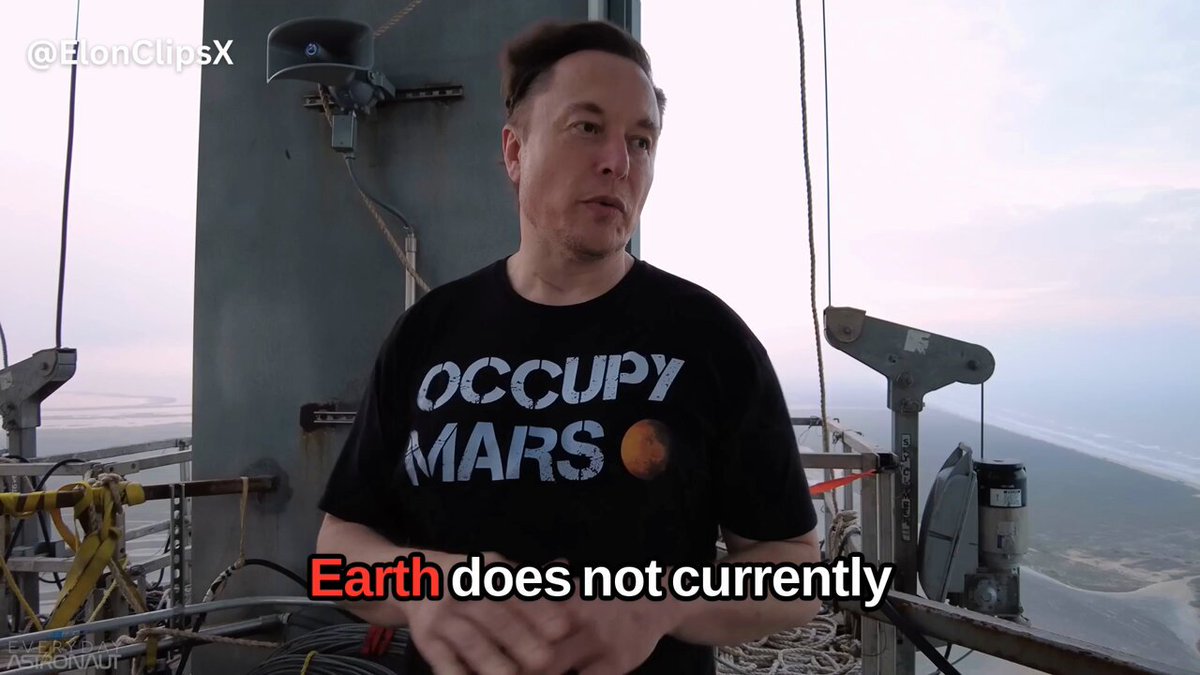
Elon Musk said humanity is currently using less than a trillionth of the sun's power output. A trillion is a million times a million. That is how far we have to go. He was explaining the Kardashev Scale on a SpaceX livestream. A Russian physicist named Nikolai Kardashev invented it in 1964 as the most objective way to measure how advanced a civilization actually is. Not by population. Not by GDP. By energy. Type 1: you harness everything your planet produces. Type 2: you harness your star. Type 3: you harness your galaxy. Where does humanity sit right now? We are not Type 1. We are not close to Type 1. We are a tiny fraction of the way to Type 1. Musk said if aliens visited us today and measured us on this scale, we would not be registering. His exact words: "One microKardashev would be an epic achievement relative to where we are right now." The sun is 99.86% of all mass in the solar system. Everything else, Jupiter, Saturn, Earth, every planet and moon and asteroid combined, is the remaining 0.14%. Earth is in the miscellaneous category. Of the sun's total power output, Earth intercepts roughly half a billionth. And of that half billionth, most hits ocean. Most of the land is Siberia or Antarctica. The actual usable surface where you can capture solar energy is tiny. To get to even a millionth of the sun's power, you cannot stay on Earth. The math does not work. You have to go to space. That is not a dream. That is a physics constraint. And that constraint is exactly why SpaceX exists.

Ihtesham Ali

11,145 Aufrufe • vor 2 Monaten

Using Grok build, now we were able to cross the magnetosphere data (from ACE and Solar-1 satellites) which shown the magnetic field lines of the Earth .... with the BOM (bureau of meteorology Australia) magnetopause feed ------ the BOM shows the standoff distance of the edge of the magnetosphere ----- the area called the "magnetopause". Now we get to see the buffeting blasts of solar wind and charged particles when they hit Earth (coming from the sun). This then perturbs the electromagnetic field lines of Earth shown by ACE and Solar-1 -- and that vibration is carried on down to the CORE OF THE EARTH! Also added in the ability to turn off Earth (transparent) so we can see inside Earth down to the calculations most people never even get to see -- and see it get vibrated , plucked like strings on a guitar! The BOM data, as well as the ACE, and Solar-1 data are all real time, and can be set to update every 1minute to every hour! The projected trail of the magnetic field around Earth is just an approximation, but it set to also vibrate along with the BOM data showing the magnetopause compression / expansion when strong solar winds, or large particle storms hit. Simply put, summed up, using Grok we were able to rebuild the old school Japanese NICT site, make it fully 3D interactive, and add in the BOM to make a new form of data observation where both the magnetopause, and magnetosphere data are combined into one, displayed on the same screen at the same time!!!!!!!!!!!!!! Both feeds can be toggled on / off so as to view one or the other as well if the user wishes! I will release this to the public for free along with the Solar and Earthquake programs very soon!

Dutchsinse

10,820 Aufrufe • vor 2 Tagen

ELON: MARS COULD SAVE EARTH JUST LIKE AMERICA SAVED EUROPE “I do think there is an important threshold if we are able to make life multiplanetary, that you can get to the point on Mars where Mars can grow by itself, even if the resupply ships from Earth stop coming. That's the critical threshold where the probable lifespan of civilization is dramatically greater. So, it's not enough just to go to Mars and have a small base or something like that. You've got to actually have enough resources on Mars that if resupply ships stop coming for any reason, and it could be that things on Earth ended with a bang or a whimper, and currently it's trending to end, it's sort of tragic, currently things are trending to end with a whimper in adult diapers because of the lack of birth rate, but as soon as we can make life multiplanetary, sustainably multiplanetary, the probable lifespan of civilization is dramatically greater. And I think that's really the fundamental test, can we get to that point before civilization collapses? Can we make life multiplanetary, sustainably multiplanetary before something happens on Earth to prevent that from occurring? And if we do, the future is exciting and bright, and Mars may one day come back and save Earth, just like America came back and saved Europe and saved the rest of the world three times last century. Three times, America saved the world last century. And what a disaster would have been if America had not existed. And one day, Mars may play that same role on Earth.” Source: Town hall in Philadelphia, Pennsylvania, October 18, 2024

Mario Nawfal

20,677,697 Aufrufe • vor 1 Jahr