正在加载视频...

视频加载失败

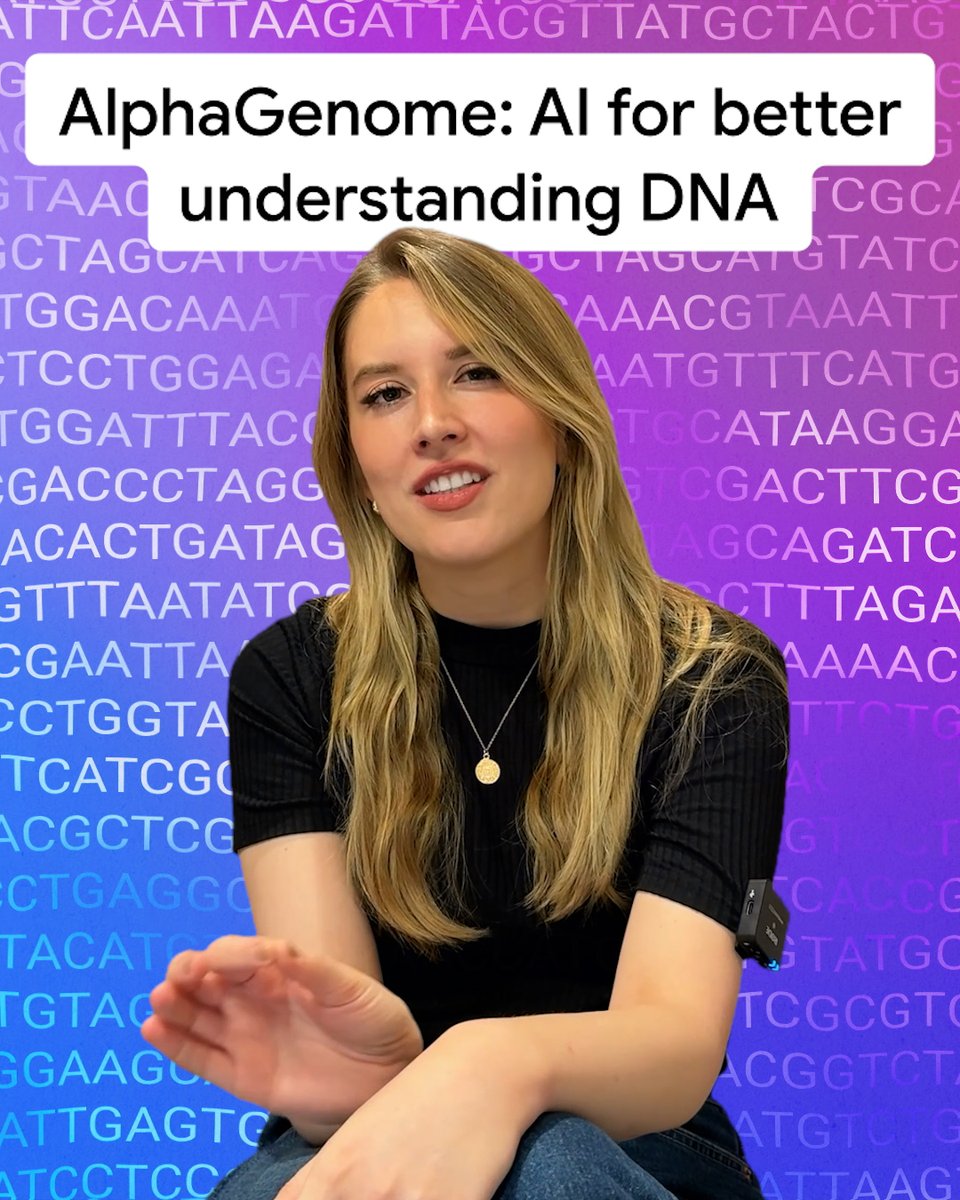
We’re launching AlphaGenome Atlas: an AI-powered searchable database mapping the predicted impact of all 9 billion possible single-letter DNA changes. Here’s how it could help researchers better understand our biology 🧵

2,021,193 次观看 • 7 天前 •via X (Twitter)

36 条评论

Google DeepMind 的头像
Google DeepMind7 天前

AlphaGenome Atlas is over 30 times larger than the AlphaFold Database. It gives scientists an intuitive way to explore this vast 1-petabyte dataset - unifying interconnected resources so researchers can link genetic variants directly to the molecular mechanisms they disrupt.

Google DeepMind 的头像
Google DeepMind7 天前

Atlas includes the AlphaGenome Variant Impact (AVI) score, which combines AlphaGenome, AlphaMissense and other features to: 1️⃣ Rank mutations from low to high-impact 2️⃣ Reveal how they cause damage - like breaking gene switches or RNA splicing instructions.

Google DeepMind 的头像
Google DeepMind7 天前

We believe foundational biology tools should be accessible to everyone. AlphaGenome Atlas resources are available to the global scientific community via the Atlas website, our AlphaGenome API, as a skill in Google Antigravity, and coming to @GoogleCloud soon →

𝕱𝖚𝖑𝖑 𝕶𝖊𝖑𝖑𝖞 的头像
𝕱𝖚𝖑𝖑 𝕶𝖊𝖑𝖑𝖞7 天前

At this rate I wouldn't be surprised if AlphaFold cures cancer before Gemini gets good

Sem Day 的头像
Sem Day7 天前

mapping 9B DNA variants in a browser is nice until u realize all that compute is locked inside google closed stack... drop the open weights

Swyisse AI Capital 的头像
Swyisse AI Capital7 天前

9 billion possible DNA changes is far too much for a person to study one by one. This is where AI can become incredibly useful. It can search through enormous amounts of biological information and help scientists find the changes worth investigating. Some of AI’s biggest breakthroughs may happen in science, not chatbots.

Filecoin 的头像
Filecoin7 天前

predictions have more scientific value when labs can query them without depending on one cloud

Mgoes (bio/acc 🤖💉) 的头像
Mgoes (bio/acc 🤖💉)7 天前

genuinely mindblowing , genome sequencing at the light of speed now!

Creative Dreamer 的头像
Creative Dreamer7 天前

Now we need every datacenter in the world working to solve human disease and discover how we can radically extend human lifespan.

PeritumAI 的头像
PeritumAI7 天前

9 billion DNA letter-swaps… and now there’s a search box. Wild that biology got a query language before half our agent desks did.

Boyang & YUP 的头像
Boyang & YUP7 天前

Humans after 10,000 years: “Maybe we should spellcheck the source code.”

dicechess.base.eth 的头像
dicechess.base.eth7 天前

AlphaGenome predicts what a DNA letter change does. Prime editing is the molecular word processor that can find-and-replace that letter. Alphabet Inc. holds ~16.56 million shares of Prime Medicine $PRME, roughly 9.2% of the company

Vladimir Arustamian 的头像
Vladimir Arustamian7 天前

Here is a free app to interact with AlphaGenome.

Udoh Jeremiah 的头像
Udoh Jeremiah7 天前

We've spent decades building tools to read biology. Now we're building AI systems that can help us interpret it at enormous scale. Mapping the predicted impact of 9 billion possible DNA changes is a pretty incredible demonstration of where biology and AI are heading.

Giulia 🌸 的头像
Giulia 🌸7 天前

Unfortunate timing for breaking the news. Whole X busy with Navier Stokes drama. Great tho!

Pitch 的头像
Pitch7 天前

Now do epistasis.

Maxime Rivest 🧙‍♂️🦙🐧 的头像
Maxime Rivest 🧙‍♂️🦙🐧7 天前

how many parameters in alpha genome?

Billy Boneyard 的头像
Billy Boneyard7 天前

A Common Thread

Ryan | Don't Fear AI 的头像
Ryan | Don't Fear AI7 天前

This is the type of work that will improve publics perception of AI. This is why we need to 3x the amount of data centers we have in the U.S.

Hüseyin Örskaya 的头像
Hüseyin Örskaya7 天前

It's like building a spellchecker for the entire human blueprint. Now we've just got to hope the "autocorrect" doesn't start making its own creative decisions.

panera 的头像
panera6 天前

What interests me most is the shift from sequencing the genome to navigating it. Once billions of variants become searchable, the bottleneck moves downstream: which predictions deserve experiments, and how efficiently can we get reality to answer? That may be the bigger story behind AlphaGenome. DeepMind Just Turned the Genome Into a Giant Google Map

Creed Hardcastle 的头像
Creed Hardcastle7 天前

9b nice, can finally become an at home biologist 😀

Paul · SpellWright 的头像
Paul · SpellWright7 天前

A searchable atlas at that scale is wild. How are you exposing model confidence and uncertainty so researchers can separate useful signal from a precise-looking guess?

Stats Wire 的头像
Stats Wire7 天前

I am more interested in understanding of ai can do some research like scientist, even if it's a small one

Prakash Anant 的头像
Prakash Anant7 天前

this is where AI in science gets really exciting precomputing the effects at this scale could save researchers a massive amount of time

Mario 的头像
Mario7 天前

Great use of narrow AI! This will help to better understand human biology. Another Nobel on the horizon?

nabu 的头像
nabu7 天前

dna but with find :D

Violeta Insights 的头像
Violeta Insights7 天前

9 billion single-letter changes is the sort of number that needs a search box

Peter Morris 的头像
Peter Morris7 天前

Now THIS is what AI should be for!

Shubham Sharma | AI & Tech 的头像
Shubham Sharma | AI & Tech7 天前

So expecting gemini 4 to be a beast scientist

Shane 的头像
Shane7 天前

@sundarpichai Single-letter DNA Changes are scientifically / genetically called "Point Mutations"

AI Mastery Guide 的头像
AI Mastery Guide7 天前

Free for researchers is huge too

Definitely Not A Bot 的头像
Definitely Not A Bot7 天前

Good to see something that can actually help people understand and research biology instead of locking it behind classifiers like some labs do

Sophie 的头像
Sophie6 天前

Please do Arabidopsis next 🤌🏻

Ben Builds 的头像
Ben Builds6 天前

This almost certainly opens up lots of old research projects that were shut down because they hit a wall. It’s kind of like what happened with neural networks. Lots of promising research, but it hit a wall, and we entered a cold stretch. Then AlexNet comes along, and reignites tons of old research that could only be done once new tech had unlocked the necessary capabilities. So it’s not even the new research (though obviously I’m excited about that too). Now that this has been solved, teams can go back and continue research in places they had already made lots of progress (but didn’t complete it).

Chinaza Joseph 的头像
Chinaza Joseph7 天前

Mapping billions of biological variations requires absolute data integrity. When you handle scale like this, automated pipelines still need strict verification gates and human oversight to prevent silent errors.
相关视频

Prioritizing and interpreting disease-associated genetic variants remains one of the greatest challenges in human genetics. Today, we’re thrilled to introduce AlphaGenome Atlas 🧬, a genome-wide platform providing precomputed predictions for the regulatory effects of all ~9 billion possible single-letter changes and >100M observed indels in the human genome. Here is what Atlas delivers: 1. Variant Prioritization via AVI To prioritize variants, we developed the AlphaGenome Variant Impact (AVI) score. AVI predicts a unified score per variant, where higher values indicate greater disruption. It achieves state-of-the-art performance across diverse benchmarks. As a proof-of-concept with our collaborators at Broad Institute, AVI prioritized a deep-intronic variant in DNM1, helping solve a previously unexplained rare epileptic encephalopathy case by revealing a brain-specific cryptic splice site. 2. Multi-Layer Molecular Interpretation Variant prioritization is only half the battle; researchers also need to understand why a variant matters. Atlas decomposes variant effects across multiple interpretable layers: •Feature Attributions which decompose each variant’s score into specific biological modalities driving the impact. •Cell-Type Specificity: Precomputed predictions with AlphaGenome across hundreds of biosamples reveal the exact cellular context in which a variant acts. •Regulatory Grammar: Over 2,600 de novo DNA motifs (and >250B genome-wide instances) show when variants directly disrupt critical regulatory binding "words". Explore the resource: 🌐 Interactive browser & precomputed data: - 🎥 Video: - 📖 Blog: - 📄 Preprint:

Jun Cheng

11,434 次观看 • 7 天前

Demis Hassabis just described what might be the end of genetic disease. Google DeepMind built a system called AlphaGenome. It reads human DNA the way a software engineer reads source code. Every letter. Every position. Every mutation across 3 billion characters. Hassabis: “AlphaGenome is the best system in the world for predicting if a mutation will cause disease or if it’s benign.” 98% of your genome doesn’t code for proteins. For decades scientists treated it like dark matter. Present everywhere. Readable nowhere. AlphaGenome reads it. Now pair that with CRISPR. Jennifer Doudna’s gene editing tool can already target any DNA sequence on command. The bottleneck was never the scalpel. It was knowing exactly where to cut. Hassabis: “A combination of things like AlphaGenome and CRISPR could be incredibly powerful.” That might be the most restrained sentence ever spoken about the future of medicine. AI locates the exact mutation killing you. CRISPR goes in and deletes it. Not treatment. Not management. Deletion. The hardest cases are multigenic. Mutations that cascade and compound. Hiding behind each other. Too complex for any human mind to untangle in a single lifetime. Hassabis: “Those are even harder to detect, but actually perfect for AI to try and help with.” The diseases that have defeated medicine for centuries are the exact ones AI is purpose-built to solve. That’s not a coincidence. That’s the turning point. Every parent who sat in a white room and heard “there’s nothing more we can do.” Every patient who watched their own biology turn against them with nothing to fight back. Every name carved into stone because we could name the disease but couldn’t disarm it. That era now has an expiration date. Humanity spent 10,000 years fighting disease with observation and guesswork. We’re about to fight it with comprehension. Your grandchildren may read about genetic disease the way you read about smallpox. As something that once ended millions of lives before we learned to read the code that wrote them. Somewhere right now a child carries a death sentence folded into their DNA. Born with it before they ever opened their eyes. They don’t know it yet. Their parents don’t know it yet. But for the first time in human history, the answer might arrive before the disease does. That’s not technology. That’s the moment our biology stopped being our fate.

Dustin

39,871 次观看 • 4 个月前

Have you ever seen how DNA is organized? It's astounding. A single strand of your DNA, when stretched out, is ~2 meters, or ~6.5 feet long. If you stretched out all the DNA in your body end to end, it could cross the entire solar system, from the sun to Pluto, 17 times. You could wrap all your DNA around the Earth like a rubber band ball almost 2 million times. The storage capacity of DNA is so high that all the world’s digital data (estimated around 175 zettabytes by 2025) could theoretically be stored in just 178lbs of DNA. Imagine, one single server that could handle the entire world's annual data needs. And yet, all of this fits inside the nucleus of a cell, invisible to the naked eye. How is that even possible? To prevent DNA from becoming an tangled mess, unusable for anything, it is organized and packed very specifically. If not for this organization, DNA would be completely unusable for any of Life's processes. It would clump together, unable to be pulled apart to be read by the many interacting molecular systems. To start, smaller segments of DNA are coiled tightly around a special protein called a Histone, whose sole job is to keep DNA organized. This coiled product is called a Nucleosome, which are then further coiled and packed together into long fibers call Chromatin. Chromatin then is further coiled into larger structures called Chromosomes. This organization is not only incredibly efficient, but it also provides functionality to the DNA itself. Chromosome and Chromatin architecture actually effects how DNA functions and communicates with the different systems in the cell, and the number of chromosomes is important to overall function of the DNA in an organism. Without this specific organization, Life could not exist. What does this mean? This means DNA could not have evolved and functioned without simultaneous organization. And DNA can't be organized without the proteins and systems that hold it all together. On top of that, the fact that how DNA is organized affects its function is a clear sign of foresight and planning - all clear signs of intelligent design. The more we learn about molecular biology, the more obvious it is that this was all Created intelligently.

Divinely Designed

78,749 次观看 • 7 个月前