正在加载视频...

视频加载失败

Werner Herzog explains how he got the inspiration to write his debut feature film, 'Signs of Life' (1968): "Whilst in Greece I walked around the mountains of Crete where I came across a valley. I had to sit down because I was sure I had gone insane. Before me...

252,727 次观看 • 9 个月前 •via X (Twitter)

0 条评论

暂无评论

原始帖子的评论将显示在这里

相关视频

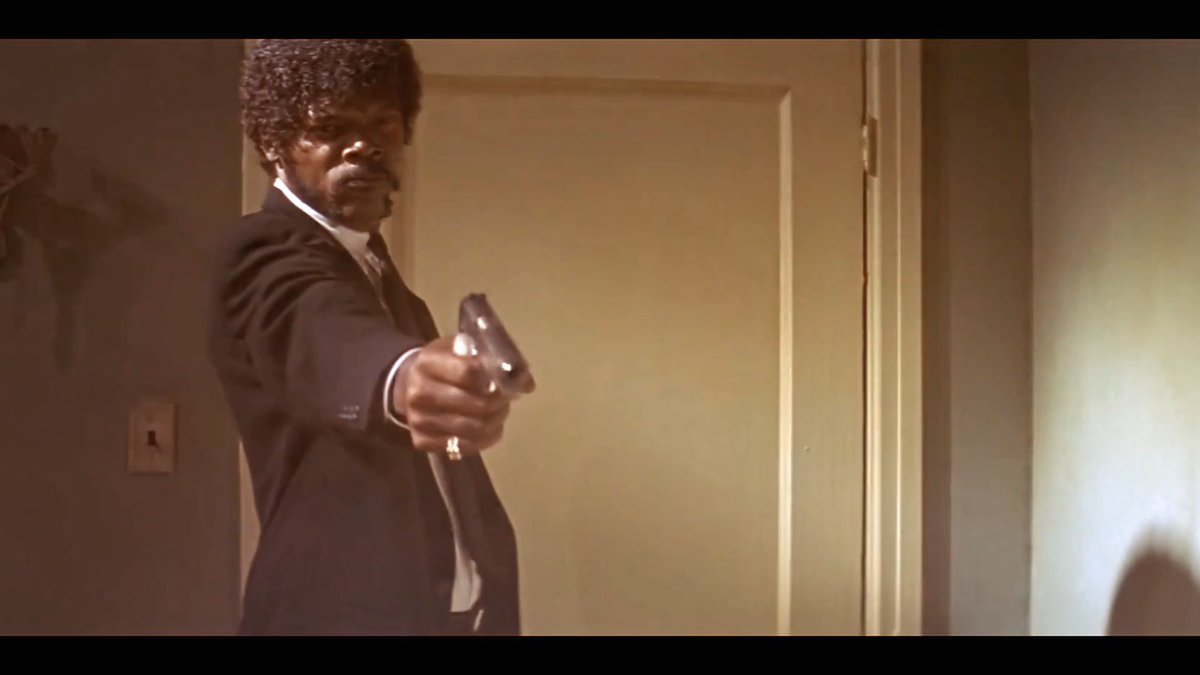
Samuel L. Jackson explains how he landed the role of Jules in Pulp Fiction, and what it was like seeing the film for the first time on the big screen: “Pulp Fiction and I came together in a very strange kind of way. I remember auditioning for Quentin for Reservoir Dogs in New York (for the role of of Detective Jim Holdaway, Mr. Orange’s police contact). And apparently I didn't get that role. But I was at Sundance the year that he screened it for the first time. I was sitting there and I watched that movie - I was awed by it. I mean, there were people running up the aisles when Michael Madsen was cutting the cop's ear off. People were going, "Oh my God, this is horrible!" All these “auteurs” were running out of the theatre. I was like, "This is good. This is happening. This is different." So after the film, I walked up to Quentin and said, "This film's amazing, man. It's great." And he looked at me and said, "Hey! How'd you like the guy who got your part?" And I was amazed that he even remembered who I was - but he remembered me. A year or so later, I got a phone call saying Quentin Tarantino wants to have dinner with you, because he'd seen Jungle Fever and he liked that Gator character. When we had dinner, we were sitting there talking. We started talking about Hong Kong films and cartoons and foreign movies and obscure things that we watched, horror movies. We found out we liked the same kind of stuff. And he told me he was writing this thing, and he was writing this part with me in mind. He was going to send it to me. I went off to do another film. I was in the backwoods of Virginia somewhere doing a film, and the script came. A little plain brown wrapper from Jersey Films. And Jersey's got these gangster images on the logo. And it said, "If you show this script to anybody, two guys named Ernie and Luigi will come and break both of your legs." Whatever. I went, "Yeah, right." So I sat down and read it. Boom. I read this thing. It's like, "Oh my God. This is awesome." And then I said to myself, "Nobody writes a script this good. There's no way that this script is as good as I thought it was." I closed it. I opened it again. I read it immediately. Okay. This is great - If whoever produces this film lets him shoot exactly what I just read, if they stay away from it, they don't try to edit any of this stuff out - this is going to be a great film. It's going to be kind of audience-specific, because I like that kind of stuff. I have friends that I knew would like it. It was a generational kind of film. I never thought it would cross over and do all this stuff. We shot it. We had a great time doing it. And the first time I actually saw the film was at the Cannes Film Festival. That night, it screened, and I was sitting there watching the film. The audience was loving this movie, loving it. About halfway through, I realized there were subtitles at the bottom of it. So I said, "Hey, these people are reading it, and they're getting it. This might be special. This really might be something special." And actually, by the time it was over, there were tears running down my face. I was just so pleased that I was part of that particular film… I never felt that satisfied, and that kind of full about a performance and about being part of something as I was in that particular moment.” Quote comes from an Interview with the American Film Institute 2010

Gangster Cinema Central

85,366 次观看 • 2 个月前

Edward Yang on the impact of watching Aguirre, the Wrath of God (1972): "I found a job in Seattle at a research laboratory that contracted to do classified defense projects in microcomputers. I was among the first generation of designers and applicators for microcomputers and microprocessors. By the time I turned thirty I was pretty well established, with a team of seven or eight guys working on some very interesting projects. Later on I made the association that designing is like writing, and I realized that this background helped me a lot. After a couple of years as an engineer, of course, the routine bored me. One night, I was driving after work in downtown Seattle, and I saw a billboard outside a movie theater with the words, German New Wave, and the title, Aguirre: The Wrath of God. It made me curious, so I went in. I was fortunate. I came out a different person. That two hours just blew me away. It restored my sense of competence that I could be a filmmaker. This is what I thought a film should be. Film school would never teach you to make those kind of shots. That was one of the crucial moments of my life. I had turned thirty, I thought I was getting old, and three more years passed before I got the chance to work on a film project with a friend who asked me to write a script for him. I went back to Taipei, and also visited Hong Kong for the first time, and the film was shot in Japan. I got an offer to write and direct a made-for-TV movie in Taiwan, so I didn't go back to Seattle." — The Engineer of Modern Perplexity: An Interview with Edward Yang by Robert Sklar, published in Cineaste, Vol. 25, No. 3 in 2000

RadiantFilm

97,385 次观看 • 10 个月前

Béla Tarr on how the concept of time works in "Sátántangó" (1994): "Interviewer: Did you have any problems when you first wanted to make the film in the ‘80s? How did you start work on the film? Tarr: It was mostly a political problem. We couldn't start in the ‘80s because of censorship from the communist government at the time, but by the early ‘90s it became possible to do it and it took four years to do, from 1990 to 1994. You have to understand. This man [Lázsló] was living in the Hungarian lowlands, and he saw a lot of things in the reality of how people were living, and of course he transformed it and created this beautiful novel. I understood when I started working on this project that I cannot do any kind of adaptation. I had to go back to the Hungarian lowlands, like him. I had to see how life is going on out there, and I had to find the film language, I had to figure out how I can get the same stuff that he did in the novel. By the end, I spent two years in the Hungarian lowlands filming, I can tell you I know all the houses, I know all f***ing roads, I know everything in this part of the country. By the end of my time there I could find the way to film and afterwards we could use the dramaturgical structure of the novel, and of course we did not have a script, we had only the novel and my vision. That's all we had. Interviewer: What about the sense of time that you found in that place? Tarr: Hey man, if you are sitting in the Hungarian lowlands, I'm sure it's the same in the desert in, let's say, Arizona, when you are out there: there is no time, no distance anymore, you can go hours, weeks, and you don't see anything. You are out of time; you have a different sense of time then when you are living in a town. And so, the slowness of the drama came from this. You know, you have to understand that first you have to know the life of the places and then afterwards you have a feeling for how you have to film it." ("I Am Interested in the World, Not Just in Filming It": Béla Tarr on "Sátántangó", David Perrin, MUBI, 2019) P.S: Remembering the great Hungarian filmmaker, Béla Tarr, on his 71st birthday!

DepressedBergman

12,439 次观看 • 1 个月前

Hirokazu Koreeda on how he directs Children: "Interviewer: I think 'Shoplifters' (2018) is very remarkable in showing different sides of a city and like you said, people who are pretty much invisible, but I do want to also commend you on another thing, is you often work with young actors, and they always tend to have a significant role in many of your films. How do you go about finding such dynamic young actors, and why do you often put these young people at the center of each one of your stories? Koreeda: First of all, I would say that I tend to make what I would call family dramas, and of course, you have to have children if you’re creating a family, but that’s how it started, but I found that as I did it, I became really interested. It became very interesting and fun to work with these children, and for example, the two children in this film, neither of them had any acting experience at all before this film. I brought them in, and what I find when you bring these children in, and you work with them is that the adult actors change. They become much more lively and natural in the way that they act, and I guess, at some point, I realized this, and I guess, became really attracted to the idea of having children and the impact that it had. Interviewer: Do you find that there is any struggle in terms of working with young actors, or in this case, young children who have not actually acted before? Koreeda: Just to clarify, I have worked with children in many of my films, and all of them have never had experienced before. I always go out and pick non-acting children to work in my films, so just, I wanted to put that out there. In terms of the struggle, it does take time. You have to give extra time to work with these children. When I choose these children, I have an audition, and I pick out who I want to the audition, and then when we get to set, I never give them the script. No child that I’ve worked with has been given a script beforehand, and when I get to the actual part where they’re going to be acting, I give them the lines myself, and work with them and coach them. What I find is that it’s actually really enjoyable, both for them and for myself that way. I also, because I’ve been doing this now for several years, I tend to have a fairly high success rate in choosing children that are able to work with me in that way. Interviewer: That’s fascinating, and it also shows how you are able to create such authentic performances from these child actors over and over again in so many of your films. I think it’s a unique gift that you have, and it’s something that very few directors, I think, here in the United States do. Koreeda: It’s true, I guess by working with these children, I learned. I discovered that the best way to do it was just to communicate verbally their lines, rather than giving them in a written format, and over time, this really worked, and so I just kept doing it. But, interestingly, I loved the movie 'Kramer vs Kramer' (1979), directed by Robert Benton, and one time I bought the movie with all the extra, the making of and everything, and I went over it, and I found through that, that in fact, the child in that movie was also given his lines every day by the assistant director each morning when they came in to set, so I discovered that it wasn’t just me that was doing this." (Koreeda's interview with Scott Menzel, We Live Entertainment, 2018)

DepressedBergman

49,522 次观看 • 8 个月前

Roman Polanski on why he took the lead role in "The Tenant" (1976) & the movie role that was offered to him by Steven Spielberg: "Interviewer: What inspired you to play the lead in The Tenant? Polanski: At that point I was working with Paramount and they had the rights to the Roland Topor novel. I thought it would be a good role for me. As a matter of fact, I found it more interesting to play the part than to direct the film. I find this with a lot of scripts, and it’s actually rare that both things appeal to me at the same time. You shouldn’t forget that I started as an actor and only became a director later. Interviewer: Have there been parts in films made by other directors you would have liked to play? Polanski: Yes, there were a few. I get a lot of these kinds of offers but I won’t name the films. Sometimes I use my other commitments as an excuse because I’m scared to work with people I don’t know. I also feel that life is too short for me to throw myself into projects that aren’t my own. But I will tell you about one part that was offered to me. A long time ago Steven Spielberg offered me a role in his first Indiana Jones film as the Nazi officer, the one who burns his hand. Unfortunately I was busy and couldn’t make it to Tunisia, the place where the film was shot, which was a shame because I would have found out just how chaotic it is to shoot there. A few years later I ended up filming Pirates in Tunisia. Interviewer: Would you have accepted the role? Polanski: I really wanted to work with Steven Spielberg." (Roman Polanski's interview with Gerhard Midding, 1990) P.S: On this day, 50 years ago, "The Tenant" (1976) premiered at the Cannes Film Festival, France.

DepressedBergman

119,082 次观看 • 3 个月前

Mark: It's been on my mind, and I just felt like I had to get this off my chest. And so I just felt like I had to turn this live on and to really just tell you guys how I felt regarding the T-shirt with the Confederate flag on it. I am aware of the pain that it brought to a lot of people, and especially to my black fans, to the black community. And I know that I should have. I am very responsible for it. But I really wanted to directly tell you guys that it really wasn't my intention, with me knowing the meaning of the flag, the historical significance of it. It really shouldn't have happened, and it really does not reflect who I am as a person. But seeing so many fans being hurt by it, it really hurt me as well. I had no intention knowing the meaning of the flag, and I should have. There are no excuses to that. But I just wanted to promise you guys directly that something like that will never happen again. With me and my whole team, we have made, we have taken steps to make sure that something like that doesn't happen. But I just, and I know that a lot of people have been waiting for me to kind of address this directly. And I've been sitting on this for a while, and I really wanted to get this off my chest. And so I thought today was the right time for me to tell you guys. It really breaks my heart to think that maybe the trust has been broken. But I promise you that I'll make it up to you guys, just with my actions and with my music. I'll make sure to make it up to you guys if you will allow me to have one more chance. I'll try my best in that. And so once again, I truly would like to apologize for the pain that that picture has brought to a lot of people. And I promise to educate myself more on that matter as well. When I first heard about it actually, I read about it. I was shocked, and we and our entire team made sure that it wasn't on any official content, but the picture got leaked, and we instantly uploaded an apology as well. But now I really felt like I had to personally take action for this. And so once again, I'd like to apologize for bringing so much pain to a lot of people. It really doesn't. It had no intention, no personal intention. So yeah. And thank you for taking the time to wait for me to really address this. I know a lot of fans have also been believing in me. But yeah, thank you for waiting till this moment.

먛¹⁹⁹⁹ #TheFirstfruit🫑

21,373 次观看 • 24 天前

Francis Ford Coppola on how young children convinced him to make 'The Outsiders' (1983) & the reason why he loves the movie: "Interviewer: 'Rumble Fish' (1983) is so completely different a film from 'The Outsiders' (1983), not just in black and white and color, but in the tone. And everybody said, “Well, he’s off in Tulsa, making two films,” rather in a way that, once, people would go up to the desert and make two westerns at the same time. 'Rumble Fish' makes 'The Outsiders' seem an odder film than I thought it was when I first saw it. 'The Outsiders' almost felt like a film in which you weren't quite there all the time. Coppola: No, I don’t think so. 'The Outsiders' (1984) was the type of film that I personally liked, a melodrama with a romantic tone. I liked the book a lot when I read it; I thought it was sweet and youthful and had something in its little, simple theme that was of value, and I wanted to make the picture very much as the book was. Maybe that’s what you're interpreting as my not always being there, except that I did make the decision to make it exactly like the book. The key to 'The Outsiders' is the score; the fact that it’s this schmaltzy classical movie score indicates that I wanted a movie told in sumptuous terms, very honestly or carefully taken from the book without changing it a lot, with young actors—putting the emphasis more on that kind of 'Gone with the Wind' (1939) lyricism which was so important to the young girl [Susie Hinton] when she wrote it. I liked the film on that basis. It’s how I made it and why I made it. But if you think about my career, I’ve never made two films that were alike... maybe the two Godfathers. But every one of my films is very different from one another and I was feeling that I was in kind of a journeyman period of my life, approaching a future style of work as a more serious, older man which would be based on a tremendous amount of exploration while I had the chance to do that. To me it’s nothing to say, well, I’m going to make that film and it’s going to be that kind of film. Like 'The Outsiders'—it’s not that I couldn’t make that sixteen other ways. People suggested, “Well, are we really going to make this book like that?” “Well,” I said, “little kids wrote me a letter and wanted me to make it that way.” Of all the letters I get from movies, 'The Outsiders' is the one where all of these cute little fourteen- year-olds . . . so I’m in it for them. I feel I must have gained something, although it wasn’t as challenging, cinematically or even on the level of acting and other things as, say, the one that came afterwards. But I always had this idea that I wanted to make one film that was romantic and schmaltzy, like 'The Godfather' (1972), and one film that was more of an art film, more in the direction of 'Apocalypse Now' (1979)." (Francis Ford Coppola's interview with David Thomson & Lucy Gray, 1983)

DepressedBergman

36,099 次观看 • 8 个月前

STAR WARS hit screens on this day in 1977. It was one of the first films I saw in the theater. Because it was in theaters for over a year (like RAIDERS OF THE LOST ARK would be four years later), I can’t be sure if I saw it in 1977 or 1978, but I do know that I was very young. I remember going with my mom, that it was a matinee, and that we sat in the middle. The seats stand out to me because I remember I had to use the restroom in the middle of the climactic battle scene :) I’d see it multiple times in the theater over its run and would see THE EMPIRE STRIKES BACK and RETURN OF THE JEDI on their opening weekends. And yes, I remember the marketing for the third film when it was called REVENGE OF THE JEDI. If you did not live through it, it is hard to describe the STAR WARS mania that gripped the country in 1977 and lasted through RETURN OF THE JEDI in 1983. From lines at the theaters to toys to costumes to books to the infamous 1978 STAR WARS HOLIDAY SPECIAL, it was an amazing time to be a kid and witness the magic of the movies firsthand through a phenomenon you knew was something extremely special. I can’t be 100% sure that STAR WARS was my first movie in the theater, as during that timeframe I also saw WATERSHIP DOWN (traumatic) and THE RESCUERS (dark) as a double feature with my dad (we had to travel to a city and I found a 9mm bullet in the street – a bullet I still have today), CLOSE ENCOUNTERS OF THE THIRD KIND with my grandmother (where I tripped running to the theater with a bowl of popcorn that was almost bigger than I was and spilling it all over the hallway - and I remember how nice the guy was behind the counter who gave us another one for free), and a double feature of ESCAPE TO WITCH MOUNTAIN and THE BLACK HOLE, but in looking at the dates of those two films I think it was after STAR WARS and that the theater paired an older film (ESCAPE TO WITCH MOUNTAIN – 1975) with a new film (THE BLACK HOLE – 1979). I just watched the original three films with my youngest son, and it brings me right back…probably the closest I can get to a time machine.

Jack Carr

27,086 次观看 • 1 年前

Krzysztof Kieślowski on why he feels it is immoral to spend a lot of money to make movies: "I don't believe in absolute freedom. In practice it is impossible, philosophically unacceptable. We direct ourselves to get freedom and every time we realize we can't reach it. And, looking at it in this way, the goal is not as important as the means of attaining it: it is not possible- thank God!- to achieve our goal. So it is obvious that I am favourably disposed to compromise. And not because it is useful. First of all, because I don't know the answers, and in making films I ask questions. Questions and doubts, lack of self-confidence, curiosity and amazement that everything goes on in a natural way- all this puts me in the position of an observer and a listener. I change my script very often- the scenes, dialogues or situations- because I can see that people around me have better ideas, more intelligent solutions. It doesn't disturb me that these are other people's ideas. When I have accepted and chosen them, they become mine. As a film director I am realistic. I am using the world of events and the world of thoughts, and I treat them equally. I am also realistic in my approach to the work. I respect my producer, money and, above all, my viewer. Not just because I have to. I do so because I want to. In my opinion, the production of a film- however costly- has its own morality. And I am trying to obey this morality, because I want to obey. A cup of coffee may cost 1½ dollars, may cost 3 or 5 dollars, but when it costs 120 dollars, drinking this coffee is immoral. It is exactly the same in the production of films. The film I want to make is the film I am able to make. There are no others. I don't think of other films. I don't have a million viewers waiting at the entrance of the cinema, but I need to feel that someone needs me for something. And even if I make films- like all my colleagues- for myself, I'm looking all the time for somebody who tells me, like a fifteen-year-old girl in France, 'I saw your 'Double Life of Veronique' (1991) Then I want to see it several more times. For the first time in my life I have seen and I have felt that there is something like 'soul'. So, if I were not concerned about this girl's opinion, there would be no reason to take the camera out of its box." ('Projections A forum for Filmmakers', edited by John Boorman and Walter Donohue)

DepressedBergman

63,389 次观看 • 7 个月前