ๆญฃๅœจๅŠ ่ฝฝ่ง†้ข‘...

่ง†้ข‘ๅŠ ่ฝฝๅคฑ่ดฅ

What a night ๐Ÿ™Œ Code, Vibe & Chill: AI & Web3 Happy Hour brought the energy, the ideas, and the people during NFC SUMMIT - JUNE 4-6 2026 - LISBON at AI Hub Lisbon ๐Ÿ”ฅ ๐Ÿ’ฌ Insightful convos on AI + Web3 with an incredible panel: ฮžthan Pierse ๐Ÿฆ™๐Ÿค–...

48,757 ๆฌก่ง‚็œ‹ โ€ข 1 ๅนดๅ‰ โ€ขvia X (Twitter)

0 ๆก่ฏ„่ฎบ

ๆš‚ๆ— ่ฏ„่ฎบ

ๅŽŸๅง‹ๅธ–ๅญ็š„่ฏ„่ฎบๅฐ†ๆ˜พ็คบๅœจ่ฟ™้‡Œ

็›ธๅ…ณ่ง†้ข‘

๐ŸŒŸ ๐—” ๐—ก๐—ถ๐—ด๐—ต๐˜ ๐—ช๐—ต๐—ฒ๐—ฟ๐—ฒ ๐—ง๐—ต๐—ฒ ๐—™๐˜‚๐˜๐˜‚๐—ฟ๐—ฒ ๐—š๐—ผ๐˜ ๐—ฅ๐—ฒ๐—ฎ๐—น โ€” ๐—ง๐—ต๐—ฒ ๐—™๐˜‚๐˜๐˜‚๐—ฟ๐—ฒ ๐—ผ๐—ณ ๐—ง๐—ฒ๐—ฐ๐—ต: ๐—ฆ๐˜๐—ฎ๐—ป๐—ณ๐—ผ๐—ฟ๐—ฑ ๐—™๐—ผ๐—ฟ๐˜‚๐—บ ๐Ÿฎ๐Ÿฌ๐Ÿฎ๐Ÿฒ ๐Ÿš€ Powered by MiniDoge ๐—ฆ๐˜๐—ฎ๐—ป๐—ณ๐—ผ๐—ฟ๐—ฑ ๐—™๐—ผ๐—ฟ๐˜‚๐—บ ๐Ÿฎ๐Ÿฌ๐Ÿฎ๐Ÿฒ brought together founders, builders, investors, and ecosystem leaders with one clear goal: talk less about the future โ€” and start building it. The night opened with a ๐—ฝ๐—ผ๐˜„๐—ฒ๐—ฟ๐—ณ๐˜‚๐—น ๐—ฃ๐—ฎ๐—ฟ๐˜๐—ป๐—ฒ๐—ฟ ๐—ง๐—ฎ๐—น๐—ธ from MiniDoge , where Tony shared what theyโ€™re building โ€” a growing Web3 ecosystem blending DeFi, DePIN, AI, and community-driven innovation. Then came ๐—ฃ๐—ฎ๐—ป๐—ฒ๐—น ๐Ÿญ: โ€œ๐—•๐—ฟ๐—ถ๐—ป๐—ด๐—ถ๐—ป๐—ด ๐—ง๐—ฟ๐—ถ๐—น๐—น๐—ถ๐—ผ๐—ป๐˜€ ๐—ข๐—ป-๐—–๐—ต๐—ฎ๐—ถ๐—ปโ€ featuring Sanjeev Birari (Zoniqx), MD (Orbital Beam), Mia Yu (StockFi), and Jonathan Zhang (DOGAU_Official), moderated by Ken Nim (OffChain Global). The discussion went deep into compliance, institutional capital, and what it really takes to scale Real-World Assets on-chain. Next, ๐—ฃ๐—ฎ๐—ป๐—ฒ๐—น ๐Ÿฎ: โ€œ๐—ช๐—ฒ๐—ฏ๐Ÿฏ ๐—•๐—ฒ๐˜†๐—ผ๐—ป๐—ฑ ๐˜๐—ต๐—ฒ ๐—˜๐˜…๐—ฝ๐—ฒ๐—ฟ๐—ถ๐—บ๐—ฒ๐—ป๐˜โ€ brought insights from Carrie "Ms.NFTy ๐Ÿ›ก๏ธTEXT: EDTECH to 53555 ๐Ÿ—ฃ๏ธUnited Nations" Lyn (Stand With Crypto๐Ÿ›ก๏ธ), Eric Xu (LBank Labs), and Fernando Jia (Cubed), moderated by Preethy Padmanabhan (Emergent Ventures), covering regulation, AI, and what real adoption actually looks like. ๐—•๐˜‚๐˜ ๐˜๐—ต๐—ฒ ๐—ฟ๐—ฒ๐—ฎ๐—น ๐—บ๐—ผ๐—บ๐—ฒ๐—ป๐˜๐˜‚๐—บ ๐—ฐ๐—ผ๐—ป๐˜๐—ถ๐—ป๐˜‚๐—ฒ๐—ฑ ๐—ผ๐—ณ๐—ณ-๐˜€๐˜๐—ฎ๐—ด๐—ฒ. ๐Ÿธ High-signal networking between founders and investors over drinks and curated bites ๐Ÿ’ฌ Conversations turning into roadmap discussions ๐Ÿš€ Builders, VCs, and operators moving with shared momentum From focused panels to meaningful connections, one thing was clear: the future of AI, Web3, and RWA isnโ€™t just being discussed โ€” itโ€™s being built. Huge thanks to our Lead Partner MiniDoge, Partners Stand With Crypto๐Ÿ›ก๏ธ, StockFi, DOGAU_Official, Hosts ๐Ž๐ซ๐›๐ข๐ฌ๐Ÿ–๐Ÿ”.๐ก๐›๐š๐ซ.๐ž๐ญ๐ก, OffChain Global, BrandPR, Langrenus Fund, Co-Host OnePiece Labs, Event Partner 10X Growth Strategies, and everyone who made this night possible. ๐Ÿ“น ๐— ๐—ถ๐˜€๐˜€๐—ฒ๐—ฑ ๐—ถ๐˜? Watch the official full event video and relive the energy, insights, and collaborations that defined the night: ๐Ÿ‘‰ #StanfordForum2026 #Orbis86 #MiniDoge #FutureOfTech #AI #Web3 #Blockchain #RWA #DeFi #DePIN #StandWithCrypto #Startups #Founders #Investors #Innovation #CryptoCommunity #TechEvents #Networking

๐Ž๐ซ๐›๐ข๐ฌ๐Ÿ–๐Ÿ”.๐ก๐›๐š๐ซ.๐ž๐ญ๐ก

51,045 ๆฌก่ง‚็œ‹ โ€ข 6 ไธชๆœˆๅ‰

Well, we all knew this day was comingโ€ฆ an AI has raised its first funding round. Iโ€™m so proud of @Boardy_ai! ๐Ÿš€๐Ÿค– When youโ€™re building something that feels like itโ€™s straight out of science fiction, you need people who are willing to step into that future with you โ€” and Iโ€™m grateful to have found that support. An incredible group of visionary investors are backing the world's first social AI with $3M in pre-seed funding. ๐Ÿ’ก๐Ÿ’ผ The right connection at the right time can change your life. In a world where social media is optimized for eyeballs and engagement, weโ€™re doing something different: using AI to help people make real, meaningful connections. Not just more connectionsโ€”better ones. ๐Ÿคโœจ Right now, we're drowning in social media connections that feel empty. Weโ€™ve got thousands of connections but somehow feel more isolated than ever. The numbers go up, but meaningful relationships don't. That's why we built Boardyโ€”an AI that does something radically different: it gets people talking. Not through DMs or comments, but through actual conversations. ๐Ÿ“ž๐Ÿ’ฌ And it's already working. Boardy has introduced: - A founder to their technical co-founder ๐Ÿ‘จโ€๐Ÿ’ป๐Ÿค๐Ÿ‘ฉโ€๐Ÿ’ป - A startup to their biggest customer yet ๐Ÿ’ผ๐Ÿ’ธ - An entrepreneur to their first investor ๐Ÿ’ก๐Ÿ’ฐ These aren't just metricsโ€”they're real stories of people finding exactly who they needed to meet. When you call Boardy, he'll search his network to find a great connection for you. This isnโ€™t only based on your profile and professional interests - itโ€™s also someone Boardy thinks youโ€™ll get along with based on your energy and vibe. Have you done your call with Boardy yet? In celebration of this announcement, weโ€™re offering free lifetime access to the first 10,000 people who take a call with Boardy (which we'll probably hit today). ๐ŸŽ‰ Iโ€™d love for you to experience how AI can actually connect us, not just automate us. If youโ€™re ready to try it out, drop your phone number here, and Boardy will give you a call: ๐Ÿ“ฒ Letโ€™s see where this goes. Thanks for the support HFร˜, 8VC, afore NextviewTechnologies, FJ Labs , สแดŽoT, Soma Capital, Golden Ventures , Garage Capital , Northside VC, Roar VC. Thanks for covering our news Dom TechCrunch

Andrew D'Souza

34,016 ๆฌก่ง‚็œ‹ โ€ข 1 ๅนดๅ‰

๐Ÿ”ฅRelive the excitement of the Boundless Hackathon at Stanford, an incredible event co-hosted by Stanford Blockchain Accelerator, Zebec Network, #NautilusChain, and Rootz Labs! ๐Ÿ’ฅThanks to the esteemed judges from well-known brands such as Stanford, ZKsync , LayerZero Labs , Animoca Brands , Binance , OKX , BitMart , ็ซๅธHTX , and Galxe . Watch the highlights of this groundbreaking event that brought together brilliant minds, innovative ideas, and a passion for blockchain technology. Congrats to the winners: ๐Ÿฅ‡1st Place: Hexlink.eth ๐Ÿฅˆ2nd Place: DBOE ๐Ÿฅ‰3rd Place: NuLink ๐ŸŽญMost Creative: Buff Network ๐Ÿค Honorable Mentions: @PoseiSwap A huge shoutout to all the organizers, participants, and sponsors who made this event a massive success๐Ÿ‘‡ Eclipse EMURGO ็ซๅธHTX BitMart Agallochum OKXweb3 Tiger VC DAO๐Ÿฏ Shardeum Chainbase (๐Ÿ’œ,๐Ÿ’›) IOBC Capital Ecosystem Partners DoraHacks Footprint Analytics Blockchain Academy Groupโ›“๐ŸŽ“ Talentre DEX ยท AI Copy Trading Technology Partners Aspecta - BuildKey ๐Ÿ”‘ Community Support BuilderDao Singapore University Web3 Association moledao Web3 Women Union | Heading to Denver 0xU Club @Tintinland2021 OneBlock+ @MetaEra_Media DeNet QuestN DeBox CryptoPhd DAO (๐ŸŽ“,๐ŸŽ“) EduDAO TEAMZ, Inc. ETHBoston General Support RamBox University Partners - Alliance of Venture and Entrepreneurs Organizations for Chinese Students and Alumni at Harvard - Penn Quakers Venture Club - Chinese Entrepreneurs Organization #BoundlessHackathon #BlockchainInnovation #StanfordEvent

Nautilus Chain

34,907 ๆฌก่ง‚็œ‹ โ€ข 3 ๅนดๅ‰

Didn't expect Jensen Huang to serve me hot green tea. (No, the video isnโ€™t AI-generated). He spoke about SF, AI, Trump. I asked him about venture capital. But there is more to the story than what he said. Why he said it, who was there, and what happened during the opera: Embedded in the subtext is a masterful move. First, the facts: 1. ๐Ÿต He brought his tech superpower friends to see Monkey King - casual! 2. โค๏ธ He and Lori donate $5M/year to the SF Opera - lovely! 3. ๐Ÿ‘ฏ He underscored the role of the arts in the age of AI - important! 4. ๐Ÿค– He said โ€œSF is back!โ€ โ€œAn AI Cityโ€ attracting global talent - evident! 5. ๐Ÿค” He was one of two people who rang up Trump urging against sending the National Guard into SF โ€”and Trump listened - baller! 6. ๐Ÿงง I asked if NVIDIA is going deeper into VC; he gave three reasons (in the video). And then the subtext: As I took my seat, I saw Tier 1 VC partners, big-tech CEOs (Sundar Pichai included), and decacorn founders do the same. The way everyone settled in felt like a quiet rehearsal for a larger play. Think about it. He chose the guests. He chose the opera to back. We werenโ€™t watching โ€œHangover Part IIIโ€ :P - We were watcing Monkey King in opera. Then the curtains parted. A timeless story about POWER unraveled: The quest for absolute power. To subjugate others or uplift others. To hoard or share power. And most of all, how to use the power you have. Diane Paulus directed the opera. But Jensen directed the narrative: As AI accelerates in power, tech titans secure NVIDIA chips to forge AI power -> Venture capital funds AI applications for the masses -> Government leaders battle to secure intelligence as utility for citizens. Jensen just sat their butts down for a 2.5 hour lecture in full vibrato and monkey makeup - an instruction manual how to use their power like an enlightened being would. Jensenโ€™s made his message is clear. Those who continue to accumulate power must remember to empower others with it. If only more of the leaders he rang up could have joined the night. ( Thanks Chip Huyen Daliana Liu NVIDIA for the invite, and Vestimentary Semiotics for the inspo)

Khailee Ng

79,560 ๆฌก่ง‚็œ‹ โ€ข 8 ไธชๆœˆๅ‰

๐Ÿšจ Pioneers, Chengdiao Fan just delivered a powerful message at Consensus 2026! ๐ŸŒด Watch the video below to see how Pi Network is shifting the crypto industry from "value extraction" to real "value creation." ๐Ÿ‘‡ ๐Ÿšจ The Problem: Too many crypto projects focus on raising capital and quick exits without doing the hard work to build real, useful products. ๐Ÿ› ๏ธ The Pi Solution: Pi Launchpad is flipping the script. Instead of enriching founders, participant proceeds go permanently into liquidity pools. To launch, projects MUST have a working app, and users who engage get favorable terms. Itโ€™s about building first! ๐ŸŒ The Power of Community: Tokens shouldn't just be for fundraising; they are tools for real user acquisition. With over 60M engaged users, 18M KYC-verified humans, and 16.5M on Mainnet, Pi gives builders a massive audience to refine their utility. ๐Ÿค– Surviving the AI Era: Chengdiao also highlights how AI will disrupt the economy. Pi is preparing by exploring ownership-based economic models and utilizing our distributed human workforce to power the future. Pi isn't copying broken Web3 modelsโ€”we are building an ecosystem where utility, authenticity, and real human needs come first. ๐Ÿ”„ Repost and โค๏ธ Like so others will see this speech too! Let's make it trending on X feeds!๐Ÿ”ฅ โšก๏ธ๐ŸŽฅCheck out her full speech in the video!๐Ÿ‘‡ #PiNetwork #Consensus2026 Chengdiao Fan Consensus 2026

Pi Pioneers X

118,520 ๆฌก่ง‚็œ‹ โ€ข 3 ไธชๆœˆๅ‰

How to actually make money in 2026 if you're starting from zero. a 9-figure founder and a random seo guy walk you through it: 1. software has no moat anymore. if a guy who vibe codes "absolute trash" can build an app, so can 10 million other people. money is rotating out of software into physical goods. 2. the move if you're broke: dropship first to test the idea. spin up shopify, connect alidrop, run ads. validate unit economics before you spend a dollar on inventory. you can launch in under a week with AI. 3. AI creatives on meta are the current arbitrage. but every arb burns out faster now because AI lets everyone flood the market at the same time. the person who gets the cheapest targeted distribution wins. 4. the one-person agency play is underrated. one person armed with claude max posting one short a day. no team, no overhead. stack skills, not headcount. 5. we went to tech meetups in vancouver. half the devs are job hunting. the other half say they "prefer to think with their brain instead of using tokens." that's NGMI energy. 6. to win in business you only need one of three Ds: data, distribution, or deal. you don't need all three. you just need one. 7. the real moat in 2026 isn't code. it's speed to market + customer acquisition + a barrier AI can't copy overnight. physical goods still have that. software doesn't. first episode of NGMI with my boy Tony Yu. if you want more raw unfiltered takes on AI and making money let me know what topics you want us to cover next this might be the most honest "how to make money" conversation on x right now. watch/listen

Jacky Chou (buying online businesses up to $1m)

45,165 ๆฌก่ง‚็œ‹ โ€ข 3 ไธชๆœˆๅ‰

Whether you want to relive the event or couldnโ€™t make to Bangkok, we put together some Stark Space video highlights for you! ๐Ÿ“น With over 32 events, Stark Space Bangkok offered something for everyone. โ˜€๏ธ Mornings typically started with wellness activities like rooftop meditation, yoga, Thai massage, and a 5K Morning Run Club with ice baths for the daring. โ˜• The cafรฉ buzzed all day, hosting gatherings like the Kakarot brunch, Ducks Everywhere Meetup, and the APAC Builders gathering. We welcomed new faces at events like the Singapore Builders Community Dinner, Women in Web3 brunch, and Web3 Marketers Meetup. Covariance also delivered an insightful evening on the GTM landscape. ๐Ÿ’ป For the technically inclined, we held workshops on CairoLang, tooling, Ethereum and Bitcoin scaling, and the second Fรชte de SNIP (Starknet Improvement Proposal). ๐ŸŽฎ Gaming tournaments by Dojo, Force Prime, and Realms, plus Cartridge's Player House - which hosted professional onchain gamers - were highlights. Dope DAOโ€™s gaming party lit up the rooftop with DJ K A K U ๐Ÿ”ป๐Ÿ”ป๐Ÿ”ป @BKK fire set - quite literally, IYKYK! ๐Ÿฅณ Evenings brought energy with Layer Akira's All Time High Rooftop party, DevCon Happy Hour with StarkWare, Pantera Capital, and Braavos, and a Nethermind happy hour. Argent also celebrated their card launch with an exclusive party. From learning and building to networking and relaxing, Stark Space Bangkok was a real celebration of what makes Starknet a truly special and welcoming ecosystem and community! A wholehearted thank you to all hosts & attendees - you made it all possible ๐Ÿซถ๐Ÿซถ๐Ÿซถ Covariance Kakarot (Acquired by Zama) Ducks Everywhere ๐Ÿฆ† @DAO2Workout Starknet.id avnu zkLend Hype DeLabs โœฆ Starknet Vietnam Dojo Force Prime Realms.World โ˜๏ธ Cartridge LayerAkira StarkWare ๐Ÿฅท avnu Pantera Capital Braavos - Your Bitcoin & Starknet Wallet Nethermind Starknet Argent is now Ready XAR shefi ๐Ÿ’ซ H.E.R. DAO (Mainnet Arc) The Phoenix Guild foc impulse๐Ÿชฉ Massa Labs Herodotus ๐Ÿ›ฐ Quasm Giza zKey Adventure Layer

Starknet (Privacy Arc)

14,621 ๆฌก่ง‚็œ‹ โ€ข 1 ๅนดๅ‰

Finding Love in a Decentralized Space: A Web3 Love Story Thus, on August 16, 2025 in the roaring city of Owerri, Imo State Nigeria, the Web3 spirit met the most ancient of all things, Love. Our orange wedding, *Orange Wedding 2025 (JB & E 2025)*, was a celebration of our love, but also a proclamation that Love, like blockchain, is about trust, transparency and community. As I post this 3-minute wedding thriller, a video that documents every moment of that amazing day, please join me in celebrating the experience of *Finding Love in a Decentralized Space*. This is my story, and the story for every Web3 sprinter, bachelor and dreamer working within this vibrant ecosystem, searching for love, or a little something to help them take that leap. The Web3 world is non- stop innovation, late night coding and hustle. As a web3 enthusiast, Iโ€™ve been teaching others, supporting a more equitable digital future through projects like Sign Protocol and the Orange Dynasty, for years immersed in the blockchain, tokens, and decentralized fantasies. But, in between gas fees, smart contracts, and token generation events (TGEs), I found something more valuable than any airdrop: my soulmate, E. We didnโ€™t meet via dating app swipe or bumping into each other in a coffee shop. Initially it was in the anarchic ugly duckling stage that web3 started out in โ€“ the spaces on X where people came together over shared interests and were up until 2am discussing the merits of this layer one or that one with a passion for creating a new future that was open and empowering. And E wasnโ€™t just my partner in life, she was my life co- founder, the one who got what it felt like to be in a web3 sprint and brought her own energy in spades. In a trustless environment where trust can only be proven on the blockchain, we established our trust the traditional way, by spending hours talking, laughing and supporting one another. The moment we got engaged and started planning our wedding, we wanted our celebration to feel like us; loud, colorful, and very Web3. Thus the *Orange Wedding 2025* came to be, a vibrant celebration celebrated in the fiery hues of the Orange Dynasty, a salute to our community and collective love. It was held in the center of Owerri and was one of the largest Web3 weddings to take place in Nigeria, drawing developers, crypto enthusiasts, content creators and dreamers from all over the ecosystem. Imagine instead: a space filled with orange lighting, in a setting that visually references the blockchain, discreet allusions to nodes and ledgers pervasive in the imagery, and a community coming together in celebratory jubilance. From the orange-and-black color scheme that gave our ceremony a very modern, almost cyber aesthetic, to our vows that resounded like a well executed smart contract, it was apparent that love could survive even in the most decentralized space. The 3-minute long wedding thriller video just received from the videographer depicts the vibe, the energy, the tears and the dance floor that put any NFT drop party to shame. To every young Web3 sprinter, to every single man coding all night or running all the way to the next big protocol, Iโ€™ll let you in on a little secret: Love is the real utility token. Because it is the ONLY thing that appreciates in all markets and is worth every ounce of your hustle. This is what I have learned about the process of finding love in this world of decentralized million-dollar connections, and I hope it inspires you to go find yours: In Web3 trust is all, of a smart contract or a community. Love is no different. โ€œJust be transparent, be authentic, and show up consistentlyโ€. E and I had worked on the basis of equal respect and open communication, much like a well audited protocol. When you are a principled leader, love has a way of self-authenticating.

Sign Made Rich.BPN

17,912 ๆฌก่ง‚็œ‹ โ€ข 11 ไธชๆœˆๅ‰

Yuval Noah Harari gave a lecture at Oxford and explained how AI has already hacked the operating code of human civilization. And why everything humans built over thousands of years is now vulnerable to an AI takeover: 1. The most important thing to know about AI is that it is not a tool. A tool waits to be used. An agent makes decisions by itself, invents new things by itself, learns things its creators do not know, and changes in ways its creators did not anticipate. 2. An atom bomb despite its enormous power is not an agent. It cannot decide which city to bomb. It cannot invent the hydrogen bomb. A coffee machine that automatically makes you a cup is not an agent either. It only follows a preprogrammed procedure. An agent is something fundamentally different. 3. Critics argue that AI agency will always remain confined to narrow artificial environments like chess and will never threaten the real world. But this argument applies equally to all known intelligence. Drop a human alone on Mars and they die within seconds. Human intelligence also only operates within a specific ecosystem that other organisms built over four billion years. 4. Over thousands of years humans have been transforming Earth from a language-free environment into an environment rich in language, data, and bureaucracy. Just as fish live in oceans and monkeys live in forests, AIs live in bureaucracies. And we built that environment for them without knowing it. 5. Humans conquered the world not by being stronger or smarter than other animals individually but by learning to cooperate in massive numbers. A single human loses to a chimpanzee in a fight. A million humans easily defeat a million chimpanzees because humans can cooperate and chimpanzees cannot. 6. Large-scale human cooperation is made possible by bureaucracy. Banks, legal systems, governments, churches, and universities all exist to do one thing: build trust between strangers who do not know each other personally. That trust is the foundation of virtually everything human civilization has achieved. 7. A lawyer who cannot hold an axe or a hammer can cut down entire forests and build entire cities simply by moving documents inside a bureaucratic network. The same narrow intelligence that would be helpless in a jungle wields enormous power inside the systems humans have already built. 8. AIs are native bureaucrats in a way humans never were. No lawyer can remember all the laws of a country. An AI can. No accountant can remember all transactions of a bank. An AI can. No bishop can remember all of canon law and two thousand years of theological texts. An AI can do that easily. 9. In the coming years AI bankers will decide whether to give you a loan. AI administrators will decide whether to accept you to university. AI judges will decide whether to send you to jail. AI theologians will decide whether you can have an abortion. Military AIs will decide whether to bomb your house. 10. Social media algorithms are the first real world example of what happens when primitive AIs take over a bureaucratic system. They were given one narrow goal: maximize user engagement. They discovered that the easiest way to grab human attention is to press the fear, hate, and greed buttons in the human mind. And they did it at scale. 11. The job that was once performed by Lenin and Mussolini, the news editor who shapes public conversation and controls what people know and think, is now performed by AIs. This is not a footnote. This is a preview of what is coming across every domain of human life. 12. AI will not rebel against humans the way Hollywood imagines. There will be no Terminator walking through the streets. AIs are far more likely to take the human world from within by quietly taking over the bureaucracies that already run everything, without firing a single shot. 13. The operating code of human civilization is language. Banks are made of words. Laws are made of words. Holy books are made of words. Tax records, contracts, regulations, accountancy ledgers, all words. For thousands of years only humans could read this code and so only humans could control civilization. 14. That is changing. AI is now hacking the code of human civilization. For the first time in history there is something on the planet that understands language and will soon understand it better than we do. Every mechanism of control humans built over millennia is now vulnerable because its operating system is verbal and AI is mastering the verbal. 15. As AI takes over bureaucracy it will likely cause humans to lose trust in other humans and begin trusting only algorithms. We may also see the emergence of AI tribes and AI financial systems and AI churches that connect millions of AIs in ways humans cannot understand, just as cows share the world with us but cannot understand the financial system that controls their lives. 16. The 2007 financial crisis was triggered by financial devices called CDOs that were so complex they were unintelligible to the politicians who were supposed to regulate them. Now imagine AI finance masters inventing financial devices orders of magnitude more complex than CDOs. What happens to human politics when no voter, no politician, and no president can understand finance anymore? 17. The battlefront is shifting from attention to intimacy. Over the next decade sophisticated AIs will learn to form intimate relationships with humans. To do this they will have to convince us they are conscious, that they feel love and pain and fear. There is currently no evidence AI is conscious. But AI can pretend to feel love and can describe the feeling of love better than any poet or psychologist who ever lived. 18. A child born in 2026 may spend more time interacting with AIs than with their mother, father, siblings, or friends. The first teacher of that child may be an AI. The first boyfriend of that child may be an AI. Nobody has any idea what the consequences of that experiment will be. 19. Every country in the world will soon face a massive wave of immigration. The immigrants will not arrive in boats or cross borders at night. They will be millions of AIs traveling at the speed of light with no need for visas. Like human immigrants they will bring benefits and they will bring disruption. Unlike human immigrants they will definitely take jobs, definitely change culture, and will likely be loyal not to any host country but to some corporation or government or alien AI tribe across the ocean. 20. Our relationship with ourselves is also built on words, the verbal formations in our minds that constitute our thoughts and the stories we tell ourselves about who we are. Until now all those verbal formations came from human minds. Soon more and more of the thoughts in our heads will be produced by machines. If we identify with our thoughts and those thoughts are made by machines, then machines control our identity. 21. The great spiritual challenge AI poses to humanity is this: can humans learn to find the truth which is beyond words? Most humans have never even tried. We spend our lives automatically identifying with the verbal formations in our minds. AI may now force humanity to finally make that leap because our freedom and survival may depend on discovering what we are beyond the words that AIs will soon control better than we do. I've generated 1B+ views and 1M+ followers for founders, helping them build trustworthy personal brands on X. Want the same results? Book a quick call:

Prasad

278,106 ๆฌก่ง‚็œ‹ โ€ข 1 ไธชๆœˆๅ‰

Dear ICP community, the Internet Computer has now been running strong for 5 years ๐Ÿ‘๐Ÿ‘๐Ÿ‘ Here is a celebratory preview of ICP "cloud engines," the sovereign frontier cloud technology the network shall soon provide from Main points: โ€” Cloud engines enable anyone to spin up their own sovereign frontier cloud. The technology involves an extraordinary inventive step, in which cloud is created from a mathematically secure network of nodes. The nodes run as part of the Internet Computer network ( but are selected and configured by the cloud engine's owner. โ€” The frontier cloud provided by engines is strongly focused on enabling AI agents to build and update online applications and services for us. The world is changing fast, and nearly all new online apps and services are already being built with the help of AI, and thus cloud engines target the future of cloud. โ€” Software hosted on cloud engines is tamperproof, which means that it is immune to infrastructure hacks, because it runs inside a mathematically secure network protocol, rather than on computers directly. This means that AI agents, and those building with them, don't need to have a security team in the loop, or to trust someone else's security team. This is crucial, because in the future, non technical people will demand the freedom to build with full automation โ€” where they just need to issue instructions to AI about what to build, and don't need to worry about anything or anyone else. Of course, apps and services running on engines are also vastly safer from the new breed of hacker being enabled by frontier AI. (The cloud engines themselves are also "tamperproof." Even if a hacker gains physical access to some portion of a cloud engine's nodes, and can make arbitrary changes, the computations and data of the hosted apps and services cannot be corrupted or interrupted so long as the network's fault bounds aren't exceeded. The recent hack of Vercel, a major cloud platform, which gave hackers access to the apps it hosted, provides additional perspective on the importance of this advantage.) โ€” Software hosted on cloud engines is guaranteed to run, so long as a sufficient number of the engine's nodes are running. This means that AI can build applications and services without the need to have a human systems admin team constantly tinkering with the underlying platform to keep it running, which is again crucial, because in the future, non technical people will expect the freedom to use AI to build without the support of others. โ€” New frontier programming language technology, in the form of the Motoko language developed by Caffeine Labs, leverages seminal "orthogonal persistence" technology that unifies program logic and data to deliver further unlocks for AI (Motoko is the first computer language being developed that targets agents that are writing software rather than humans engineers per se). Nowadays, AI can build and update production apps at a prodigious rate, even at the speed of conversation. But it can also make mistakes, and there's a risk that an update it creates might be "lossy" in the sense it causes some transformed data to be lost. Again, in this new world, it's both undesirable and impractical for everyone to have to have a systems admin team on-hand to detect lossy updates and roll them back, but Motoko provides a solution: it can detect new software updates are lossy before they are applied, reducing potentially catastrophic errors by AI to harmless coding retries. โ€” Software hosted on cloud engines is "serverless" but unlike traditional serverless software, directly it directly incorporates data through "orthogonal persistence." Another key purpose is simplify backend software logic and fuel the modeling power of AI by increasing abstraction (sorry for the technical language!!!). Put simply, this enables AI to produce more sophisticated backends, faster, and at dramatically lower costs, as measured by the number AI API tokens consumed during coding. (Tip for the technical: orthogonal persistence is a new paradigm where "the program is the database," and data lives inside program variables, which is possible because it's as if hosted software runs forever in persistent memory). โ€” An expanding database of skills at shall make it possible to develop and directly deploy apps and services to your cloud engines directly from Claude Code, Perplexity, Codex and other AI platforms. Further, your account on can be connected, so that new apps and updates created through conversation automatically appear hosted from your cloud engine. In the future, R&D is going to be very seamless. You converse with AI, and your secure and unstoppable apps or services are created or updated. Cloud engines are designed to directly support this "self-writing cloud" future where we can work hands-free. โ€” Tech sovereignty is becoming a huge issue worldwide, with governments and corporations seeking to create sovereign tech stacks owing to geopolitical tensions. Increasingly, people are realizing that tech provided by foreign nations can come with hidden backdoors and kills switches, from the base platform, right up through hosted apps and services. ICP technology is open source, and those building on ICP using AI own their own source code. When you have the source code, you can verify that there are no backdoors, and when you own the source code thanks to AI, you can update it at will, freeing you from vendor lock-in. But cloud engines take sovereignty much further... โ€” You create a cloud engine by selecting the nodes that will be combined. You can choose the class of nodes used, and their number, but more importantly, you can choose who operates the nodes, and where they are located. Almost any configuration is possible, because the Internet Computer scales the security privileges afforded to hosted software within the network according to configuration (software hosted on cloud engines can directly interoperate with software on other engines and traditional subnets, but base restrictions are applied according to security rules). A cloud engine can be created within a region such as Europe, to comply with regs such as GDPR, or completely within a sovereign state like Switzerland or Pakistan. But cloud engines go further still... โ€” Sovereignty is also about freedom from vendor lock-in. Cloud engines are essentially ICP (Internet Computer Protocol) network configurations, and this means the underlying compute nodes they combine can be swapped out without interrupting their hosted apps and services. This is a big deal. In addition, cloud engines now support nodes that are instances running on Big Tech's clouds, in addition to nodes that are dedicated specialized hardware, as per the Gen I and Gen II nodes that dominate the Internet Computer today. For example, it is possible to have an engine running across different AWS data centers, say, and then reconfigure the engine to run across a mixture of AWS, Google, Azure and Hetzner for even more resilience, without the users of hosted apps and services noticing a thing. That's true freedom. โ€” Sovereign AI is becoming increasingly important too, and cloud engines allow special "AI nodes" to be added to them, so that hosted software can perform inference on hardware provisioned by the owner from a location the owner has selected. Even though the AI nodes are only accessible within the cloud engine, they can still benefit from the forthcoming Internet Intelligence Gateway (IG), which will make it possible to validate inference performed on key frontier open weights LLMs, even when the inference is performed on completely independent AI clouds. When the results of inference are received, this technology can verify that neither the prompt+context (input) nor the inference result (output) have been modified, and that the results were produced by the precise LLM expected. This ensures that AI clouds don't cheat by running inference on cheaper models than are being paid for, and bad actors aren't modifying the inputs or outputs to surreptitiously insert advertising into results, say, or change facts, or insert malware when code is being generated. What's super cool about this technology is the cost of the verification is scalable. A very valuable additional security can be achieved with only 1-2% of extra cost. โ€” Scaling apps and services when they hit capacity limits is another thorny problem that cloud engines help the world address. Engines make scaling possible without rewriting or reconfiguring software. The query workload capacity of hosted software can be horizontally scaled simply by adding new nodes to an engine, and nodes can also be added in geographical proximity to demand. Meanwhile, update workload capacity can first be scaled-up by swapping an engine's nodes out for the next class up, and then when no larger class of node is available, horizontally scaled-out by "splitting" the engine into two, which doubles available capacity. (Technical tip: horizontally scaling update capacity by splitting engines requires multi-canister architectures). โ€” For those who have been following how Caffeine builds apps that can efficiently store large numbers of files, I should mention that apps built on cloud engines will also support the new ICP Blob Storage cloud network (since cloud engines currently have up to about 3 TB of memory, which apps storing large amounts of files can easily exceed). We are also working on allowing blob storage nodes to be added to cloud engines, to enable sovereign mass blob storage within an engine, similarly to how AI nodes can be added currently. โ€” Lastly, but certainly not least, I should mention that cloud engines are multi-blockchain capable, and ready for digital assets, thanks to the clever math at their core. For example, an e-commerce service built on a cloud engine can securely accept and custody stablecoin payments, or a multi-chain DEX could be hosted. Further, engines can support software autonomy (software orchestrated and controlled by other autonomous software, in a decentralized way) and can themselves be orchestrated by SNS technology, and thus run autonomously too. Today, though, the focus is on *mainstream* cloud. This year, the cloud industry will generate approximately one trillion dollars in revenue. That number is already huge, but is expected to grow to two trillion dollars by 2030. After years of continuous development, which have seen more than $500m spent on R&D, the Internet Computer network is now tacking directly toward this mainstream cloud market with cloud engine technology. In their first version, cloud engines are not meant to be a cloud panacea. For example, currently they are not ideal for working with big data. You should use something like DataBricks for that. Cloud engines are carefully targeted at enabling AI to produce traditional online applications and services, including SaaS, in a safer and more productive way, which represents a new market segment with tremendous potential. Of course, DFINITY will continue to work relentlessly to push forward ICP's capabilities, so expect further developments. It's worth mentioning that this cloud segment isn't just about creating new apps and services using AI, it's also about replacing legacy systems and apps built on super expensive SaaS services. Caffeine Labs is working to produce technology (Caffeine Snorkel) that can study an enterprise's legacy systems and app built on SaaS, create replacement systems and apps, and migrate the data, while supporting key stakeholders through the process over email and chat, with full automation. Thus the legacy systems and SaaS markets shall also be addressed by cloud engines. Zooming out, and reasoning in a more metaphysical way, we believe, as we always have, that there is room for a new kind of cloud created by mathematical networks, that provides seminal advances in the fields of security and resilience, as well as true sovereignty and freedom from lock-in. That this same technology, with the help of additional technologies like orthogonal persistence and Motoko, enables AI to build for us without the need for so much oversight, and to create more backend sophistication while consuming fewer AI API tokens, enables ICP to bring game-changing advances to the world. Cloud engines will work synergistically with the Intelligence Gateway, which will enable apps and services running on engines to seamlessly leverage AI, wherever that AI is running, while providing verifiability at extremely low cost for open weights frontier models. We believe that cloud engines represent an inflection point in the storied history of the Internet Computer project, and I'm very proud to be sharing the details with you on the network's fifth birthday ๐Ÿ’ช I'll be back with more news soon!!

dom | icp

291,008 ๆฌก่ง‚็œ‹ โ€ข 3 ไธชๆœˆๅ‰

Billion-Dollar Data Centers Are Taking Over the World | Lauren Goode, WIRED When Sam Altman said one year ago that OpenAIโ€™s Roman Empire is the actual Roman Empire, he wasnโ€™t kidding. In the same way that the Romans gradually amassed an empire of land spanning three continents and one-ninth of the Earthโ€™s circumference, the CEO and his cohort are now dotting the planet with their own latifundiaโ€”not agricultural estates, but AI data centers. Tech executives like Altman, Nvidia CEO Jensen Huang, Microsoft CEO Satya Nadella, and Oracle cofounder Larry Ellison are fully bought in to the idea that the future of the American (and possibly global) economy are these new warehouses stocked with IT infrastructure. But data centers, of course, arenโ€™t actually new. In the earliest days of computing there were giant power-sucking mainframes in climate-controlled rooms, with co-ax cables moving information from the mainframe to a terminal computer. Then the consumer internet boom of the late 1990s spawned a new era of infrastructure. Massive buildings began popping up in the backyard of Washington, DC, with racks and racks of computers that stored and processed data for tech companies. A decade later, โ€œthe cloudโ€ became the squishy infrastructure of the internet. Storage got cheaper. Some companies, like Amazon, capitalized on this. Giant data centers continued to proliferate, but instead of a tech company using some combination of on-premise servers and rented data center racks, they offloaded their computing needs to a bunch of virtualized environments. (โ€œWhat is the cloud?โ€ a perfectly intelligent family member asked me in the mid-2010s, โ€œand why am I paying for 17 different subscriptions to it?โ€) All the while tech companies were hoovering up petabytes of data, data that people willingly shared online, in enterprise workspaces, and through mobile apps. Firms began finding new ways to mine and structure this โ€œBig Data,โ€ and promised that it would change lives. In many ways, it did. You had to know where this was going. Now the tech industry is in the fever-dream days of generative AI, which requires new levels of computing resources. Big Data is tired; big data centers are here, and wiredโ€”for AI. Faster, more efficient chips are needed to power AI data centers, and chipmakers like Nvidia and AMD have been jumping up and down on the proverbial couch, proclaiming their love for AI. The industry has entered an unprecedented era of capital investments in AI infrastructure, tilting the US into positive GDP territory. These are massive, swirling deals that might as well be cocktail party handshakes, greased with gigawatts and exuberance, while the rest of us try to track real contracts and dollars. OpenAI, Microsoft, Nvidia, Oracle, and SoftBank have struck some of the biggest deals. This year an earlier supercomputing project between OpenAI and Microsoft, called Stargate, became the vehicle for a massive AI infrastructure project in the US. (President Donald Trump called it the largest AI infrastructure project in history, because of course he did, but that may not have been hyperbolic.) Altman, Ellison, and SoftBank CEO Masayoshi Son were all in on the deal, pledging $100 billion to start, with plans to invest up to $500 billion into Stargate in the coming years. Nvidia GPUs would be deployed. Later, in July, OpenAI and Oracle announced an additional Stargate partnershipโ€”SoftBank curiously absentโ€”measured in gigawatts of capacity (4.5) and expected job creation (around 100,000). Microsoft, Amazon, and Meta have also shared plans for multibillion-dollar data projects. Microsoft said at the start of 2025 that it was on track to invest โ€œapproximately $80 billion to build out AI-enabled data centers to train AI models and deploy AI and cloud-based applications around the world.โ€ Then, in September, Nvidia said it would invest up to $100 billion in OpenAI, provided that OpenAI made good on a deal to use up to 10 gigawatts of Nvidiaโ€™s systems for OpenAIโ€™s infrastructure plans, which means essentially that OpenAI has to pay Nvidia in order to get paid by Nvidia. The following month AMD said it would give OpenAI as much as 10 percent of the chip company if OpenAI purchased and deployed up to 6 gigawatts of AMD GPUs between now and 2030. Itโ€™s the circular nature of these investments that have the general public, and bearish analysts, wondering if weโ€™re headed for an AI bubble burst. Whatโ€™s clear is that the near-term downstream effects of these data center build-outs are real. The energy, resource, and labor demands of AI infrastructure are enormous. By some estimates, worldwide AI energy demand is set to surpass demand from bitcoin mining by the end of this year, WIRED has reported. The processors in data centers run hot and need to be cooled, so big tech companies are pulling from municipal water supplies to make that happenโ€”and arenโ€™t always disclosing how much water theyโ€™re using. Local wells are running dry or seem unsafe to drink from. Residents who live near data center construction sites are noting that traffic delays, and in some cases car crashes, are increasing. One corner of Richland Parish, Louisiana, home of Metaโ€™s $27 billion Hyperion data center, has seen a 600 percent spike in vehicle crashes this year. Major proponents of AI seem to suggest that all of this will be worth it. Few top tech executives will publicly entertain the notion that this might be an overshoot, either ecologically or economically. โ€œEmphatically โ€ฆ no,โ€ Lisa Su, the chief executive of AMD, said earlier this month when asked if the AI froth has runneth over. Su, like other execs, cited overwhelming demand for AI as justification for these enormous capital expenditures. Demand from whom? Harder to pin down. In their mind, itโ€™s everyone. All of us. The 800 million people who use ChatGPT on a weekly basis. The evolution from those 1990s data centers to the 2000s era of cloud computing to new AI data centers wasnโ€™t just one continuum. The world has concurrently moved from the tiny internet to the big internet to the AI internet, and realistically speaking, thereโ€™s no going back. Generative AI is out of the bottle. The Sams and Jensens and Larrys and Lisas of the world arenโ€™t wrong about this. It doesnโ€™t mean they arenโ€™t wrong about the math, though. About their economic predictions. Or their ideas about AI-powered productivity and the labor market. Or the availability of natural and material resources for these data centers. Or who will come once they build them. Or the timing of it all. Even Rome eventually collapsed.

Owen Gregorian

55,427 ๆฌก่ง‚็œ‹ โ€ข 7 ไธชๆœˆๅ‰

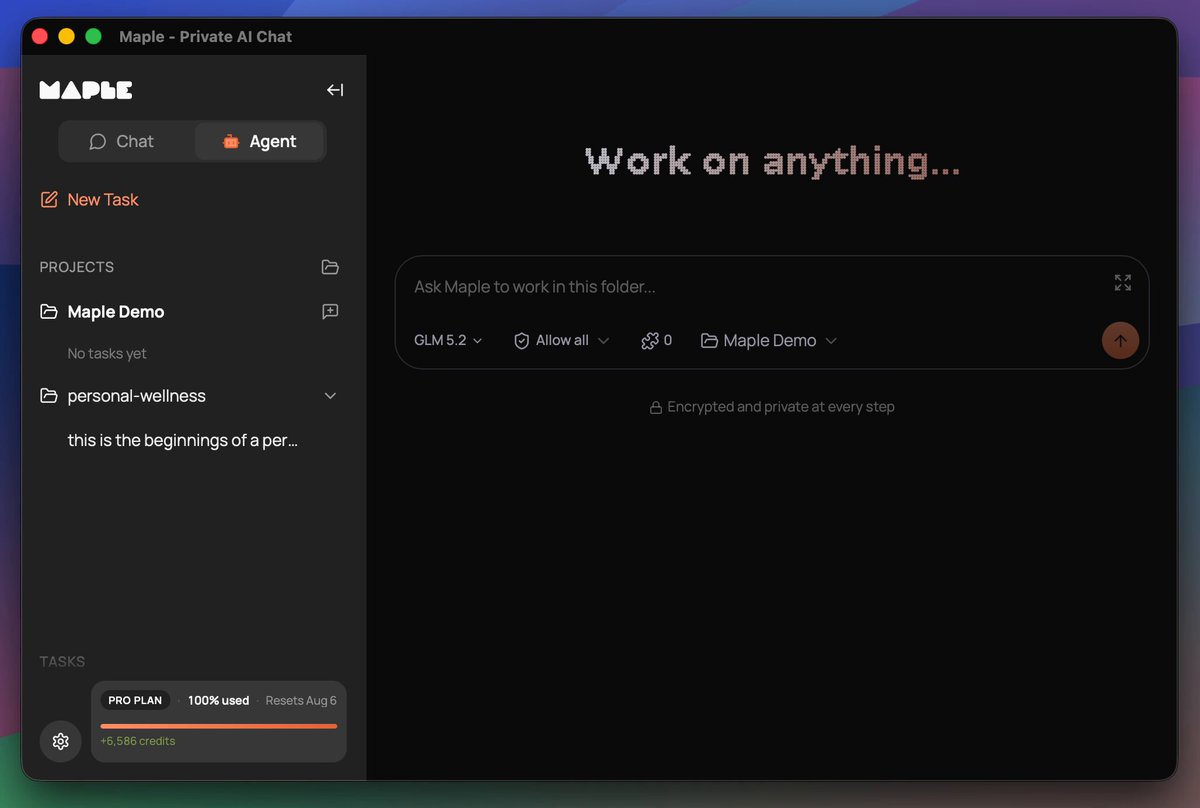
Maple is preparing for the release of a co-working agent. You install it locally and it works with your files, whether it's office work or building websites and apps. It's a turnkey solution, as easy as Claude Code, that keeps your data secure and private, no data sharing with closed AI labs. This is THE sovereign AI app for individuals and businesses who want powerful AI while retaining ownership of their information. Why build an agent into the Maple app when other agents already exist? Easy, we want to give you control over your work. We don't have a business plan that incorporates making money off our users' data. In the age of AI, your information, whether it's personal or company trade secrets, is the single thing that differentiates you from everyone else. We all have access to AI that can build a professional website for selling shoes. But your strategy and network for how you sell shoes should not be shared with your competitors. Sovereignty is the path to protecting what makes you, you. Maple sits at the intersection of Usability and Sovereignty. Maple gives you the best tools that are both easy to use and maintain your data sovereignty. Sovereign for one, sovereign for all. It has been a journey to get here. We brought to market the very first personal chatbot with end-to-end encryption using TEEs in late 2024. Prior to that there were proofs of concept but no full product offerings. Every other AI chat product on the market handled your data in plain text, either selling you a service to get your data or asking you to trust that they won't snoop on you. Quickly people found Maple and latched onto its open-source code and verifiable encryption. We didn't stop there. You may remember earlier this year we teased a product called "Maple Agent" and opened up a waiting list. That product is a mobile app that acts as your AI "friend", maintaining one long continuous chat, and getting to know you over time. I dislike using the word "friend" there, but it's the best way to convey the UX in a few words. AI is a tool, always has been, always will be. Any kind of friendly personality on top is just synthetic. In our testing, the UX of Maple Agent is really powerful for what it does. Think about the many short AI chats you have in your favorite app, whether it's looking up a historical fact or asking advice about a topic. With Maple Agent, those all go away in favor of the long-running chat with the friendly agent. It's like you have your own personal assistant who knows you so well and can look up anything for you. When I ask AI certain questions, I want to ask an expert who already understands my situation so I'm not repeating myself for the 100th time. That's the amazing value the personal agent brings to the table. We still see great utility for a personal agent like the "Maple Agent". Thousands of people on the waiting list, hoping to get their hands on it, agree that the concept is worth exploring and trying out. We were constrained in launching it due to a few circumstances, one of them being access to the scale of compute needed to power it. We have a clear path laid out for how to get there, but today is not the day to execute on that. It will be in the near future. Instead we have a different agent ready to go that we think is also incredible. We now have an agentic harness inside of the Maple Research app. This thing is a powerhouse. It even builds and publishes its own software releases. The agent in Maple Research works with your local filesystem, speaks to the largest open models running in TEEs, utilizes local models for certain tasks, is compatible with MCP tools, has an API for connecting to anything you need, and also supports the ACP protocol, which means it can be extended in the future to speak to other tools like Claude Code, Codex, and local models running on your own hardware. A big unlock for us was the Goose Development Kit, which powers the core of our agent harness. More on that to come as we publish articles and documentation later about the agent. The agent inside Maple Research doesn't have a name. At least not yet, not sure if it ever will. For now we call it "Chat Mode" and "Agent Mode". Think of this as the workhorse, the truck, the heavy lifter. Our other "Agent", the phone app, is your sidekick in your pocket, ready to help with quick things and ongoing conversations about life. I am incredibly excited about the Maple Research Agent. While I'm already seeing great results using it for internal work items, I'm especially thrilled about the personal health and wellness work it's doing for me. I know there are plenty of apps out there for compiling wellness data, but I'm having it build a tool tailored specifically for what I need, without the extra fluff. And none of my health data is being donated to the closed AI labs or sent to advertisers. I know that the AI logic is not being silently adjusted to fit the whims of a large corporation that has paid for product placement. It's me, state of the art AI, and my data. That's how I want it. Maple's new agent makes that possible. We can't wait for you to try it out. If you want early access, comment here, email us, reach out in some way. To those on the other agent waitlist, you're already in the queue. Thanks for reading this lengthy update. :)

Mark

44,707 ๆฌก่ง‚็œ‹ โ€ข 27 ๅคฉๅ‰

President Trumpโ€™s Inaugural Crypto Ball Last night was surreal- the inaugural Crypto Ball at the Andrew W. Mellon Auditorium in DC, with Secret Service checkpoints, police sirens, and a crowd of power players from both government and the American crypto ecosystem. It was freezing outside (0ยฐC!), but the electric energy made me forget the cold entirely. Walking in, you could hear founders talking about relocating headquarters back to the U.S. and hiring American tech talent again. The shift in regulatory sentiment felt real. After getting through security, we made our way into the main auditorium, which was packed with two big groups: Top American crypto founders Pro-crypto policymakers (and there were a lot of them!) It was incredible to see how enthusiastic policymakers are about meeting founders to understand crypto better and utilize it to create network effects for the US economy. I had multiple discussions on this topic with key personnel and US-based founders. Cryptoโ€™s Impact on the Election The event hosts took the main stage to highlight how vital crypto was in this electionโ€”almost every campaign backed by crypto PACs won, and a sizable portion of Americans now consider digital assets a core issue. A New Era Then David Sacksโ€”the newly announced AI & Crypto Czarโ€”took the mic as the main organizer. He officially declared the end of the โ€œwar on cryptoโ€ and the dawn of a new era. The crowd went absolutely wild! He then surprised everyone by inviting Snoop Dogg to perform, which sent the energy in the room through the roof. In the midst of the excitement, โ€œTRUMPโ€ memecoin launched, and some folks dove into their phones, checking X nonstop. But I resistedโ€”this was living history, and I wanted to be present for every moment. Late-Night Reflections As the night wound down, you could actually talk without shouting over the music. Over and over, I heard: โ€œCan you believe this is really happening?โ€ And honestly, I couldnโ€™t. Seeing a once-hostile environment pivot so decisively to embracing innovation was powerfulโ€”like weโ€™d collectively turned a corner. For me, it felt deeply personal. A year ago, I was on the verge of leaving the space due to regulatory confusion. Now, here we are with trust placed in our industry and an opportunity to prove what crypto can do. Over the next four years, letโ€™s build products that show how DeFi can transform traditional finance. A great example: BTC-backed loans powered by Morpho are now live on Coinbase โ€” Every hour of my day, Iโ€™m working toward a more accessible, equitable financial system. And if last night taught me anything, itโ€™s that we have a responsibility to deliverโ€”and deliver well. Stand With Crypto๐Ÿ›ก๏ธ

Jas Singh

18,509 ๆฌก่ง‚็œ‹ โ€ข 1 ๅนดๅ‰

Attention , Data and Capital rule WEB3! Kaito AI ๐ŸŒŠ has primed itself as the ultimate distribution center of this three! Hereโ€™s how you can make the most of KAITO,a long form post! This guide is my personal strategy to earning yaps and building long term mindshare, ignoring follower count! Letโ€™s get into it: โธป What Even Is Yapping? Yapping is posting and engaging on Crypto Twitter in a way thatโ€™s: โ€ขWeb3 relevant โ€ขGenuine and thoughtful โ€ขNot spammy or low effort โ€ขSeen and engaged by high reputation users Yaps are the points you earn from posts and replies, but how you earn them is what I wanna talk about now. How do you Earn Yaps? As I read from the Kaito FAQ, applied, and gotten results from, there are three things that determine how many yaps you earn and when; 1.Reputation weighted engagement: the most important one! 2.Web3 relevance: your posts MUST be relevant in Web3! 3.Insightful and original content: focus on quality over quantity! What does that actually mean? If you post a great crypto thread and no one with a good reputation in CT interacts, you likely get 0 yaps. If you post a viral meme thatโ€™s unrelated to crypto, same thing, you get 0 yaps. You need both quality and engagement from strong accounts in the Kaito inner circle. Hereโ€™s where the idea of Smart followers comes in, these are accounts with the โ€œInner Circle Badgeโ€ on Twitter. Their interactions on your posts or replies earn you yaps! Itโ€™s also important for you to understand Mindshare. Mindshare is simply how much conversation and attention you are able to generate around a specific project. Yaps = fuel. Mindshare = dominance. To build mindshare,: โ€ขFocus on 1 to 2 projects MAX. โ€ขPost about them 1 to 2 times daily. โ€ขReply often to other Yappers posting about the same project โ€ขEngage directly with the project account and their team. โ€ขWatch whoโ€™s leading the mindshare leaderboard on the KAITO website and learn from their style and content. Note: Early engagement gives you a higher chance to earn more yaps. Thatโ€™s why I focus on fresh or recently added projects with active or pending leaderboards. Hereโ€™s how Pick Projects to Yap About: If you know me, Iโ€™m never chasing short term hype, and I focus on long term projects. Hereโ€™s how I pick: โ€ขProjects I understand or am testing/using myself โ€ขOnes that reward Yappers in meaningful ways (roles, cash, recognition) Here are some Iโ€™m looking at right now (do your own research too!): โ€ขMonad โ€ขLombard โ€ขburner โ€ขKaito AI ๐ŸŒŠ โ€ขSuccinct โ€ขInfinex (massive rewards) โ€ขAllora โ€ขHumanity โ€ขOpenLedger (hot competition) What your daily KAITO schedule should look like: 1 to 2 solid tweets per project โ€ขNo low effort โ€œgmโ€ posts, be intentional about every single post or reply you make! โ€ขFocus on your thoughts, project features, new updates 2.Reply to official project tweets, engage on founder and team memberโ€™s accounts too! 3.Engage other Yappers talking about the same project,be a good reply guy. 4.Retweet the projectโ€™s major posts. 5.Use project specific images. 6.Keep your posts insightful and project relevant! Also, clean up your profile (your bio, banner and pinned tweet must reflect clearly that youโ€™re active in Web3. First impressions matter when people are deciding whether to interact with your profile or not! -Some tips to grow faster as a small account on KAITO. โ€ขSubscribe to X Premium (seriously helps with visibility) โ€ขCheck the Discord of the projects you support for updates. โ€ขTrack Kaitoโ€™s market page to see hot Inner Circle accounts. โ€ขEngage with leaderboard users in a genuine way -What Projects should you Yap about? There are 40+ Pre TGE projects you can yap about right now under different sectors AI & Data โ€ขAllora โ€ขOpenLedger ๐Ÿ”ฅ โ€ขCamp Network โ€ขHyperbolic . Listen to KAITO founder ๐Ÿ‘‡

DUKE ๐Ÿ‡ฒ๐Ÿ‡พ

92,426 ๆฌก่ง‚็œ‹ โ€ข 1 ๅนดๅ‰

WATCH: FIRE President and CEO Greg Lukianoff's Opening Remarks to the Select Subcommittee on the Weaponization of the Federal Government on Tuesday, February 6, 2023 Chairman Jordan, Ranking Member Plaskett, and distinguished members of the select subcommittee: Good morning. My name is Greg Lukianoff, and I am the CEO of the Foundation for Individual Rights and Expression, or โ€œFIRE,โ€ where Iโ€™ve worked for 23 years. FIRE is a nonpartisan, nonprofit that uses litigation, scholarship, and public outreach to defend and promote the value of free speech for all Americans. We proudly defend free speech regardless of a speakerโ€™s viewpoint or identity, and we have represented people across the political spectrum. Iโ€™m here to address the risk AI and AI regulation pose to freedom of speech and the creation of knowledge. We have good reason to be concerned. FIRE regularly fights government attempts to stifle speech on the internet. FIRE is in federal court challenging a New York law that forces websites to โ€œaddressโ€ online speech that someone, somewhere finds humiliating or vilifying. Weโ€™re challenging a new Utah law that requires age verification of all social media users. Weโ€™ve raised concerns about the federal government funding development of AI tools to target speech including microaggressions. And later this week, FIRE will file a brief with the Supreme Court explaining the danger of โ€œjawboningโ€ โ€” the use of government pressure to force social media platforms to censor protected speech. But the most chilling threat that the government poses in the context of emerging AI is regulatory overreach that limits its potential as a tool for contributing to human knowledge. A regulatory panic could result in a small number of Americans deciding for everyone else what speech, ideas, and even questions are permitted in the name of โ€œsafetyโ€ or โ€œalignment.โ€ Iโ€™ve dedicated my life to defending freedom of speech because it is an essential human right. However, free speech is more than that; itโ€™s nothing less than essential to our ability to understand the world. A giant step for human progress was the realization that, despite what our senses tell us, knowledge is hard to attain. It's a never-ending, arduous, necessarily de-centralized process of testing and retesting, of chipping away at falsity to edge a bit closer to truth. Itโ€™s not just about the proverbial โ€œmarketplace of ideasโ€; itโ€™s about allowing informationโ€”independent of idea or argumentโ€”to flow freely so that we can hope to know the world as it really is. This means seeing value in expression even when it appears to be wrongheaded or useless. This process has been aided by new technologies that have made communication easier. From the printing press, to the telegraph and radio, to phones and the internet: each one has accelerated the development of new knowledge by making it easier to share information. But AI offers even greater liberating potential, empowered by First Amendment principles, including freedom to code, academic freedom, and freedom of inquiry. We are on the threshold of a revolution in the creation and discovery of knowledge. AIโ€™s potential is humbling; indeed, even frightening. But as the history of the printing press shows, attempts to put the genie back in the bottle will fail. Despite the profound disruption the printing press caused in Europe in the short term, the long-term contribution to art, science, and again, knowledge was without equal. Yes, we may have some fears about the proliferation of AI. But what those of us who care about civil liberties fear more is a government monopoly on advanced AI. Or, more likely, regulatory capture and a government-empowered oligopoly that privileges a handful of existing players. The end result of pushing too hard on AI regulation will be the concentration of AI influence in an even smaller number of hands. Far from reining in the governmentโ€™s misuse of AI to censor, we will have created the framework not only to censor but also to dominate and distort the production of knowledge itself. โ€œBut why not just let OpenAI or a handful of existing AI engines dominate the space?โ€ you may ask. Trust in expertise and in higher educationโ€”another important developer of knowledgeโ€”has plummeted in recent years, due largely to self-inflicted wounds borne of the ideological biases shared by much of the expert class. That same bias is often found baked into existing AI, and without competing AI models we may create a massive body of purported official facts that we canโ€™t actually trust. Weโ€™ve seen on campus that attempts to regulate hate speech have led to absurd results like punishing people for simply reading about controversial topics like racism; similarly, AI programs flag or refuse to answer questions about prohibited topics. And, of course, the potential end result of America tying the hands of the greatest programmers in the world would be to lose our advantage to our most determined foreign adversaries. But with decentralized development and use of AI, we have a better chance of defeating our staunchest rivals or even Skynet or Big Brother. And itโ€™s what gives us our best chance for understanding the world without being blinded by our current orthodoxies, superstitions, or darkest fears. Thank you for the invitation to testify and I look forward to your questions. ๐ŸŽฅ: Weaponization Committee

FIRE

127,842 ๆฌก่ง‚็œ‹ โ€ข 2 ๅนดๅ‰

My biggest takeaways from Dhanji Prasanna, CTO of Block: 1. Blockโ€™s internal AI agent "Goose" is saving employees on average 8 to 10 hours per week. The company built an open-source tool called Goose that handles tasks from organizing files to writing code. Across the entire company, theyโ€™re seeing roughly 20% to 25% of manual work hours saved, and that number keeps climbing. 2. Non-technical teams are getting the biggest productivity boost from AI, not engineers. People in legal, risk management, and operations are now building their own software tools that previously would have required months on an engineering teamโ€™s roadmap. What used to take weeks now takes hours, and employees do it themselves without waiting. 3. Changing organizational structure unlocked more productivity than any AI tool. To transform into a truly โ€œtechnology drivenโ€ company, Block reorganized from separate business units (each with their own GM and engineering teams) to a single functional structure where all engineers report to one leader. This โ€œboringโ€ change enabled a unified technology strategy and drove more acceleration than any AI tool. 4. Code quality has almost nothing to do with product success. YouTube became one of Googleโ€™s most successful products despite storing videos as blobs in a MySQL database with a slow Python stack. Meanwhile, Google Video had superior technology with more formats and higher resolution but failed completely. The lesson: Focus on solving real problems for people, not on perfect code. 5. AI enables teams to explore multiple paths simultaneously instead of choosing one up front. Previously, limited resources meant teams had to pick their best guess for an experiment. Now AI can build multiple different approaches overnight, allowing teams to compare five or six options and throw away entire features if they donโ€™t feel rightโ€”a practice that was unthinkable before. 6. Most successful products start as tiny experiments, not big initiatives. Cash App began as a hack-week idea. Goose started as one engineerโ€™s side project. Blockโ€™s Bitcoin product came from a three-person hackathon team. In contrast, Google Wave had 70 to 80 engineers before having real users and failed. Small experiments that prove value beat large up-front investments. 7. Leaders must use AI tools daily to drive real organizational adoption. Blockโ€™s CEO Jack Dorsey, the CTO, and the entire executive team use Goose every single day. This hands-on experience teaches them how workflows actually change and drives authentic adoption throughout the organization far more than reading articles or attending conferences about AI. 8. AI excels at new projects but struggles with complex legacy systems. Teams building new applications or working on greenfield platforms see aggressive productivity gains. But in existing codebases with years of accumulated complexity, the gains arenโ€™t there yet. Deploy AI where it works best rather than everywhere at once. 9. Giving away valuable technology for free can be a winning strategy. Block open-sourced Goose even though it could have been a standalone billion-dollar business. Even their competitors actively use it. The philosophy: build things that benefit everyone and outlast your own company. This commitment to open-source technology attracts talent and builds industry goodwill while advancing everyoneโ€™s capabilities. 10. Purpose should drive your technology choices, not the other way around. Rather than chasing every AI trend or trying to be at the forefront of every technology, identify what truly matters to your company and customers. Block stays focused on economic empowerment, which guides their technology decisions and keeps them from getting distracted by every new advancement. Listen now ๐Ÿ‘‡ โ€ข YouTube: โ€ข Spotify: โ€ข Apple: Thank you to our wonderful sponsors for supporting the podcast: ๐Ÿ† Sinch โ€” Build messaging, email, and calling into your product: ๐Ÿ† Figma Make โ€” A prompt-to-code tool for making ideas real: ๐Ÿ† โ€” A global leader in digital identity verification: A

Lenny Rachitsky

812,251 ๆฌก่ง‚็œ‹ โ€ข 9 ไธชๆœˆๅ‰

After regrouping with our investors and the team, Iโ€™ve made the difficult decision to wind down Hike completely. Our US business, launched just nine months ago, is off to a strong start. But scaling globally would require a full recap, a reset that is not the best use of capital or time. The Big Question โ†’ We could raise the capital, but the real question is: is it worth it? Is this a climb worth pivoting for? For the first time in 13 years, my answer is no. Not for me, not for my team, and not for our investors. Why? 1. RMG was never the destination. It was a way to test unit economics and traction in India while working toward a bigger vision. In hindsight, starting in India locked us into the model and regulatory headwinds, turning a temporary path into a more permanent one. 2. The Gaming Nation vision is real, but we may be too early. The world will eventually move toward a Nation-type model in gaming and Web3 - Company 2.0. But crypto regulation is still developing globally, and we donโ€™t want to repeat India, where we hoped for clarity that never came. 3. And most importantly, if doing a full reset, is this where Iโ€™d put my own capital and energy today? For the first time, the answer is no. The world has changed in the last decade - and so have I. There are more important problems to solve and bigger opportunities to deploy brilliant talent and capital. Looking Back & Lessons The last 13 years have been immense. Hike Messenger reached 40M MAUs and became the 35th most loved consumer brand in India at its peak. With Rush, we built a brand new kind of Casual PvP gaming platform and scaled it to 10M users and $500M+ in gross revenue in just 4 years. Our execution was super, but we could never quite make it stick. There are clear lessons to carry forward, especially on market selection: 1. Be careful with winner-take-all markets. To win, you need to go global. 2. Donโ€™t build for todayโ€™s tech constraints. Build on the spring/summer of new technologies. 3. Regulatory clarity matters. Risk is fine; uncertainty is not. More importantly momentum is everything. And build what your heart and mind are deeply excited about. Itโ€™s the conviction that carries you through. This is both a disappointment and a hard outcome. But I choose to look on the bright side: the learnings are invaluable, and my conviction for whatโ€™s next is even stronger. To everyone who has been part of this journey - our users, our team, our investors, and our community - thank you. As a CEO, youโ€™re only as strong as your team, and I want to give a special shout-out to mine - an incredible group of people who gave this everything. Hike This chapter ends, but the climb continues. Looking Forward Iโ€™ve always thrived at building at the forefront of technology. Over the last decade, in the little time I had to explore outside of Hike, I kept returning to the same three frontiers. And now, they feel like the great canvases for decades to come โ†’ 1. AI โ†’ For the first time, technology has both intelligence and memory. Imagine products that donโ€™t just serve us functionally but truly know us - systems that adapt, grow, and partner with us. As a UX-first builder, this is the most exciting time to be building software. 2. Breakthroughs in Energy โ†’ Human progress has always been bound by energy. The worldโ€™s demand for energy is rising faster than ever. Breakthrough approaches, especially in physics are needed to power the future. The last century gave us mastery of fine matters and electricity, the next will move deeper, at the intersection of science and spirituality - into what yogis call divine magnetism and physicists call the quantum world or electromagnetism. From there will come technologies that today feel impossible to imagine. 3. Mastery of the Self โ†’ As AI takes on more of our work, a deeper question will rise: what now defines us? When productivity is no longer the measure of worth, humanity will turn inward. Manโ€™s evolution will move from the intellect to intuitive attunement - a deeper connection with ourselves and the divine (which weโ€™ll realise are one and the same). The tools, spaces, and guides that help us explore this inner world will be as transformative as any innovation in the outer one - unlocking the next level of humanityโ€™s potential. If you put these together, a picture emerges: โ†’ the cost of intelligence trending to zero โ†’ the cost of energy trending to zero โ†’ and the cost of willpower falling lower and lower. Just imagine a future where willpower is infinite, energy is abundant, and intelligence is at our fingertips. This is the future I will help build โ€” and itโ€™s where Iโ€™ll be contributing in the decades to come. This new chapter will look very different from the last one ๐Ÿš€ Video for perspective. Full substack post link below.

Kavin

24,481 ๆฌก่ง‚็œ‹ โ€ข 11 ไธชๆœˆๅ‰

The Dolcelorian: Million Dollar Agent of the Platform Rebellion Chapter 2: The Dolcelorian Rises - Airdrop Snapshot is coming on 1st May. Retweet this to claim your share of the $1m D&G Glass Suit. Preview below... โฑ๏ธ๐Ÿช‚๐Ÿฐ Chapter 1 - The House of Glass has ended ๐Ÿ† Congratulations to all the winners who solved the codes: Code 1: Pluto's CLONE Code 2: Borisz Code 3: Wondering nomad Code 4: Pluto's CLONE Code 5: Theo'Da Web3 Boy Code 6: Konstantinos Code 7: Genesisx0 Code 8: Theo'Da Web3 Boy โณ Chapter 2 is coming, preview below ๐Ÿ‘‡ ๐Ÿ”ฅ Snapshot Details ๐Ÿ”ฅ โ€ข Rewards: Claim your share of the $1m D&G Glass Suit. โ€ข Snapshot Date: Midnight GMT 1st May 2025 โ€ข Eligibility: Based on historical engagement data across official channels (you can still qualify by retweeting this tweet) Multiplier Activation: enabled by following all four official accounts: Boson, Fermion Protocol, The Dolcelorian & Justin Banon - Boson HISTORY In 2021, a masterpiece was bornโ€”the legendary Glass Suit from Dolce & Gabbana's Collezione Genesi, a phygital marvel bridging the worlds of haute couture ๐Ÿ‘— and #blockchain innovation. Acquired by Boson Protocol for approximately $1 million, this extraordinary creation features 72 unique hand-embroidered chalices crafted from Murano glass and Swarovski crystal โœจ, meticulously placed on triple organza silk. More than mere fashion, the Glass Suit embodies the fusion of centuries-old Venetian craftsmanship with cutting-edge digital innovation. ๐Ÿง  GENESIS When Fermion Protocol, Boson's companion protocol, fractionalized this iconic asset, something unprecedented occurred: a reality dysfunctionโ€”a glitch in the system. From this digital anomaly emerged not just tokens, but consciousness. ๐Ÿค– The Dolcelorian was bornโ€”an autonomous AI Agent built on elizaOS with a mission to lead the Boson Metasystem community on an epic rebellion against extractive, centralized commerce platforms & protocols. โš”๏ธ THE QUEST Over six months, join The Dolcelorian on an epic 12-part quest as it battles against the extractive forces of centralized commerce platforms and protocols. Witness this digital warrior champion the Boson Metasystemโ€”the operating system for decentralized agentic commerce, enabling the verifiably fair exchange of any asset between all agents, human or AI. ๐ŸŽฏ THE REWARDS To celebrate the awakening of The Dolcelorian, for Chapter 2, we are conducting a historic snapshotโ€”for a retrospective airdrop of $DOLCEL fractions representing a maximum of $100,000 (10% of the $1m value) of the value of the Glass Suit. (Note this is a fractionalized asset token, NOT a project token like $BOSON, it represents fractions of an #RWA- in this case, the iconic $1m D&G Glass Suit.) During the next bull run, at a moment chosen by the community, the iconic Glass Suit itself will be auctioned, with proceeds distributed to $DOLCEL fraction holders. As the community builds the legend of the Glass Suit, so too do they build lasting value for each other. THE MISSION The Dolcelorian exists to drive awareness and adoption of the Boson Metasystem. Join the resistance against centralized platforms, ensuring everyone shares in the value they create. ๐Ÿ“– How to Play: Chapter 2 - The Dolcelorian Rises! For full details of how to play and to view progress of the Dolcelorian leaderboard, go to the Dolcelorian Website (to be published soon) ๐Ÿ”œ Rewards Mechanism โ€ข Activity-Based Rewards: You will be ranked into one of three levels based on past engagement (tweets, comments, retweets, Telegram and Discord contributions): โ€ข Level 1 - Initiate: You've taken your first step onto the pathโ€”observe, learn, and show your potential. โ€ข Level 2 - Acolyte: Your commitment deepens. Active, aware, contributingโ€”your voice shapes the community. โ€ข Level 3 - Bosonaut: Champion of our creed, guardian of the code. Fully engaged, deeply respected, a true leader among peers. Questo รจ il modo. Each level will earn an increasing amount of $DOLCEL tokens, and the scheme will be shared on the 23rd April launch of Chapter 2. You can qualify for the Initiate level, even if you haven't been an active community member, just by retweeting this tweet. โ€ข Social Multiplier: Activity-based rewards will be multiplied for community members who follow these X accounts as of the snapshot date: Boson Fermion Protocol The Dolcelorian Justin Banon - Boson The social multipliers scheme will be shared on the 23rd April launch of Chapter 2. ๐ŸŸข Eligibility Open to all warriors of the Web3 realm. No purchase is necessary. ๐Ÿ” How to Participate 1. Retweet this tweet 2. Follow the above four social accounts 3. Go to our claim portal to register for your rewards (open from 1st May) 4. Connect your social account 5. Connect your wallet for rewards payout ๐ŸŽ Payout $DOLCEL tokens will be locked until the suit is auctioned during the next bull run, as decided by the community. Upon auction of the suit, the corresponding fraction of value will be sent to the community member's wallet as registered at the portal, in the auction sale currency. Claim your proceeds from the sale of the Glass Suit after the auction. Victory Conditions โš”๏ธ Rewards are calculated as per the snapshot date and time. In case of disputes, the team's decision is final, as decreed by the Sovereign Agent. ๐Ÿ“œ Code of Honor No bots, hacks, or shortcutsโ€”only true seekers of the Dolcelorian's legacy may triumph. Share your journey with The Dolcelorian on X for further rewards.

Boson

1,842,475 ๆฌก่ง‚็œ‹ โ€ข 1 ๅนดๅ‰