Video wird geladen...

Video konnte nicht geladen werden

Zur Startseite

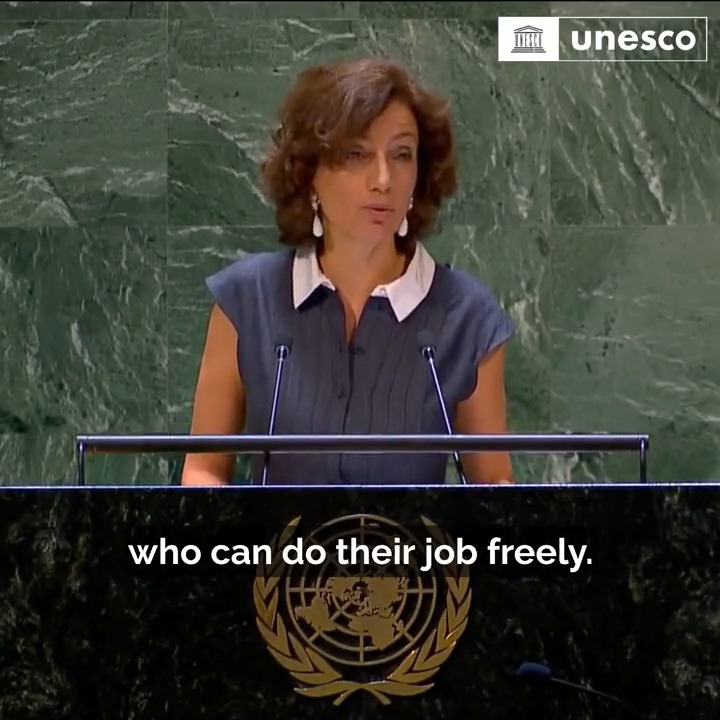
What if journalism could prevent conflict? When information breaks down: trust collapses, rumours spread, conflict follows. Yet supporting journalism costs far less than war. 15 days of global military spending = 1 year of funding for public-interest journalism. Journalism shapes peace: #WorldPressFreedomDay #PressFreedom

10,455 Aufrufe • vor 3 Monaten •via X (Twitter)

0 Kommentare

Keine Kommentare verfügbar

Kommentare vom Original-Post werden hier angezeigt

Ähnliche Videos

The media's fatal mistake was giving Silicon Valley ownership of the audience while journalists did all the work. Journalists no longer own their audience, their data, their revenue, their distribution, or increasingly, even their own work. Think about how insane that is. The people creating the content don't control the business built around it. That's a crisis that's far bigger than left versus right, censorship, or media bias: the entire economic model underpinning journalism is broken. A reporter can risk their life covering a war in Ukraine, corruption in Africa, or political unrest in the Middle East, generate millions of views, and still have no idea how much money their work made, when they'll get paid, why one story performed better than another, or whether the platform will bury them tomorrow. Meanwhile, the platforms know everything. They see every click, every view, every dollar, and every trend. The creators see almost none of it. Coinbase is trying to solve what may be the biggest problem in journalism itself: Ownership. Who owns the audience, the data, the monetization, and most importantly, the relationship with readers? Because for the last decade, the answer has largely been Silicon Valley. And that's exactly why so many journalists, newspapers, creators and independent outlets have been slowly suffocated. His argument is that journalism doesn't have a content problem; it has a control problem. And unless journalists take back ownership of their audiences, their data, their revenue, and their IP, the people producing the information society depends on will continue getting weaker while the platforms built on top of them get stronger. It's one of the most important conversations I've had about the future of media. Because if journalism can't figure out how to survive economically, then eventually there won't be any journalism left to save.

Mario Nawfal

250,194 Aufrufe • vor 1 Monat

Glenn Greenwald says corporate journalists are losing their minds over Elon Musk calling out major corporations for stifling free speech because they are in bed with the very corporations they claim to scrutinize. Glenn Greenwald explains that we are at a crossroads where journalism, once a watchdog of establishment power, is now shackled by corporate advertisers. "What went wrong here is not what Elon Musk said. It's so revealing that so many journalists are aghast that anyone would dare tell Disney and major corporations to go f**k yourself when they're trying to limit, censor, and control the flow of political content. If you aren't willing to say that to corporations who are trying to limit what you can say, don't bother calling yourself a journalist. We need way more journalists willing to say, go f**k yourself to people who try and limit what they say. The problem is, is that the people who are hired by these major media corporations, and who thrive in them and succeed in them are people who have the opposite instinct. Their instinct is to assuage and serve and placate establishment power, not to defy it. Even though the purpose of journalism is to be adversarial to establishment power. Once journalism started getting corporatized no longer owned by families dedicated to journalism or local communities but by major corporations that have all kinds of other interests besides their media division. And, what kind of attributes are awarded at major corporations? People who avoid controversy who avoid conflict, who avoid displeasing and angering powerful people. That's the corporate ethos, and the corporatization of media meant that that kind of attribute was imported into journalism. And that's why almost no one who works for large media corporations or the media corporations themselves has the courage to say this. They're shocked. They think it's a sign that he's unhinged when in reality, it's just a sign of how cowardly and craven they are."

KanekoaTheGreat

23,825,665 Aufrufe • vor 2 Jahren

Coinbase's James Morek: The media's fatal mistake was giving Silicon Valley ownership of the audience while journalists did all the work Journalists no longer own their audience, their data, their revenue, their distribution, or increasingly, even their own work. Think about how insane that is. The people creating the content don't control the business built around it. That's a crisis that's far bigger than left versus right, censorship, or media bias: the entire economic model underpinning journalism is broken. A reporter can risk their life covering a war in Ukraine, corruption in Africa, or political unrest in the Middle East, generate millions of views, and still have no idea how much money their work made, when they'll get paid, why one story performed better than another, or whether the platform will bury them tomorrow. Meanwhile, the platforms know everything. They see every click, every view, every dollar, and every trend. The creators see almost none of it. Coinbase is trying to solve what may be the biggest problem in journalism itself: Ownership. Who owns the audience, the data, the monetization, and most importantly, the relationship with readers? Because for the last decade, the answer has largely been Silicon Valley. And that's exactly why so many journalists, newspapers, creators and independent outlets have been slowly suffocated. His argument is that journalism doesn't have a content problem; it has a control problem. And unless journalists take back ownership of their audiences, their data, their revenue, and their IP, the people producing the information society depends on will continue getting weaker while the platforms built on top of them get stronger. It's one of the most important conversations I've had about the future of media. Because if journalism can't figure out how to survive economically, then eventually there won't be any journalism left to save. 01:14 - Major media is becoming a political institution, and the talent doesn't have to stay trapped inside it 01:51 - The whole system is a guessing game, right down to when you actually get paid 05:01 - One person can control what billions of people see 08:46 – It’s all about bringing professional journalism back 11:39 - Watch your earnings tick up live in the app, like a debt clock for your own work 12:30 - Shadow bans, slashed CPMs, pulled advertisers, debanking: censorship has a lot of tools 16:46 - Soon you'll be able to stake journalists, and the bidding war for the world's best begins 19:25 - Professional journalism got left behind by Silicon Valley, and the mission is to help it thrive again Disclaimer: This content was produced in collaboration with the other party and is intended for informational purposes only. It does not constitute financial or investment advice. Always conduct your own research before making any decisions.

Mario Nawfal

323,649 Aufrufe • vor 1 Monat

Elon Musk: The cumulative voice of the people should decide what's newsworthy. “In times past, we didn't have the technology for this, so the only way to learn news was for it to be filtered through a small number of news organizations and then to be printed in newspapers or broadcast. There wasn't really any way that people could speak to each other or communicate with each other. But now there is, because people can be online. I'm a big believer in citizen journalism being actually way better. At first, citizen journalism may sound like, well, doesn't that mean just a whole bunch of amateurs are doing journalism? No, actually, it's way better because if you have actual experts in the field saying things that's way better than a journalist, if you have people who are actually at the event, live. Look at the attempted assassination of President Trump, people actually at the event live, doing video, people are reporting it. That's the kind of thing that is actually far better information than filtering it through a small number of publications, which ends up being controlled by maybe five editors-in-chief. There's like five people that control the news. And even though there are multiple newspapers, New York Times, Wall Street Journal, Washington Post, a few others, they decide what is newsworthy. But that should not be how it works. It should be the voice of the people, the cumulative voice of the people should decide what is newsworthy.” Philadelphia, October 18, 2024

ELON CLIPS

20,819,970 Aufrufe • vor 1 Jahr