Загрузка видео...

Не удалось загрузить видео

На главную

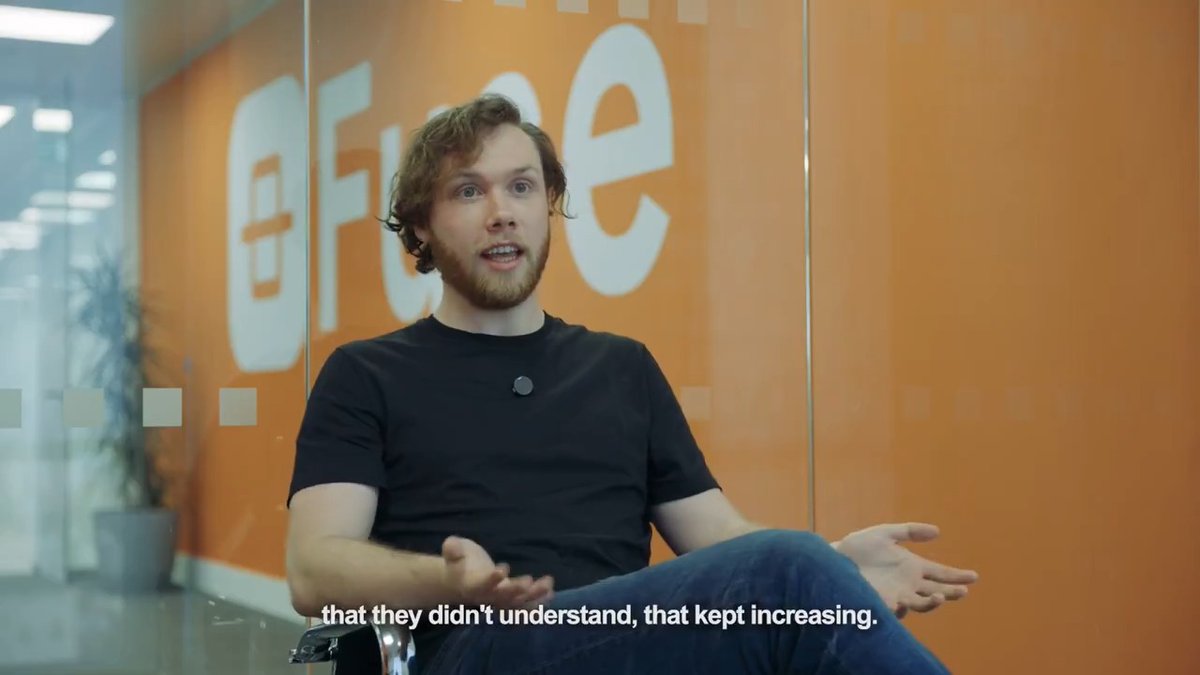
When Harvard-trained astrophysicist Stephen Perrenod looked at Bitcoin on a log-log chart, what he saw completely changed how he understood the asset. The real breakthrough for moneyordebt ∞/21M came in 2019. Applying a physics background and computational tools revealed to him a pattern unseen in traditional finance: On a...

51,087 просмотров • 6 месяцев назад •via X (Twitter)

Комментарии: 0

Нет доступных комментариев

Здесь появятся комментарии из оригинального поста

Похожие видео

Matthew Mezinskis put the number on screen that his entire model hangs on: "The power curve itself is about $145,000. #Bitcoin, as we know, is well under that, about half. So we're well under trend." To understand why he trusts that curve, you need his gold-vs-Bitcoin distinction, and it's the cleanest version of it I've heard. Gold is an exponential asset: a straight line on a log chart, constant growth. He ran the 55-year regression live, gold compounds at "5.7% per year... a doubling every 12 and a half years." That's what normal assets do. Stocks draw the same line. You can be off-trend for 20 years, but the line is the line. Bitcoin doesn't fit that line. At all. Its best fit is a power curve, a straight line only on log-log scale. Different mathematical species: growth that slows over time, but with one proportion that never changes: "For every 13% increase in the life of Bitcoin, the price doubles. That's the brass tacks of what the Bitcoin power curve does. It's a mathematical relationship that we can find and observe, and it's been going on really well for about 13 years." Early on, a doubling took 93 days. Each one takes longer now. But the proportion holds; thirteen years and counting. What I keep sitting with: he's not asking you to believe a story. Gold has a 55-year trend. Bitcoin has a 13-year one. Both are just regressions on data anyone can check. The difference is what the regression says: gold doubles every twelve and a half years on trend. Bitcoin, even as it slows, still doubles multiples faster, from half price. His curve, his math. But if price reverts to trend the way it has for thirteen years, the gap to $145K isn't a prediction. It's an observation with a delay. Matthew Mežinskis

Michaël van de Poppe

31,572 просмотров • 6 дней назад

This is how DNA turns coded information into functional proteins - the building blocks of the nanomachines that keep the cells in your body alive. This complex process highlights the sophisticated interconnected systems of Life which must all exist together from the beginning, or Life doesn't happen. First, an RNA molecule is copied from a short segment of DNA. Without the specifically ordered DNA information, RNA cannot form, proteins cannot be built, cells stop working, and life ceases to exist. Life is information first. Once the RNA Molecule is created, it gets ejected from the Polymerase where it was built, and it travels through a complex molecular machine called a Nuclear Pore Complex (NPC), which is an information recognition device that controls the flow of information in and out of a cell's nucleus. The NPC is highly complex - composed of about 500-1,000 protein subunits, derived from a set of about 35 distinct proteins. Without this molecular machine, there is no regulation for what goes in and out of the cell's nucleus, which would lead to catastrophic death for the cell. It must exist for cells to exist. Once the RNA Molecule passes through the NPC, it travels to the Ribosome, a 2-part chemical factory which reads the information on RNA and uses it to construct functional proteins using a specifically sequenced chain of amino acids. Once complete, this protein will then be sent to the section of the cell it belongs to integrate into another molecular machine and do its job. The Ribosome is another highly complex molecular machine - consisting of between 56-80 proteins. Without this molecular machines, proteins cannot be built. Proteins are the building blocks of every cell in every organism on Earth. Without Ribosomes, Life doesn't exist. If you're paying attention, you'll start to realize that Life relies on a highly sophisticated interdependent network of complex machines, which all rely on each other for the function of the system. DNA requires the cell for stability, but the cell requires the proteins for its structure and function, but those proteins require DNA and RNA to be built - it's a circle of necessary interdependence. Systems like this cannot be built by evolutionary processes, which requires that each piece of the process is built by gradual incremental means over lots of time. Without all the pieces there, from the beginning, none of it works. There is only one known source of complex & interdependent informational systems like those we find in life: and that is from Intelligence. Molecular Biology is the best and most obvious evidence of the Intelligent Design in Life.

Divinely Designed

62,517 просмотров • 8 месяцев назад

Core, ‌the Bitcoin-first ‌chain, and how it’s trying to stretch BTC’s usefulness Core DAO (Core DAO 🔶) brands itself as “The Bitcoin Everything Chain.” The pitch is simple: take Bitcoin’s strengths and push them beyond the usual buy-and-hold story. The protocol centers on one main idea: BTC shouldn’t sit still. Core wants idle Bitcoin to earn, but without giving up the properties people care about most: safety, decentralization, and full self-custody. To get there, Core leans on a mix of Satoshi Plus, timelocks, and a quick Layer 1 EVM chain. Satoshi Plus folds in Delegated Proof of Work (so Bitcoin miners can participate), self-custodial Bitcoin staking, and staking of the $CORE token. Core frames the relationship with Bitcoin as mutualistic. It borrows security and incentive alignment from Bitcoin, then tries to send value back through extra miner rewards, trustless yield opportunities for BTC holders, and infrastructure that makes it easier for Bitcoin products to plug in and scale. Key ways Core aims to expand Bitcoin utility: 1.) Self-custodial Bitcoin staking Lock BTC with timelocks directly on the Bitcoin network (CLTV) and earn CORE yield, no wrapping, no bridges, and no handing custody to anyone else. 2.) Dual staking Stake $BTC and $CORE together to reach higher yield tiers. 3.) Tapping Bitcoin’s hash power Miners can delegate hash power to earn extra CORE rewards, while Core itself is secured using a majority share of Bitcoin’s hash rate. 4.) The “Bitcoin Power Grid” A set of rails Bitcoin products can connect to, built around yield, collateral, payments, and DeFi use cases. 5.) Scalable Bitcoin DeFi An EVM-compatible network designed for faster, cheaper BTCFi apps. 6.) Two-way value flow The goal is to strengthen Bitcoin’s security budget over time, while also turning dormant BTC into something that can actively do work. In plain terms, Core DAO’s broader mission is to make Bitcoin more productive without piling on trust assumptions, converting energy and capital tied up in Bitcoin into yield, DeFi activity, and scalable infrastructure.

BSCN

27,175 просмотров • 28 дней назад

When people talk about Bitcoin, they usually anchor the conversation to price, halving & liquidity cycles, ETF flows, short-term volatility. But that mindset is far too limited. While price is signal, its short term variations are meaningless. Grant Cardone If we genuinely want to understand where Bitcoin can go, we have to stop fixating on price entirely and shift toward TAM (Total Addressable Market). Not TAM in a linear sense, but TAM in a cubed sense. This is where Peter Dunworth framework is so powerful. Instead of treating Bitcoin as an asset that competes in one market, he forces us to recognize that Bitcoin is simultaneously disrupting and replacing three of the most fundamental monetary domains: •store of value, •medium of exchange, and •unit of account. Put together, this is the worlds first “triple point asset”, or what you could call money cubed - a monetary technology that compounds across all three functions at once. And once you understand that framing, the conversation shifts from short-term price movements to the structure of the global financial system and the total markets Bitcoin is absorbing. Dunworth walks through those mechanics with absolute clarity. He illustrates how a fixed-issuance monetary network interacts with a world built on constantly expanding economic activity. When global settlement flows and monetary throughput collide with an asset whose supply schedule is permanently capped, the system is forced to revalue itself to handle that load. It’s a simple but profound dynamic: increasing global demand flowing through a monetary base that cannot expand. The result isn’t a forecast; it’s the natural economic physics of a system that cannot inflate to absorb growth, and therefore must reprice to accommodate it. This is how TAM compounds in an exponential, not linear, way… and why thinking in terms of “price targets” misses the entire point. And if it takes 30 or 40 years for this transition to unfold, that still aligns with the broader monetary reality. Fiat currencies will continue to debase, global economic output will keep expanding, and Bitcoin will remain the one monetary instrument whose supply is perfectly fixed. At some point, we have to place a net present value on all future economic activity being denominated, settled, or stored in a system that cannot be diluted. That is the essence of Dunworth’s framework: Don’t focus on numbers. Don’t obsess over timelines. Focus on the mechanics, the TAM, and the triple-layered monetary disruption. Because once you see Bitcoin as money to the third power (a store of value, medium of exchange, and unit of account all compounding together) the future valuation isn’t a prediction. It’ a logical endpoint of how the protocol is built.

MarylandHODL #BIP-110 (aka The Transition)

10,573 просмотров • 9 месяцев назад

"I used to be a bitcoiner. The transition to a new store of value only happens once every 3,000 years. That's the main prize -- just focus on that. But [security] is the criteria that ultimately convinced me to flip from Bitcoin to ETH." "I have a higher degree of certainty that Ethereum will be around longer [than Bitcoin]. The reason for that is because Bitcoin relies on proof-of-work, which is less efficient than proof-of-stake and doesn't scale with the value of the network. And as the block subsidy of Bitcoin halves every four years, it is increasingly becoming more and more reliant on transaction fees to fund the security budget paid to miners." "If you look at [Bitcoin's] security budget right now, about 0.6% of revenue to miners is transaction fees... The problem with that is if Bitcoin becomes 'digital gold', flips gold, and becomes a $30 trillion asset, but it only costs $10-20 billion to attack it, that's too asymmetric." "You want the security budget to scale with the market cap, similar to how countries spend a % of their GDP on defense. The more valuable something is, the more you need to spend to protect it." "Ethereum, with the Merge, migrated to proof-of-stake, which is fundamentally more secure because it's less reliant on transaction fees and it scales with the value of the network. If 1/3rd of ETH is staked and then you need 1/3rd of those ETH to censor the network, you're looking at roughly 10% of the total market cap as the cost to attack the network." "So if Ethereum flips Bitcoin and gold and becomes a $30 trillion asset, it'll cost ~$3 trillion to attack the Ethereum network versus Bitcoin at like $10 billion." "The other aspect here is that as AI hyperscalers invest more and more in AI, proof-of-work becomes increasingly vulnerable because the cost to attack the Bitcoin network is starting to look close to the quarterly CapEx these hyperscalers are spending on their data centers." Full interview on Bankless with Vivek Raman discussing the new Etherealize "Productive Money" report below.

Michael McGuiness

120,514 просмотров • 4 месяцев назад

Debunking the Flat Bitcoin Theory 🧵 In the early days of Bitcoin (2009-2014) there was a massive amount of experimentation and innovation on bitcoin The first NFTs and cryptoart started on Bitcoin The first memecoins started on Bitcoin The first stablecoins and real world assets started on Bitcoin The first dapps started on Bitcoin The first DEX started on Bitcoin The first on-chain governance started on Bitcoin The first crypto degens were playing Satoshi Dice on Bitcoin But then the OP_RETURN wars happened and people like Luke Dashjr vilified innovation and scared builders away resulting in a long period of stagnation (2015-2023) This period of stagnation gave birth to the Flat Bitcoin Theory which infected the minds of nearly everyone The Flat Bitcoin Theory is a belief held by "Flat Bitcoiners" who think that Bitcoin is a boring blockchain that is not capable of the innovative use cases that we see on alt L1s like Ethereum or Solana But thankfully in January 2023 Casey burst onto the scene with the ordinals protocol and one by one people have been waking up from this lie and realizing that Bitcoin is actually multidimensional and capable of everything you could possibly imagine and more Since then Bitcoin has experienced a renaissance of innovation with a new set of builders picking up where the set of OG builders left off Jeremy Lin | 🔄 DotSwap (On Nexus) from DOTSWAP•DOTSWAP - Official has defied all FUD and delivered a trustless liquidity pool style experience on Bitcoin L1 for Runes with zero MEV Stan from Sats Terminal has built an advanced order routing and aggregation engine for Runes trading on Bitcoin L1 Scott | Bound from radFi has revived the Runes trenches with a token launchpad on Bitcoin L1 that thousands of people use every day Robin from Liquidium | Bitcoin Loans built a Runes and Ordinals lending protocol that has processed hundreds of millions of dollars of volume which proves that DeFi can thrive on Bitcoin L1 domo and Binari from BRC 2.0 and Tagga from Alkanes have been relentlessly pursing a vision for general purpose smart contracts on Bitcoin L1 TO from Pizza Pets built a fully on-chain multiplayer game directly on Bitcoin L1 Ken Liao from built a Bitcoin wallet for interacting with Bitcoin L1 dapps that is so sleek that it puts Ethereum's flagship wallet MetaMask to shame danny huuep from OnChainMonkey® pioneered a new way to store an entire 10K PFP collection on Bitcoin for only $23 that is now widely adopted by hundreds of other Ordinals collections SergeSats has formed the Bitcoin Art Society to preserve Bitcoin's on-chain culture for future generation has dedicated months of his life to ensuring that once a year there is a place where bitcoin builders can gather to celebrate experimentation on bitcoin at Bitcoin Summit Massive decentralized communities like the $DOG Army and Bitcoin Puppets have rallied together to support all of these innovations and champion the Bitcoin ecosystem Do not ever let anyone tell you that Bitcoin is not capable of something or that you must only use Bitcoin in a certain way The Bitcoin network is more secure and robust longterm when it is winning at developer mindshare and blocks are filled with a diverse set of on-chain activity It is up to us, the Ordinals, Runes, and Bitcoin DeFi ecosystem to be stewards of this technology now so go build the most badass applications possible and never stop fighting for innovation on Bitcoin!

Leonidas 🧡 $DOG

63,084 просмотров • 1 год назад