Video yükleniyor...

Video Yüklenemedi

Ana Sayfaya Dön

When $NVDA talks about a $20B CPU opportunity, you should immediately think $ARM because Arm collects a royalty on every Vera CPU that ships. Its hyperscaler CPU share should keep climbing as the AI data center world gets more customized, more power-constrained and more workload-specific and that plays directly...

87,755 görüntüleme • 23 gün önce •via X (Twitter)

0 Yorum

Yorum bulunmuyor

Orijinal gönderinin yorumları burada görünecek

Benzer Videolar

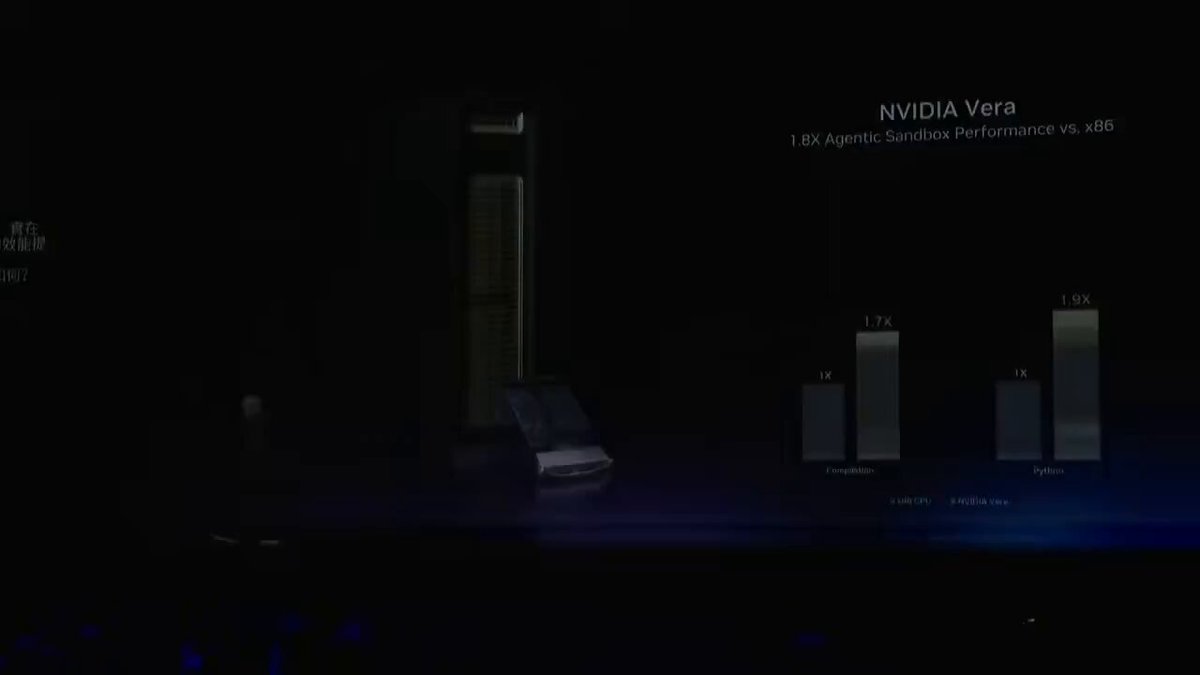
Jensen Huang just identified the next $200 billion market (Save this). The shift starts with a observation about agentic AI that changes everything about infrastructure. In the era of training and inference, the GPU was everything while CPU was a traffic cop, scheduling work, managing memory, dispatching tasks while the GPU did the heavy lifting. Agentic AI breaks that model entirely. An AI agent does not just run a single inference pass but rather it plans, calls tools, executes code in sandboxes, retrieves data from multiple sources and loops through complex multi-step reasoning sequences often thousands of times per second at scale. Every one of those operations runs through the CPU and the GPU sits idle waiting for the CPU to prepare the next task, supply the right context and execute the retrieval and tool calling logic fast enough to keep the accelerators fed. The CPU is now the conductor and the GPU is the orchestra and the bottleneck is the conductor falling behind. This is showing up in production AI factory utilization right now, which is exactly why Jensen built Vera from scratch rather than licensing x86. Vera achieves 40% lower peak memory latency than x86, 50% faster core to core communication, and 1.8 times the agentic sandbox performance of current x86 processors on a purpose-built architecture designed around the agentic loop. Now here is where the investment thesis gets interesting. The obvious beneficiary is Nvidia itself, and that thesis is real. Nvidia's CFO has guided for nearly $20 billion in Vera CPU revenue this fiscal year alone, a market Nvidia had zero presence in just three years ago. Intel held 60% of server CPU market share as recently as Q4 2025 and that transition is now happening at a pace Intel structurally cannot respond to. But the deeper question is, what architecture is Vera actually built on? Vera's Olympus cores are ARM compatible and every single Vera CPU deployed in every Vera Rubin rack in every data center in the world runs on ARM architecture. And ARM Holdings collects a royalty on every one of them. ARM does not make chips but rather licenses the instruction set architecture and CPU core designs that others build on top of. Every time Nvidia ships a Vera CPU, every time a hyperscaler deploys a Vera Rubin rack, every time an enterprise qualifies Vera for their AI factory, ARM earns a royalty. The secular tailwind here is almost perfectly constructed for ARM's business model. Amazon's Graviton, Microsoft's Cobalt, Google's Axion, Apple's silicon stack, and Qualcomm's data center push all run on ARM. And now Nvidia's Vera, which is projected to displace Intel as the largest server CPU supplier by revenue in a single fiscal year, is ARM. ARM's royalty rate on high end server chips is estimated at roughly 1 to 2% of chip selling price. At $5,000 per Vera CPU and 4 million units projected for FY2027, that is a royalty line growing from near zero to potentially $400 million to $800 million annually from Nvidia's data center CPU business alone before counting Amazon, Microsoft, Google, Apple, and Qualcomm. The total ARM addressable royalty base across all the silicon it already licenses is compounding at a rate that the current $130 billion market cap does not fully reflect. Jensen's CPU thesis is the most underappreciated catalyst in ARM's fundamental story, and the royalty compounding has barely started. Come join Milk Road Pro and get our full ARM royalty model and our entire AI trade thesis. Link below!

Milk Road AI

11,819 görüntüleme • 1 ay önce

THE 5 BIGGEST BOTTLENECKS POWERING THE AI ECONOMY The way I'm thinking about AI winners today is that the market is moving beyond the simple question of which mega-cap company spends most on AI and has been rewarding the companies that control the scarce inputs, contracted capacity, data movement, power infrastructure, edge compute and workflow layers that make the AI economy function. These are the five bottlenecks I'm watching most: • Memory | $MU, Samsung, SK Hynix Memory is the clearest scarce input because HBM feeds the accelerator, only a few companies can make it at volume and buyers are locking in supply through long-term agreements that create revenue visibility through the end of the decade. • Connectivity | $AVGO, $MRVL, $ALAB, $CRDO, $AAOI, $ANET Connectivity determines whether AI clusters can move data fast enough because training runs span tens of thousands of chips that need to act like one machine. Once copper runs out of reach that causes the cluster depends on optics, retimers, switches and custom silicon to keep the system moving. • Power | $CEG, $VST, $GEV, $FPS, $VRT, $NVTS, $TLN, $ON Power determines whether new AI data centers can actually come online because the binding constraint is shifting from getting chips to getting megawatts so the value flows to the companies that control generation, grid equipment, power delivery, thermal management and efficiency. • Compute | $NBIS, $CIFR, $IREN, $APLD, $WULF, $CORZ, $CRWV Compute capacity is overflow layer when hyperscalers are sold out. Capital alone doesn't guarantee GPU access which is why buyers are signing multi-year contracts for clusters before they are even fully built. • CPU | $NVDA, $AMD, $INTC, $ARM, $QCOM On-device CPU (edge compute) becomes next bottleneck as AI moves into inference, agents, PCs, phones, vehicles and physical devices.

Shay Boloor

108,342 görüntüleme • 27 gün önce

Rene Haas just confirmed the Vera CPU thesis on yesterday’s Arm Q4 call. He didn’t mean to His framing: GPUs are reticle-limited. CPUs are not. The ratio shift is happening in core count, not chip count His exact words: “256 Vera CPU chips, 88 cores per chip, a 200-kilowatt liquid-cooled rack designed to sit in a data center adjacent to a Vera Rubin system” That is not a host CPU. That is a dedicated agentic orchestration Two days ago NVIDIA’s own engineers published the receipt. They traced a real 33-minute Claude Code session: 283 inference requests 58 main-agent turns coordinating 225 sub-agent invocations Context grew from 15K to 156K tokens before compaction dropped it to 20K Main agent alone processed ~3.5 million input tokens in the first 40 turns Anthropic’s own number: agentic systems consume up to 15x more tokens than chat. Coding agents sustain 95 to 98 percent prompt cache hit rates. Without caching, costs would be 6x higher This is what’s happening between GPU calls. File reads. Tool invocations. Sub-agent spawns. Compaction. KV cache management. None of it runs on the GPU That’s why 12,000 GPUs need 400,000 CPU cores. The 33-to-1 ratio isn’t a forecast. It’s a measurement NVIDIA states it in the blog directly: this won’t be resolved by adding more compute FLOPs and memory capacity Translation: the GPU-only path is exhausted. The agentic chapter requires a platform, not a chip Their seven-chip answer: Vera Rubin NVL72 —capacity and prefill Vera CPU — tool execution, KV cache offload Groq 3 LPX — SRAM-first decode, low-jitter generation NVLink 6, ConnectX-9, BlueField-4, Spectrum-X — fabric Result they claim: 400+ tokens per second per user on trillion-parameter MoE at 400K context. Vera spec: 88 Olympus cores, 176 threads, 1.8 TB/s NVLink-C2C, 1.2 TB/s LPDDR5X, 227 billion transistors. A 256-CPU rack delivers 45,056 threads and 400 TB of memory One detail nobody is talking about. The blog’s second author was previously Head of Agents at Groq. The third was previously at Groq Inc and Intel. NVIDIA didn’t license the LPX architecture. They absorbed the team that built it Haas isn’t pitching a competing thesis. He’s confirming this one from the other side of the table. Arm data center royalties doubled year-on-year. He expects them to double again Things feel slow right now because we’re between platforms. The speedup ships in H2 2026. The architectural argument is over. Deployment is the only variable left I cover this in The Quiet Architect and The Fourth Piece $arm $NVDA

Ben Pouladian

62,958 görüntüleme • 2 ay önce