Video wird geladen...

Video konnte nicht geladen werden

Zur Startseite

Why is the creator of OpenCode pretty skeptical about AI productivity gains, and the hype around AI? A very conversation dax (and lots of truth bombs:) Timestamps: 00:00 Intro 07:03 Dax’s path into tech 09:04 Early startup experience 13:16 Getting involved with open source 16:13 OpenCode 23:17 Anthropic banning...

231,504 Aufrufe • vor 2 Monaten •via X (Twitter)

0 Kommentare

Keine Kommentare verfügbar

Kommentare vom Original-Post werden hier angezeigt

Ähnliche Videos

It's always energizing to do a podcast with Steve Yegge (Steve Yegge, engineer+author, formerly at Amazon+Google, creator of Gas Town). Timestamps: 00:00 Intro 01:43 Steve’s latest projects 02:27 Important blog posts 04:48 Shifts in what engineers need to know 10:46 Steve’s current AI stance 13:23 Steve’s book Vibe Coding 18:25 Layoffs and disruption in tech 31:13 Gas Town 40:10 New ways of working 51:08 The problem of too many people 54:45 Why AI results lag in business 59:57 Gamification and product stickiness 1:04:54 The ‘Bitter Lesson’ explained 1:07:14 The future of software development 1:23:06 Where languages stand 1:24:47 Adapting to change 1:27:32 Steve’s predictions Brought to you by: • Statsig – ⁠ The unified platform for flags, analytics, experiments, and more. • Sonar – The makers of SonarQube, the industry standard for automated code review. • WorkOS – Everything you need to make your app enterprise ready. Three interesting thoughts from Steve that we talked about in this conversation: 1. Reading ability is becoming a blocker for wider AI adoption. Some struggle with walls of text that current AI tools produce, and Steve predicts that in the very near future, most people will program by talking to a visual avatar, not reading terminal output because he observes that five paragraphs is already a lot to read for many devs. 2. What software engineers need to know keeps changing. In the 1990s, any decent software engineer knew Assembly, and today almost no decent developer knows it because Assembly has long been superseded by technical progress. What engineers “need” to know these days is different from the ‘90s and that process continues with AI, changing the parts of the craft that are essential for devs. We grumble about this but that won’t change anything by itself. 3. There’s a “Dracula Effect” where AI-augmented work drains engineers faster than traditional work. This is because AI automates the easy tasks, meaning that engineers are stuck doing high-intensity thinking all day. Steve says you may only get three daily productive hours at max speed, but during that time, you could produce 100x more output than before.

Gergely Orosz

41,987 Aufrufe • vor 5 Monaten

OpenClaw - the agentic software spreading like wildfire - was built on top of Pi, a minimalist, self-modifying agent. I sat down with Pi's creator, Mario Zechner and longtime Pi user (+ the creator of Flask) Armin Ronacher ⇌ to talk Pi, and their (very grounded!) takes on building with AI. Timestamps: 00:00 Intro 07:30 How Mario, Armin, and Peter Steinberger met 15:15 How 30 dev teams use AI agents: learnings 21:50 The importance of judgment 24:26 Challenges when non-engineers write code 28:30 Downsides of over-automation 32:18 Pi 48:09 OpenClaw + Pi 50:54 “Clankers” 57:32 Open source and AI 1:00:22 Complexity as the enemy 1:02:50 Building an AI-native startup 1:11:52 “Slow the F down” 1:16:40 MCPs vs. CLI 1:25:03 Predictions and staying up to date • YouTube: • Spotify: • Apple: Brought to you by: • Statsig – ⁠ The unified platform for flags, analytics, experiments, and more. • Sonar — The makers of SonarQube, the industry standard for code verification and automated code review. Try it out for yourself. • WorkOS – WorkOS gives you APIs to ship enterprise features – SSO, directory sync, RBAC, audit logs – in days, not months. Visit learn more. --- Three parts I found especially interesting in this discussion: 1. New trend: AI makes it harder for senior engineers to reject pointless complexity. Historically, senior engineers kept software complexity at bay simply by saying “no” a lot. But Armin observes that these days, more junior engineers and product managers deploy agent-scripted counterarguments when a senior colleague kicks an idea to the curb. This makes decision-making exhausting, and more bad ideas make it into production as a result. 2. It should be MUCH easier to build specialized tools for specific tasks. Different projects need different harness types because, as Mario points out, the same hammer is not ideal for every single construction job. As such, Pi is built with the goal of allowing the creation of specialized harnesses. It can modify itself so that a user can create the bespoke harness needed for any task. Mario believes it’s a preview of how self-modifiable software might look in the future. 3. Automation bias is one of the biggest risks of working with AI agents. Once devs confirm that an AI agent can produce acceptable code, they start to review its output less often, even though agents can – and do! – produce slop. Mario advises being far more sceptical with agents, and cautions that the quality of their output isn’t guaranteed, however well they performed previously.

Gergely Orosz

172,822 Aufrufe • vor 3 Monaten

In 2025, it was rational to be skeptical about whether AI would change the future of software development. In 2026, it's not, anymore. With Charity Majors: Timestamps: 00:00 Intro 02:56 How Parse led to Honeycomb 06:00 The limits of individual productivity metrics 09:08 How Charity’s perspective on AI has evolved 13:50 Rewriting code vs. editing code 19:20 Production as a stage of development 22:14 Code reviews 26:56 Non-deterministic systems 31:11 Sensible uses of AI 37:41 The two AI camps 44:40 Why AI works so well for building software 49:42 DevOps 55:13 Modern observability 1:00:40 Handling context overload 1:01:56 What’s new in Observability Engineering’s 2nd edition 1:07:45 What effective leadership looks like 1:10:25 Engineering management: what is changing? 1:16:31 Junior engineers 1:18:01 AI fatigue 1:21:39 Book recommendations Brought to you by: • Antithesis — turbocharge testing of your systems by running your whole system under aggressive fault injection. Teams like Jane Street, and the etcd community rely on Antithesis. • Buildkite — the CI platform trusted by OpenAI, Anthropic, Cursor, Meta, Uber, NVIDIA, Airbnb and many more. Engineered to absorb whatever your coding agents throw at the build queue. • WorkOS — make your app and agents Enterprise Ready, with SSO, SCIM, RBAC, and more. 1. The question engineers need to answer: what would it take for you to be fully comfortable shipping code you have not read? Charity believes it is a “when” and not an “if” that professional software engineers will ship code they never looked at – and thus do not understand – to production. Engineering is building the systems that validate this code, and allow shipping with full confidence. 2. AI could have the software industry go through the “pets” to “cattle” change that compute infra went through in the 2010s. Up to now, writing software from scratch was far more expensive than editing existing software. But now, generating hundreds of variants of a function can be done faster than how long it would take you to hand-write it once. Charity believes that we might be at the beginning of the transition from “pets” to “cattle” that happened at the hardware infrastructure layer. Before the 2010s, configuring and repairing individual servers was commonly done. But with tools like Terraform and Kubernetes, individual servers having issues are no longer fixed up: they are re-created instead. Charity thinks the same might happen with code, sooner rather than later. When there’s an issue with the code, generate new code that solves it, and is verifyably correct.​ 3. Non-deterministic systems require more engineering discipline versus before. With code written by AI, we’re reducing the trust in the code (because we no longer wrote it), so we need to increase trust at the other part of the development process. Specifically, at validation: with things like tests, evals, and conformance testing.

Gergely Orosz

30,495 Aufrufe • vor 9 Tagen

Knowing how LLM contexts work and how to work around context limitations – aka “context engineering” – is becoming so important. No better person to explain than dex Timestamps: 00:00 Intro 01:33 Dex’s path into tech 03:34 Early work in platform engineering 05:28 Replicated 11:24 Metalytics 12:36 12-factor agents 18:27 Context engineering 23:38 Harness engineering 26:11 Context overload 30:45 Loop engineering 44:34 Software factories before and after AI 50:33 Automation limits 55:18 Three options for automating 59:00 RPI framework 1:04:16 Intentional compaction 1:11:48 Token harder vs. token smarter 1:16:44 AI slop 1:19:15 HumanLayer 1:29:09 Book recommendation Brought to you by: • Antithesis — with Antithesis, you can use AI agents to work on critical systems without worrying about correctness. Teams like Jane Street, and the etcd community use Antithesis to ship better code, faster. • Buildkite — the CI orchestration platform built for reliable scale. Used by OpenAI, Anthropic, Cursor, Meta, Uber, Ramp, Nvidia, Airbnb and many more. • Sentry — application monitoring software built by developers, for developers. Check out their AI agent, Seer AI, and Sentry MCP. Three interesting learnings from this episode: 1. Lesson learned: Shipping unread code spells disaster within months. Dex experimented with having the model write the code and humans not reviewing anything in July 2025. Four months later, they shut things down and threw the whole system out. Production broke, and no matter how much the team prompted Opus 4.1, the model could not find the root cause. Once fixed, it took three weeks (!!) to re-onboard to a codebase no human had ever read 2. Context engineering 101: figure out where the “dumb zone” begins. As a rule of thumb, the less of the context window that is used, the better the outcomes are. This is because the attention mechanism is quadratic: the more that goes into the context window, the more compute is required to process it all. 3. “You’re completely right!” or “you’re right to push back on that” are phrases that mean it’s time to start a new session. These responses mean the LLM session is trajectory-poisoned, and you’re wasting time and tokens to continue. This is because models are autoregressive.

Gergely Orosz

63,174 Aufrufe • vor 1 Monat

I asked Dan Martell to walk me through every level of making money with AI. He gave me the most simple, practical advice I've ever heard on this subject. Level 1 - Making $0 - $100k Level 2 - Making $1m - $10m Level 3 - Building a $10m++ enterprise. 0:00 Only 5% of the World Has Ever Paid for AI 0:46 The Easiest Thing to Sell With AI Right Now 1:56 The Marcus and Sophie Framework 4:24 Theory of Constraints (Right Problem to Solve) 5:33 What Is the Number One Business Constraint 7:13 How to Leave Your Job and Go All In 8:27 Business Is Simple Find a Problem and Solve It 9:08 Stop Getting Ready to Get Ready 9:33 The Sarah Story One Text and $10K 9:53 Pull Up Your Phone and Message Your Contacts 11:05 Dan's Son Gets His First Client at $800/Month 12:41 Best Employee vs. Best Employer 13:59 What Other Services Can You Sell With AI 14:44 Sales Is Not Talking It's Asking 17:01 What to Do When You Hate Your Business 18:40 Pain and Pleasure Are the Only Two Motivators 19:13 They Haven't Made It a Must Yet 20:29 Make It a Must Not a Nice to Have 21:06 The Jen Story and the Gasping Moment 22:17 How to Find Your First 10 to 15 Clients 28:38 The Personal Brand Play 33:06 Vision Is What AI Cannot Do 34:55 Hard for Computers Easy for Humans 36:13 Level 2 Making Your First Million With AI 37:18 The Replacement Ladder Framework 37:39 Admin First Then Delivery Then Marketing 39:09 Why Marketing Is the Biggest AI Category 39:32 Why You Should Keep Sales for Yourself 40:00 Level 5 Leadership and AI Agents 41:41 What a Fully AI Systems Business Looks Like 43:13 The Gym Owner With Three Locations 46:16 Shutting Down the Company for Two Days 46:37 Teaching the Whole Team to Code in Claude 49:28 Wayne the 62 Year Old Who Made $12K a Month 52:38 I Only Share What Actually Works 53:21 Whisper Flow and Talking to Your AI 56:41 Claude Chat Claude Coworker and Claude Code 57:57 The Claude Browser Extension 58:49 Claude Code Is Not Just for Developers 1:00:06 How to Migrate Your AI Memory Across Tools 1:01:08 Level 3 $1M to $10M and the Brand Play 1:02:05 Nobody Buys AI They Buy Trust 1:03:25 Brand Is Association and Association Is Trust 1:05:12 A Million Followers Is $10M in Activated Revenue 1:07:03 How to Keep AI From Becoming Slop 1:07:42 Human in the Loop 1:08:16 The 10 80 10 Rule and Why AI Is Now the 80 1:10:01 The Team FIRED Themselves 1:11:45 Dan's Free AI Curriculum for Your Team

Grant

167,714 Aufrufe • vor 1 Monat

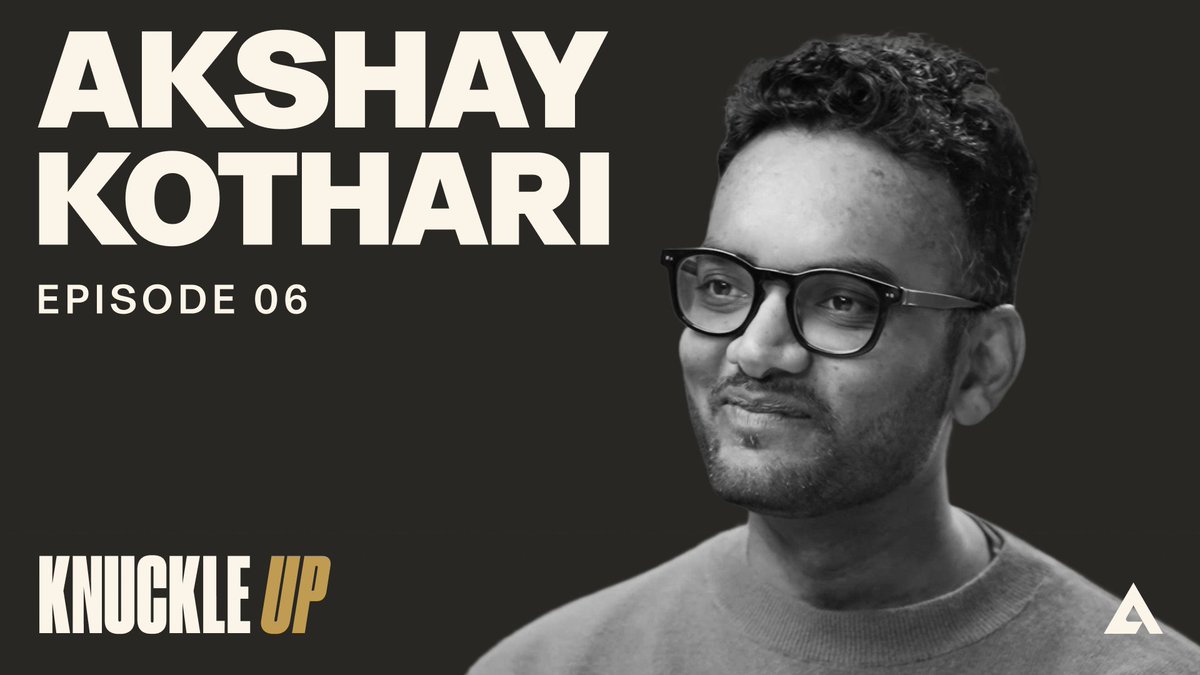
"We were go-karting and doing quite well. Now we've moved to Formula 1, and we're in the middle of the pack. We have a shot at the podium but we have to rewire for the race we're in." Akshay Kothari (Akshay Kothari). Cofounder and COO of Notion. Three years from now, most pre-AI companies will be gone. Notion will be one of the few standing stronger than before. This episode is a field study in how they're pulling it off. Knuckle Up ↓ 00:00 Intro 01:27 What were Notion's core founding principles? 06:20 Which early cultural principles scaled, and which broke? 08:22 How did Notion hire its first employees, and where did they come from? 11:48 How does hiring work now that the founders can't meet everyone? 14:35 Why does Akshay, as COO, prefer to have zero direct reports? 19:05 How do Ivan, Simon, and Akshay divide the work? 21:07 Does Notion's intentionality ever conflict with speed? 25:25 What should other founders steal from Notion's culture? 28:11 When did AI become a reason to rethink the whole product? 30:44 Why were the early AI years a "swamp of despair"? 36:05 How do you push AI across a huge product without losing the user? 39:25 Does Notion buy its AI DNA or build it? 40:44 Should Notion be afraid of OpenAI, Anthropic, and fast copycats? 46:58 What's hardest about the reinvention, and what does "meet the LLM" mean? 52:42 Is Notion AI-native in every function yet? 54:36 Are Notion's engineers still writing code, and how has engineering changed? 1:01:07 Once building is cheap, what's the new bottleneck? 1:02:39 How is AI reshaping sales, marketing, and support? 1:09:07 How many agents run inside Notion, and who builds them? 1:11:28 How has recruiting changed for the AI era? 1:13:48 What still worries Akshay about Notion's future? 1:15:22 Quickfire: admired founders, books, overrated AI advice, and Akshay’s superpower 1:19:42 What should a $50M pre-AI company do in the next 90 days?

Nakul Mandan

205,031 Aufrufe • vor 2 Monaten

There are few people who have impacted the software engineering industry like Kent Beck 🌻 has. He'd never before told his career story from start to today in one sitting - until now. What a treat. Timestamps: 00:00 Intro 03:47 Human engineers aren’t going away 08:00 Kent's path into tech 13:50 Undergraduate and graduate studies 17:21 Kent’s first programming job 18:54 The rise and fall of Smalltalk 27:04 Working with Ward Cunningham 37:36 Design patterns 44:05 Working at Apple 51:08 CRC Cards 59:29 Testing tools in the language 1:04:22 The C3 project with Martin Fowler 1:09:54 Extreme Programming 1:16:25 Developing TDD 1:25:07 Writing the Agile Manifesto 1:30:00 Agile’s impact 1:32:40 Agile’s downside 1:37:32 The Dotcom Bust 1:44:30 Lessons from working at Facebook 1:59:44 Kent’s ‘Good to Great’ program at Facebook 2:06:07 Soft skills engineers need to learn 2:09:30 AI and the challenges of acceleration 2:15:53 Explore, expand, extract 2:22:33 What Kent is excited about Brought to you by: • Antithesis – verify your system’s correctness without human review or traditional integration tests – and avoid bugs or outages • turbopuffer – a vector and full-text search engine built on object storage. It’s fast, cheap, and extremely scalable • WorkOS – everything you need to make your app enterprise ready Kent shared so many previously untold stories - like how he was fired from Apple (!!), how he and Ward Cunningham used a thesaurus to find the right words, how the Agile Manifesto came together. My favorite reflection from is this though: The human part is the most important one in software engineering. As Kent explained: “This is the biggest cosmic, practical joke ever. As young people, we were promised: “Okay, here’s this computer and once you’ve completely understand this computer, you’ll be fine. That’s all you need to do.” So I set out the first part of my career just to become the best programmer that I could be because that’s what it would take to be successful. And then you realize: sorry, there’s this whole human side. Your ability to affect change in the world is gated by your ability to communicate with, to soothe, to understand other human beings. And those are exactly the skills that I thought I didn’t need to learn! So I was promised: just understand the computer and you’ll be successful. And then someone went “just kidding, understand people!” And now I was in a position of being ten years behind.”

Gergely Orosz

26,602 Aufrufe • vor 1 Monat