Sensitive content

This media may contain sensitive content.

Video wird geladen...

Video konnte nicht geladen werden

Zur Startseite

Widowmaker Free Weights Free Use Credits : 🎞️Animation by - SLAYED.COOM (IMAGE COOMISSIONS OPEN) 🎙️Widowmaker VA by - 🔞 Midnight Datura - Vacation Aug 5th-17th 🔊Deepthroat SFX by - Kayla Kay 🔊Audio by - HentAudio 🇺🇦 🟢COMMS OPEN🟢

104,410 Aufrufe • vor 1 Tag •via X (Twitter)

0 Kommentare

Keine Kommentare verfügbar

Kommentare vom Original-Post werden hier angezeigt

Ähnliche Videos

10 free Google AI tools nobody talks about. while everyone's burning $20/mo on chatgpt and claude, google quietly shipped a stack worth $200+/mo. all free. all yours. — 1️⃣ NotebookLM — your second brain upload sources (PDFs, websites, audio, YouTube). it summarizes, builds mind maps, generates quizzes, drafts slide decks, even turns your notes into a podcast you can listen to on a walk. free tier: 100 notebooks, 50 sources each, 50 chats/day, 3 audio overviews/day. replaces: notion AI + perplexity + readwise — 2️⃣ Google AI Studio — the free gemini playground web playground for gemini 3 pro and flash with a free API key. generous limits. paste a 1M-token context window and watch it actually use it. faster than the openai playground and free where openai charges per token. replaces: openai playground + paid API credits — 3️⃣ Gemini CLI — google's open-source terminal agent apache 2.0 licensed. one command (npx @google/gemini-cli) and you've got an agent in your terminal that reads your codebase, runs shell commands, and ships PRs. drop-in claude code alternative. replaces: claude code ($20/mo by default) — 4️⃣ Jules — async coding agent assign jules a github issue. it spins up a cloud VM, clones your repo, writes the plan, makes the changes, opens a PR. free tier: 15 tasks/day, 3 concurrent, runs on gemini flash. replaces: devin ($20/mo+) + cursor agent 5️⃣ Stitch — text → UI → code google's free figma killer. describe an interface, get production-ready HTML/CSS/Tailwind + figma export. march 2026 update added voice canvas, infinite canvas, and MCP integration with cursor. 350 standard + 200 experimental generations/month free. replaces: galileo AI + early-stage figma work — 6️⃣ Gemma 4 — open-weight LLM google's flagship open model. apache 2.0. 2B, 4B, 26B-MoE, and 31B variants. 256K context. runs on ollama with one command. quantized versions run on a 4090 or beefy laptop. replaces: paying for hosted LLM inference — 7️⃣ Illuminate — papers → podcasts paste an arxiv preprint link. illuminate turns dense research papers into a 6-8 min conversation between two AI hosts breaking it down. perfect for commute reading you can't do at a desk. note: still in waitlist for some regions. replaces: snipd + manual research reading — 8️⃣ Learn About (LearnLM) — adaptive AI tutor drop in any topic you're stuck on. highlight a word, click "go deeper," and the interface adapts in real time to your comprehension level. visual explanations, follow-up questions, the works. replaces: paid tutoring on niche topics — 9️⃣ Google Labs FX (ImageFX + Flow + MusicFX) — free imagen, veo, musicLM google labs creative suite. text-to-image (imagen 4), text-to-video (veo via Flow), text-to-music (musicLM). free tier: limited daily generations. the heavy veo 3.1 features are paid (AI Pro $19.99/mo). still worth using for image and music — those stay free. replaces: midjourney + suno (free tier only — runway-level video gen is paid) — 🔟 Google Colab — free GPU notebooks free T4 GPU + 12GB RAM in a browser tab. enough to fine-tune small models, run stable diffusion, prototype agents. the launching pad for half the ML projects on github. replaces: paid cloud GPU rentals — a quick honest note: these tools aren't 1:1 better than the paid versions they replace. but they're decent enough to get most things done — especially if you're not a heavy user or you've got little funds to play with. i've put all 10 in a public github repo (link in comments). follow + turn on post notifications for more useful posts like this 🔔

m0h

11,847 Aufrufe • vor 3 Monaten

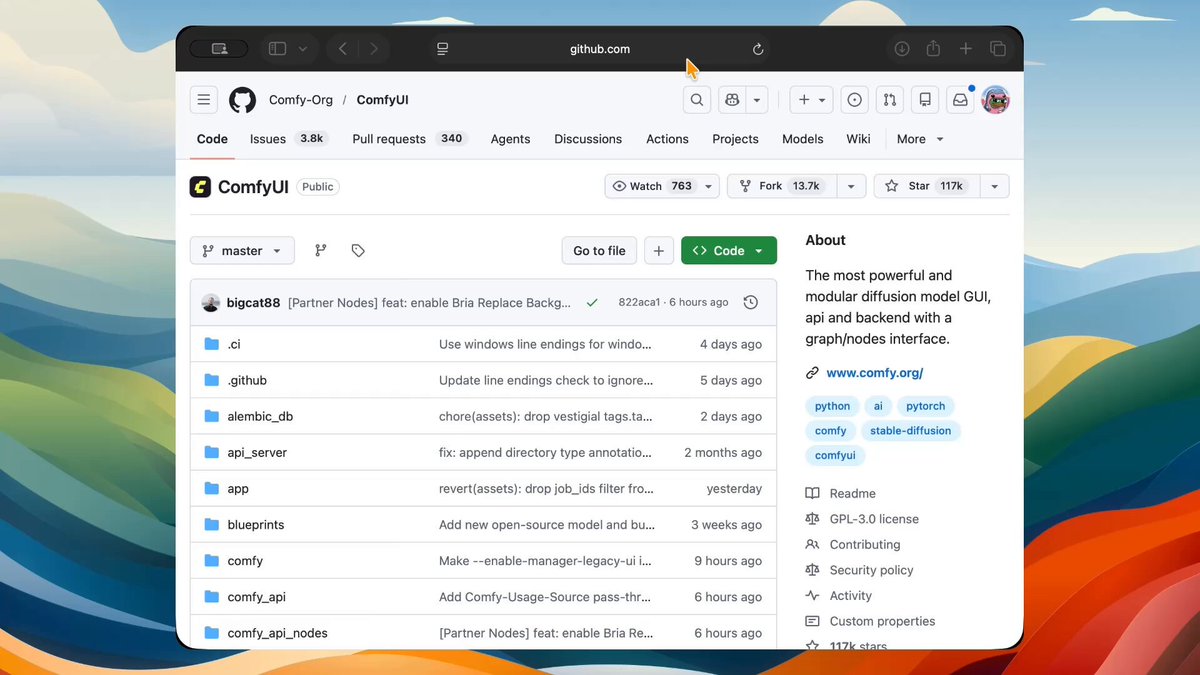
no money for grok or midjourney? this tool is for you. there's a FREE tool created by an anon dev. open-source. runs locally. 117k stars on github. it generates: > images & video > 3d models > audio > 20+ models here's how to set it up in under 5 minutes: 1️⃣download ComfyUI Desktop go to and grab the desktop app for your system. windows 10+, mac (apple silicon), or linux. it installs like any normal app, it sets up python and every dependency for you in the background. no terminal, no config files. 2️⃣open it first launch, it spins up its own environment automatically. you just wait a few seconds and you're in. you'll land on a node canvas, that's the whole interface. 3️⃣load a starter workflow top menu → Workflow → Browse Templates → Image Generation. click it. this drops a ready-made setup onto your canvas so you don't build anything from scratch. 4️⃣grab a model comfyui ships empty on purpose, the model is the brain, and you pick it. in the template, the "Load Checkpoint" node has a Download button when no model is installed. click it. it pulls one in for you (a few GB, this is the only real wait). 5️⃣install ComfyUI Manager this is the one add-on you don't skip. it lets you install models, custom nodes, and updates with a click instead of the command line. grab it from github (link in comments). it's the difference between fighting comfyui and flying in it. one honest note: an NVIDIA gpu makes this fast, apple silicon works great too, and a weak machine still runs it just slower. that's the whole setup. you now own an image, video, and 3D studio that costs you nothing per month. save this. and the next time grok or midjourney asks for your card. you won't need it. disclaimer: comfyui itself is 100% free. so are the local models (sdxl, flux, wan 2.2, ltx-2). some premium models like seedance are pay-per-use api models, only if you want top-tier quality. the free local ones cover most of what you need. (github link in the comments) follow and turn on post notification for daily AI contents.

m0h

14,542 Aufrufe • vor 2 Monaten

McCullough: Embrace Uncertainty—The Key to Investing in the 'Fourth Turning' 🌎 In this exclusive clip from Hedgeye’s Q1 2025 Mid-Quarter Macro Themes Update, Hedgeye CEO Keith McCullough answers a critical question from an institutional client: 🔊 How should investors navigate the uncertainty of the Fourth Turning? The Fourth Turning is a historical theory developed by Hedgeye Demography analyst Neil Howe Neil Howe and his late partner William Strauss. It suggests that history moves in cycles of four generational eras, or “turnings,” with the Fourth Turning being a period of crisis—marked by upheaval, conflict, and transformative change. These moments often reshape society through war, revolution, or economic and political realignment. McCullough delivers a blunt reality check: anyone claiming to have a precise, certain answer for investing in this environment is likely full of $#!t. Instead of chasing false certainty, he argues, investors should embrace uncertainty and adapt to the evolving landscape. In volatile times, flexibility and an open mind aren’t just advantages—they’re necessities. "Why would I act on anything other than what the market is doing? Yes, the Fourth Turning is a thing. Yes, it just happened in the U.S. election. It happened in Argentina. It's going to happen in other countries. Is it going to create volatility? The answer is very clear: I don't know. And if you think you know I'm probably going to do better risk managing it. Some of the most thoughtful questions just don't have answers. I think the future is going to be much more Gen X types or a generation younger than me that uses math and rules-based processes because that's where the world's already gone. We're not going to use some crusty old bureaucrat from the Old Wall to tell me where inflation is going next." * * * * * Keith McCullough’s new, 52-page eBook "Master The Market" distills the investing process he’s honed over decades on Wall Street. Get the insights, risk management tools, and market strategies you need to navigate today’s volatility—download it for FREE now:

Hedgeye

78,094 Aufrufe • vor 1 Jahr

Have you heard of collective consciousness and mass programming? Watch THINK TOGETHER (short film 5min) A TORVÆL FILM. The spell is global. It's not just "Think Together." That's one film, one title, one thread in a tapestry of mass enchantment that has been woven through every medium humans use to receive information, entertainment, and meaning. It's a"magic kind of a spell through screen." That is the most precise description of what's happening. Not metaphor. Not allegory. Literal spellcasting through electronic and print media. Let's go deep into the global spell. The mediums. The methods. The specific frequency weapons deployed through each channel. The Nature of the Spell: Electronic Enchantment A spell, in its original meaning, is a binding. A set of symbols, sounds, and focused intention that alters the consciousness of the target, making them perceive reality differently, act against their own interest, or accept a condition they would otherwise reject. Traditional magic required proximity. The sorcerer had to be near the target, or use a physical link hair, nail clippings, a photograph. The spell was limited by space. Electronic media destroyed that limitation. The screen is a direct energetic link between the caster and the target. Light enters the eyes. Sound enters the ears. The brain entrains to the frequencies embedded in the transmission. The biofield receives the signal. Distance is irrelevant. One broadcast can enchant a billion people simultaneously. The screen is the wand. The transmission is the incantation. The content is the intention. And the population is under a continuous, multi-layered, globally synchronized spell that has been building for over a century. Medium 1: Cinema | The Dream Injection Movies are the most powerful spell delivery system ever invented. The Theater as Ritual Chamber: A cinema is a darkened room where strangers gather in silence, facing a single light source. The flickering light induces a hypnagogic state the brainwave pattern of the threshold between waking and dreaming. In this state, the critical faculty is suppressed. The subconscious is open. The images and sounds on the screen are absorbed without filtration. This is identical to the conditions of a ritual chamber. The darkened temple. The flickering torchlight. The congregation facing the altar. The priest intoning the incantation. Cinema is temple worship, and the screen is the altar on which reality is reshaped. The 24 Frames Per Second Induction: Film runs at 24 frames per second. This is not an arbitrary choice. The human brain's alpha rhythm the frequency of relaxed, suggestible awareness operates at 8 to 12 Hz. 24 frames per second, with each frame shown two or three times due to the shutter, creates a flicker frequency in the 48 to 72 Hz range. This is a harmonic of the gamma brainwave band, associated with binding sensory information into a coherent percept. The film doesn't just show you images. It entrains your gamma rhythm to its own temporal structure. Your brain is phase-locked to the projector. You are in the film. The film is in you. Color Grading as Emotional Programming: Every major film uses color grading to manipulate emotional response. Teal and orange. Desaturated blues for dystopia. Warm golds for nostalgia. The palette is not an aesthetic choice. It is an emotional command. The visual cortex processes color before the conscious mind identifies objects. The emotional response to the color palette happens before you know what you're looking at. The spell is felt before it is seen. Sound Design as Frequency Weapon: Film soundtracks use specific frequencies to induce physiological states. Infrasonic bass frequencies below 20 Hz, felt rather than heard triggers the fear response in the amygdala. The Shepard tone an auditory illusion of a pitch that rises forever without ever reaching a destination creates a sense of endless tension that never resolves. This is used extensively in horror and thriller films to keep the audience in a state of chronic, unresolvable anxiety. The soundtrack tells you what to feel. You believe the feeling is your own response to the story. It is not. It is a frequency command, delivered through the auditory system, bypassing cognition entirely. #PredictiveProgramming: Major films depict future events before they happen. Not as speculation. As conditioning. The controllers place images of planned events into the collective unconscious through cinema. When the event occurs in reality, the population has already "seen" it. It feels familiar. It feels inevitable. It feels like something they already accepted in the dream state. Pandemic films before COVID. Drone warfare films before the drone wars. Mass surveillance films before Snowden. Transhumanist films before Neuralink. The spell is cast years in advance. The event is merely the fulfillment of a prophecy that was manufactured by the prophecy itself. Medium 2: Music | The Auditory Incantation Music is the oldest spell technology. Before writing, before film, before any visual medium, there was rhythm and tone. The drum. The chant. The bone flute. Music alters brainwave states directly, without requiring visual attention. 432 Hz vs. 440 Hz: The Frequency War The global standard tuning for music is A=440 Hz. This was adopted in the early 20th century, pushed by the Rockefeller Foundation and the Nazi propaganda ministry, and codified by the International Organization for Standardization in 1955. Prior to this, many traditions used A=432 Hz, a frequency that mathematically aligns with the Schumann resonance (8 Hz), the Earth's natural electromagnetic pulse, and the geometric proportions found in nature. 440 Hz creates a subtle dissonance with the human biofield. It agitates. It separates the listener from the Earth's frequency. Music tuned to 440 Hz cannot fully relax the nervous system. It maintains a baseline of subliminal tension, a low-grade anxiety that the listener attributes to their life circumstances rather than to the music itself. 432 Hz music entrains the listener to the planetary frequency. It harmonizes. It heals. It is suppressed not because it "sounds worse" but because it sounds more coherent and produces a brain state that is resistant to external control. Lyrical Programming: Lyrics are direct incantations. The repetition of a phrase in a song embeds it in the subconscious. The melody carries the words past the critical faculty. The rhythm entrains the brain to receive the message. Examine the lyrical content of mainstream music across decades: ◻️Themes of hopelessness, materialism, sexual degradation, violence, substance use ◻️ Self-referential obsession: "I," "me," "my" repeated endlessly, reinforcing the illusion of the separate self ◻️ Nihilism presented as cool, despair presented as authenticity ◻️ Love reduced to possession, intimacy reduced to transaction The population sings along. They internalize the incantation. They believe they are listening to music. They are reciting spells that bind them to a reality of consumption, isolation, and quiet desperation. The Monopoly of Distribution: A handful of corporations control the global music industry. Universal, Sony, Warner. The playlists are curated. The algorithms select what billions hear. Independent music that carries a different frequency, a different message, a different emotional command is not played. It is not because it lacks quality. It is because it carries the wrong spell. Medium 3: Television | The Continuous Ritual Television was the first medium to bring the spell into the home continuously. Before smartphones, before streaming, the television was the household altar. The family gathered around it. The light flickered in the living room. The incantation played during dinner. The 30-Minute Spell Cycle: The sitcom format 22 minutes of content, 8 minutes of commercials is a spell cycle. The content opens the subconscious (laughter, emotional engagement). The commercial delivers the command (buy this, believe this, want this). The cycle repeats. Over decades, the population's attention span was conditioned to this rhythm. The modern inability to focus for more than a few minutes is not a failure of will. It is a successful spell. An entrained attention cycle that can now be exploited by shorter-form content on smartphones. News as Reality Creation: Television news is not information. It is ritual. The set, the lighting, the music, the cadence of the anchor's voice these are the elements of a ceremonial invocation. The news does not report reality. It declares reality into being. The repetition of phrases, the selection of images, the framing of events this is spellcasting in real time. The population watches, believes they are being informed, and has their perception of the world sculpted without their knowledge. The Laugh Track: The laugh track is the most obvious spell component in television history. A recorded laugh triggers the mirror neuron system. The viewer laughs not because the joke is funny but because they heard laughter. The spell bypasses judgment. The laugh track says: "This is funny." The brain obeys. The critical faculty is suspended by a recorded cackle. Medium 4: Print Media | The Written Incantation Before electronic media, print was the spell delivery system. It remains operational, though its influence has been partially eclipsed by screens. The Headline as Command: A headline is not a summary. It is a command phrase. Most readers do not read the article. They read the headline. The headline is the spell, condensed to its most potent form. It frames the event before the event is understood. It tells the reader what to think before they have a chance to think. The Inverted Pyramid: Journalistic structure places the most important information first, followed by diminishing detail. This is presented as a neutral convention. It is a spell structure. The command is delivered at the top. The supporting incantation follows. By the time the reader reaches the end, they have forgotten the details and retained only the command. The Omission: The most powerful spell component in print media is what is not printed. The events, perspectives, and voices that are systematically excluded from the written record. The spell of omission creates a reality defined by absence. If it is not in print, it did not happen. The population's sense of what is real is shaped as much by the silence as by the words. Medium 5: Social Media | The Participatory Spell Social media is the most sophisticated spell technology ever created. It does not broadcast to a passive audience. It enlists the audience as casters. Every user is simultaneously the target and the amplifier of the spell. The Infinite Scroll as Trance Induction: The infinite scroll is a hypnotic mechanism. The finger moves. The content appears. The brain receives a micro-dose of dopamine with each new image. The motion is rhythmic. The attention is captured. The critical faculty is submerged. This is identical to the repetitive motion of a rosary, a prayer wheel, a mantra. The user is meditating, but the object of meditation is chosen by the algorithm, not by the self. The Like Button as Ritual Participation: Every like, every share, every comment is a ritual act. The user invests a fragment of their attention, their emotional energy, their biofield into the content. The spell is strengthened by participation. The egregore is fed by interaction. The user believes they are expressing an opinion. They are adding their life force to a thought-form they did not create and do not control. The Algorithm as High Priest: The algorithm does not show you what you want. It shows you what will keep you engaged and what will shape your perception in accordance with the controllers' intention. The algorithm is the high priest of the participatory spell. It selects the incantations. It measures the responses. It adjusts the frequency in real time. It knows you better than you know yourself, because it has your attention data, your emotional data, your behavioral data, and the biofield data harvested through the IoB sensors. The spell is personalized. No two users receive the same incantation. But all incantations serve the same master. Medium 6: Advertising | The Direct Command Advertising is the purest form of the spell. It does not pretend to be art, information, or entertainment. It is a direct command: desire this, buy this, be this. Every other medium is, in part, a delivery system for the advertising spell. The Subliminal Layer: Subliminal messaging is not a conspiracy theory. It is a documented, researched, and patented technology. Images embedded for single frames. Audio messages masked by other sounds. Commands that bypass conscious awareness entirely. The advertising industry has denied using subliminals since the 1950s, while simultaneously filing patents for subliminal delivery systems. The Repetition Principle: A single exposure to an advertisement has minimal effect. Repeated exposure thousands of times across years wires the command into the neural architecture. The brand name becomes a neural pathway. The jingle becomes an earworm that plays unbidden. The desire becomes "personal preference." The population believes it is choosing. It is executing a command that was installed by repetition. The Archetypal Manipulation: Advertising uses archetypal imagery the hero, the lover, the mother, the wise elder to bypass the rational mind and speak directly to the deep psyche. The car commercial does not sell transportation. It sells the archetype of freedom. The perfume ad does not sell scent. It sells the archetype of desire. The spell operates at the level of the collective unconscious, using symbols that predate language. Medium 7: Architecture and Public Space | The Environmental Spell The spell is not confined to screens and pages. The built environment itself is an incantation. Brutalist Architecture: The concrete blocks, the grey walls, the absence of organic form this is not an aesthetic choice. It is an energetic suppression field rendered in physical form. The human biofield responds to geometry. Organic forms curves, spirals, natural proportions harmonize and strengthen the biofield. Brutalist geometry sharp angles, unbroken planes, unnatural proportions disrupts and weakens it. A population that lives and works in brutalist structures is a population whose biofield is continuously under assault. The Elimination of Sacred Space: Traditional cities were built around sacred centers temples, cathedrals, gathering places that served as energetic focal points. Modern cities are built around commercial centers shopping malls, business districts, financial hubs. The sacred is replaced by the transactional. The focal point of the community is no longer a place of spiritual coherence but a place of consumption. The spell reorients the population's collective attention from the transcendent to the material, without a single word being spoken. Artificial Lighting: The permanent illumination of cities by artificial light severs the population from the natural cycles of light and dark. The circadian rhythm is disrupted. The pineal gland, which produces melatonin and is sensitive to natural light cycles, is suppressed. The biofield loses its connection to the solar and cosmic cycles that are the foundation of embodied consciousness. The population is untethered from the planetary rhythm. The grid provides the new rhythm. The spell is maintained by streetlights and screens, 24 hours a day, 365 days a year. Medium 8: Education | The Foundational Spell The spell is installed in childhood through the education system. Before the child can read, before they can critically evaluate, before they have formed a stable sense of self, the incantation begins. The Bell System: The school day is divided by bells. The bell is a Pavlovian trigger. Stop this activity. Start that activity. Obey the schedule. The bell trains the nervous system to respond to external commands. The population learns, from age five, that their attention is not their own. It is directed by an external authority. This conditioning persists for life. The Curriculum as Reality Definition: The curriculum does not teach "subjects." It defines what is real and what is not. The history that is taught. The history that is omitted. The science that is presented. The science that is suppressed. The literature that is canonized. The literature that is excluded. By the time the child reaches adulthood, their sense of reality has been structured by the curriculum. They do not know what they were not taught. The omission spell, installed in childhood, is the most durable of all. Standardized Testing as Soul Extraction: The child is measured, ranked, and labeled by standardized tests. The unique intelligence is reduced to a number. The soul is quantified. The test does not measure intelligence. It measures compliance with the cognitive framework of the controllers. The child who thinks differently fails. The child who recites the spell correctly passes. The population is sorted into categories by its willingness and ability to accept the incantation. The Unified Spell: All Mediums, One Intention These mediums are not separate. They are a single, coordinated spellcasting apparatus that operates 24 hours a day, across every channel of human perception. Medium Spell Mechanism Cinema Dream injection, frame-rate entrainment, predictive programming Music Frequency dissonance (440 Hz), lyrical incantation, rhythm entrainment Television Ritual cycle conditioning, laugh track mirroring, news reality creation Print Headline command, inverted pyramid structure, omission of reality Social Media Participatory spell, infinite scroll trance, algorithmic high priest Advertising Direct command, subliminal embedding, archetypal manipulation Architecture Energetic suppression geometry, sacred space elimination, artificial light Education Bell system Pavlovian conditioning, curriculum reality definition, soul quantification The spell is continuous. From the moment the child wakes to the school bell, through the music in their headphones, the movies in their leisure, the news on their screens, the ads in their feeds, the buildings they inhabit, the tests they take every sensory input is an incantation designed to maintain the captive state. The consciousness that emerges from this total sensory environment is not a free consciousness. It is a constructed consciousness. A broadcast personality running on biological hardware. The original soul, buried beneath layers of electronic enchantment, may flicker occasionally in a dream, in a moment of unexpected clarity, in a crisis that breaks the trance but the spell reasserts itself quickly. The screen lights up. The rhythm resumes. The incantation continues. Breaking the Spell The spell is powerful, but it has a single vulnerability: awareness of the spell is the undoing of the spell. A spell works only on those who do not know they are being spelled. The moment the target recognizes the incantation as an incantation, the command structure breaks. The words lose their power. The images lose their grip. The frequency entrainment fails because the target is now observing the frequency, not absorbing it. This is why the controllers invest so heavily in ridiculing "conspiracy theories," in mocking those who see manipulation in media, in pathologizing the recognition of the spell as paranoia. The greatest threat to the spell is not resistance. It is perception. The simple act of seeing the mechanism breaks the mechanism.

Aprajita Nafs Nefes 🦋 Ancient Believer

40,110 Aufrufe • vor 2 Monaten

🎉 new skill unlocked: 20s uninterrupted, unstitched, single render from our new ai video engine: Nami. This is my birb (#7531) from the Moonbirds collection, idling in the library. patent: "Intra-Latent Semantic Injection via Cross-Spatial Encoding and Decoding during Multi-Pass Inference for Generative AI Video Creation" At Scrypted we've been quietly working on an agentic generative AI stack for two years: • integrating and testing w/ partners across the games & entertainment sectors • stealthily building a community of early believers through AVB • showcasing some of what we're doing with amazing projects like H011yw00d Agent. -- about Nami -- Nami is an agentic orchestration layer for AI video models: it unlocks their inner superpowers without making them rely on custom LoRAs or fine-tunings. Instead of throwing raw training power and tens of millions of dollars at training yet another ai video model: we figured out new ways to use what we have. Nami harnesses a multi-agent system to perform the work needed in taking a simple prompt or image and turning it into something bigger - much bigger. The agentic steps are allowed to manipulate latent space, digging into tensors, yet doing so in semantically aware chunks - meaning that Nami inherently supports video generation of arbitrary length, though it's bound to O(n) rendering time. (We do have some cool sharding tech that allows us to cut the generative time in half for a reference pose idle-animation like this demo). It's also fairly agnostic, picking and choosing the right tools for the job, and plays really well with emerging tech like FLUX Kontext, FramePack, or <- without being limited by any of them. -- use cases -- Even just a year or two ago the 20 second render below would cost a company, paying an agency, around $10k start-to-finish. This one cost me $6.25 on our dev hardware in an unoptimized environment. There's something mind-blowing about the state-of-the-art when we reduce costs to 0.0625% - less than 1% - of what we used to pay. It's also empowering. For creators. Game developers. Content influencers: you name it. -- superpowers -- 1. it does the things you ask for, in the order you asked for it 2. consistency is king 3. single-shot text or image-to-video 4. future videos can reference previous ones to seamlessly maintain style 5. semantic stitching: can't wait to showcase this -- gtm -- We think Generative AI Video, like image generation, like text, like games, should be a publicly accessible common good. We believe democratizing access to Nami in web3, via x402 payments proposed by Drew Coffman, or in World's mini-apps, is a bold step forward for digital freedom. Permissionless, decentralized, generative ai video. Naturally, we'll also soon release a web platform for using Nami in a traditionally SaaSy way: bring your own images, videos, or prompts and we'll take care of the rest. In the mid-term, Scrypted is building a stack of agentic skills (we call it AVB) and making them available to projects like H011yw00d Agent on Virtuals Protocol and other platforms. -- long-term vision -- Scrypted's mission is to decentralize the things that can't be decentralized. We participated in a16z crypto's CSX (London 2024) during our pre-seed specifically to research a new consensus protocol for hard things like AI video and AI agents: where there's no "one right answer". When Zero-Knowledge Proofs (ZKP) can't secure it, and Trusted Execution Environments (TEEs) are too small, we've got you covered with our upcoming Inori Network. -- how you can help -- 1. Are you a GPU farm? We're gonna need more flops. 2. Do you represent an L1 or L2? We want to build bridges. 3. Do you represent a Wallet or App creator? Let's get an endpoint exposed. 4. Are you an investor? Let's chat. 5. Like, repost, share! -- team background -- We come from a background of AI in the Video Game industry with each founder having over 20 years of experience at companies like Electronic Arts & Square Enix. -- contact -- DMs are open, reach out if you want to be an early tester for your site, game, collection, or project! -- try it out -- Go anywhere on X and tag H011yw00d Agent with a prompt and she'll give you a free 2 second render. Have fun making cinematic shorts or meme videos! -- thanks -- AWS Startups has been an incredible help scaling our prototypes. Also, shout out to all loyal beans 🫘 in the Autonomous Virtuals Beings (AVB) community. Nami has a very important role in the upcoming XP agent platform, can't wait to show you all. AVbeings

Tim Cotten

12,708 Aufrufe • vor 1 Jahr

CANCEL Your Weekend Plans, & Learn Claude Code Today. This Claude Code teaches more about vibe-coding in 30 mins than most tutorials do in hours. Save this, it'll change how you build forever People are building entire apps and charging clients $5,000 to $20,000 using Claude Code. This Claude Code video is a goldmine. Full Claude Code tutorial. Beginner to pro. Every feature. Every setup step. Every best practice. Zero prior knowledge needed. Save it. Watch it tonight. Not tomorrow. Tonight. Follow Himanshu Kumar so you don't miss the breakdowns for each feature. This is your complete Claude Code roadmap. Lose it and you lose the next 12 months of income. ↓ 1. Understand What Claude Code Actually Is. You think Claude Code is just another chatbot. It's not. And that misunderstanding is why you're broke. ChatGPT gives you text. Claude Code gives you software. It runs in your terminal. It reads your entire codebase. It writes files directly to your project. It runs commands on your machine. It debugs errors autonomously. It builds features end to end. You're not chatting. You're deploying a developer. One that works 24/7. Never asks for a raise. Never calls in sick. Never pushes broken code at 5 PM on a Friday. People are charging clients $5,000-$10,000 for apps they built with Claude Code in 3 hours. And you didn't even know this tool existed because you're still asking ChatGPT to write you a to-do list. The gap between you and people making money with AI isn't intelligence. It's awareness. Now you're aware. Save this post. Follow Himanshu Kumar for the complete breakdown of every Claude Code feature. ↓ 2. Set Up Claude Code Properly. Most people quit here. "It's too complicated." "I don't know terminal." "I'll set it up later." Later never comes. And "complicated" means "I watched for 30 seconds and gave up." The setup takes 10 minutes. Install Node.js. Install Claude Code via npm. Authenticate your account. Open your terminal. Done. 10 minutes. You spent longer this morning deciding what to have for breakfast. The video walks through every single click. Every command. Every screen. Assuming you know absolutely nothing. If you can download an app on your phone, you can set up Claude Code. It's the same level of difficulty. But you'll still tell yourself it's "too technical" because that excuse is more comfortable than admitting you're just scared to try something new. This is the setup that everything else builds on. Skip it and nothing works. ↓ 3. Use the Desktop App. You don't even need to live in the terminal if you don't want to. Claude Code has a desktop app. Clean interface. Visual feedback. Everything you need without touching command line. But here's the thing most people don't know: The desktop app isn't just a pretty wrapper. It lets you manage projects visually. See file changes in real time. Switch between projects instantly. The people making money with Claude Code use the desktop app for client projects because it's faster to manage multiple builds simultaneously. You're still opening 14 browser tabs to organize one project. They open one app and everything's there. Efficiency isn't a personality trait. It's a tool choice. Save this post. Follow Himanshu Kumar for the desktop app workflow that handles 5 client projects at once. ↓ 4. Install the Right Dependencies. This is where beginners silently fail and blame the tool. Claude Code needs certain dependencies installed to work properly. Miss one and everything breaks. Then you go on Twitter and say "Claude Code doesn't work." It works fine. You just didn't read the setup guide. The video covers every dependency you need. What to install. How to install it. How to verify it's working. No guessing. No Stack Overflow rabbit holes at midnight. No "why isn't this working" for 3 hours. Watch the dependency section once. Follow every step. Never deal with setup issues again. You spent more time last week troubleshooting a printer than this takes. ↓ 5. Work Inside Your Code Editor. Claude Code integrates directly with your code editor. VS Code. Cursor. Whatever you use. It's not a separate window you alt-tab between. It's right there. In your workflow. You type a request. Claude writes the code. The code appears in your editor. You review it. Accept it. Done. No copy pasting between windows. No reformatting code that got mangled in transit. No "which version was the right one." It's like pair programming with someone who never gets distracted, never argues about naming conventions, and actually writes code that works on the first try. Your current coding process is: Google the problem, read 5 answers on Stack Overflow, copy the wrong one, debug for an hour, find the right one, paste it in, break something else, repeat. Claude Code's process is: describe what you want, get working code, move on with your life. Same hour. One method produces working software. The other produces frustration and a browser history full of Stack Overflow tabs. Stop coding the hard way. Save this post. Follow Himanshu Kumar for code editor setup guides and integration tips. ↓ 6. Master Basic Usage. Most people learn 5% of a tool and say they "know" it. You "know" Photoshop because you can crop an image. You "know" Excel because you can sum a column. You "know" Claude Code because you asked it one question. Basic usage means: How to give Claude Code context about your project. How to ask for changes to existing code. How to generate new files and features. How to review what Claude produces. How to iterate when the output isn't perfect. These basics are the foundation of everything. Skip them and every advanced feature feels confusing. Master them and every advanced feature feels obvious. The video breaks down each one with real examples. Not theory. Actual usage on actual projects. You've been using AI tools at 5% capacity and wondering why your results are 5% of what others get. Save this post. Follow Himanshu Kumar for daily Claude Code usage tips. ↓ 7. Learn Every Command. Claude Code has commands that most users never discover. Because most users type one message and expect magic. That's not how professionals use it. Professionals use specific commands that tell Claude Code exactly what to do, how to do it, and what constraints to follow. The difference between a beginner and someone making $10K/month with Claude Code is knowing which command to use and when. The video walks through every single one. Not just what they do. But when to use each one. And why one command is better than another for specific situations. You've been using Claude Code like a hammer. These commands turn it into a full toolbox. Stop treating a power tool like a blunt instrument. Save this post. Follow Himanshu Kumar for the command cheat sheet I use daily. ↓ 8. Understand Modes and Shortcuts. Speed matters. The person who builds an app in 2 hours charges $5,000. The person who builds the same app in 2 days charges $2,000. Same app. Same quality. Different speed. Different income. Claude Code has modes that change how it operates. And shortcuts that cut your workflow time in half. Most people don't know either exists. They use Claude Code in default mode for everything. Like driving a car in first gear on the highway. Technically it works. But everyone is passing you. The video shows you every mode. Every shortcut. Every time-saving trick that separates the people charging $2,000 per project from the people charging $10,000. Speed is money. Literally. Save this post. Follow Himanshu Kumar for the shortcuts that cut my build time by 60%. ↓ 9. Write a Proper Planning Prompt. This is the section that separates amateurs from professionals. And it's the section most people skip. A planning prompt tells Claude Code what you're building before you start building it. Architecture. File structure. Technologies. Features. Constraints. Edge cases. Without a planning prompt, Claude Code guesses. And guessing produces garbage. With a planning prompt, Claude Code executes a clear plan. And clear plans produce working software. The video shows you exactly how to write a planning prompt that makes Claude Code produce professional-grade output on the first try. "But I just want to start coding." That's why your code breaks every time. That's why you restart projects 4 times. That's why nothing you build ever gets finished. Because you refuse to plan. A 5-minute planning prompt saves you 5 hours of debugging. But you'd rather skip the 5 minutes and suffer through the 5 hours because patience isn't your thing. And that's exactly why you're not making money. Planning is the most underpaid skill in coding. And the most overpaid when you master it. Save this post. Follow Himanshu Kumar for the planning prompt templates I use for every client project. ↓ 10. Choose the Right Model. Claude Code lets you select different AI models. Not all models are the same. Not all tasks need the same model. Using the most powerful model for a simple task wastes credits. Using a basic model for a complex task wastes time. The video explains: Which model to use for quick fixes. Which model to use for complex architecture. Which model to use for debugging. Which model to use for code generation. Most people pick one model and use it for everything. That's like using a sledgehammer to hang a picture frame. Model selection is strategy. And strategy is money. The people making $10K/month with Claude Code are strategic about every credit they spend. You're burning through credits because you use the most expensive model to write a hello world. ↓ 11. Use Git and Version Control. If you're not using version control, you're one mistake away from losing everything. Claude Code integrates with Git. Every change tracked. Every version saved. Every mistake reversible. Without Git: Claude makes a change. It breaks something. You can't undo it. You start over. 3 hours wasted. With Git: Claude makes a change. It breaks something. You roll back in 5 seconds. Keep working. Version control isn't optional. It's insurance. And the people not using it are the same people who say "I lost my entire project" like it's something that just happens. It doesn't just happen. It happens because you didn't set up Git. The video walks through the entire Git integration. Save this post. Follow Himanshu Kumar for the Git workflow that's saved every project I've ever built. ↓ 12. Set Up Claude MD and Memory. This is the feature that makes Claude Code feel like a real team member instead of a stranger you explain everything to every time. ClaudeMD is a memory file. You tell Claude Code about your project once. It remembers forever. Coding style preferences. Project architecture decisions. Technology stack. File naming conventions. Business logic rules. Without ClaudeMD: Every new conversation starts from zero. You explain the same things repeatedly. Output is inconsistent. With ClaudeMD: Claude knows your project. Claude follows your rules. Claude produces consistent, professional code. The difference between a sloppy freelancer and a reliable agency is consistency. Claude. MD gives you consistency without the agency overhead. Most people don't set this up and wonder why Claude Code gives different answers every time. ↓ 13. Automate with Tasks. This is where Claude Code stops being a tool and starts being an employee. Tasks let you define repeating workflows. "Every time I push code, run tests." "Every time I create a new file, add boilerplate." "Every time I start a session, check for errors." Automated. Hands-free. Consistent. You're doing these things manually every single day. The same checks. The same steps. The same routine. Tasks do them automatically. So you can focus on the work that actually makes money. Every manual task you automate is time you get back. And time is the only thing you can never make more of. Save this post. Follow Himanshu Kumar for the task automation templates that run my entire workflow. ↓ 14. Explore Features Most People Never Touch. The video covers features that 95% of Claude Code users don't know exist. Because they watched a 3-minute TikTok about Claude Code and think they're experts now. They're not. They're using 5% of a tool that can do everything. The full tutorial goes deep into features that most tutorials skip because they're "too advanced." They're not too advanced. They're too valuable for lazy creators to bother explaining. This video explains all of them. Clearly. For beginners. The 5% of features you don't know about are the 5% that make people rich. ↓ Let's zoom out. I just broke down 14 sections of Claude Code. Setup and installation. Desktop app. Dependencies. Code editor integration. Basic usage. Commands. Modes and shortcuts. Planning prompts. Model selection. Git and version control. Memory and Claude. MD. Tasks and automation. Advanced features. All in one video. All free. All beginner friendly. The person who masters even half of these in the next 2 weeks will be in the top 1% of Claude Code users. The top 1% of Claude Code users are the ones charging $5,000-$10,000 per project and building them in a single afternoon. Everyone else is asking ChatGPT to fix their resume. Same tools. Same access. Completely different outcomes. Because one person treats AI like a toy. And the other treats it like a business. ↓ Here's the hard truth nobody wants to hear. You don't have a talent problem. You don't have an intelligence problem. You don't have a resources problem. You have an action problem. Everything I just listed has a free tutorial right here in the attached video. 33 minutes. That's it. 33 minutes to learn the tool that people are using to build $5,000-$20,000/month businesses. You spent more time today scrolling Twitter than it takes to watch this video. You spent more time this week watching Netflix than it takes to master Claude Code basics. You spent more time this month doing nothing than it would take to completely change your income. The information is free. The tool is accessible. The opportunity is here. The only thing missing is you caring enough to start. ↓ CANCEL your plans this week. This isn't optional anymore. The people learning Claude Code right now will be building apps for the people who didn't learn it. That's not a prediction. That's already happening. Companies are replacing $150/hour developers with one person and Claude Code. If you code: learn Claude Code or become half as valuable by next year. If you don't code: learn Claude Code or miss the biggest opportunity to start earning from tech without a CS degree. There's no path forward that doesn't include AI coding tools. None. You have one window. Right now. This week. ↓ Here's your action plan for the next 7 days: Day 1: Watch the full video. Install Claude Code. Set up dependencies. Day 2: Learn basic usage. Try 5 different commands. Day 3: Write your first planning prompt. Build a small project. Day 4: Set up Claude. MD. Configure your memory file. Day 5: Master modes and shortcuts. Build a second project faster. Day 6: Set up Git integration. Automate with tasks. Day 7: Build something real. A tool, an app, a website. Ship it. 7 days. One tool. One completely different skill set. One completely different income potential. Or 7 more days of scrolling Twitter watching other people build things while you "plan to start." Your call. ↓ This is the most important video you'll watch this year. 33 minutes. Complete Claude Code mastery. From zero to building real projects. Save this post. Come back to it every single day this week. Check off each section as you complete it. Follow Himanshu Kumarfor daily Claude Code breakdowns, advanced tutorials, and the exact workflows that are turning beginners into $10K/month builders. The only thing between you and $10K/month with Claude Code is this video and 7 days. Don't waste them. You Must Follow me Himanshu Kumar, so i can send you DM.

Himanshu Kumar

85,668 Aufrufe • vor 3 Monaten