Video yükleniyor...

Video Yüklenemedi

Ana Sayfaya Dön

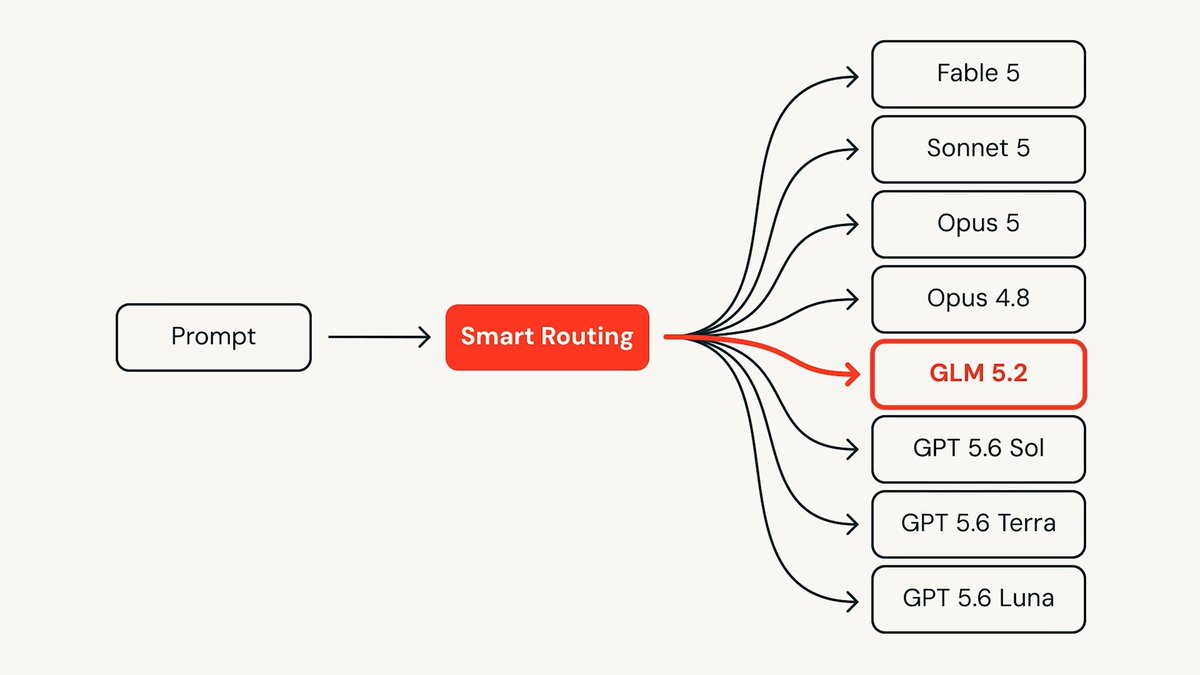
With Intelligent Model Routing, Replit picks the model for every task you send, so you can operate with quality, speed, and efficiency, at no extra cost. Here’s how it works, plus a breakdown on the difference between Free, Power and Max ↓

11,941 görüntüleme • 1 ay önce •via X (Twitter)

0 Yorum

Yorum bulunmuyor

Orijinal gönderinin yorumları burada görünecek

Benzer Videolar

Production traffic is not uniform. You get a few requests that need your best model, but most are simple questions and lookups you can solve with cheaper, faster models. The most expensive mistake you can make today is sending every request to your strongest model. You need routing. Period. This is the simplest trick to improve the architecture of whatever you are building. Please, don't implement routing yourself. You don't have to. I'm currently working with TrueFoundry's Auto Routing. It reads each request, classifies it as simple, medium, or complex, and sends it to the model assigned to that tier. You have two choices: 1. Send every request to the free heuristic classifier to score signals such as technical vocabulary, code, prompt length, and multi-step reasoning. 2. Send the request to an LLM classifier when its difficulty requires a more nuanced judgment. The beauty of using routing is that nothing changes in your code. You still call a single endpoint model, but routing works behind the scenes to pair every request with the best possible model. TrueFoundry ran several experiments with two different setups: 1. Send every request to Claude Opus 2. Send every request to a router with Haiku, Sonnet, and Opus The first experiment ran 550 deterministically graded academic prompts through every setup. Auto Routing was 69% cheaper while retaining 98% of the baseline quality. The second experiment ran three production-shaped workloads through every setup, using user chats, developer chats, and long agent tasks. Auto Routing was 80% cheaper. Thanks to the TrueFoundry team for partnering with me on this post.

Santiago

15,543 görüntüleme • 1 ay önce

36 GROK AGENTS. ASTRA ON FREE CREDITS. DUAL-MODEL ROUTING IS THE EDGE. not one chat window burning a paid invoice all day a swarm that routes cheap work to grok and only wakes gpt-6 astra when the task is actually hard ▹ the stack 36 agents on grok bot with flexible settings per role monitor, plan, write, code, QA, ship, each with its own lane part of the fleet is wired to gpt-6 astra through a china free-credit service layer free credits are not a toy promo here they are the fuel for frontier spikes without a monthly bleed ▹ dual-model routing easy jobs stay on grok: speed, volume, always-on loops hard jobs jump to astra: reasoning, long builds, sharp code the router decides by task type, not by ego if astra is not needed, astra does not spend free-credit bursts buy the expensive brain grok agents keep the factory running between bursts that is how the system feels unlimited not by breaking quotas, by refusing to waste them ▹ why it hits different most people pay frontier prices for every mid task operators split the brain and protect the credits 36 agents = parallel throughput dual routing = cost control with quality when it matters free credits = astra access without living on the invoice the constraint moved from "can i afford the model" to "did i route the job to the right model" ▹ the take single-model stacks die on bills and on boredom multi-agent + dual routing is the new default factory grok for the grind astra for the cut free credits for the spikes that used to empty the wallet bookmark this before everyone copies the route map comments: what % of your tasks actually deserve astra

cryptopsihoz

44,187 görüntüleme • 1 ay önce