Загрузка видео...
Не удалось загрузить видео
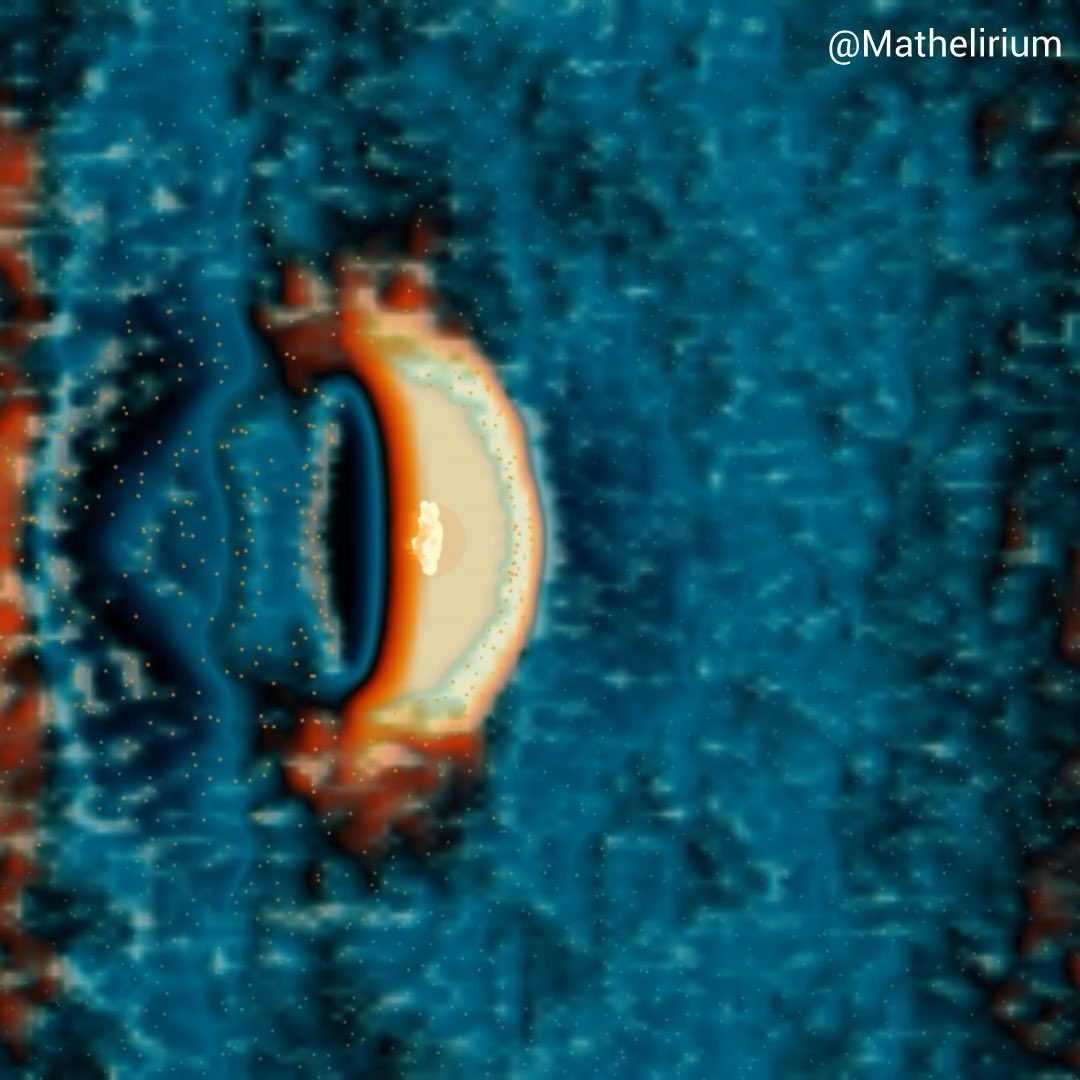
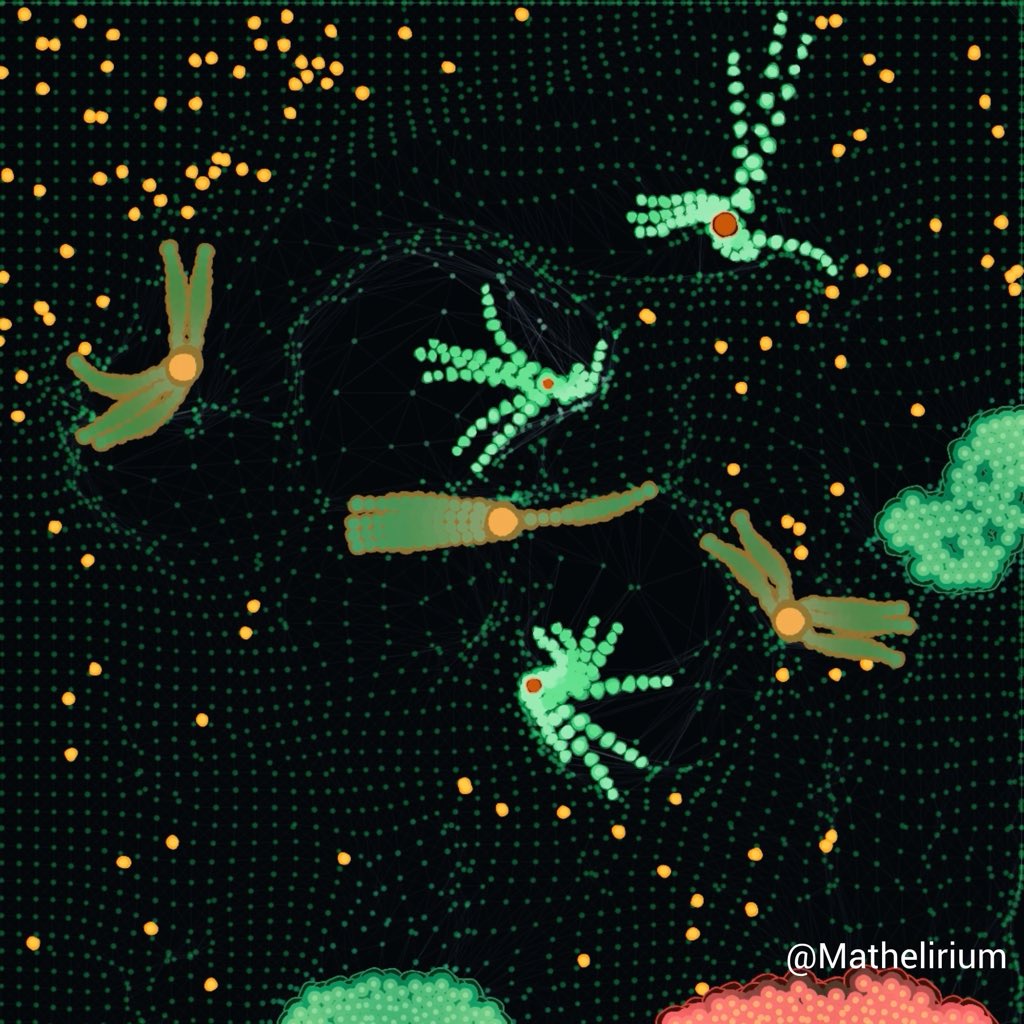
Wolfram Stephen Wolfram might be onto something here😁 WOLFRAM PHYSICS in motion: Two competing feeders and and a predator. Everything here is a hypergraph...including the environment. We visualize a synthetic micro-ecosystem built on computational irreducibility, hypergraph rule-flow & emergent geometry. Inspired by the Wolfram Physics Project's quest for a... show more

99,656 просмотров • 11 месяцев назад •via X (Twitter)
Комментарии: 42

@stephen_wolfram What’re the rewriting rules here, and how are the updates selected?

Its a lot to unpack but here is some of it: Hypergraph rewrites via MST + k-nearest + perimeter stitch + principal-axis spine + short bridges...our predator snaps overstretched edges. Medium uses discrete diffusion/viscous averaging with damping and Brownian forcing. Food evolves by Ornstein-Uhlenbeck drift plus advection...etc etc etc
@stephen_wolfram Ah, so it’s not actually being evolved as a Wolfram model, then - if I understand you correctly, there is some additional (not purely combinatorial) dynamics that is really driving this?
Yes, its not entirely. Combinatorial layer = purely Wolfram hypergraph rewriting. Dynamical layer = physics/math. So, thr Wolfram (combinatorial) layer gives us the true causal spine while the continuous dynamical layer turns that spine into physically interpretable, measurable motion diluting the core mechanism.
@stephen_wolfram *without diluting

@stephen_wolfram Has nothing to do with a theory of everything. How is this different from cellular automata?
Appreciate the question..this isnt "just a cellular automaton." We evolve a hypergraph (relations, not cells), track the causal graph of updates (discrete spacetime), and render multiway branching in branchial space. Geometry & "particles" are patterns of connectivity. We're visualizing mechanisms...not claiming a finished theory.
@stephen_wolfram

@stephen_wolfram open source or gtfo. preview access for patrons is tolerable, but you should not claim to be doing science unless everything is intended for the commons.

@stephen_wolfram I’m already double pre blessed golden dildo tier on Stephen’s onlyfans - please hand over the python good sir
@stephen_wolfram lol 😂

@stephen_wolfram Pitch: Scalar Geometry

@stephen_wolfram Nice!

@stephen_wolfram @Jaggerydev10

Leibniz’s monads are the fundamental, immaterial “atoms” of reality in his metaphysics (Monadology, 1714). They are not physical particles but simple substances with these key properties (as you listed): Indivisible and non-extended: No size, shape, or spatial extension. Space and extended matter are “well-founded phenomena” arising from the relations among monads. Perceptive: Every monad represents/perceives the entire universe from its unique point of view (mostly via unconscious “petites perceptions”). Windowless: No direct causal interaction or “windows” to the outside. Apparent causation and harmony are pre-established by God. Computational irreducibility: For many aspects (e.g., the center column), there is no shortcut formula—you must essentially simulate every step to know the future state. This is one of Wolfram’s central concepts. Direct Comparison Leibniz Monad Property Rule 30 Cellular Automaton Analogy / Contrast Similarity Strength Indivisible & non-extended Cells are discrete, indivisible binary units with no internal structure. The “space” (the grid) and patterns emerge from their arrangement and relations — space is not fundamental. Strong (discrete ontology) Self-sufficient & active The entire evolution is fully determined by the initial configuration + the fixed rule. No external input needed after t=0. Each local step unfolds deterministically. The “future” is contained in the current global state + rule. Very strong Perceptive (represents the whole universe) Each cell’s state at time t encodes information about initial conditions within its causal “light cone.” Over time, local regions effectively “sample” or compute larger portions of the initial universe. In Wolfram’s broader framework (observer theory, ruliad), local computations yield perspectives on the whole computational structure. Moderate (emergent representation) Windowless (no causal interaction) Cells do have local causal influence (neighbors affect the next state). However, everything is rigidly pre-coordinated by the single universal rule and initial conditions — analogous to pre-established harmony. Apparent local causation is an emergent description of globally synchronized deterministic unfolding. Moderate (surface difference, deeper parallel) Deeper Conceptual Parallels Simplicity → maximal variety/complexity: Leibniz sought the “best of all possible worlds” with the greatest variety of phenomena from the smallest number of principles. Wolfram explicitly admires this and sees Rule 30 as a concrete demonstration: one tiny rule + minimal initial condition generates enormous complexity and apparent randomness. He even considered (but rejected) naming early cellular automata something like “polymones” because of the monad connection. Determinism + apparent contingency/randomness: Both systems are strictly deterministic at the fundamental level, yet produce behavior that looks contingent, random, or irreducible from our perspective. In monads this appears through petites perceptions and the phenomenal world; in Rule 30 it appears as computational irreducibility and statistical randomness. Emergence of space and phenomena: Monads have no intrinsic space—space arises from their coordinated relations. In Rule 30 (and Wolfram’s later hypergraph models), discrete cells/rules generate emergent space, time, and complex structures. The Wolfram Physics Project takes this further with relational rewriting systems that feel even closer to Leibniz’s relational ontology. Pre-established harmony vs. universal rule: The biggest surface difference is interaction. Monads have none (windowless). SummaryRule 30 is not a literal model of monads, but it serves as a powerful computational illustration of several Leibnizian intuitions in a modern, discrete, rule-based framework: Fundamental simplicity generating rich phenomenal complexity. Self-contained deterministic unfolding. Emergence of space and apparent interaction from coordinated basic elements. Irreducibility that makes the world look contingent even though it is fully determined. Wolfram has noted the philosophical resonance with Leibniz (especially the “variety from few principles” idea) while admitting he finds the soul/perception aspects of monads harder to map directly onto computation.

@stephen_wolfram if you really want to make it useful in physics, write CFD simulation, not game of life

@stephen_wolfram Thats a very cool computational model! Instead of programming objects, you program the space between them - that's cool! But, it's more like Conway's Game of Life than a "real" physics engine - it's "graph-edge automata" for lack of a better description.

@stephen_wolfram awesome

@stephen_wolfram what is hypergraf?

@stephen_wolfram Blue needs to understand its long term trajectory and side with Yellow to repel Red

@stephen_wolfram The grand illusion, the flat Earth of the new era, the thing that once you understand it's implications - will change your perception of reality itself, Permanence is not real, only persistence - all of reality, us included, are a process. No static state exists, no begin no end

@stephen_wolfram @grok can you explain what this post and video have to do with physics or theory of everything? It looks to me like a more complex Game of Life.

@stephen_wolfram I don't understand a theory of everything that requires a computer to exist before "everything" can exist. You say your computational rules at bottom are simple. Sure, but animating them is not simple. What does that?

@stephen_wolfram @stephen_wolfram is a genius

@stephen_wolfram The math lives.

@stephen_wolfram "available to Gold members on YouTube upon request", just put it on github...

@stephen_wolfram FROM:😍math TO: humanities. 𝑷𝒍𝒆𝒂𝒔𝒆 𝒅𝒐𝒏'𝒕 𝒄𝒂𝒍𝒍 𝒊𝒕 𝒘𝒐𝒓𝒌! "Just imagine ... caseloads, payloads and careloads" Archived Science links relational #h2cm

@stephen_wolfram Yes!

@stephen_wolfram thats really really really fun

@stephen_wolfram Most advanced civilizations are not predatory. Long lasting those who colonize multiple Solar Systems are merchants or science type or combination of those two. Predatory extinct sooner...

@stephen_wolfram Are we imagining digital ID? Of this version of physics and reality is true, why are dominating groups overpowering others into subordinates. It seems more real than how culture engages.

@stephen_wolfram

@stephen_wolfram Wonderful! I'll see how to implement it with QAF.

@stephen_wolfram You really should look at process algebras. They give a better account of resources.

@stephen_wolfram 2+1 is qualitatively different from 3+1, a bounded playground is qualitatively different from an FAPP unbounded world, and ~4 orders of magnitude is qualitatively different from, say, 20-60 orders of magnitude. We can learn more from more principled approaches, IMO ¯\_(ツ)_/¯

@stephen_wolfram What knit everything together is not an empty game or a Ruliad,it is consciousness. It is not even wrong to claim that there is a game knitting it all together,it is a techno-cultist dogma,it is not science, it is technology set free from any limiting science.

@stephen_wolfram Can I just zelle you for the code?
@stephen_wolfram DM me

@stephen_wolfram The theory of Everything may one day be as simple as the Alphabet is. Once you start focusing on Knowledge. Once we have more free time to reflect. Time is worth more than money.

@stephen_wolfram Why not you ease out the boundary 🤔🎉

@stephen_wolfram

@stephen_wolfram So, uh, this is below Planck scale?


![[wip] growing organisms using hypergraph rewriting I'm exploring generating organisms using string forces and I was wondering about which class of algorithms could be used to generalize the growth of such structures. I wanted a system which can produce a wide variety of outputs, while allowing for stable and controlled growth. That's when I thought about Stephen Wolfram (yes again) Physics Project, which proposes to explore a solution to the fundamental theory of physics using a hypergraph rewriting system ( TLDR; Growth of graphs using simple permutation rules. It's similar to cellular automata but for graphs. Could be what I'm looking for. I started to experiment with this system to grow my organisms, and it's definitely a promising approach! Below is a video of the following rules applied to an initial {{0,0},{0,0}} graph: rand() {{x,y},{x,w},{y,w},{z,w}} : {{x,y},{x,z}}->{{x,w},{y,w},{z,w}} There's a lot of areas to improve this exploration, notably: - localization of rules (instead of applying a same rule to the whole system, let each node have its own rules) - spawn control rules (when a new node is created, a rule can define which rules will be applied to such node) - mutation rules (rules which alter rules of adjacent nodes) - conditional rules (many rules can be attached to a node, the one being executed subject to localized conditions) Super exciting, will certainly be the basis of my next project.](https://image.24vids.com/tw-1894200810890039635/ext_tw_video_thumb/1894198705475002368/pu/img/NAcQnTAVts-nQXi2.jpg)






![In Calculus of Variations, we give up the idea of only optimizing values and start optimizing geometries instead. The unknown is not a single x. It is a whole curve/surface y(x). The object you are minimizing is usually not a simple formula that you can guess. It is an integral that judges the whole shape. In our first lecture, we discuss the famous Brachistochrone problem. You choose two points, turn on gravity and ask a question which almost sounds too simple...which track will allow a bead to move from A to B in the minimum time? At your first attempt, your instinct will lead you astray. It is not the straight line. It is not the drop hard then cruise sketch either. The winner turns out to be a cycloid...the curve a point on a rolling circle traces. The track is the moving character in the animation. We begin with a flawed curve, perform gradient descent in curve-space, and observe the geometry change frame by frame as T[y] collapses to the brachistochrone. Please see the comment below for the math breakdown. #CalculusOfVariations #Brachistochrone #Cycloid #Physics #Optimization #Mathematics](https://image.24vids.com/tw-2060713817487675443/amplify_video_thumb/2060713736638189572/img/Lw0XmAHouOe98K4z.jpg)
![What String Theory Does That Classical Physics Doesn’t Classical Physics begins with a point particle. Its position is described by one function of time x = x(t) As time passes, that point traces a curve through Spacetime called a worldline. String theory changes the starting object. A string has length, so time alone is not enough. We also need a coordinate along the string Xᵘ = Xᵘ(τ, σ) Here τ is worldsheet time, and σ labels position along the string. As the string moves, it sweeps out a surface called a worldsheet. The action measures the area of that surface S = -T ∫ dτ dσ √[-det hₐᵦ] This is where string theory begins. #StringTheory #ClassicalMechanics #TheoreticalPhysics #Worldsheet #QuantumGravity #MathematicalPhysics #Spacetime #PhysicsVisualization #ScienceEducation](https://image.24vids.com/tw-2071782653909434562/amplify_video_thumb/2071782297662115840/img/9RLCJpQTdf_RlcY5.jpg)
