Video wird geladen...

Video konnte nicht geladen werden

Zur Startseite

World record-setting precision. Now supporting DARPA's first air-breathing spacecraft.​ Voyager has been awarded a contract with Redwire for DARPA's Otter program, providing its precision acceleration system to support the first air-breathing spacecraft. We're helping unlock a new class of maneuverable spacecraft in very low-Earth orbit.​ Learn more: ​ $VOYG...

27,035 Aufrufe • vor 3 Monaten •via X (Twitter)

0 Kommentare

Keine Kommentare verfügbar

Kommentare vom Original-Post werden hier angezeigt

Ähnliche Videos

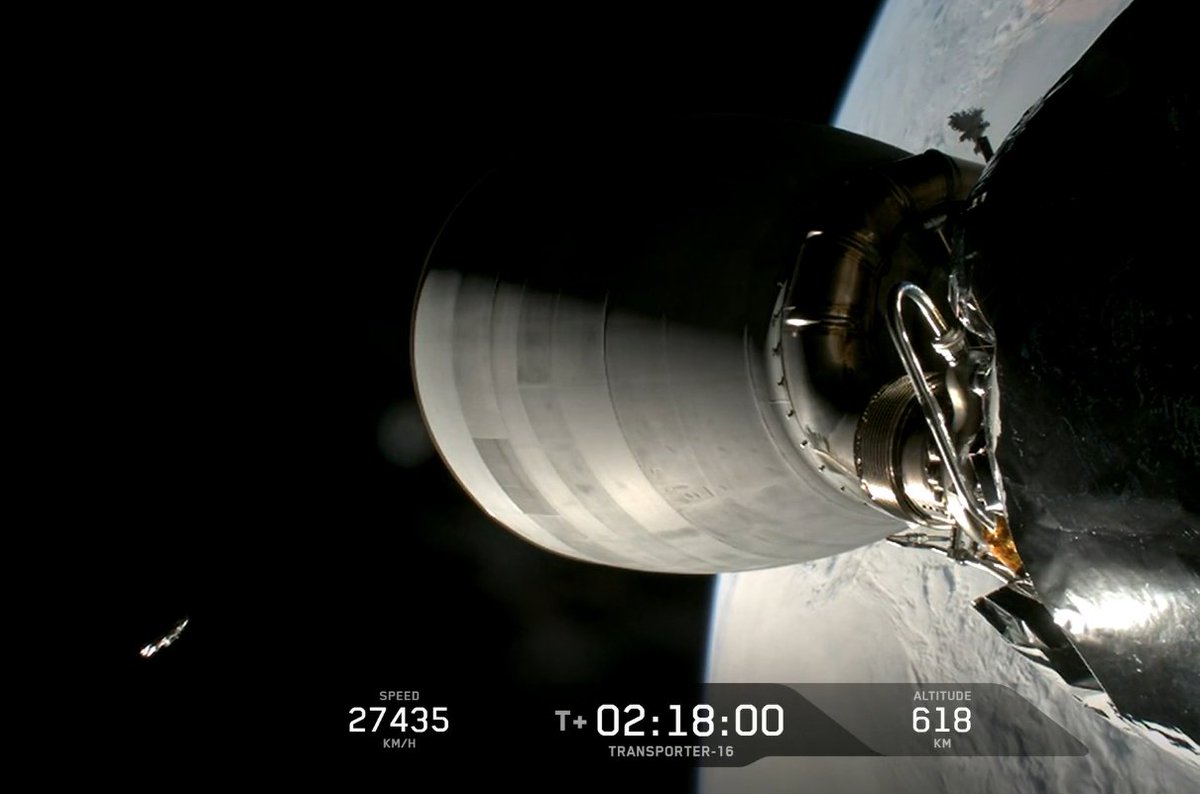
I'm excited to announce we have achieved our Tier 1 mission success criteria and have begun gathering a tremendous amount of data on how this brand new spacecraft performs. On March 30th, 13:17:08Z, the Gravitas spacecraft separated from the SpaceX Transporter-16 stack to begin its mission as one of the highest power free-flying satellites ever launched. Immediately after separation, the spacecraft autonomously: - Executed detumbling maneuvers - Established two-way communications with the ground (on our very first ground station pass) - Deployed its 20kW solar arrays - Slewed to a safe and stable attitude to await further ground commands These actions alone are a testament to the incredible work of our in-house engineering, software, and GNC teams to build a robust spacecraft. Since then, our operations team completed all initial system activations and checkouts, confirming the vehicle is in a power positive and thermally stable state with no major anomalies observed at this time. We completed this phase of the mission ahead of schedule. Next up we will be powering up and downlinking data for all payloads aboard the Gravitas spacecraft in support of our customers and partners while continuing to put the spacecraft through its paces. As we noted ahead of launch: The goal of this mission is to experiment and push our systems to the limit to inform future missions. I look forward to sharing more on our successes and challenges as the mission proceeds. Video of our satellite below; link to full T-16 webcast:

Neel Kunjur

89,923 Aufrufe • vor 4 Monaten

Like it or not, Space is now a dangerous neighborhood. It's time to bring back the neighorhood watch. Today we're announcing Perceptor-- our new Space Domain Awareness spacecraft, and our first product line outside of comms. The message we've heard from Space Force these last few years has been loud and clear-- GEO is the most important orbit for military space. But that presents a problem, since there are few companies that can reliably and quickly deploy spacecraft to GEO. And it's not just for the military. The infrastructure operating in GEO provides communications, navigation and other critical services that billions of people rely on. It is well known that China and Russia are now launching spacecraft capable of approaching, inspecting and potentially interfering with other satellites. Based on the flight proven MicroGEO platform Astranis is already flying on orbit today, Perceptor brings monitoring and maneuverability to GEO and other high orbits. When an unfamiliar object begins maneuvering near a critical asset, operators need more than a dot on a screen. They need eyes in the sky they can rely on. Satellites in GEO operate across an enormous area nearly 36,000 kilometers up, that encompasses the entire Earth. Ground-based systems can’t provide the persistent, close-range awareness needed to understand exactly what another spacecraft is doing or why it may be maneuvering near a critical asset. As humanity expands outward from LEO and builds out the infrastructure layer higher up, it needs safety and security in place to protect it. That's why Astranis has answered the call. Ad astra per aspera.

John Gedmark

13,963 Aufrufe • vor 10 Tagen