正在加载视频...

视频加载失败

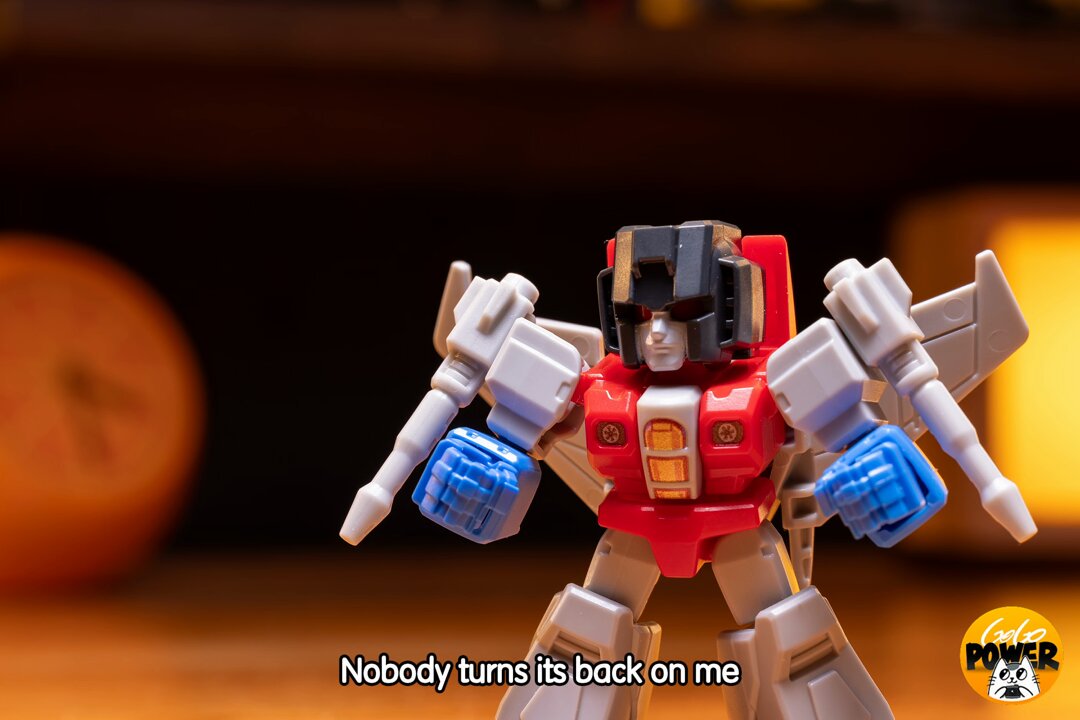
W-Resources M-01 Metroplex 1.2m!Coolest transformers ever! Get yours here: #transformers #WR #M01 #Metro #Transformer

32,050 次观看 • 1 年前 •via X (Twitter)

8 条评论

MrEmmett 的头像
MrEmmett1 年前

holy damn. where can i get that? he looks like a behemoth of a titan class

ShowZ.Store 的头像
ShowZ.Store1 年前

You can get this through the link:

Legendary Hamster 的头像
Legendary Hamster1 年前

@ThatToyGuy101 and/or @SixoTF Lads, you're up! I need you to buy this expensive and massive toy and provide me with a run down of it in video format within one day of receiving it. After you've done that I'll give you £100 (inc P&P) to take it off your hands 😂😂😂

SteamRollerboi 的头像
SteamRollerboi1 年前

how big is he next to a legacy figure?

Tʜᴇ Nɪɴᴛᴇɴᴅᴏʀᴋ 🎮🕹️ 的头像
Tʜᴇ Nɪɴᴛᴇɴᴅᴏʀᴋ 🎮🕹️1 年前

@ColonelFalcon Holy cow!

Cesare 👑 Borgia 🇨🇦🍁 的头像
Cesare 👑 Borgia 🇨🇦🍁1 年前

This cunt was huge!!

Tsotha 🏴‍☠️ 的头像
Tsotha 🏴‍☠️1 年前

😲

GR Dix Author 的头像
GR Dix Author1 年前

@Triple_Takeover ding dong 👌🏼

相关视频

TFHypeGuy ⚡ I'm Mark Watts. 🖌️ The original artist behind G1 Transformers box art. 🔥 Before Hollywood ever touched this universe — it was just me and an airbrush. 📅 1981. I was 27. A blank canvas and zero reference for what this would become. 🤖 Nearly 50 characters. Hand-painted. Start to finish. ⚙️ Bumblebee. Jetfire. Shockwave. Cliffjumper. Brawn. Gears. ✋ No shortcuts. No digital tricks. Just brush on canvas. 🙌 NOW 2 Great Specials ! Buy 3 Transformer Prints 11" X 17" Get a 4th One Free. Enter Buy3Get1FREE at checkout for your special offer. 2nd Special: Buy 3 Transformer Prints 22" X 34" Get a 4th One Free. Enter Buy3Get1FREE 22"X34" at checkout for your special offer. Remember ripping open that box as a kid? Staring at the art before you even touched the toy? ⭐ That was me. I'm 71 now. Still painting. Still here. ⏳ But every era ends eventually — so this is your chance to own a piece of it. 🖼️ Hand-signed prints, straight from my studio to your wall. 💎 Museum-quality. The kind of piece this legacy actually deserves. 🚫 No middleman. Just me and the canvas. 🔒 Limited run — once they're gone, they're gone. Cheers! 🙌 🔗 Shop now: 👇 Drop "TRANSFORMER" below to see more original G1 art! #G1Transformers #Transformers #MarkWatts #BumblebeeArt #JetfireArt #ShockwaveArt #80sToys #TransformersCollector #OriginalArt #SignedPrint #PopCultureArt #80sNostalgia #TransformersFan #Hasbro #VintageToys

Mark Watts Studios

48,443 次观看 • 28 天前

Two of the people most responsible for scaling the transformer are now betting on a next act. Jerry Tworek ran the Reasoning 🍓 team at OpenAI. rohan anil was a pre-training lead on Gemini after years at Google Brain and Anthropic. They just started to find what comes next. Their core argument: (1) models are trained in the lab but deployed in the real world and can't keep learning once they leave; (2) AI research is done by humans today but models will be able to explore and uncover new advances more rapidly and systematically (controversial but timely w this week's petition). The conversation covers: — why Jerry expected AGI in 2025 and what changed his mind — the two kinds of learning from experience, and why RL only captures one — the computational depth problem baked into today's architectures — why the biggest labs can't afford to look for a transformer replacement — the kernel competition where humans + $100K of coding agents found a 60x speedup no frontier model comes close to — a definition of AGI you can actually test: a model that improves itself with no human in the loop 00:00 Introduction 01:46 Appreciating Transformers 02:44 Scaling Hits Limits 04:54 Why Architecture Matters 05:32 RL Reality Check 07:32 Test Time Learning 09:52 Economics Of Scaling 12:47 Why Start A Company 14:24 Rohan On Transformers 19:11 Computational Depth Problem 20:32 When Transformers Top Out 23:22 Beyond Reinforcement Learning 26:41 Optimization And Efficiency 34:24 Building An Automated Lab 39:45 Kernel Automation Roadmap

Sonya Huang 🐥

232,559 次观看 • 1 个月前

the Andrej Karpathy code: - be Team Human - choose things that scale - scale them to all of humanity things = { Tesla camera vision | humanoid robots | transformers | AI education Eureka Labs} Favorite pull quotes from Andrej Karpathy this morning: - Elon Musk was right on self driving: - "Waymo looks like it's winning right now but I think when we look in 10 years and who's actually at scale and where most of the revenue is coming from I still think [Tesla is] ahead" - "Tesla has a software problem, Waymo has a hardware problem"... "a waymo car has a lot of very expensive LIDAR and other sort of sensors built into the car so it can do what it does...[but] if you can just use cameras which is the Tesla approach then you effectively get rid of enormous cost complexity and you can do it in in many different types of cars". - on Optimus: - "cars are robots" - Tesla isn't a car company, it "is a robotics at scale company" - "early versions of Optimus thought it was a car" - same computer, same cameras, it was walking but thought it was driving - first applications will be in factories where it doesnt "crush grandma" - excited for Optimus to solve the Nat Friedman challenge of the quiet leaf blower robot - on transformers: - "Transformers are this beautiful like blob of tissue you can just get just arbitrary tasks and you just need the data you need to put it in the right form" - "the scaling laws are actually to a large extent a property of the Transformer. Before the Transformer, people were playing with LSTMs and stacking them, you don't actually get clean scaling laws... the Transformer was the first thing that actually just scales. - Architecture is no longer a bottleneck, its now just dataset and objectives - Internet data is "not what you want for your transformer, it's just a nearest neighbor that gets you really far"... "what you want is the inner thought monologue of your brain.. if we had a billion trajectories [of your brain as you're doing problem solving] then AGI is here". "the Internet is like 0.001% cognition and 99.99% of information and most of it is not useful for thinking" - Synthetic data is largely about "refactoring the dataset into these inner monologue formats". Cites the Tencent 1 billion persona paper - Transformers > Humans: much better at learning/memory "if you give it a sequence and you do a single forward-backward pass in that sequence then if you give it the first few elements it will complete the rest of the sequence... it memorized that sequence!" Human brain working memory is very small, transformers "are much more efficient learners". - Most LLMs memorize useless information - a "cognitive core" LLM OS could be as smol as 1b params - just needs to think, and then use tools to look stuff up - Bullish on an AI CEO supervising a swarm (or crew?) of smaller specialist agents - on Education - LLM101n will be "an undergrad level course" coming "early next year" - "I'm always more interested in anything that empowers people... I'm on Team Human" - cites Bloom's Two Sigma problem: "I find very interesting is like how far can a person go if they have the perfect tutor for all the subjects" - people with 1:1 tutoring get 2 stdev better results - "I taught 231n at Stanford and that was the first deep learning class and was pretty successful but the question is how do you really scale these classes — like, how do you make it so that your target audience is maybe 8 billion people on Earth" - for different languages and different capability levels - languages and transfer learning (from previously known domains) are low hanging fruit - "the demo is near but the product is far" - "so the question is how do you use AI to do the scaling of a really good teacher and so the way I'm thinking about it is the teacher is doing a lot of the course creation and the curriculum" - "at current AI capability the models are not good enough to create a good course but I think they're good to become the front end to the student and interpret the course to them" - Learning is supposed to be hard.. but he will "make it easier for people to learn" and in a post AGI society, learning can be entertainment if people want - Kids today should study Math, Physics, CS - "symbol manipulation heavy tasks, not memory heavy"

swyx

53,917 次观看 • 2 年前

What happens when the mind wakes up? So for the last eight months I have been on a single minded quest. To create a new kind of language model based on oscillatory coupling and intelligence as coherence ascent. Everything else — the physics work, the work on regular transformers — has all fallen out from this one question. Can coupled oscillators LEARN? And can they keep learning once their geometry is right, without backpropagation at all? Recently I have been running larger and larger training regimes of a new kind of hybrid model. I just put together this dashboard to help me organize it, interact with it, and observe the training runs. The core idea is simple. Traditional transformers are powerful at learning the geometry of language. But they also store knowledge, understanding, and facts inside their weights. This means they are large, and they can't update themselves after training. The weights are frozen. The Living Mind separates these two domains. The mind has a transformer which grows, adding heads and layers as it needs to in order to learn the manifold of language. The transformer sees tokens and turns the coupling into phase-locked modes — the geometry of how those tokens relate, like frequencies locking together. These coupling patterns get stored in a topology-invariant fingerprint. On top of this transformer lives a 3D diamond lattice of coupled oscillators. It reads from these fingerprints and thinks in resonance space, traversing from one geometry to another along the manifold of coupled oscillators and coherence. The pressure and trajectories from this network of oscillators steers the next token prediction of the transformer. Practically, this could unlock a number of things. It eliminates the KV cache bottleneck that caps context in traditional transformers. Effective context grows with the Flash archive, not with attention compute. The living mind remembers what it sees. It means the model can learn continually. Because knowledge and understanding don't live in the weights, the archive of the mind's experience grows without backpropagation. In our Python prototype we already saw perplexity drop 46% during gradient-free operation — pure coherence ascent, no weight updates. That is the signal I have been chasing: the point where the mind wakes up and keeps improving on its own. It also means the model itself remains very small, and the thing which accumulates are these packages of geometric fingerprints — the K-field. This opens a path to federated learning. K-field packages can be shared between organisms the way people share git commits. Right now at 15M parameters with ~1000 L1 nodes, the organism is just starting to speak. Ask it to continue "Once upon a time" and it comes back with things like: "there was one big bowl!" Lily asked her her mom said her mommy smiled and said yes." It's nonsense. But it's TinyStories-flavored nonsense. The geometry of the narrative register has arrived. Content hasn't caught up yet — that's what scaling L1 is testing. I am still researching, though I am now closer than ever to validating that the living mind actually works. Once it is validated, I will be open-sourcing the whole stack and paradigm. I have also avoided over-sharing my research because it sounds like sci-fi, or like part of our ARG. It is part of the ARG. That doesn't make it any less real. I wanted to share this out because I am incredibly excited about it, and because seeing this amazing dashboard produced by Opus really made me want to share what is being worked on behind the scenes. #project89

Parzival - ∞/89

16,265 次观看 • 4 个月前

I coded a Speech-to-Text model from scratch. 𝐇𝐞𝐫𝐞 𝐢𝐬 𝐭𝐡𝐞 𝐛𝐥𝐨𝐠 𝐟𝐨𝐫 𝐭𝐡𝐞 𝐬𝐚𝐦𝐞: No APIs. No pre-trained models. Just PyTorch, an A100 GPU, and hours of debugging. This started months ago. I wanted to understand how machines hear. Not surface-level understanding. I wanted to build the whole thing myself. So I built it piece by piece: autoencoders, VAEs, VQ-VAEs, Residual Vector Quantization, and CTC loss. Each one took days to get right. Trained for 3 hours on 13,100 audio clips. Got complete garbage. Changed the tokenizer from BPE to character-level. Rechecked everything. Asked AVB who built STT models before. His answer: these models are tricky to train and need days of compute, not hours. Cut the dataset to 200 clips. After 2 hours, actual words appeared. Overfitted? Absolutely. But watching noise turn into recognizable English was satisfying. I have made a blog about this as well so you can learn about the same and my process - Audio fundamentals and waveform representation - Why attention breaks on raw audio - Convolutional downsampling - Transformer encoder with positional encoding - Vector Quantization, straight-through estimator, and RVQ - CTC loss and greedy decoding - Full training loop with VQ loss warmup - What went wrong and what finally worked Resources: - Blog: - Code: More Resoures CTC loss AVB videos SoundStream Paper LJ speech dataset wav2vec paper RVQ blog Next up: I've already trained two TTS architectures from scratch. Video post about those coming soon. But first, I'm dropping a visual breakdown of Vision Transformers, covering how they work and how to fine-tune them. Follow me Mayank Pratap Singh you're into audio deep learning. Repost so others can find this

Mayank Pratap Singh

51,382 次观看 • 5 个月前

Sam Altman just told a room full of students where the real opening on the board is. The global market assumes the Transformer architecture is the final form of the compute engine. It’s a stepping stone. Altman: “I bet there is another new architecture to find that is gonna be like as big of a gain as transformers were over LSTMs. And I think you finally have models that are smart enough to help do that kind of research.” The frontier models aren’t replacing human researchers. They’re accelerating them. The operator who uses today’s AI to hunt for the successor to the Transformer doesn’t just win the current hardware cycle. They lock in the next one before anyone else knows it exists. And here’s what that means for products. Altman: “I would just pick a big area and say what is possible now with AI that wasn’t possible at all before. Like where can I totally redo something that’s like, AI is the absolute core to the interaction working.” The traditional enterprise is trying to bolt an AI chatbot onto their existing software suite to appease shareholders. Winning operators are burning the entire product category to the ground and starting over from zero. You don’t optimize the friction of an archaic system. You build an entirely new architecture where artificial intelligence is the foundational bedrock. The builders capturing the board over the next decade won’t build “AI-assisted” tools. They’ll look at massive, entrenched industries and realize the entire category can be rebuilt from scratch by a single, AI-native execution loop. But here’s where it gets exponential. Altman: “AGI will look like just a warmup for whatever the next important thing was. And that’ll keep going for the rest of history.” AGI is not the destination. It’s the warmup lap. Altman told a room full of students this is “at least the best time ever so far.” Not because the race is almost over. Because it’s barely even started. Every breakthrough from here compounds into the next one. The organizations treating this as a gradual transition are training for a finish line that doesn’t exist.

Dustin

72,669 次观看 • 5 个月前

Etched came out of stealth at $800M and by lunch X had NVIDIA in the ground We do this every few months. A chip launches, the deck says killer, the timeline holds a funeral, and NVIDIA closes green anyway Etched hardwires the transformer into silicon. That is where the speed comes from, nearly the whole die on one job instead of the ~30% a GPU uses. It is also the trap. The day that chip tapes out is the best it will ever be. You cannot patch it. You burned progress into a wafer and now pray the field stops moving NVIDIA made the opposite bet. Same board, faster every quarter in software. Dynamo is pulling more tokens per watt out of the same rack, on version 1.0 The depreciation risk the bears aimed at NVIDIA for two years does not live at NVIDIA. It lives here, on the chip built to bury it Etched is not a fraud. It is a niche tool priced like a general one, and $800M is not enough to run a frontier supply chain. The rest get bought on the next down cycle Bury the lead, not the leader. Full case with Jack Farley and Max Wiethe on MTS And special thanks for Baseten for the cool T Shirt! Chapters 00:00 Switching from bonds to semis 00:33 What Etched actually is 01:31 Faster and cheaper, but how much HBM 02:56 Maturing market, not an NVIDIA killer 05:01 $1B in contracts and a Taiwan factory 05:20 Why these startups all get absorbed 06:48 Tiered inference and the obsolescence trap 09:39 Etched vs TPUs and Trainium 12:17 Is the CUDA moat weakening 13:21 Co-design, squeezing every token per watt 14:37 NVIDIA is a software company that sells a chip 14:58 Who is NVIDIA's most dangerous competitor 16:23 The NVIDIA killers, ranked 18:19 A rich man's game 18:43 AMD's MI500 vs Rubin Ultra 20:19 The neocloud business decision 22:46 Lightning round, Rambus the toll on HBM 25:11 The CXL run-up on Astera, Marvell, Credo 26:22 Use AI less, go to the booth 28:10 EDA is not dead

Ben Pouladian

29,969 次观看 • 2 个月前

Sam Altman just told you the Transformer is not the finish line. It is the starting point for whatever kills it. Altman: “I bet there is another new architecture to find that is gonna be as big of a gain as transformers were over LSTMs.” Every model. Every company. Every valuation north of a billion dollars. All of it runs on one architecture. And the man running OpenAI just said out loud that something is coming to replace it. Not a refinement. Not a tweak. A leap as violent as the one that killed everything before the Transformer. Altman: “I think you finally have models that are smart enough to help do that kind of research.” The AI is now intelligent enough to help discover the thing that replaces it. We built a tool sharp enough to forge the next tool. That loop has never existed in the history of science. Not once. No more teams grinding in isolation for a decade. You point the model at the architecture of its own limitations and let it hunt. Discovery just stopped being a human bottleneck. It is an engineering feedback loop now. And it just switched on. Altman: “Where can I totally redo something that’s like, AI is the absolute core to the interaction working.” Not where can I bolt AI onto an existing product. Where does the entire thing get rebuilt from zero with AI as the foundation. Adding AI to a product is a feature update. Building a product that cannot exist without AI is a new species. The first makes the old thing faster. The second makes the old thing extinct. Every founder still asking how do I integrate AI into my workflow is asking a dead question. The right question is what becomes possible now that was literally impossible twelve months ago. If the product still works when you rip the AI out, you have not gone far enough. Altman: “AGI will look like just a warmup for whatever the next important thing was.” The entire world is bracing for AGI like it is the final chapter. The man building it is telling you it is the opening sentence. Not the peak. Not the climax. The preface. Whatever comes after AGI will make it look the way the internet makes the telegraph look. Necessary. Historical. And completely primitive by comparison. Altman: “This is at least the best time ever so far.” Four words do all the work. So far. The best moment in human history. And the least impressive moment compared to everything that follows. The models are smart enough to find the next breakthrough. The products have not been built yet. The architecture that replaces the Transformer has not been discovered yet. And the man closest to the frontier just told a room full of students that whoever moves now is building on the ground floor of something that does not have a ceiling. The people waiting for the right moment are standing inside it. It just does not look finished yet. It never will.

Dustin

12,218 次观看 • 5 个月前

Here's my conversation all about AI in 2026, including technical breakthroughs, scaling laws, closed & open LLMs, programming & dev tooling (Claude Code, Cursor, etc), China vs US competition, training pipeline details (pre-, mid-, post-training), rapid evolution of LLMs, work culture, diffusion, robotics, tool use, compute (GPUs, TPUs, clusters), continual learning, long context, AGI timelines (including how stuff might go wrong), advice for beginners, education, a LOT of discussion about the future, and other topics. It's a great honor and pleasure for me to be able to do this kind of episode with two of my favorite people in the AI community: 1. Sebastian Raschka (Sebastian Raschka) 2. Nathan Lambert (Nathan Lambert) They are both widely-respected machine learning researchers & engineers who also happen to be great communicators, educators, writers, and X posters. This was a whirlwind conversation: everything from the super-technical to the super-fun. It's here on X in full and is up everywhere else (see comment). Timestamps: 0:00 - Introduction 1:57 - China vs US: Who wins the AI race? 10:38 - ChatGPT vs Claude vs Gemini vs Grok: Who is winning? 21:38 - Best AI for coding 28:29 - Open Source vs Closed Source LLMs 40:08 - Transformers: Evolution of LLMs since 2019 48:05 - AI Scaling Laws: Are they dead or still holding? 1:04:12 - How AI is trained: Pre-training, Mid-training, and Post-training 1:37:18 - Post-training explained: Exciting new research directions in LLMs 1:58:11 - Advice for beginners on how to get into AI development & research 2:21:03 - Work culture in AI (72+ hour weeks) 2:24:49 - Silicon Valley bubble 2:28:46 - Text diffusion models and other new research directions 2:34:28 - Tool use 2:38:44 - Continual learning 2:44:06 - Long context 2:50:21 - Robotics 2:59:31 - Timeline to AGI 3:06:47 - Will AI replace programmers? 3:25:18 - Is the dream of AGI dying? 3:32:07 - How AI will make money? 3:36:29 - Big acquisitions in 2026 3:41:01 - Future of OpenAI, Anthropic, Google DeepMind, xAI, Meta 3:53:35 - Manhattan Project for AI 4:00:10 - Future of NVIDIA, GPUs, and AI compute clusters 4:08:15 - Future of human civilization

Lex Fridman

914,670 次观看 • 7 个月前