Video wird geladen...

Video konnte nicht geladen werden

Zur Startseite

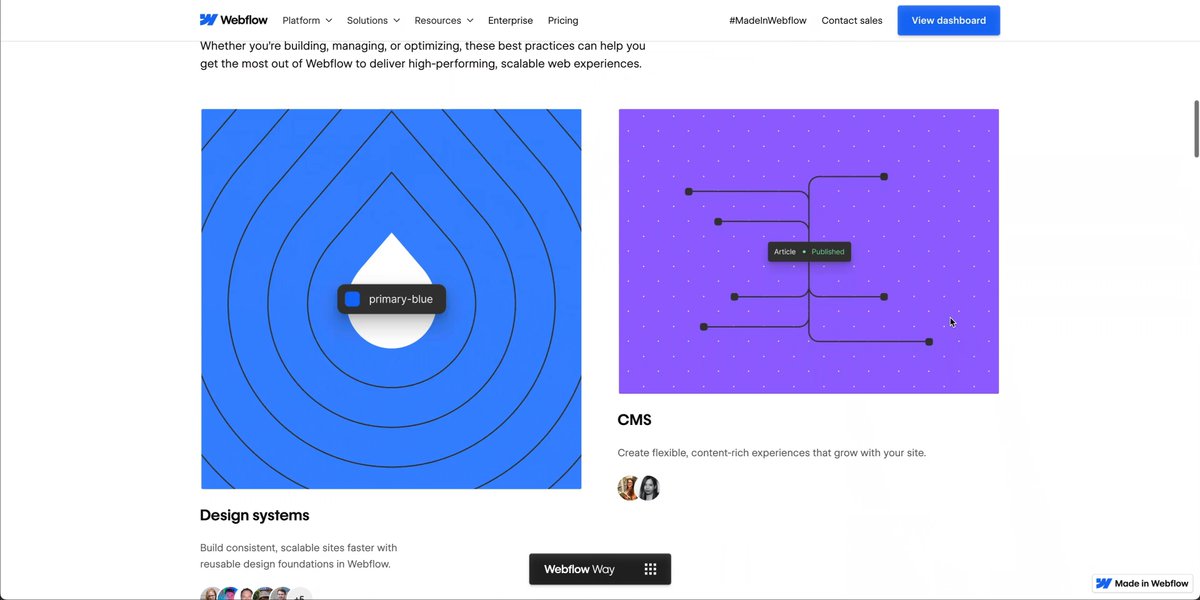
You can now dynamically control filter, sort, and limit settings on Collection lists — all through component properties (including a new Number prop type 🙌). Here’s what this means for your workflow: ✨ Easily reuse the same Collection list component in multiple contexts — with different content 🔧 Marketers...

13,273 Aufrufe • vor 1 Jahr •via X (Twitter)

10 Kommentare

Profilbild von DANN©
DANN©vor 1 Jahr

Another epic update!

Profilbild von Qodo
Qodovor 1 Jahr

Fewer bugs, more shipping. Qodo’s Agentic AI handles testing, reviews, and code generation—so you can focus on building.

Profilbild von Prax Cruz
Prax Cruzvor 1 Jahr

Also, when are you going to build a simple image gallery that does not require a lightbox and can be placed on any page. This seems like something people have been calling for, for a long time.

Profilbild von Tom Grabski
Tom Grabskivor 1 Jahr

How can I add search fields and filters to create a search bar like on real estate website? 👀 Is it possible already without using external tools like this from Finsweet?

Profilbild von Lien Swollef
Lien Swollefvor 1 Jahr

Excellent! This is exactly the kind of updates I've been waiting for. Looking forward to seeing what else is planned in the near future.

Profilbild von Mahesh Prajapati
Mahesh Prajapativor 1 Jahr

Webflow team crushing it again! 👏

Profilbild von Prax Cruz
Prax Cruzvor 1 Jahr

This has been a long time coming.

Profilbild von Mark Fa'amaoni
Mark Fa'amaonivor 1 Jahr

Hmmm. Time to experiment with the navbar!

Profilbild von Marcus
Marcusvor 1 Jahr

I'm glad to see what it means for our workflow

Profilbild von Shane | Building things
Shane | Building thingsvor 1 Jahr

This is OP

Ähnliche Videos

I just inscribed the FILTER module to Termina! You can now SEARCH and FILTER bitmap content and fields, powered by CRAWL and the WORLDTREE data! Go to: Try > filter content bitoshi blockamoto > filter type audio > filter address skynet > filter (type image) (timestamp 2023) > filter help Make sure you have the latest snapshot from WORLDTREE, or have run your own CRAWL and WORLDTREE (warning - these take a long time! I'll be looking into ways to make running these more accessible). Bring your own data: The help menu is your friend here! Please try as much as you can. You can filter single values, or multiple things at the same time with parenthesis. I've found so many inscriptions on Bitmap this way! Please have fun with it, and if you make a new inscription on Bitmap, be sure to run "crawl bitmap [range]" and "worldtree bitmap full [range]" on your district so you can search & filter, and make sure to add it to github via a pull request. This way we can share the latest snapshot data. If you want to build your own dataset, try using CRAWL and WORLDTREE. I warn you though, the CRAWL module especially will take days if you don't have 18 windows open each scanning a range (in which case it will take about 8 hours). The WORLDTREE module takes about 8 hours with just one window open, so probably can accellerate the speed with multiple windows. This is why it's easier to piggyback off the github snapshots, but in the future these scans will be baked into the fabric of the operating system, automatically updated by users exploration and constantly scanning in the background (if turned on). Maybe there's some synergy to be had in this regard with ZmAKin_1981.🟧 extension to make sure we always have latest data. Anyway, that's all for now folks! Please share your findings.

bitoshi blockamoto 🧱 BITMAP 🟧

16,472 Aufrufe • vor 9 Monaten

Obsidian 1.11 is now available for desktop and mobile! Mobile: - The interface has been refreshed to improve the editing and reading experience. - Lock Screen, Control Center, and Home Screen widgets let you quickly create a new note, open a specific note, open daily note, open search, or open Obsidian. - When scrolling down in a note, the navigation hides to maximize screen space for reading. - New sidebar navigation for switching sidebar tabs and actions, aligned to the bottom for better ergonomics. - Added double-tap to switch a note from reading mode to editing mode. iOS - Shortcuts to open a note, open daily note, capture to a note. Capture shortcuts allow you to append or prepend text to a note, without opening the Obsidian app. - Siri integration such as "Capture using Obsidian", "Capture to Obsidian", "Open my daily note in Obsidian", "Search in Obsidian". -Searching for Obsidian in Spotlight shows additional actions: New Note, Search, and Daily Note. Android - New widgets: Open Note, New Note, Search, Daily Note, Open Obsidian. You can add multiple widgets of the same type to open different files, or trigger different search queries. - Quick Settings Tile and new shortcuts: Open note, Daily note. Editor - Markdown links are now supported in text and list properties. Internal links are automatically updated when the destination file is moved or renamed. - When text is selected, pasting a URL into the editor will convert the selection into a Markdown link using the URL. Settings - New "Keychain" settings section for storing plugin secrets. A guide for plugin developers is published in our docs. - Added icons to settings sections. - Community Plugins › Automatically check for plugin updates. Obsidian will check for plugin updates in the background every 3 days, or after the app updates. - New setting Files & links › Default file to open. Choose between "Last opened files", "New note", "Specific note", or "Daily note". - The daily note format can be selected from a list of predefined formats. Obsidian URI - New, open, and daily URI actions now support a new paneType param.

Obsidian

191,518 Aufrufe • vor 6 Monaten

React tip: "use client" misconceptions (2/5) 🚫 "You cannot nest Server Components inside Client Components because "use client" turns everything into Client Components." ✅ We can pass the rendered result of Server Components to Client Components as props. Simple example: (Server Component) (Client Component) (Server Component) is designed for the client. It needs to instantly open and close when clicked. is designed for the server. It uses packages that don't work in the browser and needs to fetch data close to where it's stored without exposing credentials. So, how can we nest a component that uses server APIs inside a component that uses client APIs... without using `import`? React props to the rescue! --- (0:00) 1-4: Reminder: Importing code forms a module dependency graph. Adding dependencies to a server or client bundle. (0:23) 5-6: Reminder: Using components eventually forms a rendered component tree. (0:37) 9: Oh no! We get an error when trying to `import` a client API (useState) into a server module. (0:44) 10: We know the trick by now: Add "use client" to mark `2.js` as a client entry point. This moves the module to the client bundle and allows us to use client APIs like `useState.` (0:51) 11: But we get a new error! "use client" moved all imported dependencies into the client bundle, including our ORM package, which doesn't work in the browser. (0:59) 13: Let's refactor without changing our rendered component hierarchy. First, we move the `Cart` import to the parent file that imports `Modal`. This moves `Cart` outside the "use client" boundary and consequently the client bundle. (1:11) 15: Then, we pass down the rendered result of `Cart` as a prop to `Modal`. This allows `Cart` to be entirely rendered on the server as a Server Component before being passed down. `Modal` has no knowledge of what the `cart` prop is. Its only responsibility is placing whatever it receives into the `{cart}` slot. (1:15) 16: Finally, it's common to use the special `children` prop for a component's primary content. The key insight is that we were able to use props to retain our desired component hierarchy even though we changed our module dependency graph.

Delba

43,989 Aufrufe • vor 2 Jahren