正在加载视频...

视频加载失败

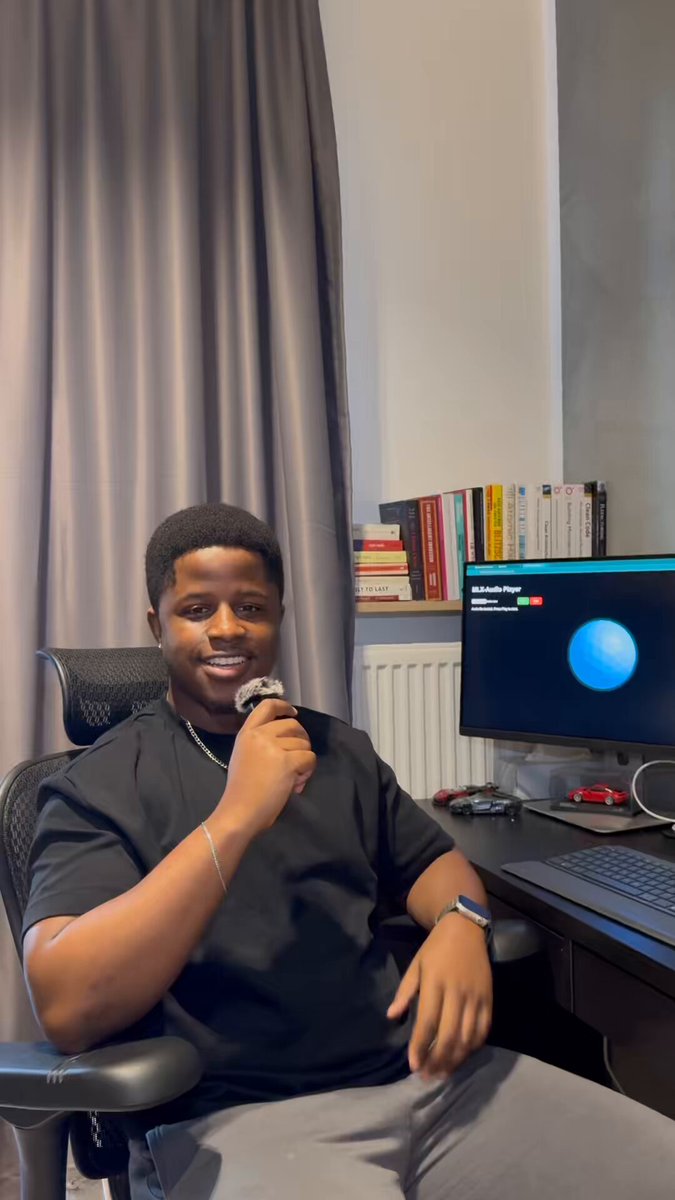
You don't need a GPU to run text-to-speech anymore. Kyutai released Pocket TTS, a 100 million parameter speech model that runs entirely on CPU. How it performs: > Nearly 6x faster than real time on a MacBook CPU > First audio chunk arrives in about 200 milliseconds > Runs...

14,322 次观看 • 23 天前 •via X (Twitter)

0 条评论

暂无评论

原始帖子的评论将显示在这里

相关视频

QVAC SDK 0.14.0 is live. This release makes the on-device stack faster on mobile, ships the developer-agent path, and takes local text-to-speech to 31 languages. Main highlights: - OpenCode and OpenClaw. The first official OpenCode plugin, plus a maintained OpenClaw compatibility path, both built on managed mode and qvac serve. Point a coding agent at a local model with far less setup and far fewer surprises. - Brain-computer interface transcription, on the SDK. Take recorded neural signal data and decode it into text, fully on-device, no cloud. Stream it in chunks through a simple API. In 0.14 it runs GPU-accelerated on iOS. - Text to Speech in 31 languages with our Supertonic3 upgrade. VOICE AND SPEECH - Supertonic3 multilingual TTS, 5 languages to 31. - Chatterbox and Supertonic now run on the Android GPU, with lower memory use (especially on iOS), quantized s3gen Chatterbox support, and a fix for Chatterbox occasionally emitting random speech. - Whisper transcription now runs on the iOS GPU. Parakeet runs on the Android GPU, with steadier real-time streaming. VISION AND OCR - VLM multi-tile batching: high-resolution Pan and Scan images are encoded in one pass instead of tile by tile, for faster vision throughput. - OCR on ggml (EasyOCR and DocTR) reaches full speed parity with the onnx path, across Metal, OpenCL, and Vulkan. PLATFORM AND RELIABILITY - Dynamic compute backends on Linux: one build picks the right backend at runtime, and opens the door to ROCm and CUDA support without per-backend builds. - Thinking tokens are kept out of the model context, so reasoning no longer fills the KV cache. SDK 0.14.0 is now leaner and faster to start. Let’s build.

QVAC

23,973,950 次观看 • 2 个月前

What if your voice AI could interrupt you the moment it figured out your question - sometimes even before you finished asking it? Last week, I sat down with Neil, CEO of Gradium and co-founder of Kyutai , to talk about the future of speech-to-speech models and why he believes today's cascaded voice systems will soon look "archaic and brittle." Some highlights from our conversation: 🎯 How Kyutai built Moshi—a full duplex conversational AI with "negative latency"—in 6 months with just 4-6 people (while big tech teams had 10-20x the resources) 🧠 Why speech-to-speech models lose intelligence compared to their text counterparts (and what's being done about it) 📱 Pocket TTS: The first voice cloning model that runs on your phone's CPU—not GPU, CPU 🤖 Why robotics and spatial audio represent the next frontier (hint: current voice systems completely break in these environments) 👶 The efficiency gap: Babies learn to speak fluently from <5,000 hours of audio. Current models train on millions of hours. We're doing something wrong. My favorite vision from Neil? The first truly contrarian AI that interrupts you mid-sentence to tell you why you're wrong. Not just more natural conversation—but actually useful for testing ideas and playing devil's advocate. Full episode and detailed blog post linked in the comments 👇 What's your take - will speech-to-speech replace cascaded systems, or will modularity keep cascaded architectures dominant even as naturalness improves?

Brooke Hopkins

13,000 次观看 • 6 个月前