Video wird geladen...

Video konnte nicht geladen werden

Zur Startseite

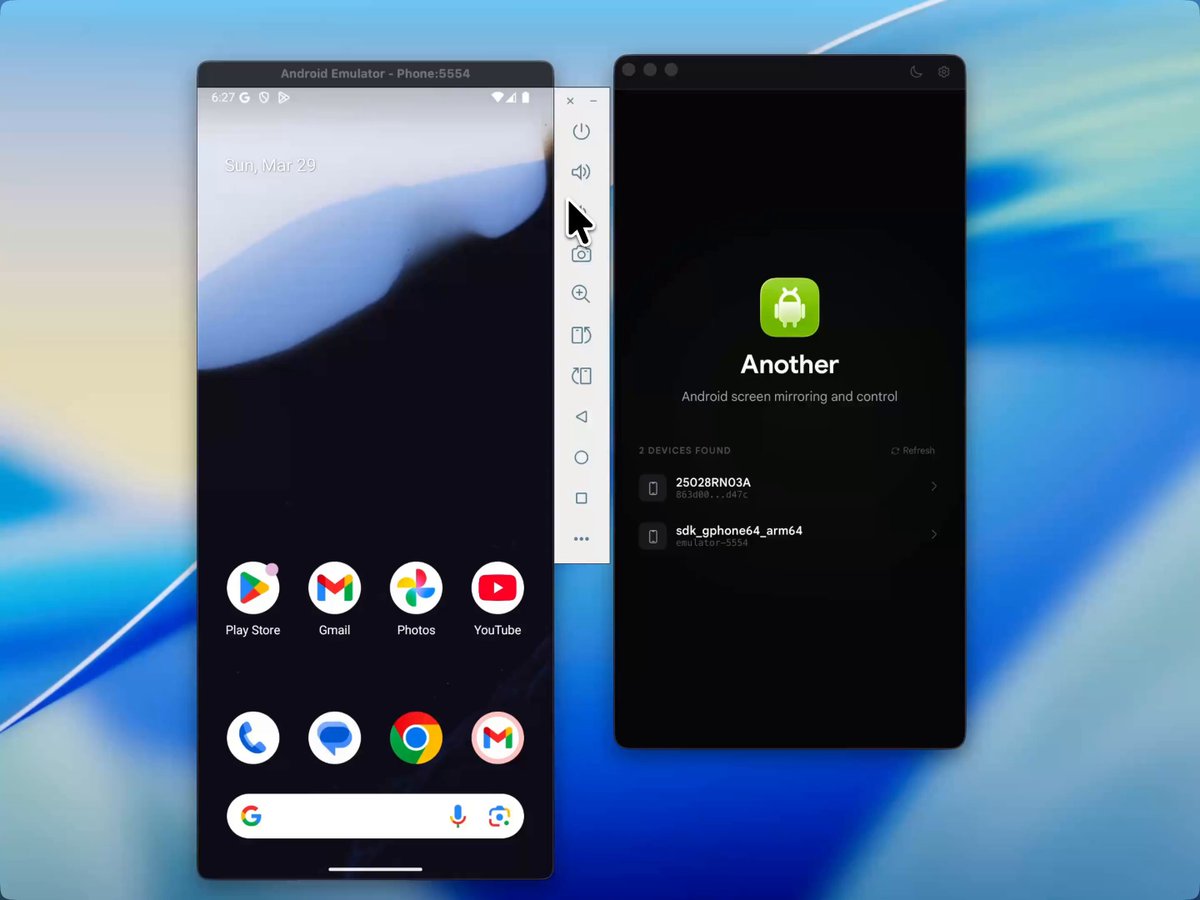
ZERO-LATENCY AIMBOT? WORSE. A ZERO-LATENCY PHYSICAL TURRET someone built a rig in their garage that shoots exactly where you click on the live video feed no cloud APIs, no server lag. just raw local execution. a simple python tkinter GUI captures mouse coordinates and streams them over websockets. -...

44,960 Aufrufe • vor 1 Tag •via X (Twitter)

0 Kommentare

Keine Kommentare verfügbar

Kommentare vom Original-Post werden hier angezeigt

Ähnliche Videos

Uber founder Travis Kalanick just identified the sovereign monopoly of the physical AI era. The software-only era is over. The next multi-trillion-dollar monopoly requires commanding the entire physical reality of the board. Kalanick: “I like to break down the physical AI stack. Includes not just computation, physical AI models, all the things you think of. What about land? Development? That should be in that stack. What about chemistry? That needs to be in the stack. Manufacturing needs to be in the stack.” Building a neural network is no longer enough. You have to physically manufacture the shell it lives in. You can’t dominate the physical universe with code alone. The winners are vertically integrating the entire atom-based supply chain. Your AI company doesn’t own the land, the chemical refinement, and the heavy manufacturing? You don’t own the stack. You’re renting space on someone else’s physical grid. Kalanick: “When you look at the stack, you’re like, ‘Damn, Tesla’s got this shit.’ They are the Google of this era.” Every decade produces a single algorithmic apex predator that captures the board. 90s: Microsoft. 2000s: Google. 2010s: Uber. Now: Tesla. Kalanick: “In the 2000s, if you were doing a startup, the first question you would get is, ‘Why isn’t Google gonna kill you?’” The sovereign entity doesn’t just compete. It creates an environment where your survival is mathematically impossible. Building a robotics or physical AI company today? If you don’t have a physics-based answer for why Tesla won’t crush you while optimizing their own supply chain, your execution loop is already dead. Kalanick: “They’re not even gonna know that they killed you.” The most dangerous force on the board is not the competitor who wants to destroy you. It’s the engine so massive it deletes your entire business model by accident. When a hyper-scaled operator controls the chemistry, the manufacturing, the land, and the compute, their velocity flattens everything in their path. They don’t need to target your startup. Routine optimization of their physical execution grid will wipe you out as collateral damage. The only way to survive is to build something so fundamentally unique it sits completely outside the blast radius. Because Tesla isn’t competing in the physical AI space. They already own it.

Dustin

53,084 Aufrufe • vor 4 Monaten

Mark Cuban just described the largest wealth transfer of the AI era. Almost nobody understood what he said. Cuban: “There are 33 million companies in this country. Aren’t going to have AI budgets. Aren’t going to have AI experts.” Not tech startups. The shoe store. The regional trucking outfit. The accounting firm with 12 employees. The businesses that actually run the physical economy. They know AI is coming. They have no idea what to do with it. Cuban: “You’ve got the head of Microsoft saying software is dead because everything’s going to be customized to your unique utilization.” Software is dead. The SaaS era ran on one rule. Build a generic product. Force millions of companies to bend their workflows around it. Charge rent forever. AI ends the contract. The business stops bending to the software. The intelligence bends to the business. But customized by whom. The third-generation manufacturer cannot tell Claude from Gemini. The county hospital is staring at a reactor asking where the light switch is. Cuban: “Who’s going to do it for them?” That question is worth more than the frontier models themselves. Hundreds of billions are being burned to build the foundation. The smartest engineers alive are locked in a bloodbath over who owns the base layer. Let them fight. Let them burn the capital. Let them drive the cost of raw intelligence toward zero. Because the wealth does not collect where the brain is built. It collects where the brain meets the business. Every ambitious kid in college right now thinks survival means a seat at OpenAI or Anthropic. Cuban is staring at the other 99 percent of the economy. Learn the models. Then learn the messy, unglamorous reality of how a 50-person company actually operates. Walk through the door. Understand their problems. Wire the intelligence directly into their revenue. That is not a job title. That is an entire economic class being born. You do not need to build the brain. You need to build the nervous system. The biggest winners of the electricity era were not the engineers who built the generators. They were the ones who walked into dark factories and showed the owners where to plug in. 33 million companies are standing in the dark right now. Silicon Valley is racing to build the god. The fortunes will belong to whoever teaches him a trade.

Dustin

3,710,815 Aufrufe • vor 3 Monaten

The value of the work we're doing at Optimum is encapsulated quite well by the phrase "speed is money". In modern markets there are real economic advantages to latency reduction. This is nothing new. Wall Street firms have long been optimizing on latency, primarily through colocation and top of the line hardware. However, when it comes to decentralized systems, expensive hardware and geographic concentration are antithetical to their purpose. Therefore we should optimize decentralized network latency through software, which I'm thrilled about because it's exactly what I've spent the better part of the past 2 decades working on with Random Linear Network Coding. Now let’s talk about networking economics, the relationship between speed and money. First, it's important to note that users will only pay for low latency if it can be consistently guaranteed. Second, you can only make that latency guarantee for a certain number of users. This is a universal law of networking. We can model this relationship on a delay curve, shown below. The delay curve is determined by the utilization rate of the network, meaning how much traffic is flowing through the network divided by the network's throughput. As you approach a level of traffic equal to the available throughput, latency trends infinitely higher. On this delay curve we can impose some utility thresholds. These thresholds are the levels of latency which are important to different groups of users because of how that latency guarantee improves their economic outcomes. Finding the point on the curve where each threshold intersects will tell us what level of traffic we can guarantee that level of latency for. Essentially, there exists a finite supply of speed on a network and the highest utility users of that speed are willing to pay more for it. I like to think of this similarly to expedited shipping options on Amazon. This is why we say speed is money, and why we can create a Latency Marketplace. The only way to increase the supply of speed is to fundamentally increase network throughput. This is what we work on at Optimum by using Random Linear Network Coding. The same relationship between traffic and throughput still applies, but now the delay curve is shifted out further to the right. Now more traffic can be processed at the same latency, or the same traffic can be processed at a lower latency. More speed available to the network. More value unlocked for the network’s users. Crucially, that value is no longer only reserved for those who can afford to sit closest to the machine. Expanding the supply of speed widens who can reach each latency threshold, keeping the network's advantage decentralized rather than concentrated in the hands of a few. When nodes join Optimum and participate, they reap the benefits, but they also add to the capacity. Rather than vying against each other in a zero-sum game, nodes help themselves and others.

Muriel Medard

43,142 Aufrufe • vor 25 Tagen