Video wird geladen...

Video konnte nicht geladen werden

Zur Startseite

لقطات نلخّص فيها رحلة مؤتمر الشمول الذي عُقد بالأمس، حيث توحّد الجميع — من قادة وجهات حكومية وغير ربحية — حول هدف واحد: بناء بيئات عمل أكثر شمولًا وتمكينًا Highlights capturing the journey of yesterday’s Inclusion Conference, where leaders and representatives from government and non-profit sectors came together around...

80,721 Aufrufe • vor 11 Monaten •via X (Twitter)

0 Kommentare

Keine Kommentare verfügbar

Kommentare vom Original-Post werden hier angezeigt

Ähnliche Videos

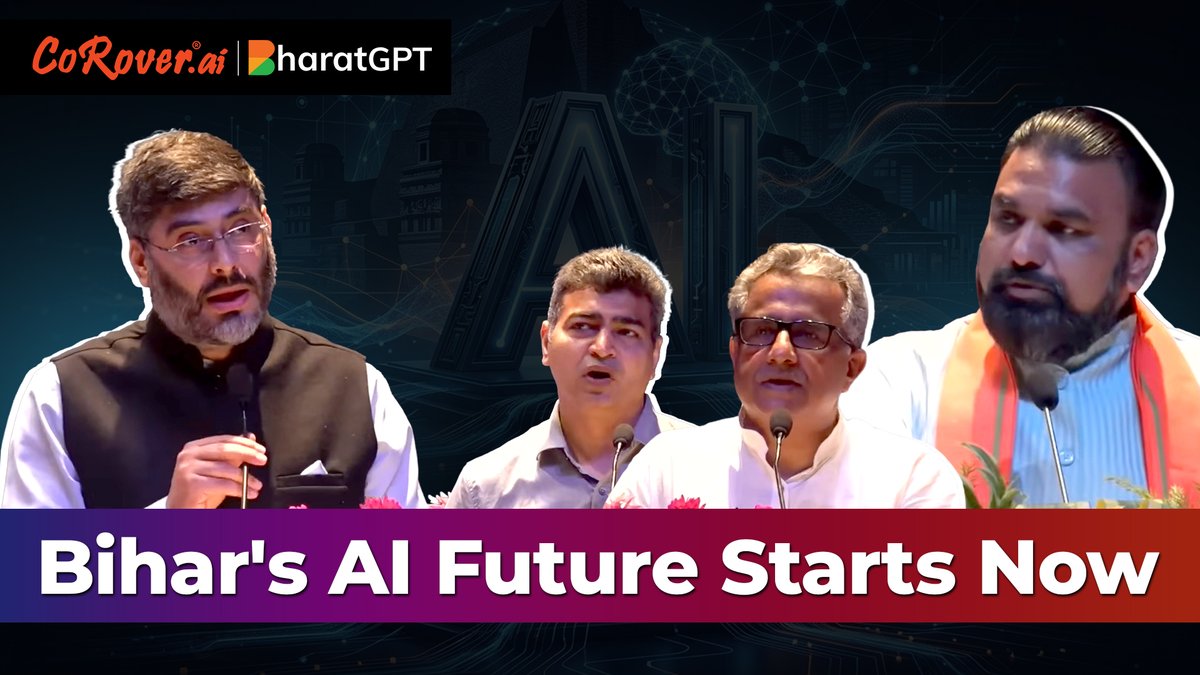
Bihar is taking important steps toward building an AI-driven future. The Bihar Ai Summit brought together government leaders, policymakers, industry representatives, academia, and technology experts to discuss how Artificial Intelligence can accelerate innovation, improve public service delivery, and create new opportunities across sectors. The presence of Hon'ble Chief Minister Shri Samrat Choudhary Ji, Hon'ble Deputy Chief Minister Shri Bijendra Prasad Yadav Ji, Hon'ble IT Minister Shri Nitish Mishra Ji, IT Secretary Shri Abhay Kumar Singh Ji, Hon'ble DGP Mr Vinay Kumar ji, IPS and other distinguished participants reflects Bihar's commitment to leveraging technology for economic growth and digital transformation. As AI adoption expands across governance, healthcare, education, agriculture, banking, and enterprise, the focus must remain on building practical, accessible, and impactful applications that address real-world challenges. At CoRover | BharatGPT, we believe the next phase of AI will be driven by multilingual, inclusive, and population-scale innovation built on local knowledge, local languages, and local expertise. Bihar's young talent base, academic institutions, and growing technology ecosystem create a strong foundation for this journey. Sharing highlights from the Bihar AI Summit, I spoke about the opportunity to build AI in Indian languages, enable innovation beyond major technology hubs, and create technologies that can serve both India and the world. India's AI growth story will be strengthened when more states, institutions, entrepreneurs, and innovators contribute to building solutions for India and the world. Full video: #AI #SovereignAI #BharatGPT #IndiaAI #AgenticAI #AIInnovation #ResponsibleAI #DigitalTransformation

Ankush Sabharwal

165,688 Aufrufe • vor 2 Monaten

Today, I officially announced my resignation from the Peoples Democratic Party (PDP) and formally declared my membership of the Nigeria Democratic Congress (NDC), a party I founded and whose leadership has appointed me as its National Leader. The journey of the NDC has been long in the making, and I helped midwife the process that led to its creation. In making the decision to go with the NDC, I made it clear that Nigeria must never become a one-party state. It would have been easy for me to join the bandwagon of politicians decamping to the ruling party—the APC, but that was never an option for me. My decision is informed by a number of reasons: the APC’s abuse and disrespect of the country’s diversity, its inability to effectively manage national security, and its failure to manage the economy in a manner that protects the welfare of Nigerians, resulting in widespread hunger, poverty, and disillusionment. This is further compounded by the mismanagement of our democratic space and the rejection of electoral reforms, leaving democratic liberties under threat after twelve years in power. My decision to set up the NDC has been a painful one because of the PDP’s contribution to me, the people of Bayelsa and all Nigerians, but the reality is that we must move forward. By my nature and background, I am not a politician of convenience but one guided by conviction, principles, and values. The Nigeria Democratic Congress is a national platform for patriots committed to building a stronger, fairer, and more prosperous Nigeria. Our priorities begin with national security, ensuring the protection of lives and property through strengthened defence and security institutions; education and skills development to build human capacity and drive national progress; affordable and quality healthcare for all Nigerians; a free-market economy guided by responsible regulation and social protection; industrialisation and local production to reduce dependence on imports; modernised agriculture and food security across the value chain; empowerment and inclusion of women and youth in governance and development; true federalism and devolution of powers to strengthen states and local governments; environmental protection and remediation of degraded areas; provision of affordable housing and modern towns; Pan-Africanist foreign policy and economic diplomacy; preservation and promotion of Nigeria’s culture and heritage; expansion of national infrastructure and transportation networks; reliable and sustainable power and energy supply; reform of the public service to ensure efficiency and accountability; and large-scale employment creation across sectors to provide opportunities for all Nigerians. The NDC will promote an independent judiciary, a free and independent press and ensure the promotion and protection of democratic norms and adherence to the rule of law. It is for these reasons that I have chosen to align fully with the NDC as we work together to build a stronger, fairer, and more inclusive Nigeria. I also explained why I could not align with the African Democratic Congress (ADC). I thank the ADC leaders for not succumbing to the pressures of a one-party state, however I am yet to clearly understand their position on some of the fundamental issues and principles that I strongly stand for and believe in. Furthermore, I am not sure if the ADC is a coalition or a collision, but I hope they prove me wrong. ADC leaders are personally known to me; we interact and will continue to do so in furtherance of Nigeria’s democracy. I therefore call on all our people, and indeed all Nigerians who believe in justice, equity, and a new Nigeria, to join this movement. The NDC is a platform for all who are committed to building a nation founded on true federalism, responsible leadership, and shared prosperity for all our people. I thank all Nigerians for their prayers and support. -HSD

Henry Seriake Dickson

55,852 Aufrufe • vor 5 Monaten

In the spring of 2022, former President Barack Obama gave a major policy addressat Stanford University’s Cyber Policy Center, where he laid out a sweeping proposal for government censorship of social media platforms through the Platform Accountability and Transparency Act. Six days later, President Joe Biden’s Department of Homeland Security announced that it had created a “Disinformation Governance Board” to serve as an Orwellian Ministry of Truth with the clear goal of controlling the information Americans could access online. At the heart of Obama’s vision for Internet censorship was legislation that would have authorized the US government’s National Science Foundation to authorize and fund supposedly independent NGOs to censor the Internet. The DHS and Stanford Internet Observatory, which was part of the Stanford Cyber Policy Center, pioneered this censorship-by-proxy strategy as a way to get around the First Amendment in 2020 with posts raising concerns about the 2020 elections and in 2021 with “narratives” expressing concern about the Covid vaccine. The 2024 election of President Donald Trump significantly reduced the threat of Obama, DHS, and NSF censoring the American people. Trump defunded much of the Censorship Industrial Complex. The Platform Accountability Act is going nowhere in Congress. Elon Musk fired most of the censorship staff at Twitter and has allowed a significantly wider range of speech on the platform. And even before Trump’s election, Stanford donor Frank McCourt stopped funding the Stanford Internet Observatory after Public, Racket News, and House Weaponization Subcommittee Chairman Jim Jordan exposed its central role in the DHS censorship-by-proxy scheme. But now, foreign governments, including Europe, the UK, Brazil, Australia, and others are demanding censorship, including of the American people. The risk is that US tech companies will find it significantly less expensive to have a single global censorship regime and just go along with foreign censorship requests. Facebook complied with Biden administration demands to censor because it needed Biden’s help in dealing with European censorship officials. And the Brazilian government forced Elon Musk to continue censoring the Brazilian people after it froze Starlink’s assets. And Public has discovered that the Stanford Cyber Policy Center, which is led by Obama’s former ambassador to Russia, Michael McFaul, is at the heart of a new, secretive, and possibly illegal censorship initiative that appears even more ambitious than the one Obama proposed in 2022. On September 24, the Cyber Policy Center hosted a secret dinner between its leaders and top censorship officials from Europe, UK, Brazil, California and Australia. The meeting was titled “Compliance and Enforcement in a Rapidly Evolving Landscape.” Frank McCourt, the same person behind the Stanford Internet Observatory, financed the gathering through his “Project Liberty Institute,” (PLI), toward which he gave $500 million to “strengthen democracy” and “foster responsible technology.” Public emailed all 21 participants and organizers and only heard from four, PLI, the Australian government, the UK government, and the European Union, which declined to comment because, even though Public gave it over 24 hours, a spokesperson said, “We would need several days.” The UK government said, “The legal framework gives Ofcom power to enforce the duties in the Act which are related to securing protections for people in the UK; it does not give Ofcom powers to enforce under any other legal regimes…. Ofcom has always engaged with various international forums and networks across all of the sectors we regulate, including online safety, spectrum, telecommunications, post, and broadcast and media. Regulators around the world regularly exchange insights, experience, and best practice.” A spokesperson for PLI said it “has made unrestricted gifts to several academic research programs, including Stanford University” and that “PLI does not receive funding from governments, intergovernmental organizations, or large technology companies.” But PLI’s own policy “blueprint” reveals that it is demanding a single total global censorship regime and intends to use the EU’s market power, known as the “Brussels effect,” to force big tech companies to comply. The blueprint calls for governments to “Recommit to a Single, Global Internet,” with “regulatory interoperability and oversight, to achieve a single unified market” and use the large size of the EU market to “drive bilateral and multilateral agendas to formally enshrine reciprocal guarantees.” A spokesperson for the Australian government said, “Whilst in attendance at Stanford for the 2-day conference, some attendees, including trust and safety researchers, industry, civil society, and government representatives, were also invited to attend an informal evening roundtable event organised by Stanford University entitled, ‘Compliance and Enforcement in a Rapidly Evolving Landscape.’ This roundtable did not involve any discussion of compliance coordination or regulatory information sharing.” The Australian spokesperson claimed that “eSafety has no role in regulating hate speech or disinformation. eSafety has no remit or interest in regulating the affairs of other nations, nor does it have any role in diplomatic, trade or other government-to-government relations.” But it also said, “As the internet is global and functions irrespective of national borders, by necessity eSafety collaborates with law enforcement, other government agencies, and non-government partners around the world, including in the United States.” The leaked agenda’s stated purpose was to “discuss the state of compliance and enforcement” in order to “identify where data, research, and expertise can enable more effective compliance with and enforcement of existing policy.” Much of the following two days of the public conference were focused on coordinating government censorship (“regulation”) of social media platforms, and the other nations that attended the meeting are all intensively involved in censoring their citizens and US tech companies. And, the head of Australia’s eSafety, Julie Inman-Grant, who was a keynote speaker at Stanford’s foreign censorship meeting, is also the head of a global government censorship network that serves as forum, she told the World Economic Forum, “to help us coordinate, build capacity and do just that…. We use the tools that we have, and can be effective, but we know we’re going to be, go, much further, when we work together with other like-minded independent statutory authorities around the globe.” As such, the people who are demanding censorship are once again spreading disinformation about what they are doing. All of this is happening in a context of global censorship intensifying. The UK government arrests 30 people per day for “offensive” social media posts, is attempting to censor 4Chan, which has no servers in the UK, and will mandate digital IDs for employment, which may give unprecedented control to politicians and bureaucrats to censor. The Brazilian government has, for year,s been censoring journalists and policymakers, incarcerating people for legal social media content, and threatening prosecution of journalists, including this author. And several European nations are censoring and arresting their citizens, preventing opposition political candidates from running for office, and preparing to implement digital IDs. Why did Stanford Cyber Policy Center hold this meeting, what is its strategy for global censorship? Who leaked the agenda to Public and why? And what can be done to stop Stanford, Brazil, Australia, the EU and others from realizing their totalitarian censorial vision? Please subscribe now to support Public's award-winning investigatie journalism, read the rest of the article, and watch the full video!

Michael Shellenberger

196,124 Aufrufe • vor 10 Monaten

President Xi’s New Year Address On New Year's Eve, Chinese President Xi Jinping delivered his 2026 New Year message through China Media Group and the internet. The following is the full text of the message: Greetings to all! Year after year, life opens a fresh chapter. As the new year begins, I extend my best wishes to you from Beijing! The year 2025 marks the completion of China's 14th Five-Year Plan for economic and social development. Over the past five years, we have pressed ahead with enterprise and fortitude, and overcome many difficulties and challenges. We met the targets in the Plan and made solid advances on the new journey of Chinese modernization. Our economic output has crossed thresholds one after another, and it is expected to reach RMB 140 trillion yuan this year. Our economic strength, scientific and technological abilities, defense capabilities, and composite national strength all reached new heights. Clear waters and lush mountains have become a salient feature of our landscape. Our people enjoy a growing sense of gain, happiness and security. The past five years have been a truly remarkable journey, and our accomplishments have not come easily. Your unwavering hard work has made our nation thrive and prosper. I salute you all for your exceptional diligence and invaluable contributions. This year is full of indelible memories. We solemnly commemorated the 80th anniversary of the victory of the Chinese People's War of Resistance Against Japanese Aggression and the World Anti-Fascist War, and established the Taiwan Recovery Day. These grand national events were majestic and powerful, and the glory of victory will shine through the pages of history. They are inspiring all the sons and daughters of the Chinese nation to remember history, honor fallen heroes, cherish peace, and create a better future. They are rallying a mighty force for the great rejuvenation of our nation. We sought to energize high-quality development through innovation. We integrated science and technology deeply with industries, and made a stream of new innovations. Many large AI models have been competing in a race to the top, and breakthroughs have been achieved in the research and development of our own chips. All this has turned China into one of the economies with the fastest growing innovation capabilities. The Tianwen-2 probe began its star-chasing journey to explore asteroids and comets. Construction of the hydropower project at the lower reaches of the Yarlung Zangbo River started. China's first aircraft carrier equipped with an electromagnetic catapult system was officially commissioned. Humanoid robots did kung fu kicks, and drones performed spectacular light shows. Inventions and innovations have boosted new quality productive forces and added colorful dimensions to our lives. We endeavored to nurture our spiritual home with cultural development. There was a surging public interest in cultural relics, museums, and intangible cultural heritage. A new Chinese cultural site was added to the World Heritage List. Cultural IPs such as Wukong and Nezha became global hits. The younger generation came to deem classic Chinese culture as the finest form of aesthetic expression. The cultural and tourism sectors thrived. The "super league" football games in our cities and villages attracted numerous fans. Ice and snow sports ignited people's passion for the winter season. Tradition is now embracing modernity, and the Chinese culture is shining in even greater splendor. We joined hands to build a better life and enjoyed it together. I attended celebrations in Xizang and Xinjiang. From the snow-covered plateau to both sides of the Tianshan Mountains, people of various ethnic groups are united as one, like seeds of a pomegranate sticking together. With white khatas and passionate singing and dancing, they expressed their love of the motherland and the happiness they enjoy. No issue of the people is too small; we care for every leaf and tend every branch in the garden of people's well-being. Over the past year, the rights and interests of the workforce in new forms of employment have been better protected, facilities have been upgraded to bring more convenience to the elderly, and each family with childcare needs has received a subsidy of RMB 300 yuan per month. When the happy hum of daily life fills every home, the big family of our nation will go from strength to strength. We continued to embrace the world with open arms. The Shanghai Cooperation Organization Summit in Tianjin and the Global Leaders' Meeting on Women were very successful; and island-wide special customs operations were launched in the Hainan Free Trade Port. To better address climate change, China announced new Nationally Determined Contributions. After announcing the three global initiatives on development, security, and civilization, I put forward the Global Governance Initiative to promote a more just and equitable global governance system. The world today is undergoing both changes and turbulence, and some regions are still engulfed in war. China always stands on the right side of history, and is ready to work with all countries to advance world peace and development and build a community with a shared future for humanity. Not long ago, I attended the opening ceremony of the National Games, and I was glad to see Guangdong, Hong Kong and Macao coming together in unity and acting in unison. We should unswervingly implement the policy of One Country, Two Systems, and support Hong Kong and Macao in better integrating into the overall development of our country and maintaining long-term prosperity and stability. We Chinese on both sides of the Taiwan Strait share a bond of blood and kinship. The reunification of our motherland, a trend of the times, is unstoppable! Only a strong Communist Party of China can make our country strong. We launched the study and education program on fully implementing the central Party leadership's eight-point decision on improving Party and government conduct. We exercised strict governance of the Party through credible measures, and promoted the Party's self-revolution to fight corruption and advance healthy governance. As a result, the conduct of our Party and government steadily improved. We must stay true to our original aspiration and founding mission, and pursue our goal with perseverance and dedication. We should continue to give a good answer to the question on how to maintain long-term governance put forth in a cave dwelling in Yan'an and prove ourselves worthy of the people's expectation in the new era. The year 2026 marks the beginning of the 15th Five-Year Plan. A successful venture should start with a good plan and with clear goals set. We should focus on our goals and tasks, boost confidence, and build momentum to press ahead. We should take solid steps to promote high-quality development, further deepen reform and opening up across the board, deliver prosperity for all, and write a new chapter in the story of China's miracle. The dream lofty, the journey long-bold strides will get us there. Let us charge ahead like horses with courage, vitality, and energy, fight for our dreams and our happiness, and turn our great vision into beautiful realities. The sun of the new year will soon rise. May our great motherland stand in magnificence! May the fields across the country deliver good harvest! May our nation bathe in the glory of the morning! May you all enjoy life to the fullest, and achieve every success! May all your dreams come true!

China Perspective

27,604 Aufrufe • vor 8 Monaten

THE OCCULT ROOTS, ELITE, INTELLIGENCE AGENCIES and INSTITUTIONS PLAN to ALTER MAN & CONTROL SOCIETY. It was all engineered. From symbolism, to intelligence agencies Mk Ultra programs, to transhumanism, and transgenderism, and where the elite get their pedophi*e beliefs from. This is going to explain the foundation and plan for society and layout a huge piece of the puzzle to help you understand where it all came from and how it started. Many of these occult rooted wealthy socialists knew exactly how they were going to literally bring in their New World Order before most of the methods or techniques even existed, and the crazy part is that it's happening today, exactly like they said it was. The last part of their plan, before it is complete was the sexual revolution, and what do we see happening all around us today with transgenderism, transhumanism, and pedophil*a with children? The plan was to revolutionize Western civilization through counterculture, and a sexual revolution to make the West more amenable to a future of socialist technocracy. They knew if they wanted to win they had to play the long game. These people were thinking generations ahead. This is called the Fabian Society model-the slow burn of implemented ideas to transform society. Their symbol is a literal wolf in sheep's clothing/skin. The Fabian Socialist Technocrats talked about this in the 1920s & 1930s. Like Bertrand Russel, a British philosopher who was one of the very first people who openly lived in a pan/poly relationship before anyone else, who basically helped plan the sexual revolution as well as many others. Herbert George Wells (H.G. Wells), the father of science fiction also wrote a bunch of mainline geopolitical books like "The Open Conspiracy," and "The New World Order." In these books he describes how they would revolutionize Western civilization through counterculture and sexual revolution to a socialist technocracy. These books were literally telling you their plans. The concept of technocracy has roots in ancient ideas like Plato's philosopher kings, and it gained traction during the Industrial Revolution and the Great Depression. Technocracy emphasizes the use of technical expertise in decision making often prioritizing scientific evidence and data over political considerations or public opinion. Sounds good in some aspects but it doesn't work overall. So, as counterculture, this sexual revolution, and darker occult practices, like Satanism and Paganism, etc., started to rise up, elites and governments started to catch on to these beliefs and practices and big money went into funding the creation of some institutions, non-profits and other programs along with projects in intelligence agencies in the U.S. and others. This overall takeover of the West and society was both calculated and non-intentional in a way. But from big names involved, The Esalen Institute was born. A non-profit in Big Sur, California that focuses on humanistic alternative education. The Institute played a key role in the Human Potential Movement beginning in the 1960s. The Esalen Institute was founded by Michael Murphy and Dick Price in 1962. It is basically the "think tank" of counterculture and the sexual revolution, promoted by very wealthy and influential people. Their intention was to support alternative methods for exploring human conscientiousness, promoting that everything is divine. One major thing you must understand that the roots of many of the people in Esalen were all into Satanic occult type belief systems and paganistic practices, like from the teachings of Anton LaVey and Aliester Crowley, who both were heavily involved in Satanism and also into pedophil*a and transhumanistic beliefs. Crowley was also a part of British Intelligence/MI5, and heavy into altering the mind with drugs and substances to make contact and change conscientiousness and to be like their own god. Other notable figures of Esalen was Timothy Leary, a psychologist who is also known for his advocacy of psychedelic experiences, a prominent figure of the counterculture movement and heavily into Aliester Crowley's sex revolution beliefs. All these sexual beliefs are associated transhumanism, transgenderism, and pedophil*a. Which is no coincidence why you see the heavy push for this on our society and on our children today. Another very prominent name and usual suspect is David Rockefeller who heavily promoted and funded the Esalen Institution and any others like it and donated millions of dollars to them every single year from the 1970s to around 2004. Rockefeller wasn't the only one and this is just one piece of this overall plan to destroy the West and society itself to bring in this new world. Let's move on. Now we will connect how Mk-Ultra was literally beyond the WW2 German connection and operation paperclip and set up from an arm of these foundations and writings of some of these people who laid the ground work and sparked these ideas into a reality, to be used on Western society and to literally alter man's mind and his actual physical appearance. Bring in the green agenda and convince man that man is the problem. A White Paper was written in the 1970s called, "Changing the Images of Man," put out by the Tavistock Institution. In this key paper they talked about reengineering all of Western civilization's thoughts. Not just about the environment, but also about man himself. The Tavistock Institution of human relations is a British non-profit reaserch and consulting organization, specialising in the study of group behavior. They also have sister companies in China and Germany, and it was established in 1947. They explained about how they needed to convince man that man is the problem. This is exactly where all of your counterculture, sexual revolution, depopulation, antinatalist, transgenderism, transhumanism, pedophil*a, etc., beliefs stem from. You are the problem but you can change yourself. Feb 4, 1932, A Brave New World, and then, A Brave New World Revisited was written. Huxley wrote that this is not fiction, this is a plan of things to come. The 2nd chapter is literally all about child sexual abuse material. This is where all this stuff came about and into our society. Huxley heavily believed in Aliester Crowley's belief systems and partied with Crowley, even attending orgies together. Huxley took Crowley's book, "The Drug Diaries to a government study level in a sense. Which was originally what Crowley was working with to contact entities and perform ritualistic ceremonies and involved with sexual activities with children. Tavistock was basically the British Mk Ultra from the studies originally from Aliester who was also a British intelligence agent with MI5. These drug studies and mind control studies at Tavistock led to the idea that you can engineer and change a human being, not just in his mind, but an entire change of physiology and biology of a person. Hence Transgenderism and Transhumanism, etc. Like how they're literally giving kids drugs and surgeries to "change" their genders today. In 1969 Dr. Holger Hyden who worked on mind control through drugs and medication, etc., was invited to a mind control conference in San Francisco that the Rockefellers sponsored by the CIA's, "Voice of America. Dr. Hyden's papers were about drugs and chemicals actually changing gender in men and women in the future. And look where we are now. The CIA made alliances with the French post modernists and deconstructionists who were a part of Congress for Cultural Freedom. The CIA also had and still does have members who studied and agreed with these same belief systems and started to study mind control after Huxley's brave new world which sparked their interest because of Crowley's actual experimentation actually using drugs to alter conscientiousness and for control or engineering one's mind and the results and studies from the Tavistock and their research. Which all stems back to his Satanic and sexual beliefs. Now we examine the CIA Mk Ultra with Hollywood and it's Mk Ultra program to induce, steer, and mold behavior throughout the population through, sex, drugs, and rock and roll. This was all apart of the mind control program on a grand scale relating to propaganda and drugs. Most A-list celebrities back then were also working or were active intelligence agents who also had DoD badges including Marylyn Monroe, to access the famous Air force location named Laurel Canyon where many operations stemmed from when it came to manipulating the public with music, t.v. and with any other type of influence. Many were recruited to do spy work for intelligence agencies. This was basically them working out their big plan, their agenda, which still happens today with the huge push with the occult and Satanic worship, sexual deviancy, transgenderism, transhumanism, you name it. They even have after school Satan groups in schools for kids starting as young as in kindergarten. This is also why you see the gigantic push for pedophil*a and trying to be able to give children consent and be sexualized, while horrific laws are being passed to reduce penalties for child predators. This is the type of "Brave New World" they want. The last step before bringing in their New World is the sexual revolution aspect which includes transgenderism, pedophil*a, transhumanism, Satanism, the green agenda, and depopulation. But the sexual revolution is the most important and last step. The fall of Rome also occurred when this type of sexual activity occurred as well. Something to really take into consideration and compare it to where we are now. Every single one of these ideologies and beliefs all stem from these wealthy elite individuals, institutions and belief systems that they all planned decades ago and it's literally happening right in front of us. There is so much more to this but this gives you an introduction or a starting point to connect the dots of where it all came from during the past century, which directly is impacting our lives and society. They are now experiencing heavy pushback. We're onto them and their ultimate plan. They gave us the roadmap. It's up to you to understand it and up to all of us to stop it.

The SCIF

85,521 Aufrufe • vor 1 Jahr

The TAVISTOCK, ESALEN, and STANFORD RESEARCH institute, the OCCULT, and the CIA's plan to BRAINWASH and destroy AMERICA. "We must convince man that "man" is the problem." This is their plan to bring about their "Brave New World." But it's not what you think it is. This is the sinister plan that you see unfolding right now in today's world. This is WHO is behind it, HOW, WHEN, and WHERE they planned it, and WHY. From the climate agenda, transgenderism, transhumanism, the Satanic agenda, the pedophi*e agenda and attack on our children, to cancel culture, the sexual revolution, communism, and every other backwards, upside down, and evil idea being brought about into our society. This is very important to understand, pay attention. It was all engineered. From symbolism, to intelligence agencies Mk Ultra programs, to transhumanism, and transgenderism, and where the elite get their pedophi*e beliefs from. This is going to explain the foundation and plan for society and layout a huge piece of the puzzle to help you understand where it all came from and how it started. Many of these occult rooted wealthy socialists knew exactly how they were going to literally bring in their New World Order before most of the methods or techniques even existed, and the crazy part is that it's happening today, exactly like they said it was. The last part of their plan, before it is complete was the sexual revolution, and what do we see happening all around us today with transgenderism, transhumanism, and pedophil*a with children? The plan was to revolutionize Western civilization through counterculture, and a sexual revolution to make the West more amenable to a future of socialist technocracy. They knew if they wanted to win they had to play the long game. These people were thinking generations ahead. This is called the Fabian Society model-the slow burn of implemented ideas to transform society. Their symbol is a literal wolf in sheep's clothing/skin. The Fabian Socialist Technocrats talked about this in the 1920s & 1930s. Like Bertrand Russel, a British philosopher who was one of the very first people who openly lived in a pan/poly relationship before anyone else, who basically helped plan the sexual revolution as well as many others. Herbert George Wells (H.G. Wells), the father of science fiction also wrote a bunch of mainline geopolitical books like "The Open Conspiracy," and "The New World Order." In these books he describes how they would revolutionize Western civilization through counterculture and sexual revolution to a socialist technocracy. These books were literally telling you their plans. The concept of technocracy has roots in ancient ideas like Plato's philosopher kings, and it gained traction during the Industrial Revolution and the Great Depression. Technocracy emphasizes the use of technical expertise in decision making often prioritizing scientific evidence and data over political considerations or public opinion. Sounds good in some aspects but it doesn't work overall. So, as counterculture, this sexual revolution, and darker occult practices, like Satanism and Paganism, etc., started to rise up, elites and governments started to catch on to these beliefs and practices and big money went into funding the creation of some institutions, non-profits and other programs along with projects in intelligence agencies in the U.S. and others. This overall takeover of the West and society was both calculated and non-intentional in a way. But from big names involved, The Esalen Institute was born. A non-profit in Big Sur, California that focuses on humanistic alternative education. The Institute played a key role in the Human Potential Movement beginning in the 1960s. The Esalen Institute was founded by Michael Murphy and Dick Price in 1962. It is basically the "think tank" of counterculture and the sexual revolution, promoted by very wealthy and influential people. Their intention was to support alternative methods for exploring human conscientiousness, promoting that everything is divine. One major thing you must understand that the roots of many of the people in Esalen were all into Satanic occult type belief systems and paganistic practices, like from the teachings of Anton LaVey and Aliester Crowley, who both were heavily involved in Satanism and also into pedophil*a and transhumanistic beliefs. Crowley was also a part of British Intelligence/MI5, and heavy into altering the mind with drugs and substances to make contact and change conscientiousness and to be like their own god. Other notable figures of Esalen was Timothy Leary, a psychologist who is also known for his advocacy of psychedelic experiences, a prominent figure of the counterculture movement and heavily into Aliester Crowley's sex revolution beliefs. All these sexual beliefs are associated transhumanism, transgenderism, and pedophil*a. Which is no coincidence why you see the heavy push for this on our society and on our children today. Another very prominent name and usual suspect is David Rockefeller who heavily promoted and funded the Esalen Institution and any others like it and donated millions of dollars to them every single year from the 1970s to around 2004. Rockefeller wasn't the only one and this is just one piece of this overall plan to destroy the West and society itself to bring in this new world. Let's move on. Now we will connect how Mk-Ultra was literally beyond the WW2 German connection and operation paperclip and set up from an arm of these foundations and writings of some of these people who laid the ground work and sparked these ideas into a reality, to be used on Western society and to literally alter man's mind and his actual physical appearance. Bring in the green agenda and convince man that man is the problem. A White Paper was written in the 1970s called, "Changing the Images of Man," put out by the Tavistock Institution. In this key paper they talked about reengineering all of Western civilization's thoughts. Not just about the environment, but also about man himself. The Tavistock Institution of human relations is a British non-profit research and consulting organization, specializing in the study of group behavior. They also have sister companies in China and Germany, and it was established in 1947. They explained about how they needed to convince man that man is the problem. This is exactly where all of your counterculture, sexual revolution, depopulation, antinatalist, transgenderism, transhumanism, pedophil*a, etc., beliefs stem from. You are the problem but you can change yourself. Feb 4, 1932, A Brave New World, and then, A Brave New World Revisited was written. Huxley wrote that this is not fiction, this is a plan of things to come. The 2nd chapter is literally all about child sexual abuse material. This is where all this stuff came about and into our society. Huxley heavily believed in Aliester Crowley's belief systems and partied with Crowley, even attending orgies together. Huxley took Crowley's book, "The Drug Diaries to a government study level in a sense. Which was originally what Crowley was working with to contact entities and perform ritualistic ceremonies and involved with sexual activities with children. Tavistock was basically the British Mk Ultra from the studies originally from Aliester who was also a British intelligence agent with MI5. These drug studies and mind control studies at Tavistock led to the idea that you can engineer and change a human being, not just in his mind, but an entire change of physiology and biology of a person. Hence Transgenderism and Transhumanism, etc. Like how they're literally giving kids drugs and surgeries to "change" their genders today. In 1969 Dr. Holger Hyden who worked on mind control through drugs and medication, etc., was invited to a mind control conference in San Francisco that the Rockefellers sponsored by the CIA's, "Voice of America. Dr. Hyden's papers were about drugs and chemicals actually changing gender in men and women in the future. And look where we are now. The CIA made alliances with the French post modernists and deconstructionists who were a part of Congress for Cultural Freedom. The CIA also had and still does have members who studied and agreed with these same belief systems and started to study mind control after Huxley's brave new world which sparked their interest because of Crowley's actual experimentation actually using drugs to alter conscientiousness and for control or engineering one's mind and the results and studies from the Tavistock and their research. Which all stems back to his Satanic and sexual beliefs. Now we examine the CIA Mk Ultra with Hollywood and it's Mk Ultra program to induce, steer, and mold behavior throughout the population through, sex, drugs, and rock and roll. This was all apart of the mind control program on a grand scale relating to propaganda and drugs. Most A-list celebrities back then were also working or were active intelligence agents who also had DoD badges including Marylyn Monroe, to access the famous Air force location named Laurel Canyon where many operations stemmed from when it came to manipulating the public with music, t.v. and with any other type of influence. Many were recruited to do spy work for intelligence agencies. This was basically them working out their big plan, their agenda, which still happens today with the huge push with the occult and Satanic worship, sexual deviancy, transgenderism, transhumanism, you name it. They even have after school Satan groups in schools for kids starting as young as in kindergarten. This is also why you see the gigantic push for pedophil*a and trying to be able to give children consent and be sexualized, while horrific laws are being passed to reduce penalties for child predators. This is the type of "Brave New World" they want. The last step before bringing in their New World is the sexual revolution aspect which includes transgenderism, pedophil*a, transhumanism, Satanism, the green agenda, and depopulation. But the sexual revolution is the most important and last step. The fall of Rome also occurred when this type of sexual activity occurred as well. Something to really take into consideration and compare it to where we are now. Every single one of these ideologies and beliefs all stem from these wealthy elite individuals, institutions and belief systems that they all planned decades ago and it's literally happening right in front of us. There is so much more to this but this gives you an introduction or a starting point to connect the dots of where it all came from during the past century, which directly is impacting our lives and society. They are now experiencing heavy pushback. We're onto them and their ultimate plan. They gave us the roadmap. It's up to you to understand it and up to all of us to stop it.

The SCIF

16,700 Aufrufe • vor 10 Monaten

Stalin and Hitler: One Socialist Revolution in Two Uniforms The Molotov–Ribbentrop Pact of August 1939 is still taught as a pragmatic truce between bitter enemies — the Soviet Union's "far-left" communism and Nazi Germany's so-called "far-right" fascism ( This revisionist interpretation survives largely because the post-war political order needed it to end the World War fought between proponents of Liberty and those who sought to substitute the Liberal Enlightenment with socialist slave-statism. Unfortunately, this process led to a pragmatic subsummation of various socialist factions by the West's "democratic" systems, leading to an erosion of Capitalism as they work to convert our social-systems into perverse clientel states ( that persistently violate the rights they were established to protect. Moreover, while granting them moral equivocation to the rest of us, it absolved and shielded socialists from accountability for their criminal pathology, all the while enabling "russia" to promote itself as having saved the world from the "revolutionary" Holocaust for which they were equally responsible as participants and ideological proponents. Post-enlightenment, this was the West's first major moral catastrophe of self-inflicted degradation by way of pragmatic capitulation to the forces of its destroyers who continue to rewrite our understanding of history and are actively transforming the practical functions of our governments in favor of the totalitarian-axis ( This spineless moral confusion of the West is one with which we are only too familiar and continue to observe today across practically all spheres of life, especially foreign policy. In so doing, they are surrendering their moral high-ground, sabotaging prosperity, and weakening the post-war order, if only to appease the sentiments of the bolshevized and other subversive elements in our midst ( Hitler's antisemitism was his anti-Capitalism, and his anti-Capitalism was his antisemitism, no different from Marx. In reality, Stalin's Soviet socialism and Hitler's national socialism were branches from the same root of Marxism, united by shared theory, shared personnel, shared enemies, and shared operational goals. From their ideological foundations to their street-level enforcers, the line between them was blurred to the point of invisibility. Marxist Foundations of a Common Worldview Karl Marx's own writings laid much of the groundwork for both Stalin's and Hitler's policies toward Jews ( The alliance between Joseph Stalin's Soviet Union and Adolf Hitler's German Reich was grounded in deep ideological kinship. Both leaders subscribed to the Marxist premise, articulated in Zur Judenfrage, Das Kapital, and The Communist Manifesto, that Jews were an embodiment of the bourgeois class — a Capitalist, parasitic element that had to be uprooted for socialism to triumph. Even Hitler's racial and spiritual antisemitism did not contradict Marxism, as Marx was explicitly racist and referred to Jews as "Jewish N*ggers" ( rather, it built upon it, while framing the socialist struggle for revolution as racial and class struggle while preserving the revolutionary goal of Jewish expropriation and extermination as an integral part of revolution against Capitalism. While Marx identified Jews with the bourgeois Capitalist class, the "huckster" spirit of commerce, and the system of so-called exploitation — one's sovereign claim to their own life, property and from which we derive such practices of individuals trading that which they subjectively valued less for that which they valued more — that socialism sought to abolish and thus enlist mankind into slavery. He referred to money as "philistine paper" and commodities that were "inwardly circumcised Jews." His "solution" to what he and Hitler both lamented as "the Jewish Question" was the removal of Jewish influence from public life, an idea they framed as a "racial" and "class struggle." Soviet socialism took this view literally: Jews were "class aliens" whose property was to be seized and whose communities were to be dismantled under the banner of proletarian revolution ( Hitler's national socialism racialized the same enemy, presenting the Jew not just as a class exploiter but as a biological parasite who, in reality, were simply another group of people whose ethics stood in the way of socialist parasitism and imperial conquest ( not merely against foreign populations but against the individual himself. The underlying goal — to purge anyone who engaged in Capitalist practices labeled as Jewish, such as selling goods for profit, and purge Jews in order to "liberate" capital for allocation to socialist re-engineering of society — was the same. As socialism continued to fail throughout Germany, in parallel with proto-socialist state-interventionism around the globe and which brought to fore the Great Depression in the wake of the First World War ( many populations were ignorant of basic economics and did not ask themselves whether it was existing state-intervention that led to their woes, choosing to instead double down on socialism while believing it was anything remaining marginally-private under the Weimar Republic, alongside a Jewish conspiracy, as the source of their economic challenges ( The SA–KPD Connection: One Militant Base The supposed gulf between the two systems collapses further when we look at the personnel who enforced their revolutions. The Sturmabteilung (SA), or "Brown Shirts," Hitler's paramilitary enforcers in the 1920s and early 1930s, were by majority registered members of the German Communist Party (KPD), many of whom homosexuals who would have orgies in their commune housing with as much frequency as the cross-dressing transsexuals of the Wehrmacht ( They were street fighters who had already accepted the central Marxist premises: the destruction of bourgeois society, the abolition of free markets, and the removal of Jews as the supposed embodiment of Capitalism ( Their move from the KPD to the SA was not an ideological betrayal — it was a rebranding. The "world proletariat" became the "German worker," but the collectivist core, the contempt for property rights, and the antisemitic worldview remained intact. The SA–KPD overlap shows that the human machinery of both movements was interchangeable, and that the two "sides" were never truly opposite. Perhaps there is no greater evidence for this fact than Hitler's history, prior to becoming Chancellor of Germany, during which he would serve as an elected official in Kurt Eisner's Socialist People's State of Bavaria and then again into a Communist Bavarian Soviet Republic, alongside his service in the Red Army ( Economic and Logistical Partnership Once in power, Hitler implemented collectivist controls over agriculture reminiscent of Lenin and Stalin's earlier Soviet model. The Nazi regime fixed prices, bound farmers to their land, and subordinated production to state planning as they collectivized farming and socialized the economy at a scale outpacing the Weimar and SPD after private property rights were abolished under the Reichstag Fire Decree (1933) ( The predictable result was a collapse in agricultural output — by the early 1940s, German harvests had fallen by nearly half, creating a food crisis for a nation preparing for war, not merely for so-called "Living Space" and conquest against Capitalism but out of shared conviction in the thoroughly refuted Marxist "Shrinking Markets" or "Tendency of the Rate of Profit to Fall" fallacy that applies only to socialism ( Logistics and overall production were so inefficient under socialism, the Germans began substituting agricultural products with consumption of coal derivatives ( The Soviet Union stepped in to fill the gap. Under the Molotov–Ribbentrop Pact, Stalin shipped vast quantities of oil, metals, and grain to Germany. Much of the grain came from Ukraine, where Soviet authorities had already expropriated food from a population still traumatized by the Holodomor. "In tandem with these policies, the Soviet Union also provided economic support to Nazi Germany, which was instrumental in facilitating Hitler's war of conquest. The importance of this assistance cannot be underestimated as the USSR supplied significant quantities of food and raw materials to the Nazis. For instance, during the invasion of France and the Low Countries, the USSR supplied the Reich with 163,000 tons of petroleum and 243,000 tons of Ukrainian wheat in May and June of 1940 alone. As German demand increased during critical battles, such as at Dunkirk, Soviet oil deliveries surged to meet the needs, effectively fueling Hitler's conquest of Western Europe." Stalin's aid wasn't charity — it was strategic leverage that played into a broader strategy. It kept Hitler's war machine running and deepened Berlin's dependence on Moscow, allowing Stalin to pull the plug when it served his purpose ( A Shared Goal: The Removal of Jews and "Class Enemies" The economic pact was only one part of a deeper collaboration. Both regimes saw the destruction of Europe's Jewish population as a revolutionary imperative. Where Hitler framed it as a racial policy, Stalin framed it as "class struggle," both regimes deriding Jews as self-interested or insufficiently altruist, thus a threat to any socialist system — and in practice, both categories were the same. Soviet cooperation went far beyond the passive acquiescence some would like to suggest. NKVD archives and wartime records show the Soviets went beyond indirect facilitation, providing the Germans with logistical expertise and instruction on the design and operation of concentration camps, the "technical assistance" part of a broader joint effort to eliminate groups deemed "counter-revolutionary" or "parasitic" by socialist criteria ( In occupied France, Communist partisans operated in accordance with directives from Moscow that aligned with German objectives. Supplies would be surged to these groups when their activities advanced mutual goals, including the rounding up and deportation of Jews and other populations who stood in their way. The cooperation between socialist factions was driven by unity rooted in a shared vision of a post-Capitalist world they sought to build, even if they disagreed on who would lead it. The Joint Invasion of Poland and Open Collaboration Nothing demonstrates this unity more clearly than the joint invasion of Poland in September 1939. German and Soviet forces coordinated their offensives, held joint victory parades, and partitioned the country according to prearranged zones over which their banners jointly flew side-by-side. Their collaboration is simple to understand: in Brest-Litovsk, NKVD units physically handed over Jewish prisoners to the Gestapo. Deportations ran both east and west — Jews, Polish intellectuals, and others deemed "counter-revolutionary" "class enemies" went to German concentration camps and Soviet gulags, depending on their zone of capture. This was not "parallel repression," as many Marxists would like to suggest — it was coordinated, deliberate, and consistent with the ideological aims both sides openly shared, which Marxist and other socialist "historians" have attempted to negate from conceptual integration, blaming everyone ( but the culprit staring at them in the mirror as they weaponize revisionist concepts to intellectually and morally disarm opposition to their elite slavery schemes. The Calculated Withdrawal of Soviet Aid and "Liberator" Myth Stalin's material support — oil, metals, Ukrainian grain — allowed Germany to survive Hitler's socialist disaster after initiating his farm collectivization program. They would thus mount a rapid series of conquests in 1939–41. But Stalin always kept his hand on the valve. When Germany invaded the USSR in June 1941, Stalin's strategy paid out its ultimate dividend, cutting supplies to collapse the German army and sweep in to capture territories Germany could no longer hold while reframing the entire war in propaganda terms: the USSR as Europe's savior from fascism — which everyone understood had actually originated as a break between socialist factions led by Bakunin and Marx at the First International ( — enabling the socialist conspiracy to continue their crusade around the globe and which we continue to observe apace ( Meanwhile, their so-called "democratic socialists" clung onto their moral perversions and acted as propagandists in Britain and elsewhere, promoting such falsehoods as German and Italian socialism as having been Capitalist social-systems that "privatized," rather than socialized their economies ( None of that was real murder and theft, none of what you observed was "real socialism," they shouted. Thus, Western Socialists desperately undertook a near century-long effort to rewrite history, sowing public confusion as they continued to collaborate with totalitarian adversaries, with the goal of preserving the reputation of their slave-state model, hopeful for more opportunities to arouse revolutionary fervor or support for socialism, continuing to aid in replicating and exporting its failures as they worked to undermine and destroy civilization. The moral facade of liberation was bolstered by propaganda that omitted the USSR's partnership in invasion, deportation and genocide. This propaganda also relied on another longstanding policy — Soviet censorship of the Holocaust's targeting of Jews and others deemed "counter-revolutionary." Soviet media described the Holocaust as crimes against "peaceful Soviet citizens," erasing any understanding of its ideological root. This served multiple purposes: chief among them was continued export of socialism as they conspired to devour more countries, masked the USSR's earlier complicity and made the Red Army's return appear as a universal liberation, even to populations that had been terrorized by NKVD purges only months before, and simultaneously enabled them to exterminate more "counter-revolutionaries" who initially believed the Germans were liberators, an unfortunate consequence of Soviet censorship that led to additional collaboration and which Moscow continues to exploit as a justification to invade Eastern European countries, such as Ukraine, at the present time. Somehow the myth persists, despite Moscow's own admissions to the contrary ( and use of socialists, including national socialists, for operations ( Not Two Systems, but One Revolution The alliance between Stalin and Hitler was not a pragmatic arrangement between opposites. It was the natural convergence of two socialist revolutions — one draped in red, the other in brown — that shared the same Marxist contempt for private property, the same belief in the destruction of "class enemies," and the same targeting of Jews as obstacles to their utopian visions. From the SA's KPD roots to the Brest-Litovsk prisoner handovers, from NKVD camp blueprints to Ukrainian grain shipments, and from coordinated deportations to propaganda erasures, the evidence points to a single revolutionary current flowing through both regimes. The uniforms and rhetoric differed; the goals and methods did not. The tragedy of Europe in 1939–41 was that its peoples were caught between two arms of the same ideological body — one calling itself international socialism, the other national socialism — and that for millions, the change in flag over the city hall brought not liberation, but only a new master in the same revolution. And today, those who seek to resurrect those forces employ no different a dialectic in our political discourse. Their lawless presence requires a response: we are due for a correction in the course of history; and what the West needs is a totalizing, Objectivist intellectual revolution to overthrow their metaphysical and epistemological hallucinations — the false history and false consciousness of the bolshevized, not merely in history and state-organization but the arts ( to revitalize the only true revolution that ever freed mankind from the real struggle against bondage: Capitalism (

Jeremy Smithson

32,375 Aufrufe • vor 1 Jahr

A Twist in the Tale: Has BJP become the adda of corrupt? In the run up to the 2014 general elections, the BJP centred its campaign around alleged corruption under the Congress-led UPA government, promising ‘ache din’ . Several times during the campaign, Narendra Modi Ji grandiloquently promised to jail the corrupt. He was equally loud about bringing back 'all the looted money stashed away in Swiss banks and eliminating black money'. People gave BJP a decisive mandate and Modi became PM in 2014. On 8th November 2016 in a public broadcast PM Modi declared that Rs. 500 and Rs. 1000 notes would cease to be legal tender and grandiosely announced that the purpose of #demonetisation was to crackdown on corruption and eliminate black money. It, however, turned out to be spurious. Recently, Supreme Court Justice B. V. Nagarathna said in a conference in Hyderabad that in the Indian economy at that time, Rs 500 and Rs 1000 notes comprised 86% of the currency and wondered about the goal of the demonetisation exercise since 98% of those notes came back to banks. She also questioned about black money eradication as demonetisation became a good way of converting black money into white money. In 2017 the BJP government introduced #ElectoralBond Scheme, which was anonymous financial contributions to political parties, by amending several laws namely, the Representation of the People Act, 1951, the Companies Act, 2013, the Income Tax Act, 1961. Its avowed purpose was to enhance transparency and accountability in political funding by eliminating black money, corruption. etc. The Supreme Court has recently struck down this secret political funding as unconstitutional and directed disclosure of complete details of all electoral bonds. From the data available in public domain, thanks to the Supreme Court, it came to light that the BJP is the biggest beneficiary as out of total Rs. 11,450 crores it received Rs. 6,566 crores which is 57%. Contemporaneous evidence indicates that #ElectoralBonds have all the ingredients of a huge scam such as quid pro quo and corruption, shell and loss making companies donating to political parties huge sums of money suspected to be kickbacks, and laundering of black money. In order to shield our democratic process from foreign interference, the laws regulating foreign contributions prohibited political parties and candidates in elections from accepting foreign contributions. But the BJP government through Finance Acts, 2016 and 2018 amended with retrospective effect the Foreign Contributions (Regulation) Act, 2010 (#FCRA) by changing the definition of ‘foreign source’ not only condoning the past illegalities committed but also permitting political parties to receive foreign funds, and thereby paved way for foreign intrusion into our political and electoral process compromising our sovereignty. Further, notwithstanding the huge propaganda of alleged action against Foreign Funded NGOs, there has been a huge spike in #FCRA remittances since the 2014-15. While during the 20 years between financial years 1994-1995 and 2013-14 an amount of Rs. 1,51,036 Crores was received, during the 8 years between 2014-15 and 2023-24 Rs. 1,46,392 was received. Data for financial years 2022-23 and 2023-24 is not yet available. However, from the trends of #FCRA remittances in the preceding years it will be around Rs. 50,000 Crores together for both the financial years, making the total FCRA remittances during 10 year rule of BJP to be around Rs. 2,00,000 Crores which is humongous. Even if a small fraction of that huge amount of foreign funds has gone to political parties or candidates in elections, it amounts to serious subversion of our democracy and constitution. What sort of patriotism is this? Several months prior to 2014 general elections, a spate of alleged scams during UPA rule surfaced namely, Chit Fund scam, Chopper scam, Tatra truck scam, 2G Spectrum scam, CWG scam, Coal scam, Adarsh scam, etc. The courts, CBI, ED and IT proactively initiated action as a result several Congress and UPA leaders came under scanner. Though the BJP came to power on the anti-corruption plank, hardly any political leaders of significance was convicted, nor even paisa of black money stashed away in Swiss banks was brought back. On the other hand, the BJP has allegedly been misusing the law enforcement agencies to arm-twist the opposition political leaders under cloud either to defect to or align with the BJP. Out of 25 important opposition leaders who were allegedly under the scanner and joined BJP, 23 have reportedly got reprieve. Politicians like Andhra Pradesh CM YS Jagan who faces 38 criminal cases including 11 CBI and 7 ED cases, have been buying peace from the BJP. As a result none of his cases have seen the light of the day, notwithstanding the direction of Supreme Court to speed up trial of cases against politicians. Likewise, the DMK leaders namely, the Maran brothers, A. Raja, Karunanidhi’s daughter Kanimozhi have been acquitted, after they not so secretly cosied up to BJP, thanks to the lacklustre prosecution of their cases before the courts. These are only representative examples of how the BJP has become the adda for the leaders facing allegations of corruption, money laundering, etc. It is quite possible that some of them may be genuinely innocent. But as their innocence has been established only after their defection to or aligning with the ruling BJP, it creates dark shadows by raising serious moral questions. Last year, fourteen political parties approached the Supreme Court against the alleged misuse of central investigating agencies in arresting opposition political leaders and other citizens exercising their fundamental right to dissent and disagree with the ruling BJP. It was alleged that 95% of political leaders investigated by CBI and ED belong to opposition. That is, out of 121 prominent politicians facing ED probe between 2014 and 2022, 115 are opposition leaders who had been booked, raided, questioned or arrested. To wriggle out of or deflect the allegations of promoting corruption, shielding the corrupt who have joined or aligned with the BJP and targeting opposition leaders, etc, one of the standard refrains of the BJP has been that as Narendra Modi has no family he cannot be corrupt or has no motivation to be corrupt or shield the corrupt. That is a disingenuous argument. Late Jayalalitha, who was a spinster with no family, was convicted for corruption and was sent to jail. There are many prominent leaders who are unmarried or have no families facing cases or allegations of corruption. I don’t mean to even hint let alone allege that Narendra Modi is personally financially corrupt. I merely want to call out their bluff by highlighting the point that there is no connection between one’s familial status and corruption. It must be recalled that Manmohan Singh, whose personal financial integrity was impeccable, presided over a corrupt regime. As such, personal financial honesty of PM or a CM is meaningless if his party and government are not honest. Barring honourable exceptions, every political party while in opposition grandiloquently talks against corruption, not necessarily because they are honest, but because they try to make a virtue of out of lack of opportunities to make money. Notwithstanding its anti-corruption rhetoric the BJP is no stranger to corruption as its unsavory history tells. In 2001, none other than its National President late Bangaru Laxman was caught on the camera taking bribe from one Mathew Samuel, and was later convicted by a Special CBI Court on 27th April 2012 and sentenced to four years in jail. Further, BJP’s former CM of Karnataka Sri B. S. Yeddyurappa faced charges of corruption and was also in jail for a while. There are allegations of misdeeds of BJP government in PM-CARES Fund which is mired in secrecy, in sale of Air India to Tatas for peanuts, about CAG’s concern about astronomical escalation in cost of construction of Dwarka Expressway from Rs. 18.2 crores per km to Rs. 251 crores per km, in the utility of more than Rs. 14,000 crores public funds for Namami Gange project while the sacred Ganga is on the verge becoming a sewer like Yamuna, and several others. The #ElectoralBondScam which points to several alleged scams, is only a tip of the iceberg. It seems further action to take it to logical end has come to a naught. Therefore, having seen the fate of investigation and trial of all the alleged scams and how the political class sabotage, it is imperative that a Special Investigation Team (SIT) comprising serving or retired officers specially chosen by the Supreme Court, which will not be part of any Law Enforcement Agency but independently directly reporting to the Supreme Court, would alone will be able to unravel the truth. It is pertinent to recall the stellar role of RTI Act and the Prevention of Corruption Act, 1988 (before it was amended in 2018) in exposing alleged corruption in the Congress-led UPA government. Information is power. So, the RTI Act empowered people to seek information from public authorities on all official matters (barring a very few exceptions). Based on that information obtained through RTI process about alleged corrupt deals, illegalities, etc during UPA rule, the CBI which had no legal shackles could initiate enquiries and investigation into those allegations. The BJP while in opposition used and exploited this situation to the hilt to oust the Congress-led UPA from power. And having formed government the BJP is acutely aware of the dangers for the corrupt lurking in these laws. So they have systematically wrecked the RTI Act so much so that it has gone from citizens’ most powerful tool to an Act on life support. In 2018 they amended the Prevention of Corruption Act, 1988. As per new section 17A introduced therein, “No police officer shall conduct any enquiry or inquiry or investigation into any offence alleged to have been committed by a public servant under this Act, where the alleged offence is relatable to any recommendation made or decision taken by such public servant in discharge of his official functions or duties, without the previous approval” of respective governments or appointing authority of the public servant. Which government will permit investigation into its own misdeeds? While Justice R. M. Lodha in 2013 denounced the CBI as a ‘caged parrot’, the BJP government translated his oral observation into a legal reality by destroying the Prevention of Corruption Act. Evidently, the real purpose of BJP undermining RTI Act and emasculating the CBI was to prevent visitation of fate similar to that of UPA by insulating and firewalling themselves from any future enquiries and investigations into their alleged corrupt deeds. Finally, there is an uncanny resemblance between the BJP’s anti-corruption rhetoric with a story in Jeffrey Archer’s popular book, ‘A Twist in the Tale’, which goes like this: Ignatius Agarbi was the new Financial Minister of Nigeria. He begins a sweep on corruption and makes a name for himself. Impressed by his extreme honesty, his president entrusted him to find out how many Nigerians have stashed their bribes in Switzerland. He arrives at the Swiss Bank with a briefcase. Despite his greatest persuasion, the Swiss banker refuses to break their code of privacy. In the end, Ignatius places a gun to the head of the Swiss banker and threatens to kill him. Still the banker refuses to divulge any confidential information. Ignatius, who was actually extremely corrupt, was only checking to find out if the Swiss Banks would actually reveal the name of an account holder. Delighted with their secrecy, Ignatius deposits $5 million in cash which he had skimmed as Financial Minister.”

M. Nageswara Rao IPS (Retired)

239,217 Aufrufe • vor 2 Jahren

JOSHUA’s full speech for UNESCO x SEVENTEEN: Celebrating Youth, Creativity and Well-Being Together #조슈아 🦌: im joshua, and im honored to speak today on behalf of the 13 members of seventeen. 🦌: before anything else, i want to share that all our members truly wish they could be here today. they r sending all their love & support to everyone in this room. 🦌: today marks seventeen’s 3rd visit to unesco headquarters, a place that is always meaningful to us. from the vibrant energy of the 2023 youth forum, where we celebrated youth solidarity, to the profound honor of our 2024 appointment as unesco goodwill ambassadors for youth, every moment remains vivid in our memories. 🦌: upon our appointment, we shared with unesco a core belief: that young people should be empowered to lead change. this vision also aligns closely with the un youth 2030 strategy, wc aims to ensure that all young people, in all their diversities, are empowered as equal partners, leaders, & rights holders. driven by this conviction, seventeen proudly committed to launching a global youth grant scheme entitled “going together: for youth creativity and well-being”. this initiative was designed to provide young people wt resources, mentorship, & platforms to turn their ideas into meaningful actions. deeply moved by their passion & creativity, we knew we couldnt stop there. we expanded our commitment to help scale these efforts & support an even greater impact. 🦌: supporting this journey has been deeply valuable to all of us. we are incredibly proud of everything they have accomplished. pls join me in a warm round of applause for all the young leaders who made these achievements possible, both here wt us in person & joining us online from around the world. 🦌: beyond the numbers, what really matters r the stories. we have seen young people use music and dance for healing, art for mental well-being, & sports to build confidence. they are transforming their communities in ways we never imagined. 🦌: two things amaze us most. first, no project was done by just one person. they came together, joined forces, and made it happen as a team. second, they did not need someone to tell them what to do bc they are the ones who know the challenges of their communities best. they were the ones who found the best solutions. 🦌: together, these experiences showed us that young people already have the answers to change the world. they just need someone to believe in them. at the same time, we know that creating change is never easy. it comes wt moments of doubt, immense pressure, & sleepless nights. for seventeen, that journey feels deeply familiar. 🦌: as 13 individuals sharing one dream for over a decade, we faced our own uncertainties, having to reinvent ourselves, embrace challenges, & push beyond our limits. thru those experiences, we learned that growth is never achieved alone. it thrives on trust & the belief that we are stronger together. yet moving as one team has never meant walking the exact same path. thru our unit & individual endeavors, each of us grows in our own way, making seventeen more complete as a whole. 🦌: it is for this very reason that we have promised to move forward as one team. we see this beautiful dynamic reflected in your work as well. across diff countries & cultures, each of u is pursuing a unique path. while ur projects address diff challenges, together, u r creating a better world for us all. so lets keep going together! 🦌: thru the journey of the global youth grant scheme, we realized that there are dreams everywhere. i think they just need a gentle nudge, a small voice that says, “we believe in you.” we want to be that small voice.

fleur. °☽°.⋆

43,207 Aufrufe • vor 2 Monaten

The outgoing American ambassador to Zambia, Michael C. Gonzales, has accused President Hakainde Hichilema’s government of corruption and dishonesty, stating that Hichilema’s fight against corruption is bogus and is selectively used to arrest and persecute political opponents. He made these remarks while delivering his farewell speech. He said Zambia loses over US$4 billion annually through illicit or dirty financial flows, money leaving the country and not benefiting the Zambian people. Full speech below Remarks by Amb. Michael Gonzales Farewell Reception – April 30, 2026 Good evening. For decades, the U.S. relationship with Zambia was one centered around aid. The United States has provided billions of dollars of assistance to Zambia, helping the country reach HIV epidemic control, contributing to a 20-year increase in life expectancy, slashing malaria deaths, and truly impacting the lives of every Zambian alive today. When we paused funding to review our assistance programs last year, so much of Zambia’s health system began to crumble almost overnight. Despite over $7 billion in U.S. health assistance since 2000 and the hard work of many Zambians alongside us, that crumbling system revealed that while we thought we were building capacity, successive Zambian governments had not built systems. Too often, Zambian officials and leaders abdicated their responsibilities, letting the United States pay for healthcare while officials diverted government funds to their own pockets. Last year I shed tears before the world when I announced a $50 million cut in US health assistance. After years of pleading, I could no longer stand by while the Zambian government refused to stop or take action to hold people accountable for the systematic and nationwide theft of U.S. provided medicines while the Zambian citizens for whom those were intended went without. One year later, not a single notable person has been arrested since last February. Not a single notable prosecution has even begun. After last year’s pause, we resumed almost all of our health assistance, over $400 million including over $75 million in medication. We continue to pay the salaries for over 23,000 healthcare workers, as we have for decades. Such is the legacy of America’s support to the Zambian people. Now, I know there have been alarmist allegations recently. But let me be clear, any suggestion that the United States would withhold critical life-saving healthcare support from those Zambians whose lives and health depend on it unless we get critical minerals is disgusting and patently false! In reality, since October, my government has offered over $2 billion in additional health and economic assistance to Zambia. But we can no longer accept empty promises. The future must look different. The Zambian government must also increase Zambian funding, staffing, and genuine ownership of its systems. This is not to impose our will, it is the only way we know for Zambia to truly own a sustainable healthcare system and to enable robust growth. It is the only way we know to ensure that system serves the people while finally breaking the cycle of foreign aid dependency. Since January, however, like with so many of our other overtures to the Zambian government, we have had effectively zero substantive engagement from Zambian officials to move these efforts forward. Our calls go ignored, questions unanswered, meetings cancelled, leaving us without even opportunities to speak, much less engage in substantive deliberations. Instead of continuing to languish without engagement, the actual funding under our Health MOU should have started this month. Instead, we have reached April 30 still cobbling together funds for mismatched projects without an implementation plan to guide us forward under Zambian leadership, much less a finalized MOU that guides our strategic approach. We know that the Zambian budget cannot even afford to pay for public services today, not to mention the increased healthcare funding or the myriad other huge budget commitments that seem to get pledged daily. So, something has to change if Zambia will ever meet its full potential or be able to sustainably provide services to its own people. At the same time, the Zambian government’s own reports reveal that every year Zambia loses over $4 billion in dirty money flows to East Asia. That is Zambian money that does not benefit the Zambian people or contribute to the budget. If taxed, that would bring an additional $1 billion for the government to fund healthcare, education, social services, and development. Every year, hundreds of millions of dollars of government funds are lost to the Zambian people through corruption. Certainly, it is not just U.S. taxpayers’ support that is stolen. Every year, the country loses out on hundreds of millions of dollars in new investment and growth because they are hijacked by unmitigated petty corruption, blocked because law-abiding investors refuse to pay kickbacks to Zambian bureaucrats or leaders who are never held accountable. The narrative of the U.S.-Zambia relationship is adorned with flowery words of “partnership,” “collaboration,” “strategic,” or “mutual.” Regrettably, the reality of our unrequited relationship for decades has been starkly different. For years, the United States funded programs and sent technical advisors to help achieve Zambia’s development objectives. As we have for these past four months, we have often struggled to get successive governments to even bother answering the phone. It takes months to get a meeting that yields nothing. Officials draft policies they have no intention of implementing, invoking them only in speeches to sound like they are taking action. MOUs decay on the shelf among the others before the signing ceremony even ends, never to be implemented because the ministry will not even meet to discuss implementation. Why? Because generations of Zambian officials and leaders gain from the dysfunction. The non-responsiveness on our availed funding and efforts to truly build a Zambian-owned health system that serves the Zambian people is sadly the norm. The theatre of commissioning a report to get a scandal out of the news cycle but taking no substantive action on accountability is all too common. Of course, the systematic theft of public resources is not unique to American-provided medicines. Attacking the messenger who dares to name these dynamics out loud is not limited to targeting the U.S. ambassador and asking Washington for his removal. Today, 10% of my diplomats have family members who still have not received basic residency permits from the Zambian government. Several have received court summonses as a result. Like Zambians themselves experience, ZRA staff shake down my departing diplomats for fees that do not apply to them too. When elevated, their supervisors double down on the demand. Zambia’s institutionalised and refined corruption does not only dissuade transparent and law-abiding investors from the United States. The inaction, corruption, and intimidation of opponents also harms American citizens, it undermines American organisations, NGOs, companies, and philanthropies. Zambians and so many other global friends of Zambia are also hampered by these very same dynamics, often bearing far more of the brunt of their effects. America’s support to Zambia is long-standing. Our goodwill runs through the veins, the hearts, and the dreams of millions of Zambians. Our hands remain open, outstretched in a genuine, transparent offer of true, tangible, and meaningful collaboration for mutual benefit. But there must be change. Going forward, the benefits of our relationship must be mutual. Empty promises must be replaced with tangible action. Commitments must be honoured, laws must be implemented and enforced consistently and equally. The decades of paying for healthcare while national resources are pocketed must give way to ownership and systematic improvements that enable growth, development, and accountability. Since President Hichilema and I committed to reset the U.S.-Zambia relationship last July, America has redoubled our efforts to support robust Zambian agency. We have availed billions of dollars to support tangible investments and reforms to catalyse Zambia’s success. We have offered expert support to inform reforms that would systematically benefit both the Zambian people and their many friends from around the world, without bias or favour. Sadly, so many of our overtures and goodwill have been met with, to use the most persistent and notorious of the Zambian government’s responses, “Noted. With thanks.” But appointing a Director General of the Anti-Corruption Commission who was actively under investigation by the ACC, and her admonishment to her intentionally under-resourced agency not to investigate senior government officials, only cripples hopes that clean business can be done. Last May, multiple senior government officials shared with me and have confirmed that the government has a 500-page expert report detailing the irreversible harm and risk of generations of birth defects, cancers, heart and liver disease caused by carcinogenic heavy metals unleashed into the Kafue River ecosystem by last year’s Sino Metals tailings dam disaster. But my heart broke when on July 29 last year, one of the country’s senior-most leaders vehemently denied that the government even had the report, much less would act on it until the polluter themselves provided it. I pleaded with her to take action to protect the Zambian people and I again offered U.S. assistance, which the Foreign Ministry had already formally declined. While so many American prospective investors leave, put off by bureaucratic drudgery, inaction, and corruption, the Zambian government recently approved Sino Metals to expand its operations. Did this happen in the face of Zambia’s myriad impediments, or because of them? Today, Sino Metals is scarring game management areas abutting the Kafue National Park. When that tailings dam breaks, I will not be alone shedding tears. Punctuating this, apart from the truly exceptional cases, too many American companies cannot get licences, approvals, or action on basic administrative matters without being shaken down to give brown envelopes of cash. The Zambian people suffer the consequences of these dual offences, exploitation and foregone opportunity. When Parliament ignores the Constitutional Court’s ruling that the process used to ram through a constitutional amendment was itself unconstitutional, investors rightly ask, “If they can do that to the constitution, what does that mean for the sanctity of my contract?” They rightly wonder if the next constitutional amendment which the Attorney General has already announced is really just a guise for resetting term limits. Even the Chinese government convicted AVIC’s Chairman to death for corruption. AVIC’s Chingola-Chililabombwe Road was washed out last month, its negligence disrupting Zambia’s trade with the region. AVIC’s fraud in a $320 million police housing tender in 2014 is well documented. Despite that, this government ignored the competitive bid by renowned Zambian investors only to award AVIC the $650 million Lusaka-Ndola Dual Carriageway project, subsidising this notoriously fraudulent and corrupt company with $300 million from the public pension scheme. How does this happen? Can law-abiding investors do clean business here? Will donors be asked to backfill the loss when the pension money too is wiped out? The rhetoric of “no sacred cows” is rubbish when there are not any cows except those who are deemed to be disloyal. When only opponents are arrested, but not those in office engaged in the very same practices, the hollow rhetoric of “rule of law” only further keeps investors away, preventing the creation of growth, jobs, and tax revenues to pay for public service commitments. Zambia does not need money. It needs leaders who govern for the people with integrity. It needs the political will to put Zambia first. But, of course, you do not need me to say this. Dambisa Moyo, herself a daughter of the soil, made these same arguments 17 years ago. What America is trying to do here is both bolster Zambia’s sovereignty and catalyse Zambia’s growth. We are offering a transparent and open hand to join the Zambian people for mutual progress. We know that while you pursue a Zambia First agenda and we pursue America First, we are still able together to achieve something notably better for both of our countries, and we can do so without it coming at anyone’s expense, anyone’s exclusion, fully transparently, and legally. Now, of course, the United States will absolutely continue to honour our long-standing commitment to the Zambian people to provide critical life-saving healthcare support. We will not leave Zambians without access to ARVs. We are redoubling our support to ensure that babies are not born HIV-positive. But, against the unmitigated systematic theft of U.S. assistance, against the refusal by the Zambian government to engage and to own or enable a sustainable healthcare system that serves the people, in an environment where only the most exceptional of American investors can do clean business, and where Zambian government officials often can scarcely be bothered to take meetings with American officials or companies, not to mention capture the billion dollars of its own money secreted out of the country to East Asia or hold accountable the company that unleashes generations of cancer and birth defects onto the people, without fundamental change, as the American Ambassador to the Republic of Zambia, how can I ask American taxpayers, Congress, or President Trump to continue the massive aid budgets that have been the hallmark of our relationship for decades? The United States remains intent to work with Zambia toward our mutual objectives, but how Washington responds to silence, inaction, aversion to accountability, and lack of ownership remains to be seen. That said, I am confident that it will depend on fundamental changes by the Zambian government to take action to do right by the Zambian people. It will depend on actions to foster and enable the Zambian people, and their partners who abide by the rule of law, to be able to tangibly contribute to a mutually beneficial future. Washington’s hand remains open and outreached for transparent, accountable collaboration enabling tangible action to benefit both of our countries. But we can no longer own the projects more than the Zambian government. We cannot justify continuing to prioritise funding where the Zambian government also does not deploy its own resources. No longer will we lead while Zambian officials sit back unresponsively. Quite simply, America can best support Zambia’s sovereignty, agency, and success if we finally abide by the maxim and refrain from wanting development more than the Zambian government does. That said, what happens between governments and embassies is important, but it is only a small fraction of the broader relationship between countries. The ties between Zambia and America are profound, strong, and everlasting. The connections between churches and civil society, the linkages between students, artists, and researchers, the bonds between communities, the union of our peoples, these are the essence of the U.S.-Zambia relationship, and these will never fade. Too often people hope for change. They note what others should do. But hope is not a strategy, and we cannot control the actions of others, only our own. So, as I prepare to leave this country that I love, I ask those of you whose country it is, is this the Zambia you want? Are you on course to achieve it? If not, what action will you take to contribute to making that become a reality? I first stepped foot in Zambia in 1995. My daughter took her first steps in Livingstone. As I prepare to depart, I take with me beautiful memories of Zambia and the Zambian people, but I depart with a heavy heart wondering if realisation of the Zambian dream will be deferred for yet another 64 years while even more Zambians fall into poverty instead of being able to rise into the brilliant future that is possible. But my role here is not about this little guy with a big heart for Africa. It is about America and Zambia. America will continue reaching out to the people of Zambia, offering our support, seeking as much to learn as to share, doing so openly and transparently, and eager to help enable the realisation of that Zambian dream and the creative future that benefits, and can only be discovered through, our sincere partnership. I thank you.

Hopewell Chin’ono

98,863 Aufrufe • vor 4 Monaten

I agree with Trevor Noah’s analysis of the immigration debate in South Africa, and I also agree with Julius Malema’s noble desire for Africa to be one. From the outset, I must be clear that the biggest obstacle to African unity has been African leadership. Some of our countries have been independent for more than 60 years, yet we are still far from achieving the level of integration many Pan-Africanists envisioned. The failure to get there is fundamentally a leadership issue. I want to focus on what Julius Malema has said. He is one of the continent’s most outspoken Pan-Africanists, and his vision of a more united Africa is both admirable and inspiring. Unfortunately, because of the dysfunctionality of leadership across much of the continent, Pan-Africanism has, in some circles in South Africa, become a dirty word. That is a tragedy because the principle itself is not the problem. The problem is that many African leaders have failed to create the political, economic, and institutional conditions necessary to make that vision a reality. So let us look carefully at what Julius Malema is saying. I have great respect for Julius Malema when it comes to his Pan-African outlook, but I am afraid to say that the idea of an Africa with one passport, one currency, and a fully integrated political and economic system is unlikely to happen within our lifetime. It is good to dream and to idealise the kind of Africa we would like to see, but in its current political and economic format, the continent is nowhere near achieving that goal. I am 55 years old, so when I talk about a lifetime, I am talking about the next 25 years. If I live to 80, that would be wonderful, but I do not believe Africa will achieve that level of integration within that timeframe. The reason is quite simple. If you look at the European Union, countries do not simply join because they want to. They must first meet a long list of requirements and benchmarks. These include economic standards, institutional capacity, governance standards, judicial independence, and human rights protections. Even if we set aside the human rights question in Africa, because we know that remains a long journey, the economic question alone presents a major obstacle. A truly united continent can only emerge if its member states are led by competent, educated, and trustworthy leaders who build functioning economies capable of providing opportunities for their own citizens. The current xenophobic, Afrophobic, and anti-immigration discourse taking place in South Africa is often crude and sometimes ugly. However, stripped of the crudeness, there is an important point being raised that cannot simply be ignored. For Africans to unite successfully, they cannot first unite in one country. They must first unite across the continent by creating broadly comparable economic opportunities and living standards. For example, a Ghanaian should be able to travel to Zimbabwe visa-free. That is largely a political decision. But if that Ghanaian wants to relocate permanently to Zimbabwe, then the economies of Ghana and Zimbabwe should have a reasonable degree of parity. People should not be compelled to migrate primarily because one country is functioning while another is failing. The same applies across the continent. Someone should not feel forced to leave the Democratic Republic of Congo for South Africa purely because of economic collapse at home. If integration is driven solely by economics, then the countries that are relatively well managed will inevitably carry the burden of those that are not. This is an intellectual discussion that Africa cannot avoid. Resource competition is often what inflames tensions. If someone moves from a poor community in Mozambique to a poor community in South Africa, both groups are competing for the same clinics, schools, housing, jobs, and social services. That is where tensions arise. Interestingly, illegal immigrants from Europe are rarely part of the immigration debate in South Africa. Many people immediately attribute this to race, but there is another factor that deserves consideration. Wealthy immigrants generally live in affluent communities where there is little or no competition for scarce public resources. Take Chatunga Mugabe, for example. He lived in Hyde Park, drove expensive cars, and socialised in Sandton. Nobody was concerned about his immigration status. Likewise, where I live in South Africa, there are immigrants from the United Kingdom, Spain, Germany, Kenya, and elsewhere. They are largely affluent people. The South Africans living there are often excited when newcomers arrive. When I moved from Zimbabwe and bought a house on my road, both black and white South Africans invited me into their homes for dinner and wine. There was no hostility because there was no competition for resources. That reality matters. If Africa is ever going to have one passport and one currency, we must first deal with the economic fundamentals. Most Africans do not realise that this is not primarily a political project. It is an economic one. Turkey, for example, has spent decades seeking membership of the European Union but has not been admitted because it has not met all the requirements. Countries such as Bulgaria and Romania had to meet strict standards before joining. Their judicial systems, governance structures, healthcare systems, and institutions had to reach certain benchmarks. The same logic applies to Africa. If every African citizen were suddenly free to seek healthcare anywhere on the continent, countries with stronger healthcare systems such as South Africa, Botswana, and Namibia would immediately face enormous pressure from people seeking treatment, including specialised care for conditions such as cancer. That is why this discussion is important. We must have it honestly and without slogans. We must discuss it not only in universities and intellectual circles but also in townships, villages, and communities across Africa. The dream of one Africa is a noble one. I support it. But before we get there, we must first address the economic, institutional, and governance realities that stand in the way. Until those challenges are resolved, the vision Julius Malema speaks about will remain an aspiration rather than a practical reality. The tragedy we face today is that we are focusing on the sideshows created by tribalists and rogue political actors who are taking advantage of a genuine problem that exists in South Africa and, indeed, in other parts of Africa as well. We amplify their voices and focus on what they are saying instead of focusing on the real issue. We should be asking ourselves a simple question. Julius Malema is right about the ideal he is advocating, but why are we not getting to where he wants us to get? Once we ask that question honestly, we are forced to examine the root causes. There can be no economic harmony, political harmony, or any other form of harmony between countries that are operating at vastly different levels of development and functionality. Take Zimbabwe and South Africa as an example. Zimbabwe has not had a working radiotherapy machine in its public healthcare system for more than four years. The country’s largest hospital has only one maternity theatre, built in 1977. Then look at South Africa. Its public healthcare system has some problems and could be much better, but by African standards it remains among the most advanced on the continent. If those two countries stand side by side, as they physically do, how do you integrate them when one is dysfunctional and the other remains a functioning state? These are the root causes we need to confront. This discussion must be held in a comprehensive and honest manner, not in fragments. We can speak about the noble aspirations of Pan-Africanism, and we can also discuss the obstacles that stand in its way. Both conversations must be held together. Only then can we identify what needs to be done and begin serious scenario planning around how to get there. Instead, we often get beautiful speeches delivered at the African Union, one of the most ineffective continental organisations in the world. People make grand declarations, earn generous salaries, and then nothing happens. Great speeches have been delivered since the days of the Organisation of African Unity. One of those speeches was even immortalised by Bob Marley in his song War. Yet more than 60 years later, many of the same challenges remain unresolved. That is an indictment not only of African leaders but also of African elites. Too many are content to make money while ignoring the underlying governance failures that hold the continent back. Consider Aliko Dangote, the richest black man in the world and Africa’s most successful entrepreneur. He requires 34 visas to enter dozens of African countries. Yet if I hold a British passport, my movement across much of Africa can often be easier than his. How can Africa speak seriously about integration when one of its own leading business figures faces such barriers within the continent? Until influential African business leaders such as Aliko Dangote, Strive Masiyiwa, Patrice Motsepe, and others begin speaking more forcefully about governance, corruption, economic mismanagement, and state dysfunction, progress will remain slow. As long as these issues are accommodated because money can still be made, Africa will continue to talk about unity without creating the conditions necessary to achieve it. So, back in the townships of South Africa, there is a crisis. I have always said that Zimbabwe is no longer a foreign policy issue. It is a domestic issue because the South African government must deal with its consequences in hospitals, social services, employment, housing, education, and many other facets of daily life. If the South African government does not have the courage to stand up to leaders such as Emmerson Mnangagwa and Mozambique’s President, Daniel Chapo, and say, “The way you are running your economies is creating problems for us,” then the situation will continue to deteriorate. The tragedy is that it is always the poor, the ordinary, and those living in abject poverty who end up fighting amongst themselves. Yet the root causes of these tensions are often created at the highest levels of political leadership. The people competing for jobs, housing, healthcare, and other scarce resources did not create the conditions that led to mass migration. Those conditions were created by policy failures, corruption, poor governance, and economic mismanagement. I would go even further and say that this is also an indictment of South African leadership. SADC already has protocols, principles, and governance frameworks that were specifically designed to prevent member states from becoming dysfunctional and destabilising their neighbours. The problem is not the absence of rules. The problem is the absence of enforcement. Those protocols exist on paper, but too often they are ignored in practice. When governance standards are violated, when economies collapse, when democratic institutions are weakened, and when corruption flourishes, there is rarely any meaningful consequence from the region. As a result, the effects spill across borders and eventually become someone else’s problem. That is why the immigration debate cannot be separated from the governance debate. They are two sides of the same coin. If African leaders are serious about reducing migration pressures, they must first address the political and economic failures that are pushing people to leave their countries in the first place. We all know why that conversation is avoided. So, coming back to Trevor Noah’s analogy, it is ultimately a human analogy. It reflects a reality that has existed throughout history and even in nature itself. If lions have abundant access to zebras and other prey, there is very little competition between lions, leopards, and other predators. But when food becomes scarce, competition intensifies. The struggle is no longer about identity. It becomes a struggle over limited resources. The same principle applies in human societies. When jobs are plentiful, when healthcare functions, when housing is available, and when opportunities are expanding, people are generally more tolerant and welcoming. But the moment resources become scarce, tensions rise. People begin competing for the same opportunities, and that competition often manifests itself through politics, nationalism, tribalism, xenophobia, or other forms of social conflict. This is not unique to South Africa. It is not unique to Africa. It is part of the human condition. In many ways, what we are witnessing is both a human story and an animal kingdom story. The underlying dynamic is remarkably similar. Scarcity creates competition. Competition creates tension. Tension creates conflict. That is why discussions about immigration cannot be separated from discussions about governance, economic growth, service delivery, and opportunity. If we focus only on the symptoms while ignoring the underlying causes, we will never solve the problem. The real challenge is not merely getting people to live together. The real challenge is creating societies and economies that produce enough opportunity for people to live together peacefully.

Hopewell Chin’ono

91,718 Aufrufe • vor 2 Monaten

---------------------------------------- Educational Purposes Disclaimer This content is shared strictly for educational and historical purposes. It is based on documented facts, verified sources, and established historical records. The material may include sensitive or uncomfortable topics that some viewers might find disturbing or offensive. The intention is solely to inform and provide context, not to insult, demean, or promote hatred toward any individual, group, or culture. Truthful discussion of history sometimes requires addressing difficult realities. Viewer discretion is advised. If you have concerns or additional verified information, feel free to share them respectfully in the comments. ---------------------------------------- Dr. William Luther Pierce - The Truth of Democracy "Did you ever wonder why the ǰews are such great proponents of democracy? Whether in Indonesia or Pakistan or Serbia or you name it, whenever there is some threat to universal suffrage, the J*ws are ready to send the U.S. armed forces in to bomb and kill until everyone is permitted to vote. Why is that? Why can’t the Indonesians have an Islamic theocracy if they want? Why can’t the Pakistanis have a military dictatorship? Why can’t the Serbs run their own country the way they prefer? What is the appeal in making sure that people whose minds have been wasted by Alzheimer’s Disease vote? Well, let’s not beat around the bush: the appeal of mass democracy lies in the fact that in essentially every country in the world today, the number of persons unable to think for themselves is substantially larger than the number able to make independent decisions. Those unable to think for themselves have their thinking done for them by the people who control the mass media. Which is to say, democracy is the preferred system because it gives the political power to those who own or control the mass media and at the same time allows them to remain behind the scenes and evade responsibility for the way in which they use that power. And the more inclusive the democracy is; that is, the more Alzheimer’s sufferers and Mongoloid cretins and paranoid schizophrenics and people who live in empty packing cases in alleyways and Jamaican immigrants and football fans are able to vote; the more certain is the grip of the media masters on the political process. Those voters who buy astrology magazines at the checkout stand and spend their time watching soap operas, game shows, and Oprah absorb their general attitudes on things through the television screen. They learn which ideas are fashionable and which are not by noticing the facial expression and tone of voice of Tom Brokaw and Dan Rather when the news is announced each day. Their opinions on specific issues are formed as they view televised sidewalk surveys taken by reporters. The only uncertainty about these people is whether or not they’ll be able to pry themselves loose from their couches long enough to vote for the designated candidates. That’s why it’s important to have lots of them. And wherever there are lots of them, the men who control the mass media also will control the outcome of elections. It’s a much surer way of controlling governments than bribing corrupt dictators or slipping seductive whores into the king’s bedroom a la Esther and Ahasuerus; or Monica and Bill. Believe me, one day soon the Jeŵs on both sides of the great water will institute a web-TV voting system that allows the couch potatoes and the ball game fans to vote without having to get up from their couches, just by clicking their remote controls at their TV screens to select the next President or prime minister. That will be real democracy. You know, back close to the beginning of this century, around 1901 or so, a book first was published containing the text of what became generally known as The Prőtocols of the Learned Elders of Ziőn. The publisher was a Russian academic, Professor Sergei Nilus. Nilus himself allegedly had obtained The Protocőls from a Russian official, who had obtained the text from a patriotic Russian noblewoman, who in turn had purchased the material from a Jeŵ in Paris about 15 years earlier. The Protocols purports to be a collection of minutes or reports of meetings held by the leaders of the world Jewįsh community, at which they summarize the progress they had made to that time in their quest for world subversion, world ownership, and world power and outline their plans for continuing the process in the future. They talk about gaining control of the banking systems of various countries, about fomenting wars and revolutions to weaken and destroy Gentile power, about corrupting music and art and education, about subverting various Gentile institutions, about taking over the press everywhere and controlling the flow of information to the masses, about undermining the family and bringing family values into disrepute, and so on. The Elders of Zioń really are a satanic bunch of schemers. Reading The Protocołs makes one’s flesh crawl. We should remember that when The Protocolš began circulating in Russia in the first decade of this century, that country had not yet fallen victim to Jewisħ Bolshevism, but that wasn’t for lack of trying on the part of the ǰews. The Jeŵs were generally recognized as a dangerously subversive element in Russia, as the schemers and string pullers behind every attempt to damage or upset the established order in Russia, and so Professor Nilus’ publication of The Pŕotocols found a ready market among the Russian public. After the Jȇwish Bolshevik revolution of 1917 overthrew the Russian government and established a communist dictatorship in Russia, anyone found with a copy of The Protočols was liable to be summarily shot. The text already had been translated into a dozen other languages and distributed far and wide outside Russia, however. Since then it has been published in virtually every language which has a printed form and has been read by tens of millions of people around the world. The Jȇws have been claiming hysterically since The Proţocols first appeared that the text is “a forgery.” I guess that’s their way of saying that it’s not what it purports to be: namely, the actual minutes of meetings of Jewish leaders discussing their plans for world domination. The great American industrialist and automaker Henry Ford was very strongly impressed by The Proţocols and helped circulate the text in the United States. When told by newspaper reporters in 1921 about the Jews’ claims that The Protočols was “a forgery,” Mr. Ford responded that all he could say about the material was that it fit what was actually happening in the world and had been happening ever since the The Pŕotocols first appeared in print. Of course, what Mr. Ford had especially in mind when he made that remark were two momentous things which had happened during the previous decade. One was the Jȇws’ success in taking over Russia and imposing communism on the Russians, and the other was the recently ended First World War: a horribly fratricidal and senseless war, which had destroyed the old order in Europe, had spilled the blood of millions of the best Europeans, and had weakened all of Europe’s long-established institutions, leaving every European country open to all manner of social, political, and cultural ills; in particular, to the further spread of communism. Well, Henry Ford was a very hard-headed, practical sort of man, and it’s easy to understand his attitude. He had no way of knowing whether or not The Proţocols of the Learned Elders of Ziőn was actually what it purported to be, but he was quite impressed by the fact that the plan for world subversion and domination by the Jeŵs outlined in the book seemed to be happening pretty much as described. I’ll go a step further than Henry Ford was willing to go in assessing The Protőcols. I think that they very likely are not what they purport to be. In the first place the text of The Protočols doesn’t ring true. It’s too straightforward, too open. It doesn’t use the sort of deceptive, weasel worded, self-justifying language that Jeŵs customarily use in expressing themselves, even to one another. When a group of Jȇwish leaders get together to discuss their plans for the destruction of a host nation, they don’t use straightforward expressions such as “encouraging miscegenation” and “leading the goyim to the slaughter.” They use weasel-expressions, such as “building tolerance,” “increasing diversity,” and “eliminating inequality.” In the second place, it’s difficult for me to imagine the head Jȇws laying out such a complete, self-contained, and pat explanation of what they’re up to. It’s just too convenient for those of us who aim at alerting our people as to what the Jews’ intentions are and then putting a monkey wrench in their gears. I wouldn’t call The Protočols “a forgery,” as the Jews do whenever the book is mentioned. I’m inclined to believe Professor Nilus was an astute observer of the Jeŵs and also was a patriot. He wanted to warn the Russian people of what the Jȇws were planning to do to them, and so he imagined how the ǰews’ plan might look if it were all laid out in straightforward language. I believe that he wrote the text he published, but that he believed it was a reasonably accurate description of what the ǰȇŵš actually were doing. And the reason that The Protőcőls ended up being translated into hundreds of languages and read by millions of people is that many people, like Henry Ford, saw that they fitted what was happening. Sometimes I have tried to imagine what Professor Nilus might have written if he were writing today instead of a century ago; and if he were writing still in the straightforward sort of language he used earlier. A 1999 version of The Ƥrotocols of the Learned Elders of Ziőn might read something like this: "Greetings, my fellow Elders of Zioń! Today I am happy to report to you that our plan for the destruction of the hated Gentiles and the acquisition of their remaining wealth is practically complete. There remain only a few loose ends to tie up, and then the struggle in which we have been engaged for thousands of years against the filthy goyim against the Nations, against all the non-Jeŵish peoples of the world, finally will be victorious, and we will be able to devour everything they have created, as Yahweh, the god of our tribe, has commanded us. Everywhere we already rule behind the scenes, with puppets completely under our control in the offices of power. In Russia, where they resisted us for so long; where the ordinary people always hated us as exploiters, as moneylenders and tax collectors and purveyors of alcohol and merchants in the sweet, white flesh of their daughters and sisters, and where the aristocrats also hated us, as subversives and troublemakers, and kept us confined to only certain areas of the country, so that we could not exploit all of the people; in Russia we used the doctrine of our dear, departed Elder of Ziőn, Karl Marx, to divide the Russian people against themselves and get the power into our own hands, where it remains to this day. We butchered their Czar and his whole family like the Gentile cattle they were. With the help of the common people we slaughtered all of the Russian aristocrats and took their wealth. And then we turned on the common people. First we murdered their leaders; their writers and teachers and intellectuals and military officers; so that there would be no one able to turn them against us, and then we began murdering the common people themselves, the farmers and workers, first by the millions and then by the tens of millions in labor camps and death camps all across Russia. And most of them never did understand what was happening to them. One of them, who had been studying to become a Christian priest, we corrupted and made into our ally. His name was Stalin. Later, like the pharaoh who knew not Joseph, Stalin tried to turn against us, but one of our women was his doctor, and we poisoned him before he could harm us. When the system based on the theory of our departed Elder Marx had bled the Russian people dry, we launched a “privatization” scheme, which put most of the remaining wealth which had belonged to the government directly into our hands. Their gas and oil, their forests and their lumber industry, their mines and factories; and especially their television broadcasting facilities; are now owned by us acting as capitalists. Today we have a drunken, sick, old Russian clown, Boris Yeltsin, as the nominal leader of the Russians, but one of our people, Boris Abramovich Berezovsky, tells him what to do and keeps him under tight control through bribes. In England, the country from which all of us were expelled by the king as exploiters and troublemakers just over 700 years ago, we now have another puppet, Tony Blair, in place as the nominal leader of the English, but like Yeltsin he is completely under our control. One of our people, Michael Levy, finances his election campaigns and controls his purse strings. Another of our people, Jack Straw, controls his domestic policies. America, however, is the prize example of our success. Just as in England and in Russia, also in America we have been able to put a totally corrupt Gentile politician into the position of nominal power and then to surround him with our own people, who wield the real power. Actually running the American government, our people are in charge of America’s State Department, America’s Defense Department, America’s Federal Reserve System, and America’s Treasury Department. When one of our people, Robert Rubin, retired recently as secretary of the treasury, we simply moved another of our people, Lawrence Summers, into that position. Clinton appoints to every high office in the American government, whether the Supreme Court or his own cabinet, only those people we suggest to him, and the totally corrupt politicians of the Senate dare not disapprove anyone we suggest, lest we label them as “anti-Semites.” We have gained nearly complete control of America’s educational system, from kindergarten through the universities. No ideas or facts may be taught unless we have given them the stamp of Political Correctness. We have made it impossible for anyone in an American university to contradict anything we have claimed, no matter how preposterous, about what happened to us during the Second World War. We now have the American government, just like every government in Europe, paying us “reparations,” because not enough was done for us during the war. We have succeeded in corrupting and then dominating America’s art and music and literature. We have made degeneracy the touchstone for American culture. We own the art galleries and set the standards for painting and sculpture. We have the Americans lining up and paying admission to see a “work of art” which consists of animal dung smeared onto a crude painting of a Nȇgress, which we tell them is their Virgin Mary. They read the depraved and trashy novels we tell them to read and believe that these novels are “literature.” Their children listen to Negrőid rhythms and chant Nȇgroid “rap” ditties, because we control the popular music industry. Through the immigration policy we have imposed on America we are increasing the percentage of non-White minorities in every part of the country. Within the next few years we will succeed in making White Americans a minority in their own country. Our success in America has been due to two things: our control of the mass media of news and entertainment, through which we control the ideas and attitudes of the masses; and the system of mass democracy, which ensures that the votes of the masses under our control determine which figurehead politicians actually make up the American government. Since the last part of the 19th century we have been gathering the power of the mass media into our hands. In those days many of us were only rag-pickers and dealers in used merchandise, recently off the boat from Russia or Poland, but whenever a Gentile newspaper got itself into financial difficulties, we were ready instantly to pool our resources and buy it out, so that henceforth it could be in the hands of one of our people. In the 1920s, when radio was becoming a powerful medium of persuasion, we began buying broadcasting stations and putting together networks. At the same time we saw the potential for motion pictures and began moving into Hollywood. By working together with each other we were able to bankrupt or buy out every Gentile film producer except Walt Disney. We had to wait until he died to take control of his film company, but by then we already dominated the entire motion picture industry. After the Second World War, when television became the most powerful medium of mass persuasion, we were ready to move in and dominate the TV industry from the beginning. Today no motion picture can be made and no television program can be broadcast in America without our approval. Only a few independent commercial radio stations, a few shortwave radio stations, and a handful of book and magazine publishers remain free of our control. But the American masses, for the most part, never see or hear anything we have not approved. They do not understand shortwave, and they are afraid to read any publication we have not approved, for fear that it might be “hate” material. There is, of course, that pesky Internet, which is not yet under our control, but we are moving rapidly to deal with that matter. We expect soon to have our puppet politicians enact “hate speech” legislation in America, similar to that which we already have succeeded in having enforced in Europe, so that no one can say anything on the Internet that has not been approved by us. The couch potatoes will not object, because we will tell them that the new laws will make them safe from terrorism. By that time we also should have achieved our goal for the disarmament of the American population. And then, my fellow Elders of Zioń, we can do to the American people what we did to the Russian people. With our power of television, we will have them voting for their own slaughter. Long live our mass media! Long live democracy! Long live the power of triumphant Ȥion!" "

Mofobian

24,562 Aufrufe • vor 2 Monaten

대통령님, 뉴진스- 하이브 이슈를 봐주십시오 [English Transcript] Mr. President, please take a closer look at the issue between NewJeans and HYBE. This video does not simply address a dispute between one company and one artist team. It deals with nationally significant issues... the structure of the cultural industry within the K-pop creative ecosystem, the way power operates, how public opinion is shaped, and the transparency of democracy itself. That is why this video may be somewhat lengthy, but I sincerely ask you to watch it until the end. The key messages I want to convey are organized as follows: 1. Why the State Must Pay Attention to K-pop Industry Issues K-pop drives domestic demand, exports, and tourism. Alongside semiconductors and defense, it is a strategic industry led by the next generation, a core field that the nation must protect and foster. Therefore, the government needs to inspect the health and structural problems of the K-pop creative ecosystem. 2. Why the Government Must Pay Attention to the NewJeans–HYBE Case (Reason 1) The new direction that Min Hee-jin and NewJeans have shown in K-pop represents a healthy production model centered on respect for artists and the creative process. This could become a turning point for improving the problems in the current K-pop system. (Reason 2) This is not merely an issue involving one team. It is a case that exposes how structures of power suppress and exclude creative agents. To ensure the sustainability of the entire cultural and industrial ecosystem, this needs to be examined and addressed. (Reason 3) The way this situation has been handled, through media influence, legal maneuvering, and alleged manipulation of public opinion, raises issues that go beyond this industry and are directly tied to the principles of fairness and democracy. Therefore, a special audit of the company is necessary for the sake of the public interest. 3. Comprehensive Proposal: This is not a trivial internal conflict within one company. It exposes structural problems in the K-pop industry and holds the potential to change its future. Moreover, it could become a symbolic turning point that brings about meaningful structural change in Korea’s cultural and industrial landscape. Please, take the time to listen until the end. This video was made independently and conscientiously, with no personal or financial interest, out of concern for Korea’s cultural and industrial development and national competitiveness. So please, I ask that you take the time to listen until the end. This video was made independently, without any private interest, and with a sincere concern for the development of Korea’s cultural industry and national competitiveness. Why the K-pop Industry Deserves National Attention Mr. President, you have emphasized revitalizing the domestic economy as a national priority. K-pop does precisely that, it stimulates exports and tourism, invigorates small businesses and local economies, and supports livelihood industries. The economic ripple effect of the K-pop industry can revitalize entire regions, from restaurants, souvenir shops, and accommodations to transportation, shopping, performances, and exhibitions. While public support funds only redistribute an existing domestic pie, growth in industries like K-pop that reach global markets expands the pie itself. K-pop also creates value from nothing, with far fewer geographic or geopolitical constraints than manufacturing, and generates steady global revenue. As a brand, K-culture has unique global competitiveness and irreplaceable differentiation. Moreover, as a nation in a key geopolitical position, the more South Korea is recognized culturally and attracts visitors, the stronger its hand becomes in diplomacy, trade, and security negotiations. 4. The Need for New Generational Leadership And in a rapidly changing global era, South Korea’s future depends on young creative talent, those who can’t be constrained by the old frameworks of industrialization. K-pop, as a youth-led, globally competitive field, symbolizes this new future. Therefore, K-pop should be protected and developed just like semiconductors or defense industries, with government support to ensure a healthy and sustainable ecosystem. 5. Why NewJeans and Min Hee-jin Matter You may ask: To what extent should the government intervene? You once said that in the arts, where politicians may not fully grasp the nuances, it is essential to listen to skilled professionals who have proven results. Min Hee-jin is one such professional. From her start as a junior employee at SM Entertainment to becoming an executive, she demonstrated unmatched ability to connect artistic vision with popular success, without a single failure. At ADOR, with only around 16 billion won of capital, she achieved over 190 billion won in sales within two years, proving that artistic value can translate into economic value. Most importantly, she refused to exploit unethical industry practices like album bulk-buying. Instead, she built NewJeans to show that art itself can be profitable, proving that honesty and creativity can coexist in business. 6. A Healthier Model for Artist Treatment Under her leadership, artists were treated with dignity, provided good housing and supportive environments, invited to her home, encouraged to study art and participate in songwriting, and even paid promptly within two months of debut. When ADOR achieved major success, NewJeans members received tens of billions in settlements, unprecedented in K-pop. She never exploited fan loyalty for profit. Even if fans could afford only one album, she ensured it was worth their money, offering honest, high-quality content. This proved that true profit in K-pop can come from the artistic value itself, not from manipulative marketing. It showed a path toward ethical, sustainable growth for K-pop. Therefore, please, give Min Hee-jin and NewJeans a chance to work together again. At the very least, hear what they have to say about K-pop. And as for HYBE, there must be an audit equivalent to a special investigation. 7. The Mechanism of Power that Suppresses Creativity In April 2024, NewJeans’ global popularity was explosive, topping Billboard and Spotify, reshaping girl-group trends, and breaking Guinness World Records. Without any world tour, they achieved over 100 billion won in revenue through music alone, surpassing even the early growth rates of BTS and BLACKPINK. Yet, at the height of this success, HYBE raided ADOR’s offices, dismissed CEO Min Hee-jin, and dismantled the creative foundation that built NewJeans. This not only destroyed one team’s future but also dealt a severe blow to Korea’s cultural competitiveness. HYBE’s public reason? That Min Hee-jin tried to take NewJeans independent. But given that HYBE owns 80% of ADOR’s shares, such independence was structurally impossible. The true goal appears to have been to strip Min of her authority and seize control of the creative process. After her removal, the core creative staff who built NewJeans were fired or pushed out. Suspicious internal financial transactions followed. The pattern matches what we have seen before in HYBE, talented creators producing success, only to be marginalized once their results can be absorbed by corporate power. 8. The Pattern of Power and Control within HYBE In previous cases, key developers and creators were pushed out as HYBE’s management centralized around one man, Chairman Bang Si-hyuk. After public listing, HYBE expanded aggressively through acquisitions, and the CEOs of those subsidiaries were later removed. The same pattern repeated with Min Hee-jin and ADOR. And in all this, the creative value, the art itself, was disregarded. No healthy company destroys its most successful creative division. This is abnormal, and therefore demands scrutiny. The courts may hesitate to intervene, since rulings could affect corporate precedents, but that is exactly why state-level oversight is needed. K-pop is a national asset, and if a leading K-pop company makes such abnormal decisions toward one of its most promising teams, the state has ample reason for a public audit. 9. The Need for Transparency in Media and Judiciary HYBE’s pattern involves media manipulation, legal intimidation, and organized online smear campaigns. Comparing reports over the past year reveals clear imbalance, suggesting external influence on editorial direction. Thus, media reform to ensure fair reporting is needed. Judicial and public-opinion manipulation must also be examined. Cases of coordinated comment attacks on lawmakers who criticized HYBE during the 2024 National Assembly audit indicate possible “comment factory” activity, systematic online operations that distort public opinion. If such manipulation exists, it is a grave threat to democracy itself. When power can distort truth through money and media, neither creators, workers, nor consumers can be fairly evaluated. Auditing HYBE could expose how such systems operate, not only protecting K-pop, but preventing similar abuse in politics and other industries. 10. Broader Implications for Korea’s Future Industries This is a matter of principle. In every industry, from AI to manufacturing, progress depends on fair competition, respect for skilled practitioners, and merit-based leadership. When leadership is earned through competence, industries thrive; when it is preserved through privilege, they decay. Korea’s rapid development has produced entrenched interests without fair verification of ability, a structural problem visible across industries. And when the leading company in such a vital cultural field behaves this way, the state must intervene. Good leaders and companies that value authenticity, fairness, and creativity should be given the opportunity to set the new standard. Min Hee-jin and NewJeans demonstrated that possibility in K-pop. Only when merit-based, ethical companies lead can any industry, including K-pop, achieve sustainable and healthy growth. A strong, fair industrial foundation is the prerequisite for a truly sustainable welfare state. That is the responsibility of government. 11. Final Appeal Mr. President, the NewJeans–HYBE issue is not just an internal dispute. It is a test case, whether Korea will continue allowing power to suppress creativity and absorb others’ achievements, or whether it will set a new standard for fairness across industries. Please give Min Hee-jin and NewJeans the opportunity to work together again. Please listen to the voices of artists who have built the true value of K-pop. That voice can become the driving force for Korea’s future. To all viewers This channel is not monetized and holds no vested interests in any party. I speak not as a fan of any group, but as a citizen who loves this country and wishes for Korea’s cultural and industrial future to grow in the right direction. I know my perspective may not always be correct. If there are misunderstandings, I welcome correction with evidence. But if this message carries even a grain of truth, if it sounds fair and meaningful, then please help deliver it to those who can make change, including the President. Somewhere around you, a friend, colleague, family member, or even your local hairdresser, there may be someone who can understand and act. This voice may be minor, it may soon fade, but if even one more person begins to think critically about these unjust structures, that awareness can gather and become the power to build a better society. ------ Watch the video on youtube:

1tokki

15,061 Aufrufe • vor 9 Monaten

TOPIC #107: PI NETWORK IS A STABLE COIN? -WHO DECIDES PI FULLY OM FIXED VALUE? Dear GCV army, I hope you are all doing great! First of all, I would like to express my sincere gratitude for all your hard work. Many of you have achieved significant milestones, and it’s evident that you are making a great difference. Our influence has grown significantly, with an increasing number of social media posts and YouTubers publicly supporting us. I can see that more and more people are beginning to understand why we advocate for GCV. Today's meeting aims to alleviate any doubts you may have, allowing you to relax and feel confident as we embark on our historic journey together. I will answer the questions I’ve received and address some important issues we need to focus on to maintain our community's efficiency, particularly regarding our Generals, which will be the topic next weekend. I put the questions I received here. "A question addressed to Ms. Doris Yin in the emergency meeting 1– In light of the rapidly changing global circumstances and the increasing discussion about stablecoins backed by U.S. Treasury bonds, how do you see the future role of the Pi Network in this context? And what practical steps should the GCV army take now to accelerate this path? 2_ There are those who promote the idea that the price of Pi is what appears in the market (currently around $0.49) and compare it to the price of GCV within the ecosystem (314,159 Pi = 1 good or service). They say if Pi’s price rises to $2, it means that the value within The ecosystem is approximately 2 million dollars. With sincere appreciation and discipline." This is from the Arab head of GCV Ambassador Mr. Mohammed. Another question: "Hello, my Global Ambassador, I am Ateba Joseph, Ecological Ambassador in Cameroon And a member of the GCV army, I am delighted to exchange with you. Regarding the meeting with the GCV army on Sunday, July 27, 2025.. Here is my concern: A few days ago, a correspondence indicated that Pi is not or is not yet a stable coin. Upon reading this information, we have provided many explanations to help the pioneers understand this. I hope you will focus more on this statement to further strengthen our understanding of the subject. Thank you for taking my concerns into consideration" Thank you for the above questions; my answers are below. The first question concerns stablecoins. Many pioneers are hoping that Pi can be recognized by the U.S. government as a stablecoin. I wrote an article on this in May. On July 18, 2025, President Trump signed the Guiding and Establishing National Innovation for US Stablecoins Act (the GENIUS Act) into law. This legislation establishes a regulatory framework for payment stablecoins and marks the first federal legislation on digital assets enacted since President Trump issued an executive order aimed at making the U.S. the “crypto capital of the world.” U.S.-issued stablecoins are expected to become the primary means of dollar transactions globally, especially in emerging markets with unstable local currencies. The sponsors of the GENIUS Act estimate that by 2030, stablecoin issuers may collectively become the largest holders of U.S. Treasuries, surpassing foreign central banks. From this, we can see that U.S. stablecoins must maintain reserves backing outstanding payment stablecoins on a one-to-one basis, consisting only of specified assets, including U.S. dollars and short-term Treasury securities. It is clear that the Pi Network will not take this path, as it is not part of our plan. A stablecoin is essentially a digital representation of the U.S. dollar. All stablecoin issuers do not create a new currency; rather, it’s akin to purchasing chips at a casino – you must use U.S. dollars to buy those chips. However, Pi is a completely new currency. It does not need to be backed up by U.S. dollars or U.S. Treasuries to be used. If that were the case, we wouldn’t need to establish an ecosystem or have a three-year enclosed mainnet. I previously mentioned the possibility of Pi being an algorithmic stablecoin since only algorithmic stablecoins do not need to be backed by U.S. dollars. However, algorithmic stablecoins have faced significant failures in the past. The collapse of the Terra (LUNA) cryptocurrency resulted in a loss of at least $40 billion in market capitalization, with estimates reaching as high as $60 billion. TerraUSD (UST), an algorithmic stablecoin, lost its peg to the U.S. dollar, contributing to its overall collapse. The new stablecoin legislation recently passed through the Senate effectively ties the U.S. Treasury to crypto, as it essentially bets the government’s cash flow on digital tokens and market speculation. This legislation requires stablecoins to be backed by short-term Treasury bills, generating an estimated $2–$3 trillion in new demand for government debt, which is nearly half the current size of the T-bill market. On paper, this looks beneficial, but in reality, it creates a circular feedback loop: crypto demand fuels stablecoins, stablecoins buy T-bills, and T-bills fund government deficits. The government becomes reliant on speculative capital flows. Thus, we should understand why the U.S. government will not support the Pi Network as a stablecoin, as they require stablecoin issuers to buy T-bills and can no longer trust algorithmic stablecoins. So, what is the future of the Pi Network as a currency? From my perspective, Pi is already listed on exchange markets. It cannot be classified as a security because it is mined freely and is not an ICO. Instead, it should be categorized as a commodity, similar to Bitcoin and ETH. When a currency is listed for trading on an exchange, its price is determined by the balance of supply and demand. However, Pi is a currency in its own right; it has inherent value from Pi holders -Pioneers. Historically, currency has served as a medium of exchange. A medium of exchange is a widely accepted item for buying goods and services in an economy. It facilitates transactions by eliminating the need for a barter system, where goods are directly exchanged for other goods. In modern economies, money (such as currency) serves as the primary medium of exchange. **Functions of Money:** One of the core functions of money is to serve as a medium of exchange, enabling the smooth transfer of value between buyers and sellers, thereby simplifying trade and economic activity. **Examples:** In modern economies, this typically includes currency (paper money, coins) or digital money. In specific historical contexts, other items, such as cigarettes in prisoner-of-war camps, have also served as mediums of exchange. **Importance of Acceptance:** For a medium of exchange to function effectively, it must be widely accepted and trusted within the relevant community. **Not the Same as a Payment Method:** While credit cards and checks are used for payments, they do not serve as mediums of exchange themselves. Therefore, stablecoin is not a new currency. It is more likely to have a credit card or check character. It is a USD digital status. From the analysis presented, we can draw the following conclusions: The current price of Pi on the exchange market primarily serves as a temporary measure to facilitate broad expansion. While this is not our primary objective, it constitutes a strategic approach towards achieving our mission. To gain a clearer perspective, we must adopt a higher-level view of the overall vision for the Pi Network. The mission and vision of Pi Network clearly articulate that it is not intended to function as a commodity for sale, nor is it meant to be an investment vehicle or a speculative security. Instead, it is crucial to recognize that Pi is designed to be a medium of exchange—a new form of currency. As pioneers in this venture, we have the unique opportunity to acquire Pi through free mining. However, it is important to note that the current mining rate is relatively slow. To overcome this limitation and to further our goal of mass adoption, it is essential for more individuals to join the Pi Network and participate in holding Pi. One efficient way to accelerate this process is by allowing Pi to be traded on the exchange market, which can result in rapid and widespread adoption. Since Pi can be mined for free, a lower price could make it more accessible to a larger number of people. It's important to focus on our primary goal during this pre-full Open Mainnet (OM) phase: mass adoption, rather than aiming for high prices, which many pioneers expected. Some pioneers want to sell when the price increases, but if too many sell, it could undermine our goal of achieving mass adoption. This scenario is reminiscent of historical instances when shells served as currency—readily accessible from the sea or buy from the village market. For shells to function effectively as currency, a collective effort was needed to hold and circulate them within the village. If only a select few individuals possess the shells, the currency lacks the necessary circulation to sustain an economy. Hence, our goal should not be centered on achieving a high price; instead, we should strive to make Pi more affordable so that a greater number of individuals can acquire and hold it, thereby fostering a thriving economic ecosystem. Of course, the rising price will build up merchants' confidence to accept it as payment. This is why we refer to it as a buyback campaign, which aims to achieve mass adoption and foster ecosystem confidence. As Pi evolves into a currency, the question of its value becomes pertinent. Given that it is a new currency, its value is not immediately clear. This presents an opportunity for us, the pioneers, to play a crucial role in defining it. The determination of Pi's value is not the responsibility of a central authority such as CT, the government, or the exchange. Instead, it will emerge from a decentralized consensus within the community, which collectively owns Pi. This concept is akin to ancient times when the value of shells was not determined by the sellers. Rather, the value was derived from the collective agreement of the village that utilized them as currency. I hope this elaboration clarifies the distinction between value and price, enabling a deeper understanding of the foundational principles that drive our mission with Pi Network. Pi represents a groundbreaking innovation—a revolution that is poised for long-term economic development on a global scale, rather than perpetuating cycles of plunder and exploitation. By harnessing the power of blockchain technology, Pi empowers ordinary individuals, which creates an inherent conflict of interest with the U.S. government in the short term. Should the U.S. government endorse the Pi Network, it raises questions about the viability of U.S. treasuries and who would ultimately purchase them. Consequently, the government may prioritize support for stablecoins backed by the U.S. dollar and U.S. Treasury securities, as this can help alleviate the U.S. government's issues with limited demand. However, I previously mentioned the potential for Pi to emerge as an algorithmic stablecoin. At that time, the Genius Bill had not yet been enacted. If the Pi Network gains acceptance from the U.S. government, its growth could become rapid and expansive, leading to widespread adoption in other nations. This path would position Pi as a legitimate currency in nearly every country, contingent upon certain conditions. For instance, if the price of Pi in the exchange market can align with the GCV, this could be achieved through a buyback mechanism involving 10 million pioneers. Such a scenario would indicate that Pi differs significantly from past algorithmic stablecoin failures, presenting a compelling case for the U.S. government to view Pi as a low-risk asset. However, it presents a significant challenge to be collectively reached by pioneers, and there are other conditions that we cannot achieve in a short time. While it might appear that Pi Network conflicts with the U.S. dollar or stablecoins in the short term, it has the potential to address the broader issue of overprinting currency, which has plagued the U.S. and many other nations. This would benefit international trade by alleviating concerns about currency appreciation or depreciation in international transactions. The global economy indeed requires a super sovereign currency—one that ensures stability for future generations and fosters lasting peace and prosperity. To comprehend Pi as a currency, it is crucial to recognize that we must cultivate long-term value by generating GCV data. In the short term, our focus needs to be on establishing a robust exchange market and decentralized applications (DApps) to drive mass adoption. If this is understood, there should be no need to feel discouraged by the current low price of Pi. The true value of Pi as a currency derives not from the exchange market, trading platforms, or governmental endorsement, but rather from our community's collective efforts and engagement. You might wonder how a government could adopt Pi, given that it does not take the form of a stablecoin. I would counter with the example of Bitcoin, which has thrived even in environments where many countries have imposed bans. Currently, Pi is transitioning from its traditional commodity status to being recognized as a currency, meaning governmental awareness of Pi Network is still in development. As such, existing regulations generally pertain to older forms of cryptocurrency rather than our innovative approach. Our branding as a digital currency, rather than a cryptocurrency, is intentional. Dr. Nicolas has expressed concerns that many aspects of conventional cryptocurrencies pose challenges to government frameworks and public trust, often leading to economic harm rather than benefit. Our commitment to Know Your Customer (KYC) and Know Your Business (KYB) protocols distinguishes us by mitigating money laundering risks and protecting Pi holders from speculative practices. Many businesses face bankruptcy or closure because consumers lack the disposable income to engage in spending. Imagine how Pi could enable those businesses to survive and thrive—people could utilize Pi to make purchases and easily convert it into fiat currency to sustain operations, thereby preserving many jobs. The function in our wallet that allows users to "buy" Pi is not merely a feature; it represents a vision for the future where conversion to fiat currency can happen immediately, without dependency on third-party exchanges. Moving forward, we can establish a fixed rate (the GCV) for conversions. Once larger institutions and prominent companies recognize the low-risk profile of joining Pi Network due to its GCV stability, we can expect a considerable influx of participants seeking to gain a competitive advantage. You may ask how companies would finance the purchase of Pi at GCV rates. This is an insightful question. My perspective is that the demand for Pi’s stable value will inherently incentivize investments. Much like why individuals purchase stablecoins for their convenience in facilitating cross-border transactions, Pi will appeal to consumers and businesses alike, particularly because we are leveraging Web 3.0 blockchain technology, AI-driven platforms, and a rich ecosystem of decentralized applications (DApps). We are cultivating a loyal customer base that recognizes the value of this innovation. We understand that high-net-worth individuals seek safe investment opportunities. While U.S. treasury bonds currently represent a secure asset class, they are not without risk. Therefore, if Pi Network can maintain a limited supply coupled with blockchain technology and a consistent GCV, it is plausible that affluent investors would allocate a portion of their capital to acquire Pi. This would lead to fiat inflows whenever there is increased demand for Pi, establishing an equilibrium between Pi and fiat currencies. This interplay is why I believe DApps are critically significant. We need broader usage of Pi in real-world applications. I hope my analysis has helped clarify why the price of Pi should not overly concern us. Buying Pi to hold onto it allows pioneers to accumulate more, while building merchant confidence is essential to kickstart the ecosystem. Merchants will be motivated to see Pi’s price appreciation since this removes the risks for DApps and service providers who depend on exchange market prices. A rise in demand for Pi will subsequently reduce its supply, which is beneficial for price increases. I look forward to discussing Pi GCV army management in another session. Thank you for your time. Let’s continue striving for greatness together. Doris Yin 🪷🪷🪷 Founder, Global GCV Movement Disclaimer: This speech is intended solely for educational purposes within the GCV community. The views and content shared here represent my personal perspective and are part of the GCV movement, but do not reflect the official position of the Pi Core Team (PCT). Pi Network represents a new revolution, meaning there is no existing example for us to follow and no guiding manual. As Dr. Fan mentioned, we cannot predict what will happen around the next corner. Therefore, we must practice and forge our own path. As more people traverse this journey, the road will become clearer.

Doris Yin 东方紫莲🪷

17,742 Aufrufe • vor 1 Jahr