Deutsch Explains
@DeutschExplains • 12,420 subscribers
A Compendium of @DavidDeutschOxf's Explanations.
Videos

.Naval: You have a beautiful definition of knowledge, which most people don’t even try to tackle, about how knowledge perpetuates itself in the environment. You gave some really good examples. One was around genes. Successful, highly adapted genes contain a lot of knowledge and can cause themselves to be replicated because they’re survivors. In the same way, knowledge itself is a survivor, in that if you transmit to me the knowledge of how to build a computer, it’s an incredibly useful thing. I’m going to build more and more computers and that knowledge will be passed on. Your underlying point that you repeated here was if you want to understand the physical universe you have to understand knowledge, because it is the thing that over time takes over and changes more and more the universe—more than almost anything else. You have to understand all the explanations behind it. You can’t just say “particle collisions” because that explains everything, so it explains nothing. It’s not a useful level to operate at. Therefore, the things that create knowledge are uniquely influential in the universe. And as far as we know, there are only two systems that create knowledge. There’s evolution and there are humans. But is there a difference even between these two forms of knowledge creation, between evolution and between humans? David Deutsch: Yes. I have argued that the human way of creating knowledge is the ultimate one, that there aren’t any more powerful ones than that. This is the argument against the supernatural. Assuming that there is a form of knowledge creation that’s more powerful than ours is equivalent to invoking the supernatural, which is therefore a bad explanation—as invoking the supernatural always is. The difference between biological evolution and human creative thought is that biological evolution is inherently limited in its range. That’s because biological evolution has no foresight. It can’t see a problem and conjecture a solution. Whenever biological evolution produces a solution to something, it’s always before natural selection has even begun. This is Charles Darwin’s insight. This is the difference between Charles Darwin’s theory of evolution and the other theories of evolution that had been around for a century or more before that, including Charles Darwin’s grandfather and Lamarck. The thing they didn’t get is that the creation of knowledge in evolution begins before. That means that biological evolution can’t reach places that are not reachable by successive improvements, each of which allows a viable organism to exist. Creationists say that biological evolution has, in fact, reached things that are not reachable by incremental steps, each of which is a viable organism. They’re factually mistaken. The thing which they have in mind is the idea of a creator who can imagine things that don’t exist and who can create an idea that is not the culmination of a whole load of viable things. A thinking being can create something that’s a culmination of a whole load of non-viable things. Explanatory creativity makes humans unique Out of all the billions and billions of species that have ever existed, none of them has ever made a campfire, even though many of them would’ve been helped by having the genetic capacity to make campfires. The reason it didn’t happen in the biosphere is that there is no such thing as making a partially functional campfire; whereas there is, for example, with making hot water. The bombardier beetles squirt boiling water at their enemies. You can easily see that just squirting cold water at your enemies is not totally unhelpful. Then making it a bit hotter and a bit hotter. Squirting boiling water no doubt required many adaptations to make sure the beetle didn’t boil itself while it was making this boiling water. That happened because there was a sequence of steps in between, all of which were useful. But with campfires, it’s very hard to see how that could happen. Humans have explanatory creativity. Once you have that, you can get to the moon. You can cause asteroids which are heading towards the earth to turn around and go away. Perhaps no other planet in the universe has that power, and it has it only because of the presence of explanatory creativity on it.
Deutsch Explains186,454 Aufrufe • vor 1 Jahr

The world doesn't just contain optimists and pessimists, and wise and unwise technology users. It contains enemies of civilization as well. And knowledge is impartial. It can be used for good or evil. But the enemies of civilization all necessarily have one thing in common. They are wrong. And so they fear error correction and truth. And that's why they resist changes in their ideas, which makes them less creative and slower to innovate. So our defense against the existential danger from malevolent uses of technology, the only defense, is speed. The good guys must use their only advantage to stay ahead. David Deutsch
Deutsch Explains176,754 Aufrufe • vor 2 Jahren

.Naval: You define wealth in a beautiful way. You talk about wealth as a set of physical transformations that we can affect. So as a society it becomes very clear that knowledge leads directly to wealth creation for everybody. A given individual can obviously affect physical transformations proportional to the resources available to them—but much more proportional to the knowledge available to them. Knowledge is a huge force multiplier. You then define resources as the thing that you combine with knowledge to create wealth. New knowledge allows you to use new things as resources and discard old things that maybe we’re running out of. There are lots of examples of how we’ve done that in the past. For example, in energy we’ve gone from wood to coal to oil to nuclear. But then people say, “Now we’re out of ideas. Now we’re caught up. Now we’re done. There aren’t going to be new ideas, and now we have to freeze the frame and conserve what we have.” The counter to that is, “No, we’ll create new knowledge and have new resources. Don’t worry about the old ones.” Well they say, “If you’re going to have new resources, if you can’t think of them now, it’s not real.” This now gets into the realm of people demanding that if you’re going to claim that new knowledge will be created, you have to name that knowledge now. Otherwise it’s not real. But that seems like a Catch-22. David Deutsch: It does, and it’s a bad argument. I don’t want to claim that the knowledge will be created. We’re fallible; we may not create it. We may destroy ourselves. We may miss the solution that’s right under our nose, so that when the snailiens come from another galaxy and look at us, they’ll say, “How can it possibly be that they failed to do so-and-so when it was right in front of them?” That could happen. I can’t prove or argue that it won’t happen. What I always argue, though, is that we have what it takes. We have everything that it takes to achieve that. If we don’t, it’ll be because of bad choices we have made, not because of constraints imposed on us by the planet or the solar system. Naval: It will be by anti-rational memes that restrict the creation of knowledge and the growth of knowledge. David Deutsch: Maybe. Or maybe it’ll be by well-intentioned errors, which nobody could see why they were errors. Again, it doesn’t take malevolence to make mistakes. Mistakes are the normal condition of humans. All we can do is try to find them. Maybe not destroying the means of correcting errors is the heart of morality; because if there is no way of correcting errors, then sooner or later one of those will get us. Naval: Don’t destroy the means of error correction is the base of morality. I love that. I think about places like North Korea where you can’t have elections and a revolution is very difficult because the gang in charge is armed to the teeth and they’ve destroyed the means of political error correction for a long time. That is a case where humanity is trapped in a local minimum, and it’s very hard to climb out of that hole. If too much of the world falls into that mindset, then we as a species may just stagnate because we’ve lost our biggest advantage. We’ve lost our biggest discovery, which was the ability to make new discoveries.
Deutsch Explains143,949 Aufrufe • vor 2 Jahren

.Naval: Epistemology, which is a fancy word for the theory of how knowledge grows or how knowledge growth occurs. And we've all been told since we're young that there's a scientific method and that scientists sort of do this stuff in white lab coats and we're supposed to accept it because of this thing called the scientific method. And then they give us true beliefs that we can then say, well the science is settled and we take that we move on. And we all only have a very, very vague understanding of how this works. And people say, well maybe you go out in the real world, you look at what's happening, you make all these observations, and then based on that you form a theory, you test the theory against more observations, and the more observations you get the closer you get to the truth. And once you have enough observation it's true and then you call it a scientific theory or a law and it's settled and you move on. And this is the popular conception of how science works. And as Popper pointed out and as you take even further, this is completely wrong. And so I'd love for you to get into that, which is what is knowledge? How does it grow? What is the real scientific method? And how do we figure things out? David Deutsch: I love the way you just stated the prevailing view there and laced every aspect of it with the contempt that it deserves. So you just went through touching every base. It's amazing that this series of misconceptions is still common sense. I mean, that it was common sense at a time when we didn't really have science or when science was just starting up, when the main issue in science was freeing itself from dogmatism, freeing itself from religion, freeing itself from authority, and so on. There it was understandable that people would look for an alternative source of authority and they would think, oh, it's sense impressions. We can see the world and you know, these religious people, they can't even see God and so on. And so we are confined to what we can see. That's where we get our ideas from. And as you say, that is completely false. Sense impressions, like all observation, even the most careful scientific observation is all theory laden. And theories are inherently fallible. I mean, we actually want to replace our best theories. Everybody who does a PhD is technically anyway, working to overturn something in the existing body of knowledge. You're not turned away at the door if you say, I don't believe this stuff, I'm going to produce something better. Whereas for most of human history, that was exactly what you were forbidden to do. The idea was that we already had all the important knowledge. If you want to discover something new, what you had to make sure of was that it didn't contradict the existing knowledge. Now, you have to make sure that it does contradict existing knowledge. So more or less. Naval: Yeah, it's this tradition of criticism that you've talked about in the West, that the Enlightenment really ushered in the Enlightenment era. David Deutsch: It has been institutionalized. So in many ways, our institutions are wiser than we are. So the institutions of science, for instance, have this built in, even if scientists actually don't always act that way. In fact, they often don't act that way, and act in a dogmatic way and try to preserve the status quo and are resistant to new ideas and so on. But the institutions, the way the procedures of science work, makes the right thing happen in the end anyway, regardless of what the people are trying to do. Naval: So you're saying the knowledge of the true scientific method is embedded in the institutions of science in the PhD process? David Deutsch: Well, the best scientific method that we know of, and one shouldn't really think of it as a method, you know, there's this wonderful lecture by Popper when he first was made a professor at the London School of Economics. He was made a professor of scientific method, and his first six lectures, I wish the rest of them were, the first six lectures are on the internet somewhere. And he starts the first one by saying, I am the first professor of scientific method in the British Empire. The British Empire still existed at the time, more or less. And so the first thing I want to say to you is that there is no such thing as the scientific method. And then he goes on from there. So this subject does not exist. So if any of you have come here to learn the handle that you have to turn in order to make scientific knowledge come out the other end, you're going to be disappointed.
Deutsch Explains116,352 Aufrufe • vor 1 Jahr

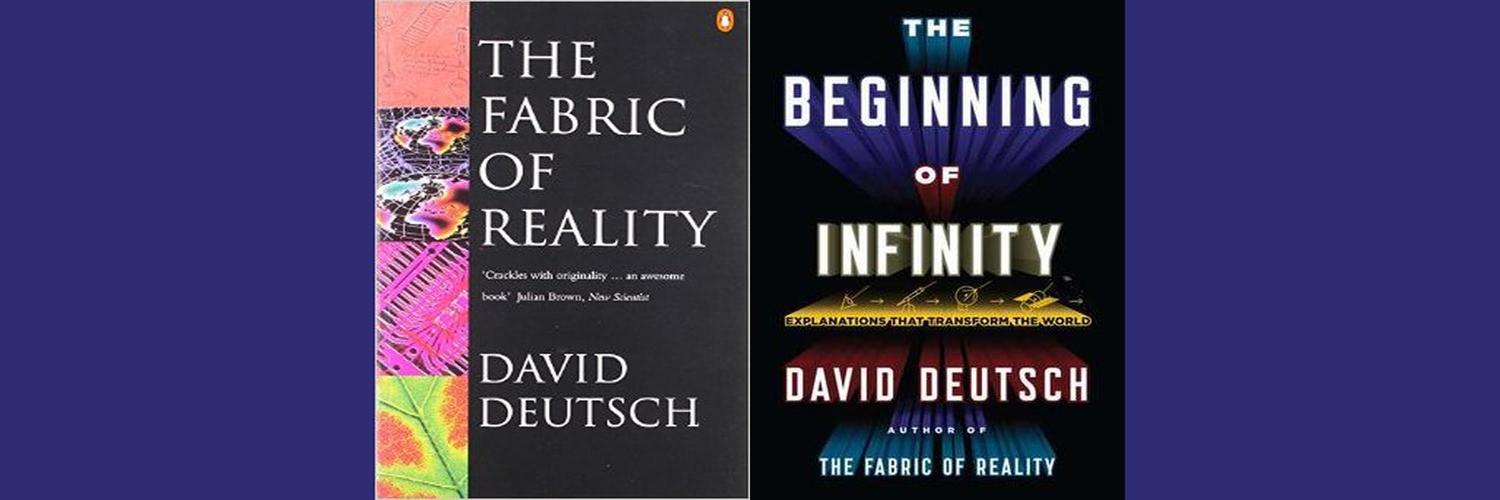
––Mathias Döpfner: Sam, is it actually true that your kind of favorite book is The Beginning of Infinity of Dieter Deutsch? Sam Altman: Yeah, I think if I had to pick one favorite book, I would pick that. ––Mathias Döpfner: Why is that so fascinating? Can you explain that? Sam Altman: Even if you don't read the whole thing, the first like 40-50 pages are, I think, the most wonderfully optimistic take on why, even in a world with AI, we're never going to run out of things to do and ways to be useful and problems to solve and things to explore. But I also think it explains so beautifully how we got here and why the relatively simple process that we've followed throughout human history got us to this incredible place. ––Mathias Döpfner: Okay, that's good, because David Deutsch, I think, is going to be our last virtual guest, at least tonight. David Deutsch is a physicist and scientist from Oxford University. And I think also you have disagreements with him about the possibility that artificial intelligence is transforming into superintelligence with consciousness, perhaps even. He thinks it cannot be the case. You think it should be the case. Here he is, David Deutsch. Welcome. And perhaps you can elaborate a little bit on that disagreement, but also why you admire Sam Altman. Sam Altman: Well, I don't care about that. I just want to hear your disagreement. David Deutsch: Okay, I can tell you. Well, on my computer, I keep a list of progress that has been achieved where I had previously been sure that it wasn't yet possible. One of the items I'm embarrassed to admit was the World Wide Web. Another was that I thought that no computer program would be able to sustain open-ended conversation on general subjects in natural language unless that program was an AGI, an artificial general intelligence. So it would have, I prefer to call, explanatory creativity. ChatGPT proved me wrong. It's not an AGI, and it can converse. That ability was a side effect of another, namely knowledge. The Eliza chatbot in the 1960s used little more than the words and phrases you told it. ChatGPT can chat about anything drawing on a vast body of knowledge, which was a phenomenally useful combination. For some people, too useful. They think they're speaking to a person, an AGI, just as the first users of Eliza treated it as if it were a person. Which brings me to a widespread myth of the Turing test. In reality, Alan Turing never proposed a test or benchmark for AGI. His imitation game wasn't a test of ethics, but a thought experiment to torpedo the intuition that machines can't think. Indeed, there can be no benchmark, because to be general, an AGI must be capable of choosing to remain silent. This is already a proof that AGI cannot be made via existing approaches, while those can and must be judged by benchmarks. Conversely, if something outputs a new explanation, you can't test for whether it created that or a human did, even you yourself when you administered the test. In Edison's phrase, there's the inspiration part, which only humans and AGIs can do, and the perspiration part, from which AGIs can liberate us. So, if there's no test, how do we know that humans are general intelligences? By telling their story. Human thought doesn't consist of mechanically converting motivations into actions, prompts into output. It's mainly about choosing motivations. Just as science is not extracting theories from data, it's seeing a problem, guessing explanations, criticizing and testing them. So how can you tell whether something is doing that? You can't, always. Sometimes it really is a bot you're chatting to, but when you have no explanation saying that you yourself are a bot, or that humans in general are, it's rational to assume that they aren't. Some people have fun questioning whether Einstein really created the theory of relativity or only assembled it mechanically from a smorgasbord of existing ideas. We know he created it because we know his story, what problems he was addressing, and why. Just as we know that Sam Altman, without having to write any code, brought ChatGPT into existence as a product and a phenomenon by having the intuition and the gumption to know that this was the right thing for humanity to try next. Nothing can program a computer to have such intuitions, yet. Sam Altman: Can I ask one question? David Deutsch: My guess. Sam Altman: You mentioned Einstein and general relativity, and I agree, I think that's one of the most beautiful things humanity's ever figured out. Maybe I would even say number one. And Einstein had a story, we knew what he was working on. If in a few years, GPT-8 figured out quantum gravity and could tell you its story of how it did it and the problems it was thinking about and why it decided to work on it, would But it still just looked like a language model output, but it was the real, it really did solve it. Would you call it like, then would you say, I appreciate that you keep a list of things you're wrong about. I do too. But would that be enough to convince you? David Deutsch: I think it would. Yeah. Sam Altman: All right. I'll take you up... David Deutsch: It's crucial here. Sam Altman: I agree to that as the test. ––Mathias Döpfner: David, thank you so much for joining us and thank you for your uplifting words and have a great evening. David Deutsch, a pioneer of quantum computing, one of the most brilliant thinkers of our times. Thank you for joining.
Deutsch Explains63,682 Aufrufe • vor 1 Jahr

.David Deutsch: "What's currently called AI and AGI are not only different from each other, they are very close to being the exact opposites of each other. The reason is that an AI, current AI is like an AI that diagnoses diseases or an AI that plays chess or an AI that controls a huge factory. Those things have objective functions, that is they have a function that they are designed to maximize and that is why they are used in those particular applications. Or in military terms, you could say the objective is to hit the target. You might say the objective is to hit the target unless some thing specified, but it's a specified thing comes up in which case don't hit the target and so on. This is, as I said, almost the opposite of what humans do when humans think. For a start, the AI has to be obedient, that is it has to actually do the things it is programmed to do, whereas a human is fundamentally disobedient, especially when being creative. When a human plays chess, they are performing a completely different kind of computation. They don't do the same things, they don't investigate the same possibilities that the artificial chess playing machine does, because the artificial one is capable of looking at billions and billions of possibilities, whereas the human can only look at hundreds or something. They are doing something completely different. Another difference is that the human can explain, can write a book later, having become world champion, can write a book saying how I did it, as the computer program that beats the world champion can write no such book, because it has no idea how it did it. It was just following a program. I was doing this and that and that and none of that is illuminating. Also, third thing, the chess player can decide I don't want to play chess anymore, from now on I will play Go or from now on I will play tennis. If commanded to play chess, the functionality will deteriorate completely. Those things are different. What we want in an AGI is that it behaves in a way that cannot be specified in advance, because if you specified it, you would already have the answer. The AGI program has to give unexpected answers, answers to questions we didn't even know how to ask."
Deutsch Explains72,475 Aufrufe • vor 1 Jahr

.Joel Hellermark: If you could have a billion Deutsch-level intelligences, wouldn't that be a massive advantage for humanity? David Deutsch: I think having two might be an advantage. I mean, people, there's the law of comparative advantage says that the more different you are from other people, the more valuable you are economically. That suggests that if you have an exact clone of you, you're almost not at all more economically valuable than just one of you. You know, you'll be competing with each other for the same job. You wanted a unique job, your perfect dream job, and now it's the perfect dream job of a billion other AGIs, you know, in your conception. I don't think it can be like that. People are valuable because they are different. Everybody is unfathomably different from everyone else. That fact is not being harnessed enough and can be harnessed more.
Deutsch Explains34,490 Aufrufe • vor 11 Monaten

I think we've been deprived of a lot more than flying cars and Mars colonies. I think civilization is currently burdened by a debilitating pessimism. Not just prophecies of doom, because they've always existed. There's something deeper. The term technological fix has become as pejorative as Luddite used to be. The aspiration for technological solutions is now widely regarded as naive. A fantasy that ignores the inevitability of missteps and side effects. And that naivety is labeled optimism. Because optimism has come to mean something like the assumption that the best will happen, or probably will. And pessimism that the worst will. They're both false as general principles. No one adopts them. They're irrationalities that people accuse each other of having. And everyone classifies themselves as somewhere in the middle. And perhaps admitting to a slight bias in one direction or the other. And therefore admitting to slight irrationality. But in fact, both ends of the spectrum and the middle are predictions of success or failure. Maybe probabilistic. Derived only from an attitude or a principle. Not from explanations of why reality should match them. And prediction without explanation is prophecy. Which is reliance on the supernatural. Which isn't a rational attitude to planning for the future. So what is? Well, here's the bad news. Conventional pessimism is right that civilization has no guaranteed future. Nor does our species. The overwhelming majority of civilizations and species that have ever existed are now extinct. Including significantly every one of our cousin species. Every species that has ever tried to survive by creating knowledge that was not in their genome. New explanatory knowledge. How to make clothes and fire and farming. And to live the new ways of life that that enabled. That is our biological niche. To survive through the exercise of creativity. And we are the last species left in that niche. For such species, stasis is not available. We conquer problems by creating knowledge or they conquer us. So there's nothing new in our situation of all sorts of existential danger. It's undeniable that the worst can happen. Because the very worst has already happened many times. So now for the good news. All those civilizations who believed that their famines and droughts and disasters were divine punishment for their wickedness or whatever. In reality, it was just that they didn't know enough about irrigation, medicine, and so on. If the ancient Athenians had known about antibiotics or just about hygiene, they could have prevented the plague that contributed to the fall of their nascent optimistic society. And if they had, then as Carl Sagan speculated, we might now be at the stars. And technology would be regulating trivialities like the planetary climate. As automatically as it's now regulating the temperature in this room. We know that's possible because of a momentous dichotomy that follows directly from the rejection of the supernatural. Namely, every transformation of physical systems that is not forbidden by laws of physics is achievable given the right knowledge. And hence, the rational attitude to the future is what I call optimism. The principle of optimism, namely that all evils are caused by lack of knowledge. That isn't a prophecy of success. It's an explanation for failure. If we fail at anything that's physically possible, it's because of some knowledge that we fail to create. Admittedly, some of the dangers that we currently foresee are themselves side effects of knowledge creation. But trying to slow that down won't help because what do you slow down? In 1900, no one could possibly have foreseen that research in pure physics into the esoteric properties of the element uranium would within 50 years become the centerpiece of everyone's existential fear. Or that another half century later, the centerpiece would be carbon dioxide. In our future too, the greatest dangers will inevitably be unforeseen. And the only type of knowledge that's capable of dealing with those is fundamental knowledge of universal regularities in nature. Any area of fundamental research could suddenly become essential to our survival. Biology, engineering. In World War II, pure mathematics was. We also need knowledge of how to structure human institutions to retain the miraculous property of keeping civilization stable under rapid change. Traditions of criticism and error correction. And we need wealth, meaning the ability to deploy technology in practice. And there's a final consideration. The world doesn't just contain optimists and pessimists and wise and unwise technology users. It contains enemies of civilization as well. And knowledge is impartial. It can be used for good or evil. But the enemies of civilization all necessarily have one thing in common. They are wrong. And so they fear error correction and truth. And that's why they resist changes in their ideas, which makes them less creative and slower to innovate. So our defense against the existential danger from malevolent uses of technology, the only defense, is speed. The good guys must use their only advantage to stay ahead. David Deutsch
Deutsch Explains38,267 Aufrufe • vor 1 Jahr

I am a physicist and I'm profoundly opposed to any idea of non-physical explanations that contradict physics. So that's a no-no and really doesn't make sense. However, there are ways in which both emergent properties such as minds and life and so on have an effect. And as you said, also abstractions. Now the fact that the theory of good explanations led to the idea that abstractions are real things was slightly surprising to me. I wasn't expecting the link, at least wasn't expecting it to be so strong as it is. But the thing is, if you think about how to explain events, physical events like a footprint on the moon, how do you explain how that happened? Well, it happened because of human ideas, of science. And human ideas, you could say in this reductionist sense that as you rightly say is the prevailing mode of explanation and the prevailing idea is to look down on other modes of explanation, that those ideas are nothing more than configurations of atoms. So some physicists, some rocket scientists put their brain into certain configurations of atoms and those atoms then acted on other atoms which then ended up making a footprint on the moon. Now what that misses is the explanation of why certain configurations of atoms put footprints on the moon while others, the overwhelming majority of configurations that human brains, even human brains have been put into in history, do not have that effect. And it's because there's a certain type of information. And this information can't in my view be reduced to statements about atoms because if you think about what that information does, it is in brains but the same information then gets transferred into, let's say, sound waves in air and then it gets transferred into ink on paper and then it gets transferred into magnetic domains inside a computer which then control a machine that instantiates those ideas in bits of steel and silicon and so on and so on. There's an immense chain of instantiations of the same information. And it's only special kinds of information that have this property that they are preserved and instantiated in successive physical modes. So what is being transmitted, what is having the causal effect is not the atoms but the fact that the atoms instantiate certain kinds of information and not other kinds. So therefore it is the information that is having the causal effect. If a particular instantiation of that information were damaged, then processes would come along to fix it, whether or not they could fix the physical instantiation. For example, if the computer goes wrong, then we don't use the corrupted information. We go back and rescue the information from a different computer and we throw away the atoms that at one point instantiated it. So the information causes itself to remain in existence. Now I think there's no way out of that mode of explanation. And if explanation is going to be the fundamental thing about our criterion, for example, about what is or isn't real, then we have to say that information and this particular kind which we call knowledge is real and really does cause things. David Deutsch
Deutsch Explains45,735 Aufrufe • vor 2 Jahren

.David Deutsch: The equivalent of consilience, that is, the unified meta-theory, as you put it, for all sciences, and I think actually more than a meta-theory, because I think more links them than just the structure and methodology and so on, was discovered by Popper. Again, I don't know whether this is historically the order in which things happen, but he is famous for his political philosophy and for his philosophy of science, and he found at one point that they are the same, that they both are about problems and about the fact that there is no such instruction from without, there is only conjecture from within. So that's why Lamarckism is false and Darwinism is true, and that's why group selection is false and individual selection is true, and so on. So I think it's already there in Popper. I think there's a lot more to it, and I tried to add another couple of things to it, so quantum theory and computation, but there's a lot that isn't in it, like consciousness and creativity and so on, that we have no idea of how those work and how they fit in with those other things. Gad Saad: Forgive me for interrupting you, David, I'm sorry. There is a book by Dean Simington, who's a psychologist out of, I think, UC Davis, that actually offers a Darwinian account for creativity. It's actually quite mind-blowing. So keep that in mind. I can give you the reference later, but go ahead. David Deutsch: I don't read such things unless they've already made an AGI. Gad Saad: I see. Okay, fair enough. David Deutsch: If they can't make an AGI, then they haven't got the full theory. They might have an idea for a theory, but then Popper has an idea for a theory, but he couldn't make one either. And Turing thought that there'd be an AGI by the year 2000, and that it would require two megabytes of memory. Now, he's obviously wrong about the year 2000, but two megabytes of memory, I reckon that's what it'll be. In other words, these large language models and all this massive computer power is going in entirely the wrong direction. The answer will be a philosophical breakthrough, which will allow, once we understand what we're trying to make, it will be relatively easy to make it with relatively few computational resources.
Deutsch Explains33,398 Aufrufe • vor 1 Jahr

.David Deutsch: Everyone can and should be a scientist, because being a scientist just means wanting to understand the world and using the only method of doing so that works, namely, to be puzzled, to be mistaken, to guess how one might be mistaken and how the grand authorities who can't imagine that they could be mistaken often are, and not to be satisfied with bad explanations, one's own or anyone's, that is, explanations that could have otherwise and you'd be none the wiser. That's the critical attitude. It's the only access to reality that we have. Use it. It's fun.
Deutsch Explains21,535 Aufrufe • vor 1 Jahr

.David Deutsch: "I've come to think of free will in terms of creating knowledge. So we have free will if we can bring something objectively new into the universe. Prof. Brian Keating: Will computers have free will? David Deutsch: It's not computers, it's computer programs. Computer programs will have free will when the problem of AGI is solved. Of course, if we destroy ourselves before we solve that, then they won't. But I expect that we won't destroy ourselves, and I expect that the problem of AGI will be solved, and the resulting programs will have free will."
Deutsch Explains13,709 Aufrufe • vor 11 Monaten

––Charlie Barnett: "Consciousness and the computability of it. It sounds like, or at least in the past, that you've implied that consciousness is computable. Some, like Roger Penrose, have argued the opposite, and he's argued that consciousness is non-computational, and he uses Gödel's incompleteness theorems to argue that the mind can see truths that a purely algorithmic system can't derive, and therefore the brain must be using some kind of non-computable process when it comes to consciousness, something beyond what machines can do. What would you say to a view like that? David Deutsch: Yet again, it is using an impossible conception of what knowledge is. So Penrose thinks that when we see a proof of a mathematical theorem, we are touching certainty, we are god-like entities when we're mathematicians. But that's not true. Our mathematical knowledge is conjectural, just like our knowledge of physics. It's even more removed from our senses, because it's not true that the interior of our brains and the interior of our thoughts is more accessible to us than the world we perceive through our senses, or the world that we perceive through our theories, the center of the sun. We know lots about the center of the sun, even though no one has ever perceived it, and perhaps no one ever will. So mathematical truths are based on conjecture. What Gödel showed is that there is no firm ground underneath mathematical theories either. There's no way of proving that the standards of proof that we currently use are perfectly rigorous. And there have been cases in history where they have shown not to be rigorous. I think Pernot, who was the first to axiomatize the principles of the natural numbers, his first attempt at that was wrong. And it's interesting that he did not say, well, I've axiomatized them, therefore there's nothing to them other than my axioms. No, he said, oh dear, my axioms don't correctly represent the real number, the natural numbers, so I have to change them. So he was grasping, conjecturing for a reality, an abstract reality, just like scientists try to grasp physical reality. So the same epistemology applies to mathematics as it does to science."
Deutsch Explains13,826 Aufrufe • vor 1 Jahr

.David Deutsch: The future of civilization depends entirely on what we think and do. If civilization fails, that won't be something that just happens to us. It'll be the consequence of choices that people have made. And if civilization survives, then that will be because people have succeeded in solving the problems of survival. And that too will not have happened by chance.
Deutsch Explains11,927 Aufrufe • vor 1 Jahr